

Class 10 Science Practice Set: Practical
Review targeted practice sets for Class 10 Science Practical. Built according to official educational guidelines for the 2026-27 academic year, these downloadable worksheets support daily revision and core concept reinforcement.
Download Practical Worksheet PDF
View or download the dedicated Practical practice resource below. Engaging with these objective and subjective questions daily ensures continuous academic progress and mastery of the 2026-27 curriculum.
To study Saponification recation for the preparation of Soap
Experiment No: 6
Objective: To study Saponification reaction for the preparation of Soap.
Requirements: Sodium hydroxide, vegetable oil, ethanol, common salt, distilled water, beakers, measuring cylinder etc.
Theory : Soaps are sodium or potassium salts of carboxylic acids with long hydrocarbon chains. Soap can be made from the base hydrolysis of fat or oil. The process in which oil or fat reacts with NaOH to form soap(sodium salt of fatty acid) and glycerol is called saponification reaction.
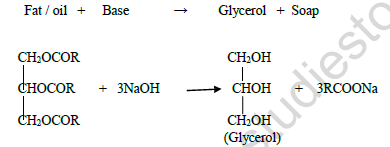
Procedure :
· Take about 20 ml of vegetable oil in a beaker.
· Add 15 ml of ethanol &25 ml of 20 %NaOH to vegetable oil with stirring. Heat the mixture for 20 minutes until the solution no longer has 2 separate layers.(do not over heat the mixture to dryness).
· Remove the beaker from the burner,& add 20 ml of saturated NaCl solution.This process is called ‘salting out’ .
· Cool the mixture till it becomes solid
· Remove &cut it into desired shape &size.
Result
· Soap solution is basic in nature .
Precautions
· Do not touch solid NaOH
· Stir the soap soln care fully so that it does not spill out.
· The mixture of oil ðanol may splatter or catch fire ,have a watch glass nearby to smother any flames.
Questions
• What is the by product of saponification reaction?
• What is the chemical reaction involved in soap preparation?
• Give a method to separate glycerol from the reaction mixture?
• Distillation under reduced pressure
• Why is it advised to add common salt while preparing soap? It helps in complete precipitation of soap.
Multiple choice questions
1. When you a 20% soln of NaOH in a beaker containing water, you record certain observations. Select the correct observations from the following:
a) NaOH is in the form of pellets/flakes.
b) It dissolves in water completely.
c) The beaker appears cold when touched from outside immediately after adding NaOH to water.
d) When litmus paper is dipped into the soln. It turns blue.
2. While preparing soap we generally add small amount of common salt to the reaction mixture of oil and NaOH. The purpose of adding common salt is
a) Make the soap neutral .
b) Reduce the basic nature of the soap.
c) Enhance the cleansing power of the soap.
d) Favour the precipitation of the soap.
3. A student dipped a red litmus paper in the soap soln. She observed that
a) It changed to blue.
b) It remained red.
c) It changed to green.
d) It changed to orange
4. Soaps have different foaming capacities due to
a) Different alkyl groups.
b) Different cations present
c) Same alkyl groups.
d) Same cation present in soap
5. Part of soap which is hydrophobic
a) Hydrocarbon
b) COONa
c) Both
d) None of these
6. Which is the by-product of saponification reaction?
a) Glycol
b) Glycerol
c) Ethanol
d) Methanol
7. Which process describes saponification ?
a) Acid hydrolysis
b) Esterification
c) Alkaline hydrolysis of ester
d) Alkali formation
8. A student is provided with four types of acids for the preparation of soaps. Which among the following is the most suitable one:
a) Acetic acid
b) Propanoic acid
c) Citric acid
d) Palmitic acid
Please click on below link to download CBSE Class 10 Chemistry Practical Worksheet Set A
Free study material for Science
Download CBSE Practice Material: Class 10 Science Practical
CBSE Practice Material: Class 10 Science Practical
Explore reliable practice questions for Practical tailored for Class 10 Science learners. Use these structured worksheets to evaluate preparedness and strengthen problem-solving skills.
NCERT-Aligned Questions and Solutions
Cross-reference your completed exercises with comprehensive NCERT solutions for Class 10 Science to ensure absolute clarity across all sub-topics in this chapter.
Next Steps in Your Exam Preparation
Wrap up your chapter revision by testing your knowledge against standard question formats. Everything on our platform is provided free of charge.
FAQs
You can download the teacher-verified PDF for CBSE Class 10 Chemistry Practical Worksheet Set 01 from StudiesToday.com. These practice sheets for Class 10 Science are designed as per the latest CBSE academic session.
Yes, our CBSE Class 10 Chemistry Practical Worksheet Set 01 includes a variety of questions like Case-based studies, Assertion-Reasoning, and MCQs as per the 50% competency-based weightage in the latest curriculum for Class 10.
Yes, we have provided detailed solutions for CBSE Class 10 Chemistry Practical Worksheet Set 01 to help Class 10 and follow the official CBSE marking scheme.
Daily practice with these Science worksheets helps in identifying understanding gaps. It also improves question solving speed and ensures that Class 10 students get more marks in CBSE exams.
All our Class 10 Science practice test papers and worksheets are available for free download in mobile-friendly PDF format. You can access CBSE Class 10 Chemistry Practical Worksheet Set 01 without any registration.