

Practice Worksheets for Class 10 Science: Chapter 06 Control and Coordination
Review targeted practice sets for Class 10 Science Chapter 06 Control and Coordination. Built according to official educational guidelines for the 2026-27 academic year, these downloadable worksheets support daily revision and core concept reinforcement.
Practice Chapter 06 Control and Coordination Worksheets for Class 10 Science
Navigate directly to the printable exercises for Chapter 06 Control and Coordination using the digital viewer below. Each practice set allows students to isolate specific topics for thorough review and uninterrupted practice alongside standard textbooks.
Question. Posture and balance of the body is controlled by
(a) Pons
(b) Medulla oblongata
(c) Cerebellum
(d) Cerebrum
Answer : C
Question. Which gland secretes the growth hormone?
(a) Pituitary gland
(b) Thyroid
(c) Hypothalamus
(d) Adrenal
Answer : A
Question. The secretion of which hormone leads to physical changes in the body when you are 10-12 years of age?
(a) Oestrogen from testes and testosterone from ovar.
(b) Estrogen from adrenal gland and testosterone from pituitary gland.
(c) Testosterone from testes and estrogen from ovary.
(d) Testosterone from thyroid gland and estrogen from pituitary gland.
Answer : C
Question. A part of the body which responds to the in-structions sent from nervous system is called
(a) receptor
(b) effector
(c) nerves
(d) muscles
Answer : B
Question. The longest fibre on the cell body of a neuron is called
(a) sheath
(b) cytoplasm
(c) axon
(d) dendrites
Answer : C
Question. A diabetic patient suffers from deficiency of which hormone?
(a) Thyroxine
(b) Testosterone
(c) Oestrogen
(d) Insulin
Answer : D
Question. Which plant hormone promotes cell division?
(a) Auxin
(b) Gibberellin
(c) Cytokinin
(d) Abscisic acid
Answer : C
Question. Give the missing term.
(a) Spinal cord
(b) Brain
(c) Cranial nerves
(d) Relay nerves
Answer : A
Question. Ageing in human beings is caused by disappearance of which of the following glands?
(a) Adrenal
(b) Pituitary
(c) Thyroid
(d) Thymus
Answer : D
Question. Involuntary actions in the body are controlled by
(a) medulla in forebrain
(b) medulla in midbrain
(c) medulla in hindbrain
(d) medulla in spinal cord
Answer : C
Question. Which of the following endocrine glands does not exist in pairs?
(a) Testes
(b) Adrenal
(c) Pituitary
(d) Ovary
Answer : C
Question. Breathing is controlled by which part of the brain?
(a) Cerebrum
(b) Cerebellum
(c) Hypothalamus
(d) Medulla oblongata
Answer : D
Question. Roots of plants are:
(a) positively geotropic
(b) negatively geotropic
(c) positively phototropic
(d) None of these
Answer : A
Question. Which of the following tissues provide control and coordination in animals?
(a) Nervous and Skeletal
(b) Muscular and Skeletal
(c) Muscular and Transport
(d) Nervous and Muscular
Answer : D
Question. Reflex actions are mediated through
(a) brain
(b) effectors
(c) spinal cord
(d) receptors
Answer : C
Question. The leaves of Mimosa are sensitive to
(a) light
(b) smell
(c) touch
(d) heat
Answer : C
Question. Identify which of the following statements about thyroxin is incorrect?
(a) Thyroid gland requires iodine to synthesize thyroxin.
(b) Thyroxin is also called thyroid hormone.
(c) It regulates protein, carbohydrates and fat metabolism in the body.
(d) Iron is essential for the synthesis of thyroxin.
Answer : D
Question. Which statement is incorrect about auxins?
(a) They promote the growth of root
(b) They promote the growth of shoot
(c) They influence the formation of flower and ripening of fruit
(d) They inhibit the growth of root
Answer : A
Question. Response of plant roots towards water is called:
(a) Chemotropism
(b) Phototropism
(c) Hydrotropism
(d) Geotropism
Answer : C
Question. Which part of a nerve cell contains a nucleus?
(a) Axon
(b) Dendrite
(c) Cyton
(d) Nerve endings
Answer : C
Important Questions for NCERT Class 10 Science Control and Coordination
Very Short Answer
Question. Which gland is known as glands of emergency?
Answer: Adrenal glands are often known as glands of emergency.
Question. What is the highest coordinating center in the body?
Answer: Brain is the highest coordinating center in the body.
Question. What is insulin?
Answer: Insulin solution being filled in a syringe through the injection mode.
Question. What is the use of voluntary nervous system?
Answer: The voluntary nervous system helps us to take voluntary actions which are under the conscious control of the brain.
Question. What are meninges?
Answer: The brain is surrounded by three membranes called meninges.
Question. Name one plant hormone that promotes growth and another plant hormone which inhibits growth.
Answer : Promotes growth : Gibberellin ; Inhibits growth : Abscisic acid
Question. Name one example of the movement of a plant part which is very quick and can be observed easily.
Answer : Folding up of the leaves of a sensitive plant on touching
Question. Which of the following is a growth movement and which is not ?
(a) folding up of leaves of sensitive plant on touching with hand.
(b) folding up of petals of dandelion flower when light fades.
Answer : (a) Not a growth movement
(b) It is a growth movement
Question. Name the plant part :
(a) which bends in the direction of gravity but away from light
(b) which bends towards light but away from the force of gravity
Answer : (a) Root (b) Stem (or Shoot)
Question. To which directional stimuli do :
(a) roots respond ?
(b) shoots respond ?
Answer : (a) Light, Gravity and Water (b) Light and Gravity
Question. Name the type of chemical substances that control the growth in plants.
Answer : Plant hormones
Question. What is the stimulus in : (a) phototropism ? (b) geotropism ? (c) chemotropism ? (d) hydrotropism ? (e) thigmotropism ?
Answer : (a) phototropism- light
(b) geotropism - gravity
(c) chemotropism - chemicals
(d) Hydrotropism - water
(e) thigmotropism- touch or physical contact
Question. Give the scientific terms used to represent the following :
(a) Bending of a shoot towards light.
(b) Growing of roots towards the earth.
(c) Growth of a pollen tube towards ovule.
(d) Bending of roots towards water.
(e) Winding of tendril around a support.
Answer : (a) Bending of shoot towards light - phototropism
(b) Growing of roots towards earth - geotropism.
(This means that plant respond positively for gravitational force.)
(c) Growing of pollen tube towards ovule - chemotropism (chemo = chemicals)
(d) :- Bending of roots towards the water - hydrotropism (hydro =water)
(e) The winding of tendril around a support - thigmotropism.
Question. What is the general name of chemical substances which bring about control and coordination in plants ?
Answer : Phytohormones (or Plant hormones)
Question. Which plant hormone is responsible for the wilting and falling of leaves ?
Answer : Abscisic acid
Question. Which plant hormone makes a stem (or shoot) bend towards light ?
Answer : Auxin
Question. Where is the auxin hormone made in a plant stem ?
Answer : In the tip of plant stem
Question. What is the scientific name of sensitive plant ?
Answer : Mimosa pudica
Question. Give one example of the movement of a plant part which is caused by the loss of water (or migration of water).
Answer : Folding up of the leaves of a sensitive plant on touching
Question. (a) which is positively hydrotropic as well as positively geotropic.
(b) which is positively phototropic but negatively geotropic.
Answer : (a) Root (b) Stem (or Shoot)
16. Fill in the following blanks :
(a) A plant’s response to light is called ................
Answer : (a) phototropism
(b) A plant’s response to gravity is called ................
Answer : geotropism
(c) Plant shoot grows upward in response to ................
Answer : sunlight
(d) Plant roots grow downward in response to ................
Answer : gravity
(e) Tendrils wind around a support in response to ...............
Answer : touch
(f) Plant roots grow towards……. and in the direction of force of ...............
Answer : water ; gravity
(g) A root of a plant grows downward. This is known as ...............
Answer : positive geotropism
(h) …… is the hormone that causes phototropism in plants
Answer : Auxin
(i) The response of leaves to the sunlight is called ...............
Answer : phototropism
Short Answer type Questions
Question. (a) Draw the structure of neuron and label its part.
(b) Name the part of neuron:
(i) where information is acquired
(ii) through which information travels as an electrical impulse.
Answer : a) Refer diagram given in the study material. (FIG.1)
b) i. Dendrites
ii. cell body and axon
Question. What is chemotropism? Give one example. Name any two plant hormones and mention their functions.
Answer : Chemotropism is the movement of a part of the plant in response to a chemical stimulus.
It can be positive chemotropism or negative chemotropism. Example: The growth of pollen tube towards a chemical which is produced by an ovule during the process of fertilisation in a flower.
Two plant hormones with their functions are as follows:
Auxins promote growth, cell elongation, cell differentiation, root formation.
Gibberellins stimulate stem elongation, seed germination.
Question. Write one example each of the following tropic movements :
(i) Positive phototropism (ii) Negative phototropism
(iii) Positive geotropism (iv) Negative geotropism
(v) Hydrotropism (vi) Chemotropism
Answer : (i) Positive phototropism: shoots growing towards light.
(ii) Negative phototropism: roots growing away from light towards ground.
(iii) Positive geotropism: growth of roots towards earth due to the pull of the earth.
(iv) Negative geotropism: shoots growing away from the earth.
(v) Hydrotropism: roots growing towards the source of water.
(vi) Chemotropism: growth of pollen tubes towards the ovules.
Question. What is ‘hydrotropism’? Describe an experiment to demonstrate ‘hydrotropism’.
Answer : ‘Hydrotropism’ is the directional growth of a plant part in response to water. For example, roots show hydrotropism as they grow towards water in the soil and are positively hydrotropic.
An experiment to demonstrate hydrotropism is as follows:
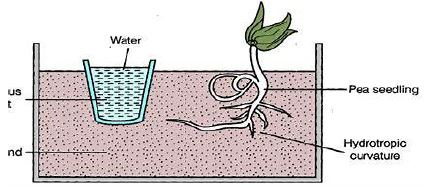
• A porous pot filled with water is taken and inserted in a tub filled with dry sand.
• A freshly germinated pea seedling is sown in the sand.
• As water is not available in sand, the root growing will bend towards the porous pot filled with water.
• A hydrotropic curvature of the root is observed as it grows towards water.
• This bending of root shows the movement in response towards water
Click below to download practice worksheet for CBSE Class 10 Biology Control and Coordination Worksheet Set B
Free study material for Science
Chapter 06 Control and Coordination Practice Sheet and Solutions for Class 10 Science
Chapter 06 Control and Coordination Printable Worksheet for Class 10 Science
Explore reliable practice questions for Chapter 06 Control and Coordination tailored for Class 10 Science learners. Use these structured worksheets to evaluate preparedness and strengthen problem-solving skills.
How to Use These Practice Sheets
Each worksheet is structured around standard CBSE textbooks, allowing students to check their working steps and correct mistakes early in their revision.
Enhance Speed with Online Practice
Follow up your worksheet practice by attempting the interactive online Science MCQ test for this chapter to evaluate your execution speed. All platform resources are free to access.
FAQs
You can download the teacher-verified PDF for CBSE Class 10 Biology Control and Coordination Worksheet Set 02 from StudiesToday.com. These practice sheets for Class 10 Science are designed as per the latest CBSE academic session.
Yes, our CBSE Class 10 Biology Control and Coordination Worksheet Set 02 includes a variety of questions like Case-based studies, Assertion-Reasoning, and MCQs as per the 50% competency-based weightage in the latest curriculum for Class 10.
Yes, we have provided detailed solutions for CBSE Class 10 Biology Control and Coordination Worksheet Set 02 to help Class 10 and follow the official CBSE marking scheme.
Daily practice with these Science worksheets helps in identifying understanding gaps. It also improves question solving speed and ensures that Class 10 students get more marks in CBSE exams.
All our Class 10 Science practice test papers and worksheets are available for free download in mobile-friendly PDF format. You can access CBSE Class 10 Biology Control and Coordination Worksheet Set 02 without any registration.