IMPORTANT POINTS
Five kingdom classification system was given by Whittaker on the basis of following four criteria :
(i) Cell structure
(ii) Body Structure
(iii) Mode of nutrition - Autotrophic and Heterotrophic
(iv) Major ecological role.
The five kingdoms are Monera, Protista, Fungi, Plantae and Animalia.
The three-domain system is closely based on five-kingdom system.
The Eukarya are then divided into 4 kingdoms :
Protistsa, Fungi, plantae and anamalia.
Viroids were discovered by Diener from infectious agents which are even smaller than viruses. It consists of a very simple structure and short RNA strand viroids lack protective protein coat known as capsid.
Viruses are self reproducing and obligate parasite in living cells : They Viroids remain inactive and behave as non-living things. When they enter inside of the living cells, they are active and behave as living organisms Because of this they are intermediate between living and non-living things. They are also called as living chemical.
Algae, Fungi and Lichens are included under thallophyta. The gametophytic plant body is thalloid, without differentiation in to true root, stem and leaves. Zygote does not develop into embryo. Algae have Chlorophylls and they synthesize their one own food so it is Autotrophs, while Fungi are non chlorophylls and they do not Synthesize their own food so it own is called heterotrophs. The lichens, show symbiotic relationship between algae and fungi components.
Bryophytes are non vascular plants. After fertilization Zygote undergoes divisions to form embryo.
The life cycle of bryophytes has two distinct phases.
(1) Gametophytic phases - Haploid, main, autotrophic and gametes formative
(2) Sporophytic phase - Diploid, Subsidiary, heterotrophic, spores formative.
Pteridophytes have vascular tissues, and develop the embryo. The life cycle of pteridophytes shows alternation of generation. Gemetophytic phase is haploid, subsidiary, short lived and Gametes producing while sporophytic phase is diploid, main long lived and spores producing.
Gymnosperm is sporophytic. It is differntiated into root, stem and leaves. Ovules are naked and not enclosed by the ovary therefore recognized as a gymnosperm. The sporophytic and gametophytic phases alternate with each other to complete the life cycle. Gametophytic phase is haploid, subsidiary, short lived and under ground and sporophytic phase is diploid, Main, long and as a whole plant.
Endosperm develops before fertilization, ovules are orthotropous and true fruits are lacking because, of the absence of ovary.
From the given options, select the correct option (a, b, c, d) Each carries one mark.
Question. Which of the following is included in five kingdom classification.
(A) Monera, Protista, Animalia, Plantae, Algae
(B) Monera, Protista, Fungi, Plantae, Animalia
(C) Virus, Prokaryota, Fungi, Plantae, Animalia
(D) Algae, Fungi, Bryophyta, Pteridophyta, Gymnosperm
Answer: B
Question. Who is the “Father of Taxonomy” among the following ?
(A) Linnaeus
(B) Aristotle
(C) Maheshwari
(D) Birbal Sahani
Answer: A
Question. Helophiles is also called___
(A) Eubacteria
(B) Actinomycetes
(C) Cynobacteria
(D) Archae bacteria
Answer: D
Question. According to Whittaker’s classification, prokaryotes are placed in ________
(A) Monera
(B) Plantae
(C) Protista
(D) Animalia
Answer: A
Question. Example of blue green algae is in ________ .
(A) Fungi
(B) Monera
(C) Protista
(D) Plantae
Answer: B
Question. By how many criteria, living organisms have been classified into five kingdom.
(A) Two
(B) Four
(C) Five
(D) Three
Answer: B
Question. In which of the following kingdoms, bacteria and blue-green algae are included ?
(A) Monera
(B) Plantae
(C) Animalia
(D) Protista
Answer: A
Question. Prokaryotes are included in the kingdom ________ .
(A) Monera
(B) Protista
(C) Protozoa
(D) Basidiomycetes
Answer: A
Question. Which one of the following is also called halophiles ?
(A) Eubacteria
(B) Actinomyces
(C) Cyanobacteria
(D) Archaebacteria
Answer: D
Question. Match the following.
A B
(p) Archaea (i) Cell wall is made up of either cellulose or Fungal-cellulose
(q) Bacteria (ii) Cell wall does not contain peptidoglycan
(r) Eukarya (iii) Cell wall is made up of peptidoglycan.
(A) p - (iii), q - (i), r - (ii)
(B) p - (i), q - (ii), r - (iii)
(C) p - (ii), q - (i), r - (iii)
(D) p - (ii), q - (iii), r - (i)
Answer: D
Question. Viroids were discovered by ____
(A) Diener
(B) Woese
(C) Pasteur
(D) Iyengar
Answer: A
Question. Viroid consists of____
(A) DNA
(B) RNA
(C) Protein
(D) none of above
Answer: B
Question. Which of the following diseases is caused by viroid ?
(A) Polio
(B) Diphtheria
(C) Alzheimers
(D) Typhoid
Answer: C
Question. The name virus was given by ________ .
(A) Ivanowsky
(B) Pasteur
(C) Diener
(D) Hershey
Answer: B
Question. Virus have___
(A) DNA core, Lipid coat
(B) DNA or RNA core, Protein coat
(C) DNA or RNA core, plasma membrane
(D) DNA containing nucleus, lipid envelope
Answer: B
Question. A virus contains ________ .
(A) DNA
(B) RNA
(C) DNA or RNA
(D) DNA and RNA
Answer: C
Question. TMV virus was discovered by ________ .
(A) Pasteur
(B) S. L. Miller
(C) Ivanowsky
(D) W. M. Stanley
Answer: C
Question. The main structural component of virus is ________ .
(A) nucleic acid
(B) Protein
(C) nucleic acid and protein
(D) nucleic acid or protein
Answer: C
Question. The first existing group of plant is ________ .
(A) Fungi
(B) Alage
(C) Lichens
(D) Pteridophytes
Answer: B
Question. Match the following :
A B
(p) Chlamydomonas (i) Colonial Forms
(q) Volvox (ii) Unicellular
(r) Ulothrix (iii) Filamentous forms
(s) Nostoc (iv) Cyanophyceae
(A) p - (i), q - (ii), r - (iii), s-(iv)
(B) p - (ii), q - (iii), r - (i), s-(iv)
(C) p - (iii), q - (i), r - (iv), s-(ii)
(D) p - (ii), q - (i), r - (iii), s-(iv)
Answer: D
Question. The study of algae is called ________ .
(A) Mycology
(B) Algology
(C) Taxonomy
(D) Lichenology
Answer: B
Question. Unicellular eukaryotic microorganisms comprise ________ .
(A) Fungi
(B) Monera
(C) Plants
(D) Protista
Answer: C
Question. Protista include :
(A) Paramecium, Euglena, Dinoflagellates
(B) Hydra, Amoeba, Paramoecium
(C) Yeast, Euglena, Dinoflagellates
(D) Mushroom, Paramoecium, Euglena.
Answer: A
Question. The study of fungi is ________ .
(A) Cytology
(B) Mycology
(D) Virology
(D) Algology
Answer: B
Question. Fungus cell wall is made up of ________ .
(A) Cellulose
(B) Protein
(C) Chitin
(D) Carbohydrates
Answer: C
Question. In Fungi reserved food materials are _______ .
(A) Glycogen and Lipid droplets
(B) Starch
(C) Protein
(D) Lipid
Answer: A
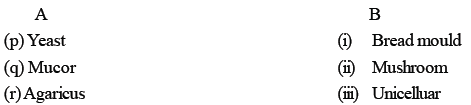
Question. Match the following :
(A) p - (ii), q - (i), r - (iii)
(B) p - (i), q - (ii), r - (iii)
(C) p - (iii), q - (i), r - (ii)
(D) p - (iii), q - (ii), r - (i)
Answer: C
Question. Study of lichens is called _______ .
(A) Algology
(B) Mycology
(C) Lichenology
(D) Cytology
Answer: C
Question. Lichens were first discovered by _______ .
(A) Iyengar
(B) Tulsane
(C) Pasteur
(D) Shiv Ram Kashyap
Answer: B
Question. In lichens Algal component is known as _______ .
(A) mycobiont
(B) Phycobiont
(C) A & B
(D) none of these
Answer: B
Question. In lichens fungal component is known as _______ .
(A) mycobiont
(B) phycobiont
(C) A & B
(D) none of these
Answer: A
Question. The plant cell without chloroplast is _______ .
(A) Algue
(B) Fungi
(C) Bryophytes
(D) pteridophytes
Answer: B
Question. The shape of Fruting body of lichens is _______ .
(A) apothecium - flask shaped
(B) perithecium - cup shaped
(C) perithecium - flask shaped
(D) apothecium - Disc chaped
Answer: C
Question. On the basis of external form lichen are _______ .
(A) Crustose
(B) Foliose
(C) Fruticose
(D) All of the three
Answer: D
Question. “Fruting body” is characteristic of _______ .
(A) Algae
(B) Lichens
(C) Bryophytes
(D) Pteridophytes
Answer: B
Question. Symbiotic relationship is found in _______ .
(A) Algae
(B) Fungi
(C) Bryophytes
(D) Lichens
Answer: D
Question. Plant of this group possess naked seed
(A) Pteridophytes
(B) Angiosperms
(C) Gymnosperms
(D) Bryophytes
Answer: C
Question. The father of Indian Bryology is _______ .
(A) Tulsane
(B) Professor Iyengar
(C) Ivanowsky
(D) Pro. Shiv Ram Kashyap
Answer: D
Question. Rothmelur has diveded the Bryophytes into _______ .
(A) 3 classes
(B) 4 classes
(C) 5 classes
(D) 6 classes
Answer: A
Question. Which sentence is true for Bryophytes ?
(A) They are autotropic
(B) Vascular tissues are absent
(C) Fertilization takes plasce in the presence of water
(D) All of the three
Answer: D
Question. In which plant, gametophytic phase is main and sporophytic phase is subsidiary.
(A) Bryophytes
(B) Pteridophytes
(C) Gymnosperms
(D) Angiosperms
Answer: A
Question. The first land plant on earth was _______ .
(A) Bryophytes
(B) Pteridophytes
(C) Gymnosperms
(D) Angiosperms
Answer: B
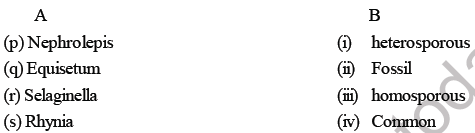
Question. Match the following :
(A) p - (iv), q - (iii), r - (i), s -(ii)
(B) p - (iv), q - (iii), r - (ii), s - (i)
(C) p - (iv), q - (ii), r - (iii), s - (i)
(D) p - (iv), q - (i), r - (ii), s - (iii)
Answer: A
Question. In which plant, the gametophytic phase is main and sporophytic phase is subsidiary.
(A) Nephrolepis
(B) Selaginella
(C) Anthoceros
(D) Equisetum
Answer: C
Question. The tallest living tree in the world is _______ .
(A) Zamia sp.
(B) Eucalyptus sp.
(C) Wolffia sp.
(D) Sequoia sp.
Answer: D
Question. The smallest gymnosperm is _______ .
(A) Zamia sp.
(B) Eucalyptus
(C) Wolfia sp.
(D) Sequoia sp.
Answer: A
Question. Xerophytic Characters are present in _______ .
(A) Bryophytes
(B) Pteridophytes
(C) Gymnosperms
(D) Angiosperms
Answer: C
Question. Microsporophyll : Stamen then Megasporophyll : _______ .
(A) anther
(B) gynoecium
(C) Pollen grains
(D) ovule
Answer: B
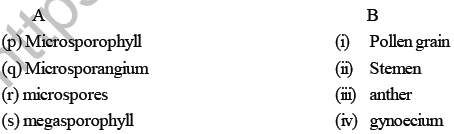
Question. Match the following :
(A) p - (iv), q - (iii), r - (i), s - (ii)
(B) p - (ii), q - (i), r - (iii), s - (iv)
(C) p - (iii), q - (ii), r - (i), s - (iv)
(D) p - (ii), q - (iii), r - (i), s - (iv)
Answer: D
Question. Which is the Fossil member ?
(A) Cycas
(B) Bennettites
(C) Thuja
(D) Pinus
Answer: B
Question. The biggest and dominant group is _______ .
(A) Bryophytes
(B) Pteridophytes
(C) Gymnosperms
(D) Angiosperms
Answer: D
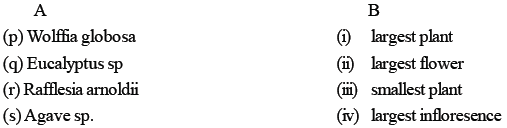
Question. Match the following :
(A) p - (i), q - (ii), r - (iii), s - (iv)
(B) p - (iii), q - (ii), r - (i), s - (iv)
(C) p - (iii), q - (i), r - (iv), s - (ii)
(D) p - (iii), q - (i), r - (ii), s - (iv)
Answer: D
Question. Pre-fertilized endosperm is characteristic of _______ .
(A) Pteridophytes
(B) Angiosperms
(C) Gymnosperms
(D) Bryophytes
Answer: C
Question. Class dicotyledon is dived into _______ .
(A) 7 sub classes
(B) 5 sub classes
(C) 3 sub classes
(D) 2 sub classes.
Answer: C
Question. Who classified the Angiosperms into two classes ?
(A) Theophratus
(B) Bentham and Hooker
(C) Aristotle
(D) Linnaeus
Answer: B
Question. Presence of rigid cell wall is characterized by kingdom _______ .
(A) Protista
(B) Plantae
(C) Monera
(D) Animalia
Answer: C
Question. The tallest living tree of a Angioperm is _______ .
(A) Wolffia sp.
(B) Zamia sp.
(C) Eucalyptus sp.
(D) Sequoia sp.
Answer: D
Question. If the seeds are formed from the megasporophylls and not enclosed in a fruits the plant belongs to _______ .
(A) Pteridophytes
(B) Bryophytes
(C) Angiosperms
(D) Gymnosperms
Answer: D
Question. Embryo is not formed in _______ .
(A) Bryophytes
(B) Algae
(C) Gymnosperms
(D) Pteriodophytes
Answer: B
Question. Which classification system had been given by Whittaker ?
(A) Three domain classification
(B) Binomial classification
(C) Five kingdom classification
(D) Artificial classification
Answer: C
Question. A = Lichens show symbiotic relationship between algae and fungi.
R = Algae absorb water and mineral nutrients from environment and provides to fungi. While fungi synthesize food by the process of photo synthesis and provide to algae.
(A) Both (A) and (R) true and (R) is the correct explanation of (A)
(B) Both (A) and (R) are true but (R) is not the correct explanation of (A)
(C) (A) is true statement but (R) is false
(D) A is false and R is true.
Answer: C