IMPORTANT POINTS
* End of metabolic activities in organisms nitrogen waste material like ammonia, urea and ureic acid are produced.
* Execretion means the separation and elimination of Waste material from the body.
* Organisms are three type on the bases of excretory substances :
(i) Ammonotelic
(ii) Ureotelic
(iii) Urecotelic
* In human excretory organ is a pair of kidney, one urinary blandder and urethra.
* Kidney are reddish brown color, bean shaped and on either side of the vertebral column in the lumber region. Each kidney is about 10cm long, 5 cm wide and 3 cm thick. In adult, it weight about 125-170 gm
* Each human kidney is containing about a million nephrons. Nephrons are refered to as the structural and the function units of the kidney. It known as uriniferous tubules.
* Each nephrons is about 3 cm long and 20-30 cm in diameter. Nephron consists of Bowman’s capsule, proximal convoluted, henle’s loops, distal convoluted and colleting duct.
* They comprise structure of glomerules and Brown’s capsule is called malpighian corpuscles, where filtration of blood and urine formation is started.
* Urine formation involves three phase :
(i) Glomerular filtration
(ii) Re-absorption and
(iii) Tubular secreation.
* The function of the kidney is efficiently monitored and regulated hormonal feedback mechanisms involving mainly hypothalamus, pituitary, JGA and heart at cretain extent.
* The norrmal urine is pale yellow colored watery fluid which is slightly acidic (pH-6.0)and with a charactedristic odour. On an average 1 to 1.5 liter urineis produced per day, through it 25-30 gm of urea is excreted.
* Mammalian skin having sebaceous and sweat glands. Sebaceous gland discharge waxes, sterols, fatty acid and hydrocarbons, It lubricates the and prevents drying up of skin and wetting of hair. While sweet gland scretion is watery and consists of water, salts, mainly Nacl, urea, lactic acid, and little amino acid.
* Corbon dioxide and water are eliminated through human langs. About 18 liter of CO2 per hour and about 400 ml of water per day are removed by human lungs.
* By the disorders of excretion uremia, kidney failure, renal calculi and nephritis occurs.
MCQ
(1) Which of the following is a metabolic waste of nitrogenous substances?
(a) NH3,urea,CO2 (b) NH3,aranine, urea (c) Urea, NH3, creatinine (d) Urea, oxugen, SO2
(2) Excretion of nitrogenous waste produt is remirolid form occure in
(a) ureotelic animals (b) Ammorotelic animals (c) ureotelic animals (d) ammiotes
(3) In man, the area is mainly produced in
(a) Liver (b) Kidneys (c) Gall bladder (d) Spleen
(4) Ureotelism is found in
(a) Mammals (b) Aquatic insects (c) Tadpoles (d) Birds
(5) Which of the following are uricotelic animals?
(a) Rohu and Frog (b) Lizard and Crow (c) Camel and Frog (d) Earthworm and eagle
(6) If liver from body is removed then which component of blood increases
(a) Ammonia (b) Protein (c) urea (d) Uric acid
(7) Man is....
(A)Ureotelic (b) Uricotelic (c) Ammonotelic (d) Both b and c
(8) Uric acid is formed in human from
(a) purines (b) proteins (c) glucose (d) pyrimidines
(9) Green glands are excretony in function which are found in
(a) Spiders (b) Moth (c) Scropions (d) Prawn
(10) For maintanance of osmoregulation by animals where urea is sored?
(a) Medulla of Kidney (b) Cortex of Kidney (c) Renal of pelvis (d) Renal artery
(11) Excretory structure of earthworms is...
(a) Malpighian tubules (b) Nephridia (c) Kidney (d) Anternal glands
(12) Those animals which excrete a large amount of NH3 are...
(a) Terretrial (B)Eegg lying (c) Amphibions (d) Aquatic
(13) ”Columns of Bertini” is the kidney of manimals are found as the extersion of
(a) Medulla into cortex (b) Cortex into medulla (c) Medulla into pelvis (d) Pelvis into ureter
(14) Each human kidney has nearly ___
(a) 10,000 neophrons (b) 50,000 neophrons
(c) 1,00,000 neophrons (d) 1 million neophrons
(d) CO2
(15) ADH influences water permbeality in the
(a) Regulation of blood pressure (b) Removal of urea
(c) Regulation of acidity of fluids (d) secretion of antibiotics
(16) Inner living of Bowman’s capsule is lined by:
(a) Podocytes (b) Squamous calls (c) Microvilli (d) Colummar calls
(17) Nitrogenous waste in the Malpighian tubule flows into __
(a) PCT (b) Intestine (c) Haemocoel (d) DCT
(18) Urinary Excretion of Na is regulated by ___
(a) Anteroir pituitary (b) Posterior Pituitary (c) Adrenal cortex (d) Adenal medulla
(19) The yellow colour of urine of the vertebrates in due to
(a) Cholesterol (b) Urochrome (c) Uric acid (d) Malamin
(20) The glomerular filteration rate in a normal adult is nearly
(a) 200 ml/min (b) 250 ml/min (c) 125 ml/min (d) 170 ml/min
(21) Sodium water and phosphate reabsorption is maximum in
(a) Loop of henle (b) PCT (c) DCT (d) Collecting tuble
(22) What is the approximately length and diameter of uriniterous tubule?
(A)3 cm length,diameter 35um
(B)3 cm length,diameter 20.30um
(C)30 cm length,diameter 25um
(D)25 cm length,diameter 20um
(23) Urea formation occure by:
(a) Arginine cycle (b) Krebs cycle(c) Ornithine cycle (d) Citulline cycle
(24) Ornithine cycle ic found in ___
(a) Kidney (b) Liver (c) Spleen (d) Pencreas
(25) Function of loop of Henle is ___
(a) Formation of urine (b) Passage of urine
(c) Conservation of water (d) Filtration of blood
(26) Ascending loop if henle is perrneable to:
(a) K+ (b) Cl- (c) Na+ (d) All of above
(27) Proboscis gland is balanoglossus is associated with
(a) Digestion (b) Excretion (c) Circulation (d) Respiration
(28) The appearance of albumin in the urine is most likely due to ___
(a) Increase is blood pressure (b) Decrease in the blood osmotic pressure
(c) Damage to the Malpighian corpuscles (d) Damage to the PCT
(29) The blood constituents that remain unchanged in quality after circulating through the kidneys are___
(a) Urea and glucose (b) Glucose and proteins(C) Urea and proteins (d) Urea and uric acid
(30) The renal vain carries bloood
(a) Towards liver (b) Into the kidney
(c) Away from the kidney (d) Towards urinary blodder
(31) Animals which cannot maintain thier osmotic environment at a constant level are called
(a) Osmoregulators (b) Oamoconfirmers (c) Pokilotherms (d) Homeotherms
(32) The Organism which maintain an independent concentration of their extracellular fluids
(a) Osmoconfirmers (b) Osmoregulators (c) a & b both (d) None of above
(33) The mechanism of urine formation in nephorn involves
(a) Ultrafilteration (b) Secretion (c) Reabrorption (d) All of above
(34) As compared to efferent arterule the afferent arteriont of kidney is
(a) Shorter and wider (b) Shorter and narrower
(c) Longer and wider (d) Longer and narrower
(35) Diabities incipidus is due to
(a) Hyposecretion of vasopressin (b) Hyposecretion of insulin
(c) Hyposecretion insulin (d) Hyposecretion vaspresssin
(36) Inflammation of joints due to accumulation of uric acid crystals is called as___
(a) Gout (b)Myasthenia gravis
(c)Osteoporosis (d)Osteomalacia
(37) Protein rich diet bring about relatively no change in one of the following constituents of urine
(A)Urea (b) Creatinine (c) Uric acid (D)Ammonium salts
(38) the least toric nitrogen waste of urine is
(a) Ammonia (b) Allantois (c) Urea (d) Uric acid
(39) Deamination is proccess in which____
(a) Poisonous urea is removed from the blood and it occures in kidney
(b) Amino acid is absorbed from the digested food and it occur in intestinal
(c) Amino acid combined with ammonia to from protein
(d) Amino acid broken down to release CO2 and NH2
(40) Find the incorrect statement regarding mechanism of urine formation in man
(a) The glomerular filteration rate is about 125 ml/min
(b) Tubular secretion takes place in the PCT
(c) Aldostrone induces greater reabsorption of sodium
(d) The counter current system contributes in diluting the urine
(41) Transmination process takes place in
(a) Liver (b) Kidney (c) Heart (d) All of above
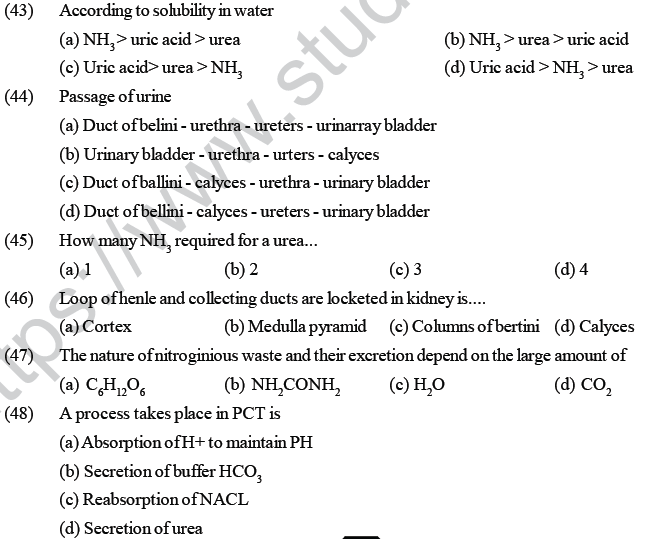
(49) In cortical nephrones (LOH = Loop of henle)
(a) LOH is long (b) coloecting tubule is short
(c) LOH is sort (d) Absesnce of LOH
(50) Peritubuler is in
(a) Cortex (b) Deep in medulla (c) Calyces (d) Surround to duct of bellini
(51) Osmolarity of interstitial fluid in cortex is
(a) 1200 mosmoiL-1 (b) 900 mosmoiL-1 (c) 600 mosmoiL-1 (d) 300 mosmoiL-1
(52) Urine produced by human kidney is concertratal by _________ times than the initial filtrate formed
(a) 2 (b) 300 (c) 4 (d) 1200
(53) Involving mainly in RAAS
(a) Angiotensin (b) Aldosteron (c) Renin (d) All of these
(54) Function of ANF is
(a) Increase the blood pressure (b) Decrease the blood pressure
(c) Diulting the blood (d) Concentrating the blood
(55) Renin is secreted by
(a) PCT (b) DCT (c) LOH (d) JG cells
(56) In Amoeba amonia is excreted by
(a) Food vacuole (b) Coutractile vacuole (c) Plasma membrance (d) All of these
(57) Angitensigngen I is secreted by
(a) Pencreas (b) JG cells (c) Liver (d) Kidney
(58) Angitensinogen is converted in Angiotensin by
(a) dil HCl (b) casein (c) Renin (d) Hippuric acid
(59) Secretion of renin from JG cell is due to
(a) A fall gloerular blood flow (b) glomerular blood pressure
(c) GFR (d) All of these
(60) ADH is secerted by
(a) Liver (b) Neurohypophysis (c) Kidney (d) JG cells
(61) It is also acivate the adraral cortex to release aldosterone
(a) Angiotensin II (b) Adrenal gland (c) Cortisol (d) ADH
(62) It is activated us he change of blood volume and volume of body fluid
(a) Medulla oblongata (b) Osmoreceptor (c) Aorta (d) Renal vein
(63) It increases excretion of ca+2 in the kidney
(a) Prostaglandin (b) Renin (c) Thyrocalcitonin (D)Angiotensin
(64) Elimination f insoluble calcium phophate takes place by
(a) Kidney (b) Liver (c) Lungs (d) Large intestine
(65) The function of renin is
(a) Degradation of angiotensinogen (b) Stimulation of corpus luteum
(c) To reduce blood pressure (d) Vasodilation
(66) For release of Urine
(a) Urinary bTrack contracts (b) Urinary track relaxes
(c) Ureter relaxes (d) Ureter contracts
(67) Presence of blood in urine is known as
(a) Glycosuria (b) Aoligourea (c) Hemetourea (d) Kitonurea
(68) Presence of excessive ammount urea in blood is known as
(a) Uremia (b) Hemeturia (c) Diurea (d) Aniurea
(69) Longest loop of henle is found in
(a) Kangaroorat (b) Rhesus monkey (c) Dog (d) Frog
(70) Marine teleost fishes excrete
(a) Uric acid (b) Ammonia (c) Urea (d) None of these
(71) Sebaceous glands discharge
(a) Water, salts, NaCl, Lactic acid (b) Water, salts, NaCl, Fatty acid
(c) Water, sterols, fatty acid hydrobarbos (d) Water, sterols, latic acid, NaCl
(72) Sweat gland secretion consist of
(a) Water, salts, NaCl, Lactic acid (b) Water, salts, NaCl, Fatty acid
(c) Water, sterols, fatty acid hydrobarbos (d) Water, sterols, latic acid, NaCl
(73) Kidney are
(a) Yellowwish brown (b) Reddish brown (c) Greenish yellow (d) Grey in colour
(74) kidney in human being occure in the region of:
(a) 10th thoracic and first lumber vertebra (b) 12th thoracic and second lumber vertebra
(c) 11th thoracic and third lumber vertebra (d) 9th thoracic and forth lumber vertebra
(75) (1) In human being NH3 is convert in urea is liver
(2) Insect birds and land nail are urecotelic
(3) A small amount of water is wasted n excretion of anomia however not much energy is used in doing so.
(4) More energy is required in the preparation of urea but not a large amount of water is needed to be lost
(a) TFFF (b) TFFT (c) TTFT (D)TTTF
(76) (1) The outer surface of the kidney is concave while inner is convex
(2) The projection of renal pelvis are called collecting duct
(3) Renal columns called columns of bertini
(4) Afferent renal arterioles are narrower then efferent renal arteriioles
(a) FFTF (b) FTTF (c) FFTT (d) FTFF
(77) (1) In PCT the filterate is hypertonic to nblood plasma
(2) In DCT the filterrte is hypertonic to blood plasma
(3) Decending limb of LOH is permecable to water but nearly imperable to salts
(4) Ascending limb of LOH is Segment to water but nearly imperable to salts
(a) FTFT (b) FTTF (c) TFTT (d) FFTF
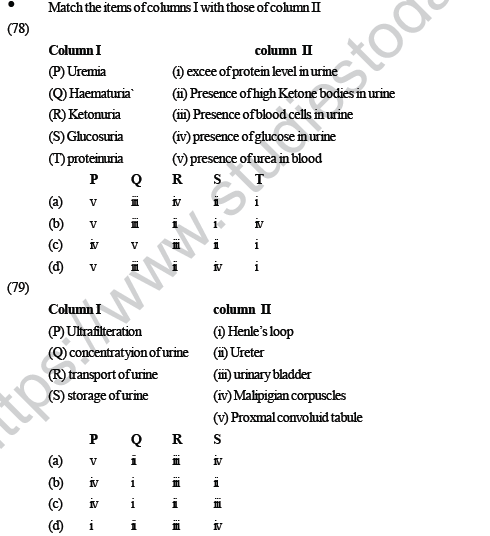
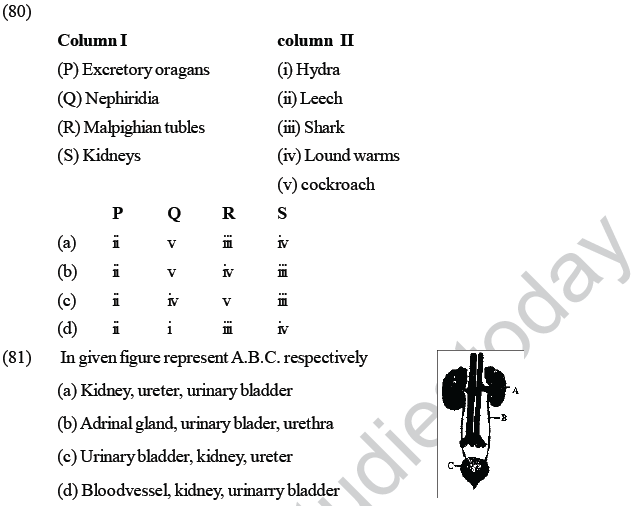
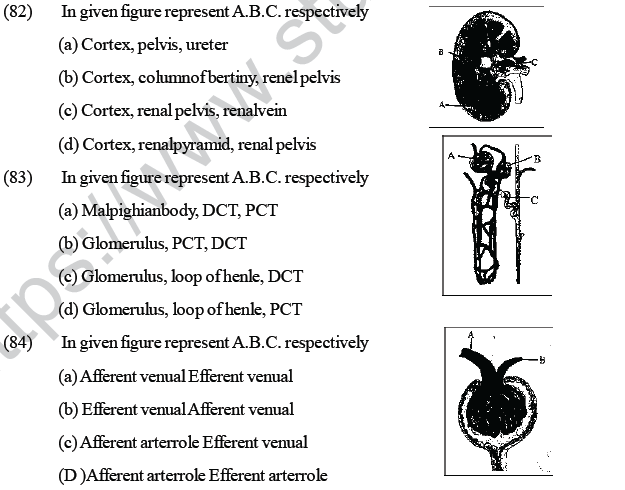
Question based on various competitive Examination:-
(85) Main function of uriniferous tubules
(a) Concentration of urine
(b) Passage of urine
(c) Reabsorption of useful substances from glomerular filtrate
(d) Removal of urea and other waste from blood
(86) The mechnism of urine foundation nephrone involves
(a) Utrafication (b) Secretion
(c) Reabsorption (d) All of above
(87) Which hormone induced the process of reabsorption from glomerouous?
(a) Oxytosin (b) Vasopression (c) Relkgin (d) Calsitonin
(88) Glucose is reabsorbed from glomerular filterate though
(a) Active transport (b) Passive transport (c) Osmosis (d) Difusion
(89) Excretory product of birds and raptiles is
(a) Urea (b) Uric acid (c) Ammonia (d) Creatinin
(90) Part not belonging to urinferous tubule is
(a) Glomerules (b) Henle’s loop
(c) Distal convoluted tuble (d) Connecting tubule
(91) the two kidneys lie:
(a) At the level of ovaries
(b) At the same level
(c) Left kidney at a higher level than the ight one
(d) Right kidney at a higher level than the left one
(92) Which blood vessel takes blood away from kidney?
(a) Renal portal vein (b) Renal vein (c) Afferent arteiote (d) Efferent artribute
(93) Which hormone influence the activity of kidney?
(a) Vasopression (b) Thyoxine (c) Vasopression & aldosterone(d) Gonadotrophin
(94) NA+ and Cl- are absorbed in kidney in the region of
(a) Ascending limb of henel’s loop (b) decending limb of henel’s loop
(c) DCT (d) PCT
(95) Blood which leaves liver and pases towardds heart has higher concentrattion of
(a) Bile (b) Oxygen (c) RBCS (d) Urea
(96) Urea is transformed through
(a) RBCS (b) WBCS (c) blood plasma (d) All of above
(97) A person underoing protonged fsting his urine will be ound to contain abnormal quantities of
(a) Fats (b) Ammino acid (c) Glucose (d) Ketones
(98) The net pressure glaient that cause the luid to filler out the glomeruti into thecapsule is
(a) 50 mm hg (b) 75 mm hg (c) 20 mm hg (d) 30 mm hg
(99) In ornithin cycle which of the following waste are removed from the blood?
(a) CO2 and urea (b) Ammonia and urea (c) CO2 and ammonia (d) Urea and urine
(100) Angiotensinogen is a protein produced an recreted by _____
(a) Tuxta glomerular (JG) cells (b) Macula densa cells
(c) Endothelial cells of blood vessels (d) Liver cells
(101) A person who is oon a long hunger strike and is surving only on water will have
(a) Less amino acids in his urine (b) More glucose in this blood
(c) Less urea in his urine (d) More sodium in his urine
(102) What will happen if the stretch receptor of the urinary bladder wall are totally removed ?
(a) Micturition will continue (b) Urine will continue to collect normally in the bladder
(c) These will be no nicturition (d) Urine will not collect in the bladder
(103) Uric acid is the chief nitrogenous component of the excretory product of
(a) Earthwarm (b) Cockroach (c) Frog (d) Man
(104) Which one of the following statement is impereble to water
(a) Descending limb of loop of henle is impereable to water
(b) DCT is incapable of reabsorbing HCO3
(c) Nearly 99% of the glomerular filterate is reasorbed by the renal tubules
(d) Ascending limb of loop of henle is impereable to water
(105) The principal nitrogenous excretory compound in human is synthesised
(a) In kidney but eliminted mostly though liver
(b) In kidney as well as eliminated by kidneys
(c) In the liver but eliminated mostly kidneys
(d) In the liver and also eliminated mostly by the same bile
(106) Which are of the following is not a part of a renal pyramid?
(a) Peritubular capilariers (b) Conoluted tubules
(c) Collecting ducts (d) Loop of Henle’s
(107) Uricotelic mode of excreting nitrogenous waste is found in
(a) Reptiles and birds (b) Birds and annelids
(c) Amphibianls and reptiles (d) Insects and amphibians
(108) A fall in glemerular filtration rate (GFR)
(a) Juxtaglomerular alls to realase remin
(b) Adrenal cortex to release aldosterone
(c) Adrenal medulla to release adernaline
(d) Dosterior pituitary to release ADH
(109) Haemodialysis is also called as artificial:
(a) Liver (b) Lung (c) Heart (d) Kidney
(110) which one is an accessory excretory organ?
(a) Liver (b) Stomach (c) intertine (d) Heart
(111) Part of nephron involved in active reabsorption of sodium is
(a) PCT (b) Ascending limb of Henle’s loop (c) Bowman’s capsule (d) DCT
(112) Haemodialysis helps the paitent having
(a) Goitre (b) Anaemia (c) Uremia (d) Diabetes
(113) Lungs expel
(a) CO2 (b) H2O
(c) CO2 and water (d) CO2 and water vapours
(114) The glomenuli are continued to the
(a) Medulla (b) Calyces
(c) Cortex (d) REnal Pelvis
(115) The kidney of adult mammals are
(a) Opisthonephron (b) pronephros (c) Mesonephros (d) rletanaphros
(116) A kidney stone is
(a) Blockage by fats
(b) Desposition of sand in kidney
(c) A salt such as Oxalate crystallised in pelvis
(d) Blockage by proteins
(117) Which of the following is both osmoregulator as well as nitrogenours product
(a) NH3 (b) Urea (c) Uric acid (d) All of these
(118) which of these is not a keton body
(a) Asetoacetic acid (b) Acetone (c) Succinic acid (d) Betabychoxy butyric acid
(119) Maximum reabsorption of useful substance occurs in the region of nephron:
(a) Henle’s loop (b) Glomeruls (c) PCT (d) DCT
(120) Excertory organs of cockroach are
(a) Malpighian corpucles (b) Malpighian tubules
(c) Hepetic caecae (d) Green glands
(121) Consider the following statement:
A. Flame cElls are excretory structures of flat worms
B. Green glands are excetory organs of annelids
C. Columns of Bertini are conial propertions of renal pelvis into renal medulla between the renal pyramids
(a) A and B correct (b) B and C incorrect
(c) A and C incorrect (d) B and C correct
(122) Juxta glomerular cells of renal cortex synthesize a hormone called:
(a) ADH (b) Oxytocin (c) Renin (d) Urochrom
(123) RAAS secretes which of the following hormones?
(a) Mineralocorticoids (b) glucoticoids
(c) Both A and B (d) None of these
(124) Which blood vessel carries least ammount of urea?
(a) Pulmonary vein (b) Renal artery(c) Renal vein (d) Hepatic portal vein
(125) Kidney stone are
(a) Crystals of sillica (b) crystals of Nacl (c) Cystals of Oxalate (d) Crystals of NaHco3
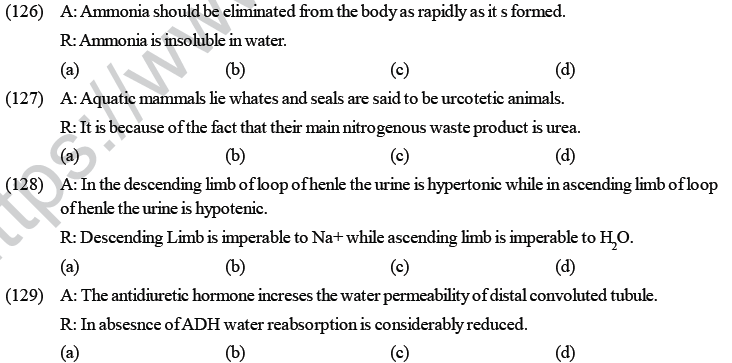
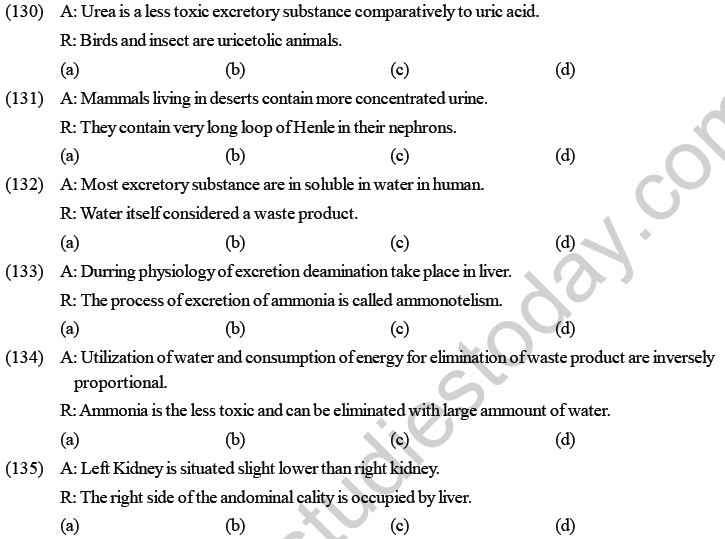
• Assertion & reason Read the assertion and reason carefully to mark the correct option out of the option given bellow
(a) If both the ‘A’ and ‘R’ true and ‘R’ is a correct explaination of ’A’
(b) If both the ‘A’ and ‘R’ true and ‘R’ isnot a correct explaination of ’A’
(C)If A is true the R is false
(D)If A is false the R is true