IMPORTANT POINTS
• Removal of CO2 and intaking O2 is essential for cells during various processes in the body of organisms to take O2 is inspiration and removeing co2 is expiration processes. Both together called as breathing.
• In human for breathing activity nose, phalynx, larynx ,trachea,bronchi and lungs like organs makes togather respiratory system.
• Diagphram and intercostal muscel play important role in inspiration and expiration process. l In exchange and transport of resiratory gases O2 and CO2 both are transported, in this blood play important role.
• The process of respiration is regulating by nervous system and chemical
• Disorders of Respiratory system are Asthma,Emphysema, Occupational Respiratiory Disorders.
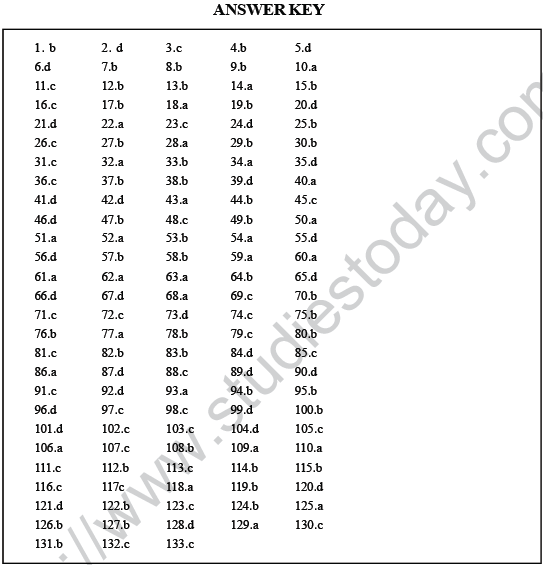
(1) Respiration is helpful in
(a) Removing waste from the body (b) Producing energy within the body
(c) Production of proteins (d) Production of carbohydrates.
(2) Respiration,occures in the presence of oxygen in called
(a) Fermentation (b)Anaerobic respiration (c) Glycolysis (d)Aerobic respiration
(3) The surface, from which the exchange of, gas takes place, is called
(a) Plasma surface (b)Respiratory substrates (c) Respiration surface (d)Gaseous surface.
(4) During respiration ____
(a) O2 is produced and CO2 is consumed (b) O2 is consumed and CO2 is produced
(c) Both O2 and CO2 are produced (d) Both O2 and CO2 are consumed.
(5) A respiratory surface must be ?
(a) Thin (b) Moist (c) Wide spread (d) All these.
(6) Which of the following shows pulmonary respiration
(a) Sponge (b) Fishes (c) Coelentrate (d) Human
(7) What is called the Upper region of Pharynx in man ?
(a) Oropharynx (b) Nasopharynx (c) Laryngopharynx (d) None of these
(8) The diameter of human trachea is about
(a) 1 cm (b) 2.5 cm (c) 2 inches (d) 0.1 cm
(9) The length of human trachea is about (Gujarat C.E.T.Q.B.)
(a) 6 inches (b) 12 cm (c) 12 inches (d) 18 cm
(10) The trachea is supported by, cartilaginous rings,which are____shaped
(a) C (b) L (c) O (d) S
(11) Sound production in humans is controlled by
(a) Nares (b) Lungs (c) Larynx (d) Pharynx
(12) A lung contains many small balloon like air sacs. are called ____
(a) Gas spaces (b) Alveoli (c) Bronchi (d) Bronchioles
(13) The intake of air is called ?
(a) Venitlation (b) Inhalation (c) Exhalation (d) Respiration.
(14) Intercostal muscles regulate the movement of
(a) Ribs (b) Trachea (c) Diapharagm (d) Pharynx.
(15) The muscles present between ribs are called
(a) Phrenic muscles (b) Intercoslal muscles (c) Cardiac muscles (d) Voluntary muscles.
(16) During exhalation, the diaphragm moves
(a) Apart (b) Downwards (c) Upwards (d) Inwards
(17) Respiratory control centres are loacted in
(a) Lungs (b) Medulla oblongata (c) Spinal cord (d) Ribs
(18) The de-oxygenated blood from heart comes to the lungs by
(a) Pulmonary artery (b) Pulmonary vein (c) Branchial artery (d) Renal artery
(19) Oxygen containing blood transported from lungs is to heart by
(a) Pulmonary artery (b) Pulmonary vein (c) Branchial artery (d) Renal vein
(20) How much fraction of oxygen is transported to tissues through RBCs?
(a) 100% (b) 56% (c) 45% (d) 97%.
(21) H2CO3 is converted into CO2 and H2O with the help of an enzyme known as
(a) Carboxylase (b) Carbonic dehydrogenase (c) Carbonicenhydrase (d) Carbonic anhydrase.
(22) The metal ion present in haemoglobin is
(a) Iron (b) Magnesium (c) Copper (d) Zinc
(23) One RBC can transport about how many molecles of oxygen?
(a) One million (b) Ten million (c) One billion (d) Ten billion
(24) How many percentage of CO2 transport in the form of carbamino compounds ?
(a) 70% (b) 90% (c) 5% (d) 20%
(25) The largest amount of CO2 is transported in blood as
(a) Carbamino compounds (b) Bicarbonates (c) Carbonic acid -(d) Carbonate ions.
(26) Chloride back-shift is associated with the transport of
(a) Carbamino (b) CO2 (c) Oxygen (d) Water
(27) CO2 reacts with water to form
(a) Haemoglobinic acid (b) Carbonic acid
(c) Bicarbonate ions (d) Carbon mono oxide.
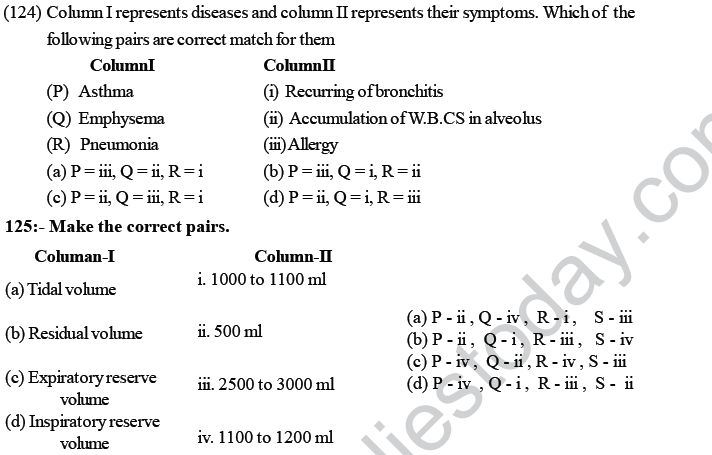
(28) Bronchitis is a
(a) Bacterial infection (b) Viral infection
(c) Protozoan infection (d) Fungal infection.
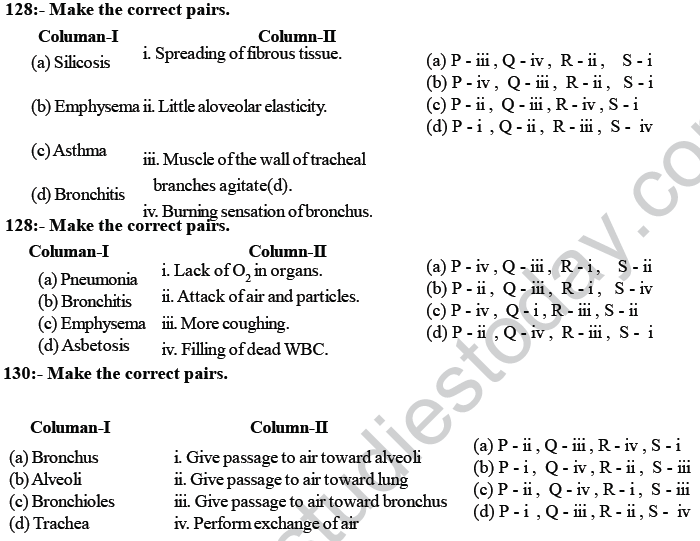
(29) Asthma is a disease of
(a) Pharynx (b) Trachea and its branches
(c) Lungs (d) Blood capillaries
(30) Flattening of alveolar ducts (tracheal vessels) results in
(a) Asthma (b) Emphysema (c) Lung cancer (d) Bronchitis.
(31) Which of these protects the larynx
(a) Pharnx (b) Trachea (c) Epiglottis (d) Naso-pharynx.
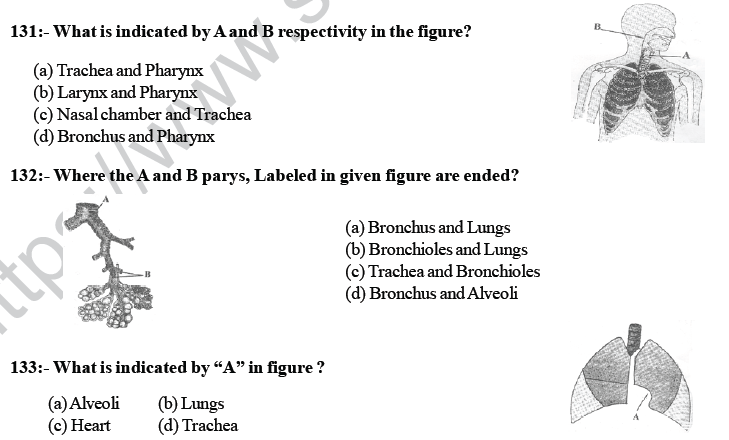
(32) Trachea terminates in
(a) Bronchi (b) Alveoli (c) Bronchioles (d) Nares
(33) In which form CO2 is not transported by blood plasma
(a) NaHCO3 (b) KHCO3 (c) Carbamino proteins (d) KHbO2
(34) Which one is not viral infection
(a) Vocational lung disease (b) Bronchitis
(c) Asthma (d) Emphysema.
(35) In which case specific gases, chemicals or suspended particulate matter in air are not responsible for this disease.
(a) Silicosis (b) Asbestosis (c) Fibrosis (d) Pneumonia
(36) They respire through lungs
(a) Fish (b) Cockroaches (c) Crocodiles (d) Earthworms
(37) The muscles take part in rapid breathing
(a) Muscles of rib cage
(b) Muscles of neck region and abdominal region
(c) Thoracic and abdominal muscles
(d) Muscles of neck region and thoracic region.
(38) Human lungs are situated in
(a) Abdominal cavity (b) Thoracic cavity (c) Inside diaphragm (d) Abdominal cavity
(39) Blockage in respiratory passage in humans is prevented due to the presence of
(a) Epiglottis (b) Larynx
(c) Alveoli (d) ‘C’ shaped cartilagenous rings.
(40) In human beings
(a) Left lung is slightly smaller (b) Left lung is slightly wider
(c) Right lung is slightly smaller (d) Both lungs are of similar size.
(41) The left lung is slightly smaller so as
(a) It is exception (b) No specific reason
(c) Both A and B (d) To accommodate heart.
(42) In which disease lung tissue degenerate?
(a) Bronchitis (b) Pneumonia (c) Asthma (d) Emphysema.
(43) Which is the lung disorder related to profession?
(a) Silicosis (b) Emphysema (c) Pneumonia (d) Asthma
(44) This disease is due to first virus infection followed by bacterial attack
(a) Asthma (b) Bronchitis (c) Emphysema (d) Allergy
(45) The disease in which masses of undifferentiated cells formed in tracheal walls
(a) Acute bronchitis (b) Emphysema (c) Lung cancer (d) Pneumonia
(46) This disease is due lo allergens
(a) Emphysema (b) Bronchitis (c) Pneumonia (d) Asthma
(47) During inhalation the following activities occur
(a) Area of rib cage increases, diaphragm is pulled upwards
(b) Area of rib cage increases, diaphragm is pulled downward
(c) Area of rib cage reduces, diaphram gets contracted
(d) Area of rib cage reduces, diaphram gets relaxed.
(48) Blood transports oxygen in the form of
(a) HHbO2 (b) KHCO3 (c) KHbO2 (d) H2CO3
(49) In which three forms of CO2 is transported by blood
(a) As a solution, carbamino compunds, bicarbonates
(b) As a solution, carbamino proteins,KHCO3
(c) As a solution, carbamino haemoglobin, NaHCO3
(d) As A solution, carbamino compound H2CO3
(50) Carbamino proteins are formed in
(a) Blood plasma (b) Blood platelets (c) Blood cells (d) RBC
(51) The centre which excites both the activities during rapid breathing is
(a) Ventral respiratory center (b) Lateral respiratory center
(c) Pneumotoxic center (d) Dorsal respiratory center.
(52) The function of pneumotoxic center is
(a) To regulate inhalation (b) To maintain rhythmicity of respiration
(c) Increases rate of ethalation (d) Does not play significant role.
(53) During normal breathing the ventral respiratory center
(a) Maintian rhythmicity of respiration (b) Does not play significant role
(d) Excites both inhalation and exhalation (d) Regulate breathing
(54) AIDS patients are susceptible to this respiratoty disease
(a)Pneumonia (b)Fibrosis (c)Emphysema (d)Asthma
(55) The full from of Hb is
(a) Hydrogen bromide (b) Henson bond (c) Hydrogen bond (d) Haemoglobin
(56) H.Hb is
(a) H2b (b) Heavy hydrogen bond
(c) Reduced bromide (d) Haemoglobin acid
(57) The enzyme carbonic anhydrase is of which type?
(a) Lyases (b) reversible (c) Unidirectional (d) Isomerase.
(58) What is role of buffer system in blood ?
(a) To maintain pH of blood plasma (b) To maintain pH of blood
(c) To maintain pH of RBC (d) To maintain pH of blood platelets
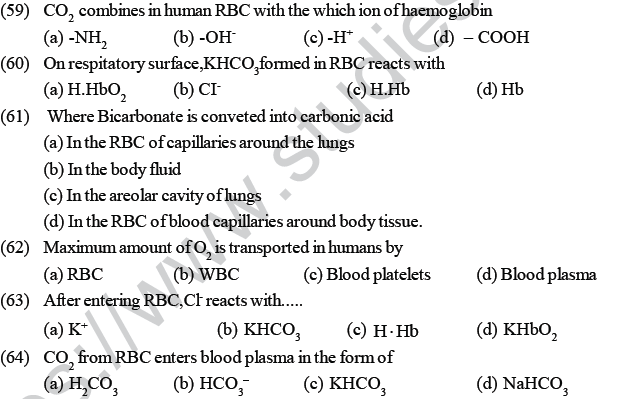
(65) The human ribs
(a) Are accessory respiratory organs (b) Do not help in breathing
(c) Are main respiratory organs (d) Are not respiratory organs
(66) Respiration rate is the lowest during.
(a) Running (b) Playing (c) Eating (d) Sleeping
(67) Hamburger’s phenomenon is also known as
(a) HCO3 – shift (b) Na+ shift (c) H+ shift (d) Chloride shift
(68) Oxygen carrying capacity of blood is
(a) 20% (b) 30% (c) 40% (d) 50%
(69) Respiratory movements are controlled by
(a) Cerebelluam (b) Cerebrum (c) Medulla oblongata (d) Crura cerebri
(70) At higher CO2 condtcentration,oxygen dissociation curve of haemoglobin will
(a) Move to left (b) Move to right (c) Become irregular (d) Move upwardly
(71) Chloride shift is required for transport of
(a) Nitrogen (b) Oxygen
(c) Carbon dioxide (d) Carbon dixide and oxygen
(72) Volume of air inspired or expired with each normal breath is known as
(a) Inspiratory capacity (b) Total Lung capacity
(c) Tidal volume (d) Residual volume
(73) Oxygen haemoglobin dissociation curve will shift to right on decrease of
(a) Acidity (b) Carbon dioxide concentration
(c) Temperature (d) pH
(74) Is Double membrane pleard sac is situated
(a) Envelops the kidneys (b) Envelops the brain
(c) Envelops the lungs (d) Lines the nasal passage
(75) Volume of air remaining in lungs after: maximum respiratory effort is
(a) Vital capacity (b) Residual volume
(c) Total lung capacity (d) Tidal volume
(76) In expiration, diaphragm becomes
(a) Flattened (b) Relaxed
(c) Straightened (d) Arched
(77) Carbon dioxide is transported from tissues to respiratory surface by only
(a) Plasma and erythrocytcs (b) Plasma
(c) Erythrocytes (d) Erythrocytes and leucocytes.
(78) Respiratory centre is situated in
(a) Cerebellum (b) Medulla oblongata
(c) Hypothalamus (d) Cerebrum
(79) Air is breathed through
(a) Trachea→lung→larynx→pharynx→alveoli
(b) Nose→larynx→pharynx→alveoli→bronchioles
(c) Nostrils→pharynx→larynx→trachea→bronchi→bronchioles→alveoli
(d) Nose→mouth→lungs.
(80) Which is false ?
(a) Blood from right side of heart is carried to lungs by pulmonary artery
(b) Pleura is double covering of kindey
(c) Pancreas is both exocrine & endocrine gland
(d) Scurvy is due to vitamin C deficiency.
(81) Volume of air breathed in and out during effortless respiration is
(a) residual volume (b) vital volume (c)tidal volume (d) normal volume
(82) Body tissue obtain oxygen from haemoglobin due to its dissociation in tissues caused by
(a) Low oxygen concentration and high carbon dioxide concentration
(b) Low oxygen concentration
(c) Low carbon dioxide concentration
(d) High carbon dioxide concentration.
(83) Lungs have a number of alveoli for
(a) Having spongy texture and proper shape
(b) More surface area for diffusion of gases
(c) More space for increasing volume of inspired air
(d) More nerve supply.
(84) Presence of large number of alveoli around alveolar ducts opening into bronchioles in mammalian lungs is
(a) Inefficient system of ventilation with little of residual air
(b) Inefficient system of ventilation with high percentage of residual air
(c) An efficient system of ventilation with no residual air
(d) An efficient system of ventilation with little residual air.
(85) During transport of CO2 blood does not become acidic due to
(a) Neutralisation of H2CO3 by Na2CO3 (b) Absorption by leucocytes
(c) Blood buffers (d) Non accumulation
(86) At high altitude,RBCs of human blood will
(a) Increase in number (b) Decrease in number
(c) Decrease in size (d) Increase in size
(87) CO2 is transported
(a) dissolved in blood plasma (b) As carbonic acid
(c) In carbaminohaemoglobin (d) As carbaminolaemoglobin and carbonic acid
(88) Maximum amount 70-75% of carbon dioxide transport occurs as
(a) Dissolved in plasma (b) Carbaminohaemoglobin complex
(c) Bicarbonate (d) None of the above
(89) Trachea is lined with incomplete rings of
(a) Fibrous cartilage (b) Calcified cartilage
(c) Elastic cartilage (d) Hyaline cartilage
(90) Oxygen and carbon dioxide are transported in blood through
(a) Platelets and corpuscles (b) RBCs and WBCs
(c) WBCs and serum (d) RBCs and plasma
(91) About 1500 ml of air left in lungs is called
(a) Tidal volume (b) Inspiratory reserve volume
(c) Residual volume (d) Vital capacity
(92) Which one protects the lungs?
(a) Ribs (b) Vertebral column (c) Sternum (d) All the above
(93) Which one has the lowest value?
(a) Tidal volume (b)Vital capacity
(c) Inspiratory reserve volume (d) Expiratory reserve volume
(94) A child was killed through asphyxiation. Post morturm confirmed it because a piece of lung put in water
(a) Settled dowm (b) Kept floating
(c) Had blood spots (d) None of the above
(95) Amount of oxygen present in one gram of haemoglobin is
(a) 20 ml (b) 1-34 ml
(c) 13-4 ml (c) None of the above
(96) A molecule of haemoglobin carries how many oxygen molecules
(a) 1 (b)2 (c) 3 (d) 4
(97) In carbon monoxide poisoning there is
(a) Increase in carbon dioxide concentration
(b) Decrease in oxygen availability
(c) Decrease in free haemoglobin
(d) None of the above.
(98) Exchange of gases in lung alveoli occurs through
(a) Active transport (b)Osmosis
(c)Simple diffusion (d) Passive transport
(99) Haemoglobin is
(a) Vitamin (b) Skin pigment
(c) Blood carrier (d)Respiratoy pigment
(100) Vocal cords occur in
(a)Pharynx (b) Larynx (c)Glottis (d) Bronchial tube
(101) The cells which do not respire
(a) Epidermal cells (b) Sieve cells
(c)Cortical cells (d)Erythocytes
(102) Hiccough (hiccup) is due to activity of
(a)Intercostal muscles (b) Food in air tract
(c)Diaphragm (d) Inadequate oxygen in environment
(103) Bicarbonate formed inside erythrocytes moves out to plasma while chloride of plasma pass into erythrocytes.The phenomenon is called
(a) Bicarbonate shift (b)Carbonation
(c) Hamburger phenomenon (d) None of the above
(104) Respiratory centre of brain is stimulated by
(a)Carbon dioxide content in venous blood (b)Carbon dioxide content in arterial blood
(c)Oxygen content in venous blood (d) Oxygen content in arterial blood
(105) A higher CO2 concentration of blood causes
(a) Slow diffusion of CO2 from blood (b) Slow transport of CO2 from blood
(c) Slow diffusion of O2 from blood (d) Both A and B
(106) Gases diffuse over the respiratory surface because of
(a) O2 is more in alveoli than in blood (b)O2 is more in blood than in tissues
(c) CO2 is more in alveoli than in blood (d) PCO2 is more in blood than in tissues
(107) Dissociation curve of O2 (which is dissociation from Hb) shifts to the rights ____
(a) O2 concentration decrease (b) CO2 concentration decreases
(c) CO2 concentration increase (d) Chloride concentration increases
(108) Thoracic cage of man is formed of
(a)Ribs and sternum (b)Ribs,sternum and thoracic vertebrae
(c)Ribs,sternum and lumbar vertebrae (d)Ribs and thoracic vertebrae.
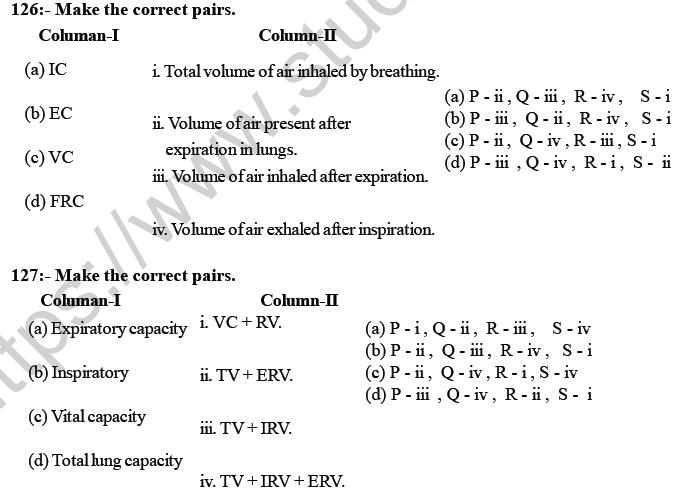
(109) Vital capacity of lung is equal to
(a)IRV+ERV+TV (b) IRV+ERV+TV-RV
(c)IRV+ERV+TV+RV (d)IRV+ERV
(110) Dead space is
(a) Upper respiratory tract (b) Nasal chambers
(c) Alveolar space (d) Lower respiratory tract.
(111) Carbon monoxide contained in Tobacco smoke
(a) Is carcinogenic (b) Causes gastric ulcers
(c) Reduces oxygen carrying capacity of blood (d) Raises blood pressure
(112) What is correct ?
(a) Pulomonary ventilation is equal to alveolar ventilation
(b) Alveolar ventilation is less than pulmonary ventilation
(c) Alveolar ventilation is more than pulmonary ventilation
(d) Both are variable.
(113) Increase in CO2 concentration shall cause
(a) Slower and shallower breathing
(b) Slower and deeper breathing
(c) Faster and deeper breathing
(d) No effect on breathing
(114) Alveoli become enlarged and damaged with reduced surface area in heavy smokers. the condition is called
(a) Silicosis (b) Emphysema
(c) Asthma (d) Bronchitis
(115) SARS is caused by a variant of
(a) Pneumococcus pneumonia
(b) Common cold by Corona virus
(c) Asthma
(d) Bronchitis
(116) During inspiration
(a) Diaphragm and external muscles relax
(b) Diaphragm and internal intercostal muscles relax
(c) Diaphragm and external intercostal muscles contract
(d) Diaphragm and internal intercostal muscles contract.
(117) Mountain sickness at high altitude is due to
(a) Excess CO2 in blood (b) Decreased CO2 in air
(c) Decreased partial pressure of oxygen (d) Decreased efficiency of haemoglobin
(118) Capacity of human lungs for air in a healthy person is
(a) 3000 ml (b) 1500 ml (c) 1000 ml (d) 500 ml
(119) Rate of breathing is controlled by
(a) Amount of freely avilable oxygen (b) Carbon dioxide in blood
(c) Muscular functions of body (d) All the above
(120) During strenous exercise,glucose is converted into
(a) Glycogen (b) Pyravic acid (c) Starch (d) Lactic acid
(121) How much pulmonary air is expired normally
(a) 70% (b) 20% (c) 25% (d) 32%
(122) Which is incorrect ?
(a) Presence of nonrespiratory air sacs increases efficinency of respiration in birds
(b) In insects,circulation body fluids serve to distribute oxygen to tissues
(c) Principle of counter - current flow facilitates efficient respiration in gills of fishes
(d) Residual air in lungs slightly decreases the efficiency of respiration in mammals
(123) Percenatage of oxygen being carried by blood plasma is
(a) 6-9% (b) 3-6% (c) 2-3% (d) 1-2%