IMPORTANT POINTS
Reproduction is biological process in which organism give rise to offspring similar to itself. In living orgamism there are two types of reproduction. (1) Asexual reproduction and (2) Sexual reproduction. In a sexual reproduction single parent is involved and capable of producing offspring . Fission, sporulation, budding and fragmenation are the comman modes of a sexual reproduction seen in animals and plants.
Zoospore, conidia etc are the comman a sexual structures formed in several algae and fungi. In flowering plants vegetative reproduction, are natural and artificial. In natural method the development of new plant takes place under suitable environmental conditions from some organ like stem,leaf,root or even flower of the mother plant.runners,offsets,stolons and suckers are the common other natural methods of reproduction seen in angiosperms.The artificial method of propagation are cutting,layering and grafting. Sexual reproductin involves formation and fusion of gametes.it is a complex and slow process as compared to a sexual reproduction.Events of sexual reproduction may be categorized into the pre-fertilization, fertilization and post-fertilzation events.
Pre-fertilization events of sexual reproduction are found prior to the fusion of gametes. The two main pre-fertilization events are gametogenesis and gamete transfer. Gametes are always haploid and homogametes or heterogametes. After formation, the male and female gametes are brought together to facilitiate fertilization. The fusion of two similar or disssimilar gametes is called syngamy and its result in Formation of diploid zygote is formed, this process is known as fertilization. It is external or internal. The formation of zygote and the process of development of embryo are called post fertilization events. Zygote is the vital link that ensures continuity of species between organisms of one generation and the next. Embryogenesis is the process of development of embryo from the zygote during embryogenesis zygote undergoes cell division and cell differentiation cell divisions increase the number of cells while differentiation helps group of cells to under go certain modification to form specialized tisse and organs to form an organism.
For the given options select the correct options (a, b, c, d) each carries one mark.
1. Which animals have developed capacity of regeneration ?
(a) Hydra, Starfish (b) Plasmodium (c) Earthworm (d) Spongilla
2. Sporulation occurs in ____
(a) Plasmodium (b) Hydra (c) Starfish (d) Spongilla
3. Which plant reproduce vegetatively by roots ?
(a) Oxalis (b) Bryophyllum (c) Onion (d) Dahlia
4. Which plant performs vegetative reproduction with the help of floral buds ?
(a) Agave (b) Bryophyllum (c) Ginger (d) Asparagus
5. Which part of the plant bryophyllum performs vegetative reproduction ?
(a) Stem (b) Floral buds (c) Underground roots (d) Buds on life margin
6. What types of chromosomes are always present in gametes ?
(a) Haploid (b) Diploid (c) Triploid (d) Tetraploid
7. Which physiological process is necessary for birth, growth, death, production of offspring and for continuity of the species ?
(a) Digestion (b) Transportation (c) Reproduction (d) Nutrition
8. In which type of reproduction single parent is essential for reproduction ?
(a) Asexual (b) Sexual (c) Vegetative (d) Fragmentation
9. In which type of reproduction two individual of opposite sex are essential ?
(a) Asexual (b) Sexual (c) Vegetative (d) Fragmentation
10. In which type of organism asexual reproduction is seen ?
(a) Unicellular (b) Bicellular (c) Multicellular (d) Both a and c
11. How does Amoeba reproduce ?
(a) Binary fission (b) Budding (c) Sporulation (d) Both a and c
12. What are ciliated spore ?
(a) Non-motile spores (b) Zoospores (c) Homospores (d) Heterospores
13. Non-flagellate spores are called conidia ? In which organism they are seen ?
(a) Pencillium (b) Hydra (c) Amoeba (d) Chlamydomonas
14. Which animals reproduce by exogenous budding ?
(a) Hydra (b) Spongilla (c) Plasmodium (d) Amoeba
15. Which animal reproduce by multiple fission ?
(a) Hydra (b)Plasmodium (c) Spongilla (d) Euglena
16. In which metohd of asexual reproduction the division of cytoplasm is not possible ?
(a) Amitotic division (b) Binary fission (c) Division (d) Budding
17. During which process cyst is formed ?
(a) Binary fission (b) Multiple fission (c) Sporulation (d) Budding
18. In which method pseudopodiospores are formed ?
(a) Binary fission (b) Multiple fission (c) Sporulation (d) Budding
19. In which organism other than amoeba,sporulation is seen ?
(a) Paramoecium (b) Plasmodium (c) Hydra (d) Planaria
20. In which animal,formation of exogenous budding takes place from parent body ?
(a) Hydra (b) Planaria (c) Amoeba (d) Paramoecium
21. Which special method of reproduction is found on Nephrolepis ?
(a) Offsets (b) Stolons (c) Runner (d) Suckers
22. Which of the following is not a natural method of vegetative reproduction ?
(a) Suckers (b) Cutting (c) Runners (d) Offsets
23. How many chromosomes are there in meiocyte of Apple ?
(a) 17 (b)34 (c) 20 (d)10
24. In which animal conjugation occurs as a sexual reproduction ?
(a)Birds (b)Hydra (c) Paramoecium (d) Spirogyra
25. Devlopment of zygote taking place outside the body is called ?
(a) Viviparous (b)Oviporous (c) Omnivorous (d) Frugivorous
26. By which asexual reproductive method do Dictyota, Fucus and Yeast reproduces ?
(a) Budding (b) Sporulation (c) Fragmentation (d) Fission
27. Which algae reproduce by fragmentation ?
(a) Ulothrix, Oedogonium (b) Spirogyra, Zygnema
(c) Sargasum, Oscillatoria (d) Both a and b
28. In which plants motile ciliated spores are produced during spore formation ?
(a) Chlamydomonas (b) Spirogyra (c) Dictyota (d) Fucus
29. What divides first during the method of fission ?
(a) Cytoplasmic membrane (b) Cytoplasm
(c) Nucleus (d) Cell organelles
30. In Amoeba, the plane of cytoplasmic division is in which direction ?
(a) One direction (b) Two direction
(c) Three direction (d)Any direction
31. Which type of division happens in Euglena ?
(a) Transversal (b) Longitudinal (c) Peripheral (d) Radial
32. Other than Euglena, which of the following organism divides by longitudinal division ?
(a) Amoeba (b) Paramoecium (c) Vorticella (d) Plasmodium
33. In which method of asexual reproduction the offspring's are genetically identical,to the parents ?
(a) Amitotic division (b) Multiple fission (c) Division (d) Binary fission
34. Non-motile and non-flagellate spores are commonly seen in which plants ?
(a) Penicillium (b) Aspergillus (c) Mucor (d) Both a and b
35. The plants which bears only one kind of spores during Sporophytic, stage are known as _____
(a) Spores (b) Heterosporous (c) Homosporous (d) Gametes
36. The plants which bears only two types of hetero spores during Sporophytic stage is known as_____
(a) Spores (b) Somatic spores (c) Homosporous (d) Heterosporous
37. Which type of spores are produce by pteridophytes and gymnosperms ?
(a) Spores (b) Somatic spores (c) Heterospores (d) Homospores
38. How does vegetative reproduction takes place in flowering plants ?
(a) Natural (b) Artificial (c) By chemicals (d) Both a and b
39. Which of the following pair is incorrect ?
(a) Lawn grass-runner (b) Pistia-offset
(c) Nephrolepis-stolons (d) Sellaginella-Suckers
40. Which of the following Plant shows root cutting ?
(a) Sugarcane (b) Croton (c) Rose (d) Lemon
41. In Which plant stem is used for vegetative propagation of the plant ?
(a) Lemon, grapes (b) Hibiscus, mogra
(c) Sugarcane, rose (d) Mango, apple
42. In which of the following organism, internal bud formation is seen ?
(a) Amoeba, Plasmodium (b) Amoeba, Paramecium
(c) Planaria, Hydra (d) Spongilla, sycon
43. What are Internal buds known as ?
(a) Gene (b) Clone (c) Gemmules (d) Bud
44. Which method of asexual reproduction can be said as method of regeneration ?
(a) Binary fission (b) Sporulation (c) Budding (d) Fragmentation
45. Which of the following group of animals show regeneration ?
(a) Planaria, Hydra, Starfish (b) Starfish, Amoeba, Plasmodium
(c) Amoeba, Hydra, Paramoecium (d) Amoeba, Planaria, Starfish
46. Which asexual reproduction process is seen in bacteria?
(a) Budding (b) Sporulation (c) Fragmentation (d) Fission
47. For which plants layering method of vegetative propagation is used ?
(a) Lemon, Grapes (b) Sugarcane, Rose (c) Mango, Apple (d) Guava, Litchi
48. What do a stock have ?
(a) Bud (b) Branches
(c) Leaves (d) Possess regular or irregular roots
49. Grafting is useful for production of _____
(a) Agriculture (b) Horticulture
(c) For inducing flowering (d) Fruit yield plants
50. Which gametes take part in sexual reproduction ?
(a) Male gametes (b) Female gametes
(c) Neutral gametes (d) Both a and b
51. During which phase an living organism becomes sexually mature ?
(a) Childhood (b) Adolesence (c) Old age (d) None of these
52. In plants, the phase from germination to grow till its maturity is known as ?
(a) Linear growth phase (b)Germination phase
(c) Flowering phase (d) None of the above
53. Which phase of conjugation is impossible in gametes ?
(a) Post-fertilization phase (b) Fertilization phase
(c) Pre-fertilization phase (d) Gamete phase
54. Two gametes having similar appearance are called as ___
(a) Gametes (b) Isogametes (c) Heterogametes (d) Isospores
55. In which plants isogametes are seen?
(a) Cladophora (b) Ulothrix (c) Spirogyra (d) Both a and b
56. Morphologically distinct gametes are called as
(a) Isogametes (b) Heterogametes (c) Gametes (d) Iso-spores
57. Which organisms have diploid body organization?
(a) Monera and Fungi (b) Algae and Bryophyte
(c) Pteridophytes and Angiosperms (d) Both a and b
58. Which organisms have diploid body organization?
(a) Pteridophytes, angiosperms (b) Angiosperms
(c) Most of the animals (d) All three
59. Normally male gametes are ____
(a) Stationary (b) Ordinary (c) Nutritive (d) Motile
60. Normally Female gametes are ____
(a) Stationary (b) Ordinary (c) Nutritive (d) Motile
61. By which medium gametes of Algae, Bryophytes and Pteridophytes move ?
(a) Air (b) Water (c) Lipids (d) Tissue
62. Which structure provides surface for the settlement of pollen grains in angiosperm plants ?
(a) Anther (b) Style (c) Stigma (d) Pollen tube
63. The process of transfer of pollen grains from the anther to the stigma is known as _____
(A) Distribution of pollen grains (b) Transportation of pollen grains
(c) Formation of pollen grains (d) Pollination
64. Where do pollen grains germinate ?
(a) Anther (b) Style (c) Stigma (d) Pollen tube
65. Which structare is produced by germination of pollen grain ?
(a) Pollen tube (b) Style (c) Tube (d) Vessels
66. In which organ the growth of pollen tube is observed, till it reaches the ovules ?
(a)Pollen tube (b) Style (c) Ovary (d) Stigma
67. Devlopment of zygote result in formation of ____
(a) Seed (b) Fruit (c) Embryo (d) Seed coat
68. During conjugation, the-bridge is formed of _____
(a) Nucleus (b) Inter cytoplasm (c) Chromosomes (d) Cytoplasm
69. The process oforgan formation start of _____
(a) Due to growth (b) Due to development
(c) Due to differentiation (d) Due to division
70. The fertilized eggs of reptile and birds are covered with calcareous shell. Due to this the zygote passes from which phase ?
(a) Growth phase (b) Vegetative phase
(c) Development phase (d) Incubation phase
71. In Angiosperms, which parts of the flowers wither and fall off ?
(a) Sepals (b) Petals (c)Stamens (d) All the three
72. In Angiosperms which part of the flowers attached with plant body.
(a) Calyx (b) Carolla (c) Gynoecium (d) Androecium
73. In asexual reproduction embryosac develop from which part ?
(a) Pollengrain (b) Ovum (c) Ovary (d) Mother megaspore
74. In amorphophalus and colocasia vegetetive reproduction occur by which plant organ ?
(a) Tuber stem (b) Bubil (c) Corm (d) Offsets
75. What is the eye of potato ?
(a) Root (b) Stem (c) Bud (d) Flower
76. Which type of vegetetive reproduction occurs in Grape and Hibiscus ?
(a) Cutting (b) Layering (c) By seed (d) Grafting
77. Find out mismatched from the following.
(a) Lawn grass-runner (b) Mango-Grafting
(c) Lemon-by embryo grafting (d) Bamboo-Grafting
78. Which one is the best ?
(a) Stock (b) Scion (c) Cutting (d) All a, b, c
79. Which method is used for vegetetive reproduction the devlopment of banana plant ?
(a) Cutting (b) Layering (c) Grafting (d) Bud Grafting
80. Which organism becomes reproductive due to deficiency of mitosis and meiosis ?
(a) Dog (b) Ameoba (c) Grasshopper (d) Earthworm
81. In wich circumstances psuedopodial spore are produced ?
(a) Normal (b) Favourable (c) Unfavourable (d) Specific condition
82. Which asexual reproduction three layered encysts develop ?
(a) Binary fission (b) multiple fisssion (c) Sporulation (d) Fragmentation
83. Which type of asexual reproduction takes place in sycon and spongilla ?
(a) Exo budding (b) Endo budding (c) Fragmentation (d) Division
84. Asexual reproduction takes place by which method in dictyota and fucus ?
(a) By Bud method (b) By Binary fission
(c) By Multiple fission (d) By Fragmentation
85. Flagellated spore is known as___________.
(a) Non-flaglleted spore (b) Motile spore (c) spore (d) Hetero spore
86. Conidia spore is known as ___________
(a) Motile spore (b) Non-flaglleted spore (c) spore (d) Hetero spore
87. In which reproductive system plants,Animals & Fungi or differentiated morphologically, histologically,and physiologicaly ?
(a) Asexual (b) Sexual (c) Vegetative (d) Artificial reproduction
88. Which are the various stages of sexual reproduction ?
(a) Growth, Development, Diffrentiation.
(b) Pre fertilization, Fertilization, Post fertilization.
(c) Fertilization, Post Fertilization, Pre Fertilization.
(d) Gametogenesis, Gamete transfer, Gamete Fertilization.
89. How many chromosome number are seen in Onion and Housefly during meiosis ?
(a) 32,12 (b) 16,12 (c) 16,06 (d) 32,06
90. In which development of zygote takes place in female is called as........ in animals.
(a) Oviparous (b) Viviparous (c) Ovoviviparous (d) None
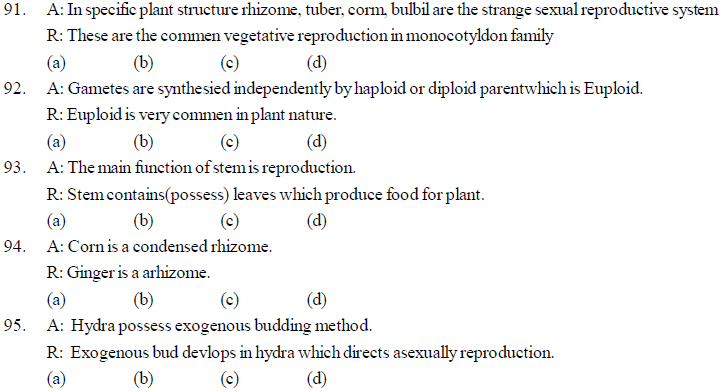
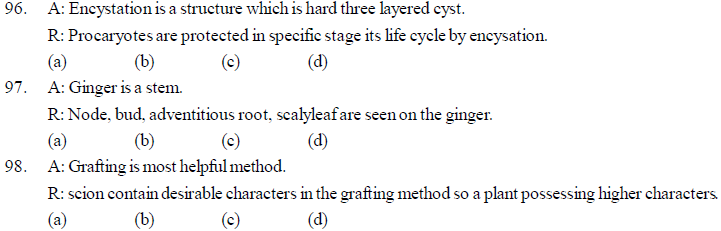
A-R types of MCQ
a. A is true and R is false.
b. A is false and R is true
c. A and R both are true andR is correct explanation of A.
d. A and R both are true but R is not correct explatation of A.

Competitive Exam's MCQ
115. The production of new plant from the maternal plant is called.
(a) Vegetative reproduction (b) Cutting
(c) Grafting (d) Layering
116. Which of the following plant reproduces by leaf ?
(a) Agave (b) Bryophyllum
(c) Gladiolus (d) Potato
117. Pollen tube enters the embryo sac through
(a) Any one synergid cell
(b) Directly penetrating the egg cell
(c) In between one synergid cell and secondary nucleus.
(d) The help of antipodal cells.
118. Grafting is impossible in monocot-because
(a) Vascular bundles are scattered. (b) Meristem is absent
(c) Collateral open vascular bundle (d) Radial vascular bundle.
119. If vegetative growth of the plant takes place but flower production does not occur-then what could be the reason for this?
(a) Imbalance of hormones (b) Photoperiod
(c) Imbalance of sugar in water (d) Irregular transport of solute.
120. What is the name of the technique for the production of large number of top?
(a) Top production (b) Organo genesis
(c) Micro culture (d) Embryo culture
121. Where does the culture of haploid pollen grain is useful in plant breeding?
(a) For production of better hybrid
(b) For production of homogametic organisms.
(c) For production of disease causing organisms
(d) None of this
122. Haploid plants are obtained by culture of-
(a) Young leaves (b) Endosperm (c) Pollen grain (d) Root apex
123. Which of the following is associated with vegetative reproduction?
(a) Combination of pre existing cytoplasm.
(b) Tissue culture
(c) Endo static fertilization
(d) (a) and (b) Both.
124. With the help of which quick cell division could be induced?
(a) By T1 plasmid (b) PBR-32 (c) F-speed (d) By sexual plasmid
125. Which auxin is used in callus and suspension culture technique in general?
(a) Napthelene acetic acid (b) 2-4 Dichloro acetic acid
(c) 2,4,5, Tri phenoxy acetic acid (d) 2,4 dichloro phenoxy acetic acid.
126. Which of the following animal shows longitudinal binary fission?
(a) Englena (b) Plasmodium (c) Planaria (d) Paramoecium
127. Identify the mis-match statement regarding post fertilization events from the following statements.
(a) Wall of ovary is converted in to pericarp.
(b) Outer integument is converted in inner integument
(c) Triploid nucleus develops as endosperm
(d) Ovary is developed as fruit.
128. In cryptogamic tracheophyte's prothallus the male gamate and an egg are produceed at different time.the reason for this is-
(a) Because they possess higher sterility
(b) They are produced from cells which are meiotically formed.
(c) Because they does not allow self fertilization.
(d Because there is no change in their successful fertilization rate.
129. What type of fruit will be produced by fixing the stock of sour juice producing branch on scion of plant having sweet branch?
(a) Sweet and fibrous (b) Sweet and juicy
(c) Sour and juicy (d) Sour and fibrous
130. How man eggs will be formed from an ovary of a woman,in absence implantation of an embryo?
(a) 12 (b) 06 (c) 24 (d) 48
131. Which tissue is required to be present in between stock and scion during grafting?
(a) Xylem (b) Phloem (c) Meristem (d) Parenchyma.
132. Where does maturity is observed in the sporophytic stage of the plants?
(a) In gemina (b) In primay structures
(c) In sporophylls (d) In eggs.
133. If primary spermetocyte have 2n=16 chromosomes during first meiotic division,in such case how many chromatids could be present in each secondary spermatocyte?
(a) 32 (b) 8 (c) 16 (d) 24
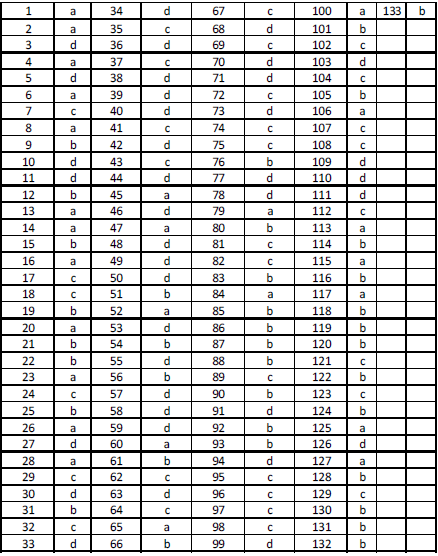
ANSWER KEY