

Class 12 Biology Practice Set: Chapter 03 Reproductive Health
Access printable practice worksheets for Chapter 03 Reproductive Health designed to align with the 2026-27 academic syllabus for Class 12 Biology. These structured exercises help students evaluate their conceptual understanding and improve exam readiness.
Download Chapter 03 Reproductive Health Worksheet PDF
Access the complete worksheet PDF for Chapter 03 Reproductive Health below. Regular practice with these targeted questions builds familiarity with standard exam patterns and helps secure higher marks in final Biology evaluations.
MULTIPLE CHOICE QUESTIONS
Question. GIFT is
(a) transfer of a sperm in fallopian tube of a female with the help of injections.
(b) transfer of a zygote fertilized in vitro in the fallopian tube of female incapable to conceive.
(c) transfer of an ovum collected from a donor into another females fallopian tube who can’t produce an ovum but can provide a good environment for further development.
(d) embryo is developed in vitro and then transferred into female’s tract.
Answer. C
Question. What is the function of copper-T ?
(a) Checks mutation
(b) Stops fertilization
(c) Stops zygote formation
(d) Stops oblituation of blastocoel
Answer. B
Question. Progestasert and LNG-20 are
(a) Implants
(b) Copper releasing IUDs
(c) Non-medicated IUDs
(d) Hormone releasing IUDs
Answer. D
Question. What is the figure given below showing in particular ?
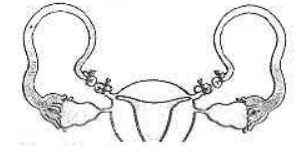
(a) Ovarian cancer
(b) Uterine cancer
(c) Tubectomy
(d) Vasectomy
Answer. C
Question. Match Column -I with Column - II.
Column I Column II
Method Mode of Action
A. The pill I. Prevents sperms reaching cervix
B. Condom II. Prevents implantation
C. Vasectomy III. Prevents ovulation
D. Copper T IV. Semen contains no sperms
(a) A – III; B – I; C – IV; D – II
(b) A – IV; B – I; C – II; D – III
(c) A – III; B – IV; C – I; D – II
(d) A – II; B – III; C – I; D – IV
Answer. A
Question. Select the correct match of the techniques given in column I with its feature given in column II.
Column I Column II
A. ICSI I Artificially introduction of semen into the vagina or uterus.
B. IUI II Transfer of ovum collected from a donor into the fallopian tube where fertilization occur
C. IUT III Formation of embryo by directly injecting sperm into the
D. GIFT IV Tovraunmsfer of the zygote or early embryo (with upto 8 blastomeres) into a fallopian tube.
E. ZIFT V Transfer of embryo with more than 8 blastomeres into the uterus
(a) A – V; B – IV; C – I; D – III; E – IV
(b) A – I; B – II; C – III; D – IV; E – V
(c) A – III; B – V; C – II; D – IV; E – I
(d) A – III; B – I; C – V; D – II; E – IV
Answer. D
ASSERTION REASON QUESTIONS
Directions : Each of these questions contains an Assertion followed by Reason. Read them carefully and answer the question on the basis of following options. You have to select the one that best describes the two statements.
(a) If both Assertion and Reason are correct and Reason is the correct explanation of Assertion.
(b) If both Assertion and Reason are correct, but Reason is not the correct explanation of Assertion.
(c) If Assertion is correct but Reason is incorrect.
(d) If both the Assertion and Reason are incorrect.
Question. Assertion : Cu-T and Cu-7 do not suppresses sperm-motility.
Reason : Hormones released by them affect sperm motility.
Answer. C
Question. Assertion : HIV infection can be avoided by use of condoms.
Reason : Condoms secrete anti-viral interferons.
Answer. C
Question. Assertion : Copper-T is an effective contraceptive device in human females.
Reason : Copper-T prevents passage of sperms from vagina upwards into fallopian tubes.
Answer. C
Question. Government of India has raised the marriageable age of female to 18 years and of males to 21 years. Suggest any two more measures adopted by Government for the purpose.
Answer. (i) Incentives given to couples with small families.
(ii) Media publicity through posters of happy couples with two children (Hum Do Humare Do).
(iii) Motivation to promote smaller families by using contraceptive methods.
(iv) Raising marriageable age of females to 18 years & males to 21 years. (Any two)
Question. Why is tubectomy considered a contraceptive method?
Answer. Tubectomy involves cutting a piece of the fallopian tube and tying its ends. This way, the sperms are not able to reach the egg so fertilisation cannot take place. Thus, it acts as a contraceptive method.
Question. A woman’s husband is infertile. So the lady has decided to have baby by taking sperms from sperm bank. Which technique will you suggest for her pregnancy?
Answer. Intra cytoplasmic sperm injection
Short Answer Questions
Question. At the time of Independence, the population of India was 350 million, which exploded to over 1 billion by May 2000. List any two reasons for this rise in population and any two steps taken by the government to check this population explosion.
Answer. Two reasons for increase in population are:
(i) A rapid decline in death rate, maternal mortality rate and infant mortality rate.
(ii) Increase in number of people in reproducible age.
Two steps for checking population explosion:
(i) Statutory raising of marriageable age of the females to 18 years and males to 21 years.
(ii) Incentives given to couples with small families.
Question. The alarming population growth is leading to scarcity of basic requirements. Suggest with reasons, any two population control measures other than contraception to address the situation.
Answer. Following are the population control measures other than contraception:
(a) Advertisements in the media to generate awareness about advantages of small families.
(b) Statutory raising of marriageable age of the female to 18 years and that of males to 21 years,to delay the number of births.
(c) Incentives given to couples with small families, to motivate others to comply. (Any two)
Question. Comment on the RCH programme of the government to improve the reproductive health of the people.
Answer. The basic aims of the RCH programmes are creating public awareness regarding reproductionrelated aspects population growth and providing facilities to build up a healthy society with added emphasis on the health of mother and child.
Question. State True/False with explanation.
(a) Abortions could happen spontaneously too. (True/False)
(b) Infertility is defined as the inability to produce a viable offspring and is always due to abnormalities/defects in the female partner. (True/False)
(c) Complete lactation could help as a natural method of contraception. (True/False)
(d) Creating awareness about sex related aspects is an effective method to improve reproductive health of the people. (True/False)
Answer. (a) True: Due to internal factors like incompatibility, abortion could happen spontaneously.
(b) False: Infertility may also be caused due to male partner when sperm count is low or their mobility is less.
(c) True: Lactational amenorrhea is a method of contraception as ovulation does not occur during the period of intense lactation following parturition.
(d) True: Creating awareness about sex-related aspects removes the myths and misconceptions about these problems.
Question. A couple is eager to know the sex of their unborn child. What diagnostic technique will you suggest? What social abuse is associated with the application of this technique?
Answer. Amniocentesis is the suggested diagnostic technique which when applied helps in sex determination of the foetus and may lead to social abuse like female foeticides.
Question. Name an oral pill used as a contraceptive by human females. Explain how does it prevent pregnancy.
Answer. ‘Saheli’ is an oral pill used as a contraceptive by females. Oral pills inhibit ovulation and implantation, as well as, alter the quality of cervical mucus to prevent or retard entry of sperms.
Thus, fertilisation and further pregnancy is prevented.
Question. Why is ‘Saheli’ considered to be an improved form of oral contraceptive for human female?
Answer. “Saheli” contains a non-steroidal preparation and is a once-a-week pill, with high contraceptive value and very less side-effects. Therefore, it is considered an improved form of contraceptive pills.
Please click on below link to download CBSE Class 12 Biology Reproductive Health Worksheet Set A
Free study material for Biology
Chapter 03 Reproductive Health Practice Sheet and Solutions for Class 12 Biology
CBSE Practice Material: Class 12 Biology Chapter 03 Reproductive Health
Review targeted practice exercises for Class 12 Biology Chapter 03 Reproductive Health. Curated to match official CBSE guidelines, these downloadable PDF sheets support daily revision and core concept reinforcement.
NCERT-Aligned Questions and Solutions
Built using the official NCERT book for Class 12 Biology, these practice materials provide reliable academic guidance. Pair your practice with our recommended NCERT solutions to master optimal problem-solving approaches.
Next Steps in Your Exam Preparation
Follow up your worksheet practice by attempting the interactive online Biology MCQ test for this chapter to evaluate your execution speed. All platform resources are free to access.
FAQs
You can download the teacher-verified PDF for CBSE Class 12 Biology Reproductive Health Worksheet Set 01 from StudiesToday.com. These practice sheets for Class 12 Biology are designed as per the latest CBSE academic session.
Yes, our CBSE Class 12 Biology Reproductive Health Worksheet Set 01 includes a variety of questions like Case-based studies, Assertion-Reasoning, and MCQs as per the 50% competency-based weightage in the latest curriculum for Class 12.
Yes, we have provided detailed solutions for CBSE Class 12 Biology Reproductive Health Worksheet Set 01 to help Class 12 and follow the official CBSE marking scheme.
Daily practice with these Biology worksheets helps in identifying understanding gaps. It also improves question solving speed and ensures that Class 12 students get more marks in CBSE exams.
All our Class 12 Biology practice test papers and worksheets are available for free download in mobile-friendly PDF format. You can access CBSE Class 12 Biology Reproductive Health Worksheet Set 01 without any registration.