
CBSE Class 12 Biology Reproduction In Organisms Worksheet Set 06

Official Class 12 Biology Worksheets: Chapter 01 Reproduction in Organisms

Review targeted practice sets for Class 12 Biology Chapter 01 Reproduction in Organisms. Built according to official educational guidelines for the 2026-27 academic year, these downloadable worksheets support daily revision and core concept reinforcement.

Chapter-wise Practice Material: Chapter 01 Reproduction in Organisms

Access the complete worksheet PDF for Chapter 01 Reproduction in Organisms below. Regular practice with these targeted questions builds familiarity with standard exam patterns and helps secure higher marks in final Biology evaluations.
REPRODUCTION IN ORGANISMS
 
Reproduction is a biological process of formation of new offsprings from the pre-existing undergo senescence and ultimately they die.
 
Life span - • The period from birth to the natural death of an organism represents its life
span. Life span of organisms varies from few days (Butterfly-1to 2 weeks) to thousands of
years (Banyan tree).
 
Types of Reproduction:
 
Based on whether there is one or two organisms taking part in the process of reproduction
 
• ASEXUAL REPRODUCTON
• SEXUAL REPRODUCTION
 
When the offspring is produced by single parents with or without the involvement of gamete formation, the reproduction is called asexual reproduction.
When two parents (opposite sex) participates in reproduction process and also involves the fusion of male and female gametes, it is called sexual reproduction.
 
Asexual Reproduction
 
1. Usually followed by organisms with relatively simpler organizations.
2. Off springs produced by single parent.
3. With/without involvement of gamete formation.
4. Off springs produced are genetically and morphologically similar to each other and to the parent, i.e. they are clones.
 
• In Protista and Monera, the parent cells divides into two to give rise to new individuals. Thus, in these organisms cell division is the mode of reproduction itself.
 
Binary fission- in this method of asexual reproduction, a cell divides into two halves and rapidly grows into an adult. Ex- amoeba, paramecium.
 
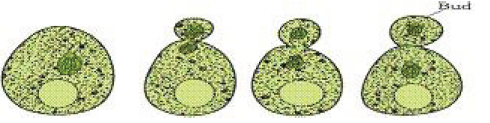
Budding- small buds are produced that remain attached initially with parents and get separated on maturation. Ex. Yeast.
CBSE Class 12 Biology Reproduction In Organisms Worksheet 1
 
• Fungi and simple plants like algae reproduce through special reproductive structures like zoospores (motile structure), conidia (penicillium), buds (hydra) and gemmules (sponges).
 
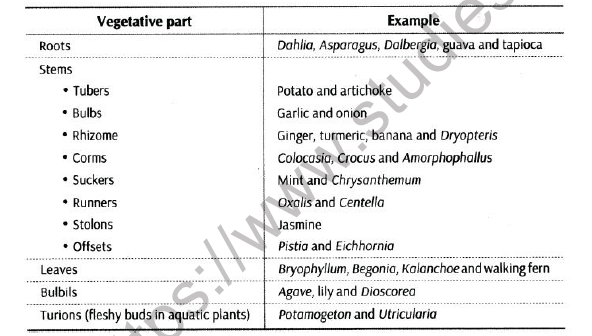
• In plants, vegetative reproduction occurs by vegetative propagules like runner, rhizome, sucker, tuber, offset and bulb.
CBSE Class 12 Biology Reproduction In Organisms Worksheet 2
 
WATER HYACINTH (Terror of Bengal)
 
• One of the most invasive weeds
• Grows wherever there is standing water
• Drains oxygen from water- leads to death of fishes.
• Introduced in India because of its pretty flowers & shape of leaves
• Vegetative propagation occurs at a phenomenal rate
• Asexual reproduction is the most common method of reproduction in organisms having simpler body like in algae and fungi but during unfavorable condition they shift to sexual reproduction.
 
SEXUAL REPRODUCTION:
 
Involves formation of male and female gamete by two individuals of the opposite sex. Offspring produced by fusion of male and female gametes not identical to each other or to the parents. All sexually reproducing organisms share a similar pattern of reproduction.
 
• In sexual reproduction, fusion of male and female gametes results in offspring that are not identical to parents.
 
DIFFERENT PHASES IN SEXUAL REPRODUCTION:
 
a. Juvenile phase - The period between birth and sexual maturity is called juvenile phase. In plants it is known as vegetative phase.The end of juvenile/vegetative phase marks the beginning of the reproductive phase.
 
b. Reproductive phase-
• Some plants show flowering in particular season and some other flowers in all seasons. Some other plants like bamboo species flowers once in life time (after 50-100 years), Strobilanthus kunthiana (neelakuranji),flowers once in 12 years.
• The female placental animals exhibit cyclic change in activities ovaries and accessary glands as well as hormone during the reproductive phase.
 
Menstrual cycle
• It occurs in monkeys, apes and human beings.
• Cycle consists of 3 phases-menstrual, proliferative and secretory phase.
• Blood flows in the last few days of the cycle. The broken endometrium is passed out during menstruation.
• Female does not permit copulation during menstrual phase of the cycle.
 
Oestrous cycle
• It occurs in non primates like cow, sheep, rat, deer, dog, tiger etc.
• It consists of a short period of oestrous or heat. it is 12-24 hours in cow followed by anoestrous or passive period.
• Blood does not flow in this cycle. The broken endometrium is reabsorbed.
• Female permits copulation only during oestrous period.
• Both in plants and animals, hormones are responsible for the transition between different phases of life cycle. Interaction between hormones and environmental factors regulate the reproductive processes.


Please click on below link to download CBSE Class 12 Biology Reproduction In Organisms Worksheet

Exam Preparation Worksheet for Class 12 Biology Chapter 01 Reproduction in Organisms

CBSE Practice Material: Class 12 Biology Chapter 01 Reproduction in Organisms

Explore reliable practice questions for Chapter 01 Reproduction in Organisms tailored for Class 12 Biology learners. Use these structured worksheets to evaluate preparedness and strengthen problem-solving skills.

NCERT-Aligned Questions and Solutions

Built using the official NCERT book for Class 12 Biology, these practice materials provide reliable academic guidance. Pair your practice with our recommended NCERT solutions to master optimal problem-solving approaches.

Next Steps in Your Exam Preparation

Follow up your worksheet practice by attempting the interactive online Biology MCQ test for this chapter to evaluate your execution speed. All platform resources are free to access.

FAQs

Where can I download the latest PDF for CBSE Class 12 Biology Reproduction In Organisms Worksheet Set 06?

You can download the teacher-verified PDF for CBSE Class 12 Biology Reproduction In Organisms Worksheet Set 06 from StudiesToday.com. These practice sheets for Class 12 Biology are designed as per the latest CBSE academic session.

Are these Biology Class 12 worksheets based on the 2026-27 competency-based pattern?

Yes, our CBSE Class 12 Biology Reproduction In Organisms Worksheet Set 06 includes a variety of questions like Case-based studies, Assertion-Reasoning, and MCQs as per the 50% competency-based weightage in the latest curriculum for Class 12.

Do you provide solved answers for CBSE Class 12 Biology Reproduction In Organisms Worksheet Set 06?

Yes, we have provided detailed solutions for CBSE Class 12 Biology Reproduction In Organisms Worksheet Set 06 to help Class 12 and follow the official CBSE marking scheme.

How does solving CBSE Class 12 Biology Reproduction In Organisms Worksheet Set 06 help in exam preparation?

Daily practice with these Biology worksheets helps in identifying understanding gaps. It also improves question solving speed and ensures that Class 12 students get more marks in CBSE exams.

Is there any charge for the Class 12 Biology practice test papers?

All our Class 12 Biology practice test papers and worksheets are available for free download in mobile-friendly PDF format. You can access CBSE Class 12 Biology Reproduction In Organisms Worksheet Set 06 without any registration.