

Download Class 12 Biology Worksheets for Chapter 02 Human Reproduction
Access printable practice worksheets for Chapter 02 Human Reproduction designed to align with the 2026-27 academic syllabus for Class 12 Biology. These structured exercises help students evaluate their conceptual understanding and improve exam readiness.
Access Chapter 02 Human Reproduction Questions and Exercises
Navigate directly to the printable exercises for Chapter 02 Human Reproduction using the digital viewer below. Each practice set allows students to isolate specific topics for thorough review and uninterrupted practice alongside standard textbooks.
Very Short Answer Questions
Question. Mention the location and the function of Leydig cells in humans.
Answer. Leydig cells are present in the regions called interstitial spaces outside the seminiferous tubules.
They synthesise and secrete androgens (testosterone).
Question. Mention the function of mitochondria in sperm.
Answer. Provide energy for the movement of sperm tail.
Question. Identify the figure given below and the part labelled “A”.
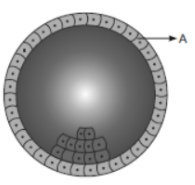
Answer. The figure is of blastula/blastocyst.
A—Trophoblast.
Question. When do the oogenesis and the spermatogenesis initiate in human females and males respectively?
Answer. Oogenesis in human females initiate at the foetal/embryonic stage.
Spermatogenesis in human males starts at puberty.
Question. What is the role of cervix of the human female system in reproduction?
Answer. Cervix helps in regulating the passage of sperms into the uterus and forms the birth canal to facilitate parturition.
Question. What are the major functions of male accessory ducts and glands?
Answer. Male accessory ducts include rete testes, vasa efferentia, epididymis and vas deferens. These ducts store and transport the sperms from the testes to the outside through urethra. Male accessory glands include paired seminal vesicles, prostate gland and paired bulbourethral glands. Secretion of these glands constitute the seminal plasma which is rich in fructose, calcium and certain enzymes. The secretions of bulbourethral glands also help in the lubrication of the penis.
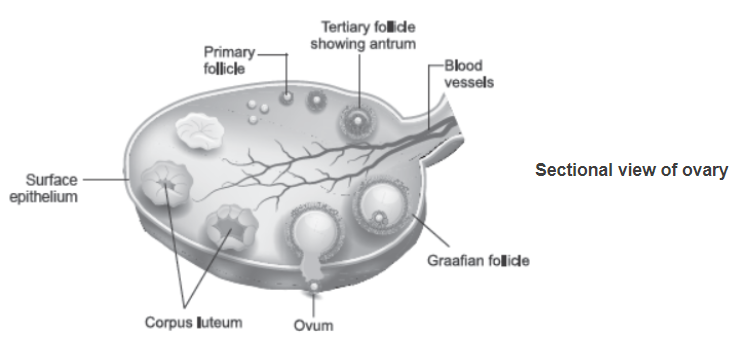
Question. Draw a labelled diagram of a section through ovary.
Answer.
Question. Write two major functions each of testis and ovary.
Answer. Functions of testis:
(i) Production of sperms by seminiferous tubules.
(ii) Production of male sex hormone, testosterone, by Leydig cells.
Functions of ovary:
(i) Production of ova (eggs).
(ii) Production of female sex hormones, estrogen and progesterone.
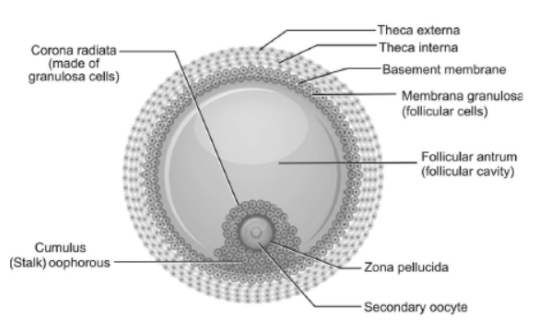
Question. Draw a labelled diagram of a Graafian follicle.
Answer.
Short Answer Questions
Question. Why are the human testes located outside the abdominal cavity? Name the pouch in which they are present.
Answer. The human testes need lower temperature, 2 – 2.5°C less than the body temperature, for the formation of sperms which is provided outside the body.
Testes are present in scrotal sac or scrotum.
Question. (i) How many spermatozoa are formed from one secondary spermatocyte?
(ii) Where does the first cleavage division of zygote take place?
Answer. (i) Two
(ii) During the passage of zygote from fallopian tube to the uterus.
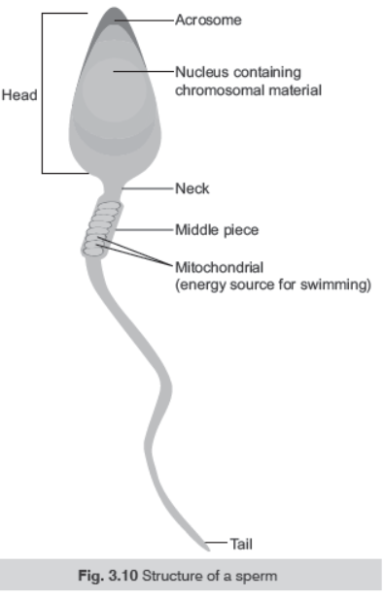
Question. Draw a diagram of a human sperm. Label only those parts along with their functions, that assist the sperm to reach and gain entry into the female gamete.
Answer.
Question. Given below is a flow chart showing ovarian changes during menstrual cycle. Fill in the spaces with the hormonal factor(s) responsible for the events shown.
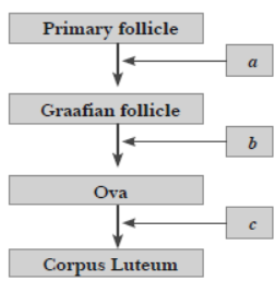
Answer. a: FSH and estrogen
b: LH
c: Progesterone
Question. Differentiate between major structural changes in the human ovary during the follicular and luteal phase of the menstrual cycle.
Answer.
| S.No. | Follicular phase | Luteal phase |
| (i) | During this, primary follicles grow to become fully mature Graafian follicle | During this, remaining part of Graafian follicle transforms into corpus luteum. |
| (ii) | Endometrium regenerates through proliferation. | Endometrium further thickens secreting progesterone for implantation after fertilisation.If fertilisation does not occur, corpus luteum degenerates. |
Question. Where is acrosome present in humans? Write its function.
Answer. Acrosome is present on the sperm head. It has enzymes to help the sperm enter into the cytoplasm of ovum through zona pellucida and plasma membrane to facilitate entry of sperm nucleus for fertilisation.
Question. Write the function of each of the following:
(a) Middle piece in human sperm.
(b) Luteinising hormone in human males.
Answer. (a) Provides energy for movement as it contains mitochondria.
(b) Stimulates synthesis and secretion of androgens or male hormones for spermatogenesis.
Question. What is spermatogenesis? Briefly describe the process of spermatogenesis.
Answer. The process of formation of spermatozoa (sperms) from diploid spermatogonia is called spermatogenesis. The male germ cells of seminiferous tubules multiply mitotically to increase in numbers. Spermatogonia grow and increase in size to form primary spermatocyte (2n). The primary spermatocytes undergo the first meiotic division and produce two haploid secondary spermatocytes (n). Each secondary spermatocyte undergoes the second meiotic division and produces 4 equal haploid spermatids. The spermatids are finally transformed into spermatozoa by the process of spermiogenesis.
Question. Define spermiogenesis and spermiation.
Answer. Spermiogenesis: The process involving transformation of spermatids into spermatozoa is called spermiogenesis.
Spermiation: After spermiogenesis, sperm heads become embedded in the Sertoli cells and are finally released from the seminiferous tubules by the process called spermiation.
Please click on below link to download CBSE Class 12 Biology Human Reproduction Worksheet Set D
Free study material for Biology
Chapter 02 Human Reproduction Practice Sheet and Solutions for Class 12 Biology
CBSE Practice Material: Class 12 Biology Chapter 02 Human Reproduction
Access structured practice worksheets for Chapter 02 Human Reproduction designed in alignment with the latest CBSE curriculum for Class 12 Biology. These printable problem sets help students build accuracy and prepare effectively for school tests.
NCERT-Aligned Questions and Solutions
Cross-reference your completed exercises with comprehensive NCERT solutions for Class 12 Biology to ensure absolute clarity across all sub-topics in this chapter.
Next Steps in Your Exam Preparation
Explore our broader library of printable assignments, chapter notes, and mock tests designed to support continuous revision and secure higher marks in CBSE assessments.
FAQs
You can download the teacher-verified PDF for CBSE Class 12 Biology Human Reproduction Worksheet Set 04 from StudiesToday.com. These practice sheets for Class 12 Biology are designed as per the latest CBSE academic session.
Yes, our CBSE Class 12 Biology Human Reproduction Worksheet Set 04 includes a variety of questions like Case-based studies, Assertion-Reasoning, and MCQs as per the 50% competency-based weightage in the latest curriculum for Class 12.
Yes, we have provided detailed solutions for CBSE Class 12 Biology Human Reproduction Worksheet Set 04 to help Class 12 and follow the official CBSE marking scheme.
Daily practice with these Biology worksheets helps in identifying understanding gaps. It also improves question solving speed and ensures that Class 12 students get more marks in CBSE exams.
All our Class 12 Biology practice test papers and worksheets are available for free download in mobile-friendly PDF format. You can access CBSE Class 12 Biology Human Reproduction Worksheet Set 04 without any registration.