

Class 12 Biology Practice Set: Chapter 02 Human Reproduction
Access printable practice worksheets for Chapter 02 Human Reproduction designed to align with the 2026-27 academic syllabus for Class 12 Biology. These structured exercises help students evaluate their conceptual understanding and improve exam readiness.
Download Chapter 02 Human Reproduction Worksheet PDF
View or download the dedicated Chapter 02 Human Reproduction practice resource below. Engaging with these objective and subjective questions daily ensures continuous academic progress and mastery of the 2026-27 curriculum.
Very Short Answer Questions
Question. Mention the function of trophoblast in human embryo.
Answer. Trophoblast is the outer layer of blastocyst which helps in the attachment of blastocyst to the endometrium of the uterus.
Question. Explain the function of umbilical cord.
Answer. Umbilical cord transports nutrients and respiratory gases and metabolic wastes to and from mother and foetus.
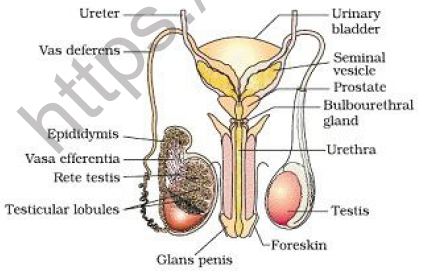
Question. The path of sperm transport is given below. Provide the missing steps in blank boxes. (Image 96 P)
Answer. Vasa efferentia, Vas deferens.
Question. What is corona radiata?
Answer. The follicle cells that envelope the egg outside zona pellucida are called corona radiata.
Question. Which part of the blastula is destined to form the germ layers of the developing embryo in humans?
Answer. Inner cell mass.
Question. In our society the women are often blamed for giving birth to daughters. Can you explain why this is not correct?
Answer. It is not correct to blame women for giving birth to daughters. The male sperm contains either X or Y chromosome whereas the female egg contains only X chromosomes. At the time of fertilisation when sperm carrying X chromosome combines with egg carrying X chromosome of female, XXzygote is formed which would be a female and when sperm with Y chromosome combines with egg containing X chromosome, XY-zygote is formed which would be a male. Thus, scientifically sex of the baby is determined by the father and not by the mother as blamed in our society.
Question. What are the major components of seminal plasma?
Answer. Seminal plasma is the mixture of secretions of male accessory glands which include paired seminal vesicles, a prostate gland and a pair of bulbourethral glands.
Question. What is parturition? Which hormones are involved in induction of parturition?
Answer. The process of delivery of the foetus (child birth) at the end of the pregnancy is called parturition.
The signals for parturition originate from the fully developed foetus and the placenta, which trigger the release of oxytocin from the maternal pituitary. Oxytocin acts on the uterine muscles and induces stronger uterine contractions leading to expulsion of the baby. Relaxin hormone released by the ovary widens the vagina to facilitate birth.
Question. How many eggs do you think were released by the ovary of a female dog which gave birth to 6 puppies?
Answer. Six eggs are released by the ovary of a female dog if it gave birth to six puppies.
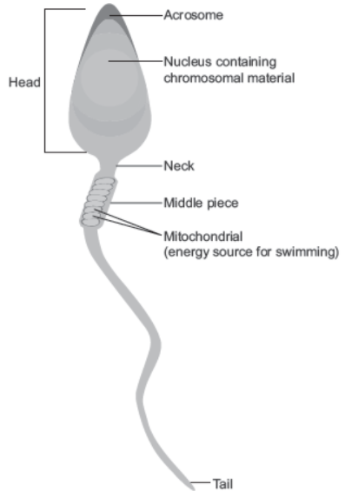
Question. Draw a labelled diagram of sperm.
Answer.
Short Answer Questions
Question. Differentiate with the help of diagrams only between morula and blastocyst of a human.
Answer.
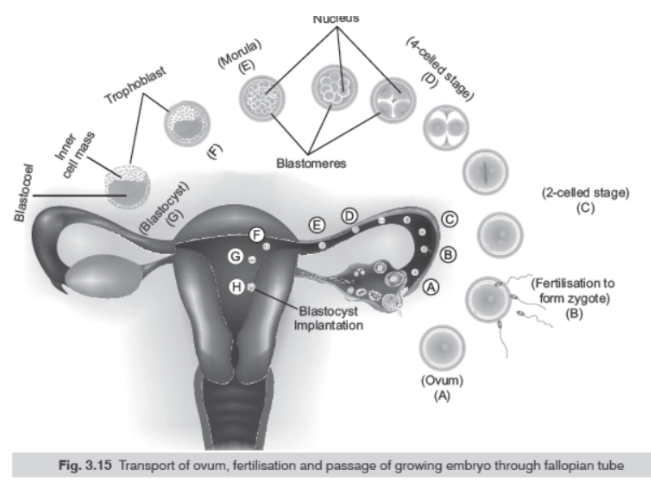
Question. Write the function of each one of the following:
(i) (Oviducal) Fimbriae (ii) Oxytocin
Answer. (i) Collection of ovum released by ovary.
(ii) Cause uterine contraction for parturition; promotes milk ejection.
Question. State the fate of trophoblast of a human blastocyst at the time of implantation and that of the inner cell mass immediately after implantation.
Answer. The trophoblast layer gets attached to the endometrium, and the inner cell mass gets differentiated as the embryo.
Question. Placenta acts as an endocrine tissue. Justify.
Answer. Placenta produces several hormones like human chorionic gonadotropin (hCG), human placental lactogen (hPL), estrogens, progesterones that are essential to maintain pregnancy. This way placenta acts as an endocrine tissue.
Question. What stimulates pituitary to release the hormone responsible for parturition? Name the hormone.
Answer. The signal from the fully developed foetus and placenta or the foetal ejection reflex induces mild uterine contraction. The hormone released is oxytocin.
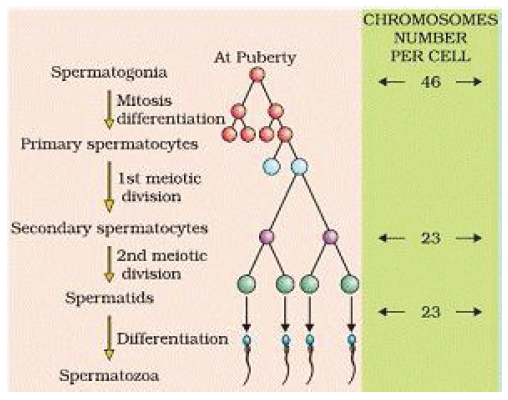
Question What is the number of chromosomes in the following cells of a human male?
(i) Spermatogonial cells (ii) Spermatids
(iii) Primary spermatocytes (iv) Sertoli cells
Answer. (i) 46 (ii) 23
(iii) 46 (iv) 46.
Question. What are the events taking place in the ovary and uterus during follicular phase of the menstrual cycle?
Answer. (i) The primarfyo llicles grow and become mfualtluy re Graafia n follicles.
(ii) Secretion of estrogen hormone.
(iii) Endometrium of uterus regenerates through proliferation.
Question. (i) Where do the signals for parturition originate from in humans?
(ii) Why is it important to feed the newborn babies on colostrum?
Answer. (i) Signals for parturition originate from the fully developed foetus the placenta which induce uterine contractions. This is called as foetal ejection reflex. (Any one)
(ii) Colostrum contains antibodies (IgA), to (passively) immunise the baby.
Question. Why is breast-feeding recommended during the initial period of an infant’s growth? Give reasons.
OR
Medically it is advised to all young mothers that breast feeding is the best for their newborn babies. Do you agree? Give reasons in support of your answer.
Answer. The milk produced during the initial few days of lactation is called colostrum. It contains several antibodies (IgA) absolutely essential, to develop passive immunity in the new-born babies. It also contains nutrients such as calcium, fats, lactose. Breast feeding also develops a bond between mother and child.
Question. Name the functions of the following:
(a) Corpus luteum (b) Endometrium
(c) Acrosome (d) Sperm tail
(e) Fimbriae
Answer. (a) Corpus luteum: It acts as an endocrine gland and secretes progesterone which is essential for maintenance of the endometrium.
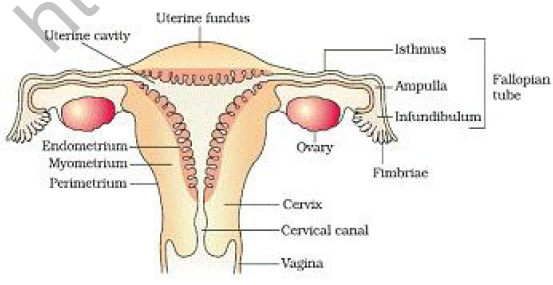
(b) Endometrium: It is the innermost layer of uterus responsible for nutrition and development of the foetus. It undergoes cyclic changes during menstrual cycle. Implantation of blastocyst takes place on the endometrium.
(c) Acrosome: It contains hydrolytic enzymes that help in dissolving membranes of the ovum for fertilisation.
(d) Sperm tail: It helps in the sperm movement in the female genital tract for fertilisation.
(e) Fimbriae: It is present at the opening of oviduct which helps in the collection of the eggs after ovulation.
Please click on below link to download CBSE Class 12 Biology Human Reproduction Worksheet Set H
Free study material for Biology
Chapter 02 Human Reproduction Practice Sheet and Solutions for Class 12 Biology
Download Practice Sheet: Chapter 02 Human Reproduction (Class 12 Biology)
Explore reliable practice questions for Chapter 02 Human Reproduction tailored for Class 12 Biology learners. Use these structured worksheets to evaluate preparedness and strengthen problem-solving skills.
Concept Clarification for Chapter 02 Human Reproduction
Built using the official NCERT book for Class 12 Biology, these practice materials provide reliable academic guidance. Pair your practice with our recommended NCERT solutions to master optimal problem-solving approaches.
Additional Study Resources for Class 12 Biology
Explore our broader library of printable assignments, chapter notes, and mock tests designed to support continuous revision and secure higher marks in CBSE assessments.
FAQs
You can download the teacher-verified PDF for CBSE Class 12 Biology Human Reproduction Worksheet Set 08 from StudiesToday.com. These practice sheets for Class 12 Biology are designed as per the latest CBSE academic session.
Yes, our CBSE Class 12 Biology Human Reproduction Worksheet Set 08 includes a variety of questions like Case-based studies, Assertion-Reasoning, and MCQs as per the 50% competency-based weightage in the latest curriculum for Class 12.
Yes, we have provided detailed solutions for CBSE Class 12 Biology Human Reproduction Worksheet Set 08 to help Class 12 and follow the official CBSE marking scheme.
Daily practice with these Biology worksheets helps in identifying understanding gaps. It also improves question solving speed and ensures that Class 12 students get more marks in CBSE exams.
All our Class 12 Biology practice test papers and worksheets are available for free download in mobile-friendly PDF format. You can access CBSE Class 12 Biology Human Reproduction Worksheet Set 08 without any registration.