

Practice Worksheets for Class 12 Biology: Chapter 02 Human Reproduction
Explore reliable practice materials for Chapter 02 Human Reproduction tailored for Class 12 learners. Utilizing these Biology worksheets ensures thorough preparation and strengthens problem-solving speed for upcoming school assessments.
Practice Chapter 02 Human Reproduction Worksheets for Class 12 Biology
Navigate directly to the printable exercises for Chapter 02 Human Reproduction using the digital viewer below. Each practice set allows students to isolate specific topics for thorough review and uninterrupted practice alongside standard textbooks.
Very Short Answer Questions
Question. List the changes that the primary ooctye undergoes in the tertiary follicular stage in the human ovary.
Answer. The primary oocyte within the tertiary follicle grows in size and completes its first meiotic division to form secondary oocyte and first polar body.
Question. Female reproductive organs and associated functions are given below in column A and B. Fill in the blank boxes.

Answer. A—Fertilisation
Question. Name the embryonic stage that gets implanted in the uterine wall of a human female.
Answer. Blastocyst/blastula.
Question. Males in whom testes fail to descend to the scrotum are generally infertile. Why?
Answer. If the testes fail to descend to the scrotum, gametogenesis could be inhibited. The process of spermatogenesis requires a marginally lesser (2°C less) ambient temperature than that in the abdominal cavity.
Question. What is menstrual cycle? Which hormones regulate menstrual cycle?
Answer. The reproductive cycle in the female primates is called menstrual cycle. The uterus lining becomes thick and spongy to receive fertilised egg. If the egg is not fertilised this lining is not needed any longer so, it slowly breaks and comes out through vagina as along with blood and mucous and is called menstruation.
Menstrual cycle is regulated by FSH (Follicle stimulating hormone), LH (Lutenising hormone),estrogen and progesterone.
Question. What is oogenesis? Give a brief account of oogenesis.
Answer. Oogenesis
• The process of formation of a mature female gamete is called oogenesis. It occurs in the ovaries.
It consists of the following three phases:
(a) Multiplication phase: Oogenesis is initiated during the embryonic development stage when
a couple of million gamete mother cells (oogonia) are formed within each foetal ovary. No more oogonia are formed and added after birth. These cells start division and enter into prophase-I of the meiotic division. They get temporarily arrested at this stage and are called primary oocytes.
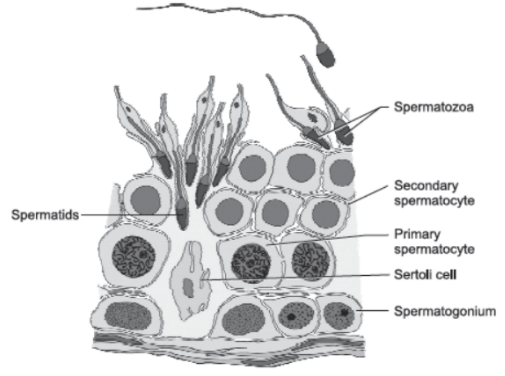
Question. Describe the structure of a seminiferous tubule.
Answer. A seminiferous tubule is made up of layer of male germ cells and large Sertoli cells (nurse cells). The male germ cells undergo spermatogenesis to produce spermatocytes, spermatids and sperms. The regions outside the seminiferous tubules called interstitial spaces have connective tissue which includes blood vessels and Leydig cells (interstitial cells). Leydig cells synthesise and secrete the male sex hormones called androgens, of which testosterone is the principle one.
For diagram,
Question. How is the entry of only one sperm and not many ensured into an ovum during fertilisation in humans?
Answer. During fertilisation a sperm head comes in contact with zona pellucida layer of ovum and induces changes in the membrane that block the entry of additional sperms.
Short Answer Questions
Question. Explain the events that follow up to fertilisation when the sperms come in contact with the ovum in the fallopian tube of a human female.
Answer. The secretion of the acrosome help the sperm enter into the cytoplasm of ovum through zona pellucida and the plasma membrane. This induce the completion of second meiotic division of the secondary oocyte, forming second polar body and a haploid ovum. Soon the haploid nucleus of the sperm and that of the ovum fuse together to form a diploid zygote.
Question. When and where do chorionic villi appear in humans? State their functions.
Answer. Chorionic villi appear after implantation on the trophoblast. It becomes interdigitated with uterine tissue to form the placenta and increases the surface area for exchange of materials between the mother and the embryo.
Question. Name two hormones that can be found only in the blood of a pregnant woman. Mention the source organ/tissue that secretes each of them.
Answer. Human chorionic gonadotropin (hCG)—Placenta.
Human placental lactogen (hPL)—Placenta.
Relaxin (towards the end of pregnancy)—Ovary.
Question. Mention the target cells of luteinising hormone in human males and females. Explain the effect and the changes which the hormone induces in each case.
Answer. The target cells of luteinising hormone (LH) in males are the Leydig cells and in females are the mature growing follicles.
LH in males stimulates the Leydig cells (interstitial cells) of testes to synthesise and secrete androgens which in turn stimulate the process of spermatogenesis. LH in females stimulate the ovulation (release of ovum) and transformation of Graafian follicle into corpus luteum to secrete progesterone which prepares the endometrium to receive and implant blastocyst.
Question. State the role of oxytocin in parturition. What triggers its release from the pituitary?
Answer. Oxytocin acts on uterine muscle and cause stronger uterine contraction. This leads to expulsion of the foetus or baby out of uterus.
Question. Write the effect of the high concentration of LH on a mature Graafian follicle.
Answer. In high conventration of LH, the mature Graafian follicle ruptures to release the secondary oocyte or ovum from the ovary by the process of ovulation.
Question. After implantation interdigitation of maternal and foetal tissues takes place. Identify the tissues involved and justify their role.
Answer. After implantation interdigitation of maternal and foetal tissues results in formation of structural and functional unit between embryo and maternal body called placenta.
It facilitates supply of oxygen and nutrients to the embryo, removal of carbon dioxide and excretory material and also acts as an endocrine tissue and produces hormones like HCG, hPL, estrogen, progesterone and relaxin.
Question. Draw a labelled diagram of a human blastocyst. How does it get implanted in the uterus?
Answer. Human blastocyst
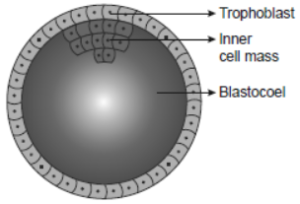
The trophoblast layer of the blastocyst gets attached to the cells of the endometrium and the inner cell mass gives rise to the embryo. The cells of endometrium divide rapidly and cover the blastocyst. So, the blastocyst gets embedded in the endometrium of the uterus.
Please click on below link to download CBSE Class 12 Biology Human Reproduction Worksheet Set F
Free study material for Biology
Exam Preparation Worksheet for Class 12 Biology Chapter 02 Human Reproduction
Chapter Practice Questions for Class 12 Biology
Review targeted practice exercises for Class 12 Biology Chapter 02 Human Reproduction. Curated to match official CBSE guidelines, these downloadable PDF sheets support daily revision and core concept reinforcement.
Expert Practice Material for Class 12 Biology
Built using the official NCERT book for Class 12 Biology, these practice materials provide reliable academic guidance. Pair your practice with our recommended NCERT solutions to master optimal problem-solving approaches.
Complete Your Chapter Revision
Wrap up your chapter revision by testing your knowledge against standard question formats. Everything on our platform is provided free of charge.
FAQs
You can download the teacher-verified PDF for CBSE Class 12 Biology Human Reproduction Worksheet Set 06 from StudiesToday.com. These practice sheets for Class 12 Biology are designed as per the latest CBSE academic session.
Yes, our CBSE Class 12 Biology Human Reproduction Worksheet Set 06 includes a variety of questions like Case-based studies, Assertion-Reasoning, and MCQs as per the 50% competency-based weightage in the latest curriculum for Class 12.
Yes, we have provided detailed solutions for CBSE Class 12 Biology Human Reproduction Worksheet Set 06 to help Class 12 and follow the official CBSE marking scheme.
Daily practice with these Biology worksheets helps in identifying understanding gaps. It also improves question solving speed and ensures that Class 12 students get more marks in CBSE exams.
All our Class 12 Biology practice test papers and worksheets are available for free download in mobile-friendly PDF format. You can access CBSE Class 12 Biology Human Reproduction Worksheet Set 06 without any registration.