

Practice Worksheets for Class 12 Biology: Chapter 01 Reproduction in Organisms
Review targeted practice sets for Class 12 Biology Chapter 01 Reproduction in Organisms. Built according to official educational guidelines for the 2026-27 academic year, these downloadable worksheets support daily revision and core concept reinforcement.
Practice Chapter 01 Reproduction in Organisms Worksheets for Class 12 Biology
Navigate directly to the printable exercises for Chapter 01 Reproduction in Organisms using the digital viewer below. Each practice set allows students to isolate specific topics for thorough review and uninterrupted practice alongside standard textbooks.


Very Short Answer Questions
Question. Why is banana considered a good example of parthenocarpy?
Answer. In banana, formation of fruit occurs without fertilisation, and thus there is no formation of seeds.
So, it is considered a good example of parthenocarpy.
Question. Name an organism where cell division is itself a mode of reproduction.
Answer. Protists/Monerans/Amoeba/Paramecium (any unicellular organism).
Question. Cucurbits and papaya plants bear staminate and pistillate flowers. Mention the categories they are put under separately on the basis of the type of flowers they bear.
Answer. Cucurbit is a monoecious plant having staminate and pistillate flowers on the same plant. Papaya has staminate and pistillate flowers on separate plants and hence it is dioecious.
Question. Name two animals that exhibit oestrus cycle.
Answer. Cow, sheep and rat (Any two).
Question. Examine a few flowers of any Cucurbit plant and try to identify the staminate and pistillate flowers. Do you know any other plant that bears unisexual flowers?
Answer. A staminate or male flower has only stamens and no carpel. A pistillate flower has only carpel and no stamens. Plants that bear unisexual flowers are papaya and date palm.
Question. Rearrange the following events of sexual reproduction in the sequence in which they occur in a flowering plant: embryogenesis, fertilisation, gametogenesis, pollination.
Answer. Gametogenesis, pollination, fertilisation, embryogenesis.
Short Answer Questions
Question. (a) State the difference between meiocyte and gamete with respect to chromosome number.
(b) Why is a whiptail lizard referred to as parthenogenetic?
Answer. (a) Meiocytes contain diploid sets of chromosomes whereas gametes contain haploid sets of chromosomes.
(b) Whiptail lizard reproduces without fertilisation, i.e., an unfertilised egg develops into a new individual. Therefore, they are referred to as parthenogenetic.
Question. Angiosperms bearing unisexual flowers are said to be either monoecious or dioecious. Explain with the help of one example each.
Answer. In some flowering plants, both male and female flowers may be present on the same individual (monoecious) or on separate individuals (dioecious). Some examples of onoecious plants areCucurbits and coconuts and of dioecious plants are papaya and date palm.
Question. Why do algae and fungi shift to sexual mode of reproduction just before the onset of adverse conditions?
Answer. Algae and fungi shift to sexual mode of reproduction for survival during unfavourable conditions.
Fusion of gametes helps to pool their resources for survival. The zygote develops a thick wall that is resistant to dessication and damage which undergoes a period of rest before germination.
Question. A list of three flowering plants is given below. Which ones out of them are (i) monoecious and (ii) bearing pistillate flowers?
List: Date palm, Cucurbits and Pea.
Answer. (i) Monoecious plant—Cucurbits
(ii) Bearing pistillate flowers—Date palm, Cucurbits.
Question. If the chromosome numbers in meiocytes of human beings, rat, elephant, rice, butterfly and onion are 46, 42, 56, 24, 380 and 32, respectively. What will be the chromosome numbers in gametes of these species?
Answer. The chromosome numbers in the gametes of these species will be Human beings = 23, rat = 21, elephant = 28, rice = 12, butterfly = 190 and onion = 16.
Question. Zygote forms the major link between one generation and those of the next generation organism. What is the fate of zygote in organisms which show:
(i) haplontic life cycle and (ii) diplontic life cycle?
Answer. (i) Zygote of haplontic life cycle divides meiotically to form new organisms.
(ii) Zygote of diplontic life cycle divides mitotically during embryogenesis to form embryo and then individual.
Question. The cell division involved in gamete formation is not of the same type in different organisms. Justify.
Answer. The parents may be haploid or diploid but the gametes always have to be haploid. Diploid parents undergo meiosis to produce haploid gametes, whereas haploid parents undergo mitosis to produce haploid gametes.
Long Answer Questions
Question.
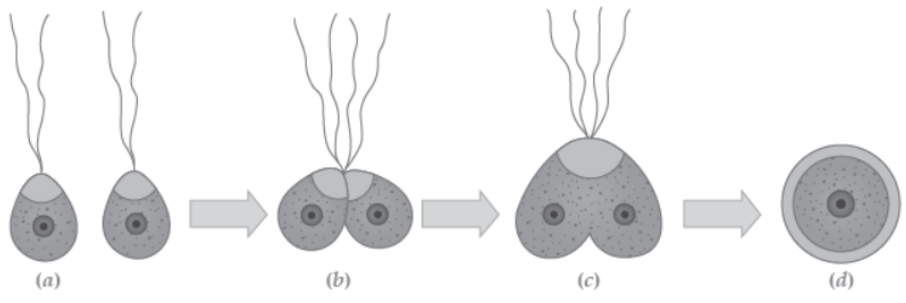
(i) State the type of gametes shown in the diagram. (Image)
(ii) Identify the process taking place and the resultant structure.
(iii) Name an organism that reproduces in this manner.
(iv) Label (c) and (d).
Question. Differentiate between (a) oestrus and menstrual cycles; (b) ovipary and vivipary. Cite an example for each type.
Answer.

Question. Define (i) Juvenile phase, (ii) Reproductive phase, (iii) Senescent phase.
Answer. (i) Juvenile phase: It is the pre-reproductive phase in which all organisms require a certain growth and maturity in the life before reproducing sexually.
(ii) Reproductive phase is the phase in the life cycle, where an organism possess all the capacity and potential to reproduce sexually. It is the end of juvenile phase or vegetative phase.
(iii) Senescent phase is the post-reproductive phase in the life cycle where an organism slowly loses the rate of metabolism, reproductive potential and shows deterioration of the
physiological activity of the body.
Please click on below link to download CBSE Class 12 Biology Reproduction In Organisms Worksheet Set B
Free study material for Biology
Exam Preparation Worksheet for Class 12 Biology Chapter 01 Reproduction in Organisms
Chapter 01 Reproduction in Organisms Printable Worksheet for Class 12 Biology
Explore reliable practice questions for Chapter 01 Reproduction in Organisms tailored for Class 12 Biology learners. Use these structured worksheets to evaluate preparedness and strengthen problem-solving skills.
How to Use These Practice Sheets
Each worksheet is structured around standard CBSE textbooks, allowing students to check their working steps and correct mistakes early in their revision.
Enhance Speed with Online Practice
Wrap up your chapter revision by testing your knowledge against standard question formats. Everything on our platform is provided free of charge.
FAQs
You can download the teacher-verified PDF for CBSE Class 12 Biology Reproduction In Organisms Worksheet Set 04 from StudiesToday.com. These practice sheets for Class 12 Biology are designed as per the latest CBSE academic session.
Yes, our CBSE Class 12 Biology Reproduction In Organisms Worksheet Set 04 includes a variety of questions like Case-based studies, Assertion-Reasoning, and MCQs as per the 50% competency-based weightage in the latest curriculum for Class 12.
Yes, we have provided detailed solutions for CBSE Class 12 Biology Reproduction In Organisms Worksheet Set 04 to help Class 12 and follow the official CBSE marking scheme.
Daily practice with these Biology worksheets helps in identifying understanding gaps. It also improves question solving speed and ensures that Class 12 students get more marks in CBSE exams.
All our Class 12 Biology practice test papers and worksheets are available for free download in mobile-friendly PDF format. You can access CBSE Class 12 Biology Reproduction In Organisms Worksheet Set 04 without any registration.