

Official Class 12 Biology Worksheets: Chapter 01 Sexual Reproduction In Flowering Plants
Access printable practice worksheets for Chapter 01 Sexual Reproduction In Flowering Plants designed to align with the 2026-27 academic syllabus for Class 12 Biology. These structured exercises help students evaluate their conceptual understanding and improve exam readiness.
Chapter-wise Practice Material: Chapter 01 Sexual Reproduction In Flowering Plants
Access the complete worksheet PDF for Chapter 01 Sexual Reproduction In Flowering Plants below. Regular practice with these targeted questions builds familiarity with standard exam patterns and helps secure higher marks in final Biology evaluations.
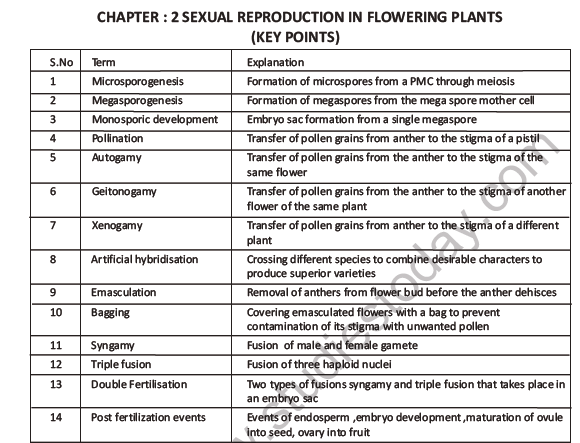
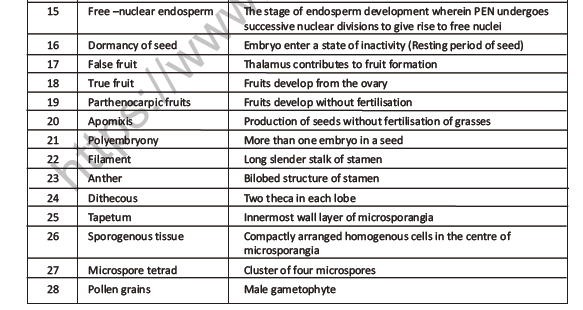
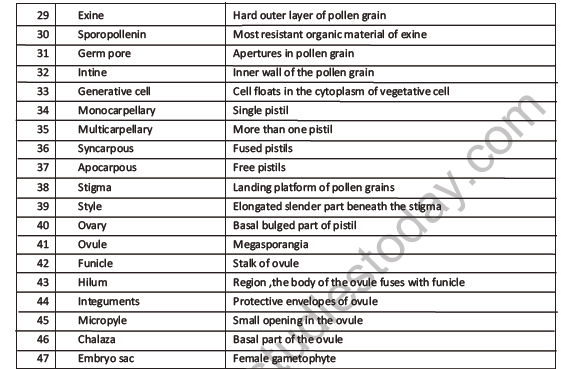
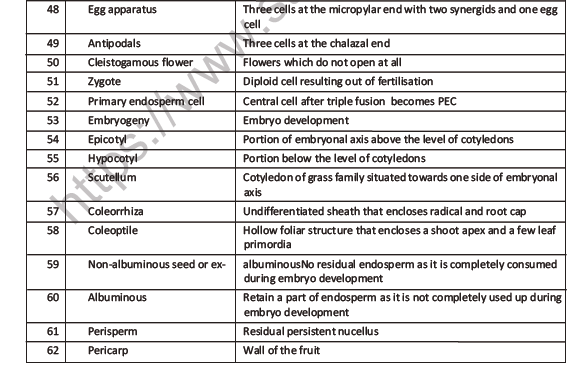
Very Short Answer Questions
Question. What is an anatropous ovule?
Answer It is an ovule that is completely inverted through 180° such that the micropyle comes close to the base of the funiculus and nucellus remains straight.
Question. Papaver and Michelia both have multicarpellary ovaries. How do they differ from each other?
Answer Papaver has syncarpous gynoecium whereas Michelia has apocarpous gynoecium.
Question. An anther with malfunctioning tapetum often fails to produce viable male gametophytes.
Give any one reason.
Answer A malfunctioning tapetum does not provide enough nourishment to the developing male gametophytes and thus fail to produce viable male gametophytes.
Question. How many microspore mother cells would be required to produce one hundred pollen grains in a pollen sac? And why?
Answer 1 microspore mother cell undergoes meiosis to form 4 pollen grains. In order to produce 100 pollen grains, 25 microspore mother cells must undergo meiosis.
Question. What is pollen–pistil interaction and how is it mediated?
Answer The ability of the pistil to recognise the pollen followed by its acceptance or rejection is called pollen–pistil interaction. It is mediated by chemical components of pollen interacting with those of pistil.
Question. Name the type of pollination in self-incompatible plants.
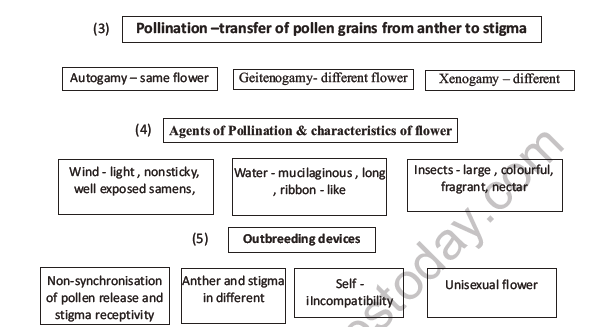
Answer Xenogamy.
Question. In maximum angiosperms pollen grains are shed at the two-celled stage. Name the 2 cells.
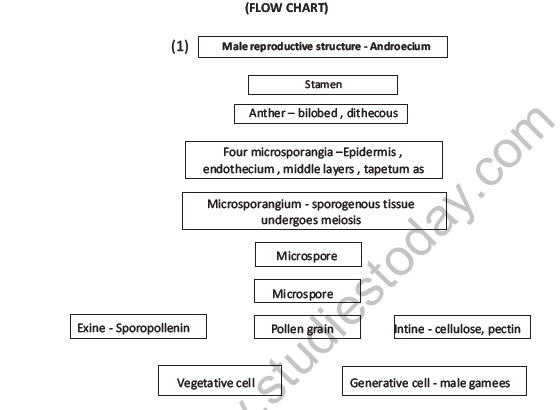
Answer Vegetative cell and generative cell are the two-celled stage in which pollen grains are shed.
Question. Name the component cells of the ‘egg apparatus’ in an embryo sac.
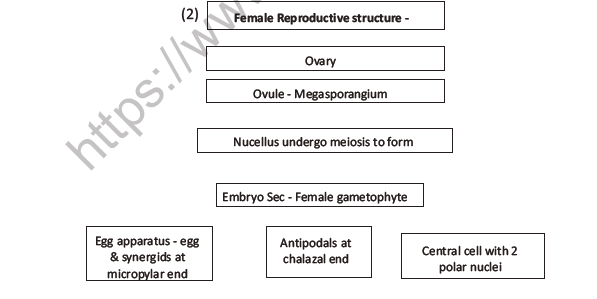
Answer Two synergids and an egg.
Question. Mention any two characteristics of pollen grains of plants such as maize and Cannabis.
Answer (i) Pollen grains are small, dry and light in weight, non-sticky.
(ii) Pollen are produced in large numbers.
Short Answer Questions
Question. Write briefly the role of pollination in the growth and development in an angiosperm.
Answer. Pollination is transfer of pollen grains from anthers to the stigma of a flower. Pollination is prerequisite for fertilisation, events after fertilisation like endosperm development, seed setting and fruit formation. Thus, pollination plays an important role in the growth and development of angiosperms.
Question. A pollen grain in angiosperm at the time of dehiscence from an anther could be 2-celled or 3-celled. Explain. How are the cells placed within the pollen grain when shed at a 2-celled stage?
Answer. In 2-celled stage the mature pollen grain contains one generative and vegetative cells, whereas in 3-celled stage one vegetative cell and two male gamete cells are present.
The generative cell being small floats in the cytoplasm of the vegetative cell. The pollen grains are shed at this 2-celled stage.
Question. State one advantage and one disadvantage of cleistogamy.
Answer. Advantage: Self-pollination is assured/Seed production is assured.
Disadvantage: Least variations observed/Leads to inbreeding depression.
Question. Name the product of fertilisation that forms the kernel of coconut. How does the kernel differ from coconut water?
Answer. Endosperm forms the kernel of coconut.
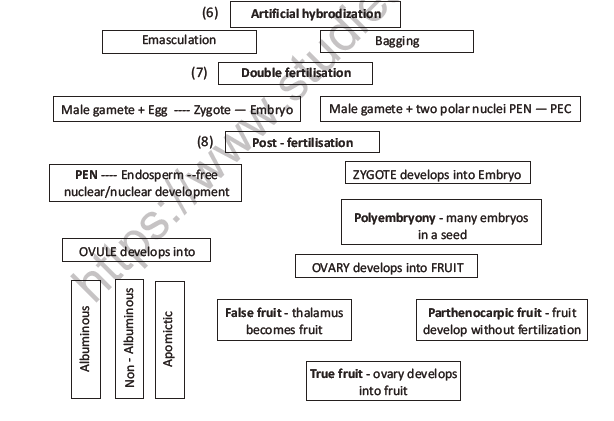
The coconut water is free-nuclear endosperm whereas kernel is cellular endosperm.
Question. Why does the zygote begin to divide only after the division of primary endosperm cell?
Answer. The zygote needs nourishment during its development. As the mature, fertilised embryo sac offers very little nourishment to the zygote, the primary endosperm cell (PEC) divides and generates the endosperm tissue which nourishes the zygote. Hence, the zygote always divides after division of PEC.
Question. Given alongside is an enlarged view of one microsporangium of a mature anther.
(i) Name ‘a’, ‘b’ and ‘c’ wall layers.
(ii) Mention the characteristics and function of the cells forming wall layer ‘c’.
Answer. (i) a = Endothecium, b = Middle layers, c = Tapetum
(ii) Tapetum provides nourishment to the developing pollen grains. The tapetal cells also secrete Ubisch granules that provide sporopollenin and other materials for exine formation.
Question. List the post-fertilisation events in angiosperms.
Answer. (i) Development of endosperm
(ii) Embryogeny/development of embryo
(iii) Seed formation
(iv) Fruit formation
Question. Mention the function of each of the following:
(a) Tassels of corn cob.
(b) Tapetum in the microsporangium.
Answer. (a) These are the stigma and style which wave in the wind to trap pollen grains.
(b) Provides nourishment to the developing pollen grains.
Question. What is cleistogamy? Write one advantage and one disadvantage of it, to the plant.
Answer. Pollination occurring in closed flowers is referred to as cleistogamy.
Advantage: It ensures self-pollination and assured seed set formation Disadvantage: It does not allow cross-pollination. This can cause inbreeding depression as there
will be no genetic variation.
Question. (a) List any two characteristic features of wheat flowers that make it a good example of wind pollination.
(b) It is observed that plant breeders carrying out wheat hybridisation often take pollen grains from the ‘pollen banks’. Do you agree ? Give one reason in support of your answer.
Answer. (a) Light pollen grains/Pollen grains more in number/well exposed stamen/feathery and sticky stigma/Numerous flowers are packed into an inflo rescence. A(ny two)
(b) Yes.
Viability of wheat pollen grain is only 30 minutes and so it is stored in pollen bank for a long period of time for later use.
Question. Describe the development of endosperm after double fertilization in an angiosperm. Why does endosperm development proceeds that of zygote?
Answer. Refer to Basic Concepts Point 9 (Endosperm Development).
Cells of the endosperm provide nutrition to the developimh embryo.
Question. Draw a vertical section of a maize grain and label (i) pericarp, (ii) scutellum, (iii) coleoptile and
(iv) radicle.
Answer. Refer to Fig. 2.15(d).
Question. Mention the ploidy of the different types of cells present in the female gametophyte of an angiosperm.
Answer.
| Cells in female gametophyte | Their ploidy |
| 1. Synergids | Haploid |
| 2. Egg | Haploid |
| 3. Polar nuclei | Haploid |
| 4. Antipodals | Haploid |
| 5. Central cell | 2 haploid nuclei |
Please click on below link to download CBSE Class 12 Biology Sexual Reproduction In Flowering Plants Worksheet Set F
Free study material for Biology
Download CBSE Practice Material: Class 12 Biology Chapter 01 Sexual Reproduction In Flowering Plants
CBSE Practice Material: Class 12 Biology Chapter 01 Sexual Reproduction In Flowering Plants
Review targeted practice exercises for Class 12 Biology Chapter 01 Sexual Reproduction In Flowering Plants. Curated to match official CBSE guidelines, these downloadable PDF sheets support daily revision and core concept reinforcement.
NCERT-Aligned Questions and Solutions
Cross-reference your completed exercises with comprehensive NCERT solutions for Class 12 Biology to ensure absolute clarity across all sub-topics in this chapter.
Next Steps in Your Exam Preparation
Follow up your worksheet practice by attempting the interactive online Biology MCQ test for this chapter to evaluate your execution speed. All platform resources are free to access.
FAQs
You can download the teacher-verified PDF for CBSE Class 12 Biology Sexual Reproduction In Flowering Plants Worksheet Set 06 from StudiesToday.com. These practice sheets for Class 12 Biology are designed as per the latest CBSE academic session.
Yes, our CBSE Class 12 Biology Sexual Reproduction In Flowering Plants Worksheet Set 06 includes a variety of questions like Case-based studies, Assertion-Reasoning, and MCQs as per the 50% competency-based weightage in the latest curriculum for Class 12.
Yes, we have provided detailed solutions for CBSE Class 12 Biology Sexual Reproduction In Flowering Plants Worksheet Set 06 to help Class 12 and follow the official CBSE marking scheme.
Daily practice with these Biology worksheets helps in identifying understanding gaps. It also improves question solving speed and ensures that Class 12 students get more marks in CBSE exams.
All our Class 12 Biology practice test papers and worksheets are available for free download in mobile-friendly PDF format. You can access CBSE Class 12 Biology Sexual Reproduction In Flowering Plants Worksheet Set 06 without any registration.