

Official Class 12 Biology Worksheets: Chapter 10 Biotechnology and Its Application
Access printable practice worksheets for Chapter 10 Biotechnology and Its Application designed to align with the 2026-27 academic syllabus for Class 12 Biology. These structured exercises help students evaluate their conceptual understanding and improve exam readiness.
Chapter-wise Practice Material: Chapter 10 Biotechnology and Its Application
Navigate directly to the printable exercises for Chapter 10 Biotechnology and Its Application using the digital viewer below. Each practice set allows students to isolate specific topics for thorough review and uninterrupted practice alongside standard textbooks.
Question. RNA interference involves
(a) Synthesis of cDNA and RNA using reverse transcriptase
(b) Silencing of specific mRNA due to complementary RNA
(c) Interference of RNA in synthesis of DNA
(d) Synthesis of mRNA from DNA
Answer: B
Question. Children with Severe Combined Immunodeficiency Disorder(SCID) cannot produce the many types of white blood cells that fight infections. This is because they do not have the functional gene to make the enzyme Adenosine Deaminase (ADA). Some children with SCID have been treated with stem cells as shown in the given flow chart.
Why stem cells are used in this treatment?
(a) Stem cells are capable of dividing for long periods to generate replacements for cells that are unable to produce ADA.
(b) The stem cells used here belong to the child and there will be no triggering immune response
(c) Stem cells are unspecialized and can differentiate to specialized cell types such as white blood cells to fight infection
(d) All of these
Answer: D
Question. Genetic engineering has been successfully used for producing
(a) Transgenic models for studying new treatments for certain disease
(b) Transgenic mice for testing safety of polio vaccine before use in humans
(c) Animals like bulls for farm work as they have super power
(d) Transgenic cow Rosie which produces high fat milk for making ghee
Answer: B
Question. Bacillus thuringiensis forms protein crystals which contain insecticidal protein. This protein:-
(a) Binds with epithelial cells of mid gut of the insect pest ultimately killing it
(b) Is coded by several genes including the gene cry
(c) Is activated by the acid pH of the foregut of the insect pest
(d) Does not kill the carrier bacterium which is itself resistant to this toxin
Answer: A
Question. The illegal and unlawful development of biomaterials without payment to the inhabitants of their origin is called
(a) bio patent
(b) bio war
(c) bio piracy
(d) biotechnology
Answer: C
Question. The proteins encoded by the genes cryIAc and cryIIAb control
(a) Cotton bollworms
(b) Corn borer
(c) Budworms
(d) Butterflies
Answer: A
Question. Given figure represents the maturation of pro-insulin into insulin. Identify the product A.
(a) polypeptide cghain A
(b) polypeptide chain B
(c) polypeptide chain C
(d) pro-hormone
Answer: C
Question. Golden rice is a genetically modified crop plant where the incorporated gene is meant for biosynthesis of
(a) vitamin E
(b) vitamin K
(c) vitamin D
(d) vitamin A
Answer: D
Question. Human insulin is being commercially produced from a transgenic species of
(a) Rhizobium
(b) Saccharomyces
(c) Escherichia
(d) Agrobacterium
Answer: C
Question. What is the source of Ti (Tumor inducing) plasmid which is modified and used as a cloning vector to deliver the desirable genes into plant cells?
(a) Bacillus thuringiensis
(b) Meloidogyne incognita
(c) Thermus aquaticus
(d) Agrobacterium tumefaciens
Answer: D
Assertion Reason Type Questions:
(a) Both assertion and reason are true, and reason is the correct explanation of assertion
(b) Both assertion and reason are true, but reason is not the correct explanation of assertion
(c) Assertion is true, reason is false
(d) Assertion is false, reason is true
Question. Assertion: Organisations like GEAC are necessary to monitor GM researches and test the safety of introducing GM organisms for public services.
Reason: GM researches can have unpredictable results which can be disastrous when genetically modified organisms are introduced into the ecosystem.
Answer: A
Question. Assertion: To cure ADA deficiency, erythrocytes from the blood of the patient are grown in a culture outside the body.
Reason: A functional ADA cDNA (using a retroviral vector) is then introduced into these lymphocytes, which are subsequently returned to the patient.
Answer: D
Question. Assertion: Biopiracy is the practice of commercially exploiting naturally occurring biochemical or genetic material especially by obtaining patents that restricts its future use while failing to pay fair compensation to the community from which it originates.
Reason: US patented turmeric and neem which ios a case of biopiracy.
Answer: B
Question. Assertion: Transgenic animals are used to study the physiology and development of an organism.
Reason: Transgenic animals are specifically designed to allow the study of regulation of genes.
Answer: A
Question. Assertion: A novel strategy was adopted to prevent nematode infestation which was based on the process of RNA interference (RNAi).
Reason: RNAi takes place in all prokaryotic organisms as a method of cellular defense.
Answer: C
Very Short Answer Questions
Question. State a method of cellular defence which works in all eukaryotic organisms.
Answer. RNA interference.
Question. Can you suggest a method to remove oil (hydrocarbon) from seeds based on your understanding of rDNA technology and chemistry of oil?
Answer. To remove oil from seeds, the genes responsible for formation of glycerol or fatty acids need to be identified and removed by using restriction endonucleases. The restricted DNA of the seed then needs to be ligated using the enzyme ligase and allowed to grow in nutrient media under aseptic condition.
Question. Name the first transgenic cow. Which gene was introduced in this cow?
Answer. Rosie was the first transgenic cow. Human α-lactalbumin gene was introduced.
Question. A multinational company outside India tried to sell new varieties of turmeric without proper rights. What is such an act referred to?
Answer. Biopiracy.
Question. What was the speciality of the milk produced by the transgenic cow Rosie?
Answer. The first transgenic cow, Rosie, produced milk with human alpha-lactalbumin (2.4 g protein/litre of milk) which was nutritionally, more balanced product for human babies than natural cow milk.
Question. Mention the chemical change that proinsulin undergoes, to be able to act as mature insulin.
Answer. An extra stretch called C-peptide is removed from pro-insulin during maturation.
Question. What is Chakravarthy bug? Give its scientific name and its application?
Answer. Chakravarthy bug is a super bug of Pseudomonas with multiple plasmids. They are helpful in removing oil spills.
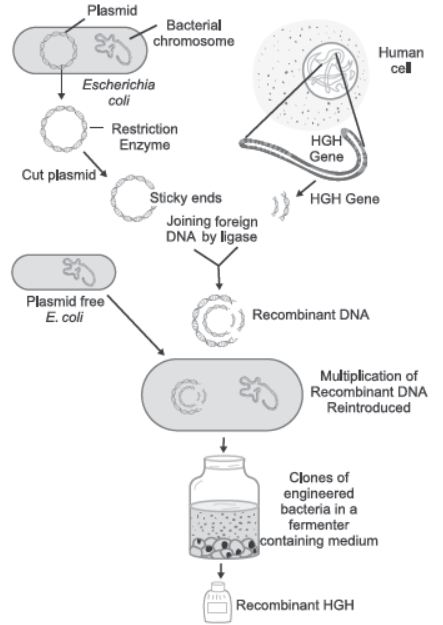
Question. Diagrammatically represent the experimental steps in cloning and expressing a human gene (say the gene for growth hormone) into bacterium like E. coli.
Answer. It is possible to produce HGH (human growth hormone) by recombinant DNA technology. This is represented diagrammatically as follows:
Short Answer Questions
Question. (i) Mention the cause and the body system affected by ADA deficiency in humans.
(ii) Name the vector used for transferring ADA-DNA into the recipient cells in humans. Name the recipient cells.
Answer: (i) ADA is caused due to deletion of gene for adenosine deaminase. Immune system of the body is affected due to this.
(ii) Retroviral vector is used to transfer ADA-DNA into the recipient cells of human.
Recipient cells are the lymphocytes.
Question. Why is Agrobacterium mediated genetic transformation described as natural genetic engineering in plants?
Answer: Agrobacterium tumefaciens, a natural pathogen of several dicot plants is able to deliver a piece of DNA known as ―t – DNA‖ to transform normal plant cell into a tumor & direct gene transfer transform tumor cells to produce chemicals required by pathogen. The tumor inducing (Ti) plasmid of Agrobacterium tumefaciens has now been modified into a cloning vector which is no more pathogenic to plant but is still able to use the mechanism to deliver gene of our interest into a variety of plants. Since Agrobacterium tumefaciens has the natural ability to donate a part of its DNA to the plant during infection, this property of Agrobacterium is exploited and a gene of interest is ligated into T-DNA so that it automatically gets transformed into plant cell thus, Agrobacterium tumefaciens is known as ―Natural Genetic Engineer‖ of plants.
Question. Why is pro insulin so called? How is insulin different from it?
Answer: Proinsulin contains an extra stretch called C-peptide that needs to be removed to become fully mature insulin, therefore it is called proinsulin (prohormone). The mature functional insulin contains only A and Bpeptide chain.
Question. GEAC is one of the organisation set up by Indian Government. Write its full form. Give its two objectives.
Answer: GEAC – Genetic Engineering Approval Committee. Objectives of GEAC as below:(i) To make decisions regarding validity of GM research.
(ii) Safety of introducing GMO for public use.
Question. Name the host plant and its part that Meloidogyne incognita infects. Explain the role of Agrobacterium in the production of dsRNA in the host plant.
Answer: The nematode Meloidogyne incognita infects the roots of tobacco plants.
The Agrobacterium are used as vectors carrying nematode specific genes to be introduced in host plant.
These genes when expressed inside host plant produces sense and anti-sense RNA strands, complementary to nematode‘s functional mRNA. This binding results in formation of double stranded RNA and inhibiting or silencing the translation of RNA specified. This process is called RNA interference.
Question. What do you mean by biopiracy ? Give an example.
Answer: Biopiracy refers to the use of bioresources by multinational companies and other organizations without proper authorizations from the countries and people concerned. For example, Basmati rice grown in India is distinct for its unique flavor and aroma but an American company got patent rights on Basmati through US patent.
Question. Name the source and the types of cry genes isolated from it for incorporation into crops by biotechnologists. Explain how have these genes brought beneficial changes in genetically modified crops.
Answer: The source is Bacillus thuringiensis. Types of cry genes are cryIAc, cry IIAb, cryIAb. The cry genes code for certain crystal proteins that have Bt toxin. Bt toxin exists as inactive protoxin and gets converted into active form (toxin) in the alkaline pH of the gut of the insect.
The activated toxin binds to the epithelial cells lining the epithelial surface of the midgut and creates pores leading to swelling and lysis of the cells and ultimately cause death of the insect. This way GM crops show resistance against insect pests.
Question. A bacterium Bacillus thuringiensis produces a toxic protein named 'cry protein‘ that is lethal to certain insects but not to bacterium
(i) Why this toxin does not kill the bacteria?
(ii) What type of changes occur in the gut of insects on consuming this protein?
(iii) How man has exploited this protein for his benefit?
Answer: (i) Produced in inactive form as prototoxin
(ii) Prototoxin becomes active toxin in alkaline pH of gut of insects. Toxins bind to surface of midgut and cause perforation, swelling, lysis of cells ultimately leading to death.
(iii) Specific Bt toxin genes isolated from Bacillus thuringiensis and incorporated into several crop plants such as cotton and corn which become pest resistant against certain insects.
Question. Compare and contrast the advantages and disadvantages of producing genetically modified organisms.
Answer: ADVANTAGES OF PRODUCING GMOs:
(i) GM crops produce desired phenotypic traits in crop plants
(ii) The genes responsible for production of specific proteins are inserted into GM crops. These crops then produce that specific protein.
(iii) Transgenic crops synthesizes new end product of specific biochemical pathway.
(iv) These crops also help in preventing expression of existing native gene.
DISADVANTAGES OF PRODUCING GMOs:
(i) Transgenic crops may endanger wild & native species.
(ii) GM crops may cause health problems by supplying allergens
(iii) GM crops may damage the natural environment.
Question. How is „ Rosie‟ considered different from a normal cow? Explain.
Answer: 3. The transgenic cow, Rosie, produced human protein-enriched milk (2.4 gm/L). It contained the human α - lactalbumin and was nutritionally more balanced product for human babies than natural cow‘s milk.
Question. How is PCR used to detect gene mutation in case of suspected cancer patient?
Answer: A single stranded small DNA or RNA is tagged with radioactive molecule to be used as a probe.
The probe is hybridised with DNA in cancer cells, to be followed by autoradiography. The clone with mutated gene will not appear in the autoradiography, because the probe will not have the complementary sequence with mutated gene.
Question. Nematode-specific genes are introduced into the tobacco plants using Agrobacterium vectors to develop resistance in tobacco plants against nematodes. Explain the events that occur in tobacco plant to develop resistance.
OR
How has RNAi technique helped to prevent the infestation of roots in tobacco plants by a nematode Meloidogyne incognita?
Answer: Pest resistant plants
• A nematode Meloidogyne incognita infects the roots of tobacco plants which reduces the production of tobacco.
• It can be prevented by using RNA interference (RNAi) process which is checked by silencing of specific mRNA due to a complementary dsRNA.
• dsRNA binds and prevents translation of the mRNA (silencing).
• The source of this dsRNA could be from an infection by viruses having RNA genomes or mobile genetic elements (transposons) which replicate through an RNA intermediate.
• By using Agrobacterium vectors, nematode-specific genes were introduced into the host plants which produce both sense and anti-sense RNA in the host cells.
• These two RNAs are complementary to each other and form a double-stranded RNA (dsRNA) that initiates RNAi and hence silence the specific mRNA of the nematode.
• The parasite cannot survive in the transgenic host, so protects the plants from pests.
Pest resistant plants.
• A nematode Meloidogyne incognita infects the roots of tobacco plants which reduces the production of tobacco.
• It can be prevented by using RNA interference (RNAi) process which is checked by silencing of specific mRNA due to a complementary dsRNA.
• dsRNA binds and prevents translation of the mRNA (silencing).
• The source of this dsRNA could be from an infection by viruses having RNA genomes or mobile genetic elements (transposons) which replicate through an RNA intermediate.
Question. How is ‘Rosie’ considered different from a normal cow? Explain.
Answer: Rosie is a transgenic cow.
Rosie produces human protein-enriched milk containing human a -lactalbumin.
Question. (a) State the role of DNA ligase in biotechnology.
(b) What happens when Meloidogyne incognita consumes cells with RNAi gene?
Answer: (a) DNA ligase joins the DNA fragments with same sticky ends. It also links Okazaki fragments or discontinuously synthesised fragments. DNA ligose is used to link desired gene with plasmid to form recombinant DNA. (Any one) (b) The specifimc RNA of the nematode is silenced and the parasite dies.
Question. Why does the Bt toxin not kill the bacterium that produces it but kills the insect that ingests it?
Answer: Bt toxin exist as inactive protoxin in the bacterium. It becomes active only when it enters the gut of insect due to the alkaline pH of the gut which solubilise the crystals.
Question. Name a genus of baculovirus. Why are they considered good biocontrol agents?
Answer: Nucleopolyhedrovirus is a genus of baculovirus.
They are species-specific, have narrow-spectrum insecticidal application and no negative impact on non-target organisms, hence they are considered good biocontrol agents.
Question. A corn farmer has perennial problem of corn-borer infestation in his crop. Being environmentally conscious he does not want to spray insectisides. Suggest solution based on your knowledge of biotechnology. Write the steps to be carried out to achieve it.
Answer: The following steps should be followed:
(i) Isolation of Bt toxin genes from Bacillus thuringiensis.
(ii) Incorporation of gene into corn.
(iii) Toxin coded by gene cryIAb in corn, kills the pests and the pest dies.
Question. Find out from internet what is golden rice.
Answer: Golden rice is a genetically modified rice that contains b-carotene (provitamin A). This provitamin A is converted into vitamin A inside the body and gives the rice grain its characteristic golden colour. It produces two new enzymes that completes the b-carotene expression in the grain. It is intended to complement current strategies in the fight against vitamin A deficiency.
Question. Explain the process of RNA interference.
Answer: RNA interference takes place in all eukaryotic organisms as a method of cellular defence. It
involves silencing of a specific mRNA due to complementary dsRNA molecule that binds to and prevents translation of the mRNA.
Question. (a) Given below is a single stranded DNA molecule. Frame and label its sense and antisense RNA molecule. 5′ ATGGGGCTC 3′
(b) How the RNA molecules made from above DNA strand help in silencing of the specific RNA molecules?
Answer: (a) 5′ ATGGGGCTC 3′ sense
3′ TACCCCGAG 5′ antisense
5′AUGGGGCUC 3′ sense
3′UACCCCGAG 5′ antisense
(b) The two strands of RNA (i.e., sense and antisense) being complementary will bind with each other and form double stranded RNA as a result its translation and protein expression would be inhibited.
Long Answer Type Questions:
Question. (i) Name the insect that attacks cotton crops and causes lot of damage to the crop. How have Bt cotton plants overcome this problem? Explain.
(ii) Write the role of gene cry I Ab.
Answer: (i) Cotton bollworm larvae that attacks cotton crops. Bt cotton plants are GMO containing active cry gene from Bacillus thuringiensis which form protein crystals during a particular phase of their growth. These crystals contain toxic insecticidal protein which is present in inactive form, but becomes active toxin in the alkaline pH of the insect gut. The activated toxin binds to the midgut epithelial cells and creates pores that cause cell swelling and lysis and eventually cause the death of the insect. Most Bt toxin genes are insect
specific, and the toxin is coded by a gene named cry.
(ii) The protein coded by cryIAb controls corn borer.
Question. (i) Name the source from which insulin was extracted earlier. Why this insulin no more in use by diabetic people?
(ii) Explain the process of synthesis of insulin by EH Lilly company. Name the technique used by the company.
(iii) How is the insulin produced by human body different from the insulin produced by the above mentioned company?
Answer: (i) Insulin was extracted earlier from pancreas of slaughtered pigs and cattle animals. Insulin obtained from these sources caused some allergy or some other reactions to the foreign protein.
(ii) DNA sequences corresponding to the two polypeptide, A and B- chains of insulin are synthesized in vitro.
They are introduced into plasmid DNA of E. coli. This bacterium is cloned under suitable conditions. The transgene is expressed in the form of polypeptides A and B, secreted into the medium. They are extracted and combined by creating disulphide bridge to form human insulin.
(iii) Differences between insulin produced by rDNA and insulin produced by pancreas are:
Proinsulin
Non functional, inactive form of insulin
Along with two polypeptide chains, it contains an extra stretch called C peptide
Insulin
Functional insulin produced by pancreas
It is made up of two short polypeptide chains A and B linked by disulphide bridges.
Case Based Questions:
Case study 1:
Monopoly over indigenous resources
Read the following and answer the questions that follows:
Turmeric is one of the most famous plants that is known to miraculously cure almost all health problems and is known to be used by Indians for thousands of years due to its immense health benefits and antiinflammatory properties. The University of Mississippi applied for a patent on the use of turmeric for wound healing properties and the patent was granted to them in 1994. The university claimed that the turmeric was mainly used in India for curing sprains and for anti-inflammatory applications but there was no proof on the use of turmeric for treating external wounds. The Indian Council for Scientific and Industrial Research disputed the patent by submitting relevant records and Sanskrit tests, including a research that showed the use of turmeric in treating wounds which was published in 1953. On the basis of submitted proofs, the U.S patent and trademark office revoked the patent which was given to the Mississippi University on the use of turmeric for healing external wounds.
Question. What are the three criteria to obtain a patent?
Answer: Novelty, Non-obviousness and Utility
Question. State any two drawbacks of patents.
Answer: Biopiracy and patenting of indigenous knowledge is a double theft because first it allows theft of creativity and innovation, and secondly, the exclusive rights established by patents on stolen knowledge steal economic options of everyday survival on the basis of our indigenous biodiversity and indigenous knowledge.
Overtime, the patents can be used to create monopolies and make everyday products highly priced.
Question. Suggest the term for the unauthorized use of bio resources by multinational companies and organizations, without approval of a nation or its related people
Answer: Biopiracy
Question. Give any two examples of plants for which patent has been revoked.
Answer: Neem and Basmati
Case study 2: Gene Therapy
Read the following and answer the questions that follows:
Human gene therapy seeks to modify or manipulate the expression of a gene or to alter the biological properties of living cells for therapeutic use.Gene therapy is a technique that modifies a person‘s genes to treat or cure disease. Gene therapies can work by several mechanisms:
♦ Replacing a disease-causing gene with a healthy copy of the gene
♦ Inactivating a disease-causing gene that is not functioning properly
♦ Introducing a new or modified gene into the body to help treat a disease
Question. …………… is an alternative method to cure ADA deficiency
(a) Cloning
(b) Bone marrow transplantation
(c) Hybrdization
(d) Southern blotting
Answer: B
Question. Introduction of gene isolate from bone marrow producing ADA should be introduced at what age to permanently cure ADA?
(a) adulthood
(b) adolescent
(c) old age
(d) embryonic
Answer: D
Question. What kind of disease can be cured with the help of gene therapy?
(a) acute diseases
(b) physiological diseases
(c) hereditary diseases
(d) infectious diseases
Answer: C
Question. In gene therapy, the gene defects are cured in a child or in ……………. stage.
(a) adulthood
(b) adolescent
(c) old age
(d) embryonic
Answer: D
Question. In 1990 the first gene therapy was given to treat which deficiency?
(a) Adenosine deaminase
(b) phenylketonuria
(c) Phenylalanine
(d) tyrosine
Answer: A
Very Short Answer
Question. Define genetically modified organisms?
Question. What are the three options that can be thought for increasing the food production?
Question. What definition is given by European Federation of biotechnology of the biotechnology?
Question. What are the applications of biotechnology?
Question. How Bt toxin is produced?
Short Answer
Question. What do you understand by cry proteins?
Question. What are the useful ways of genetic modified plants?
Question. What do you mean by biopiracy in biotechnology?
Question. What are transgenic bacteria?
Question. What are the three critical research areas of the biotechnology?
Long Answer
Question. Write short note on gene therapy?
Question. Explain the reasons of using the transgenic animals?
Question. State the difference between traditional biotechnology and modern biotechnology?
Please click on below link to download CBSE Class 12 Biology Biotechnology and Its Applications Worksheet Set A
Free study material for Biology
Download CBSE Practice Material: Class 12 Biology Chapter 10 Biotechnology and Its Application
Download Practice Sheet: Chapter 10 Biotechnology and Its Application (Class 12 Biology)
Access structured practice worksheets for Chapter 10 Biotechnology and Its Application designed in alignment with the latest CBSE curriculum for Class 12 Biology. These printable problem sets help students build accuracy and prepare effectively for school tests.
Concept Clarification for Chapter 10 Biotechnology and Its Application
Each worksheet is structured around standard CBSE textbooks, allowing students to check their working steps and correct mistakes early in their revision.
Additional Study Resources for Class 12 Biology
Explore our broader library of printable assignments, chapter notes, and mock tests designed to support continuous revision and secure higher marks in CBSE assessments.
FAQs
You can download the teacher-verified PDF for CBSE Class 12 Biology Biotechnology and Its Applications Worksheet Set 01 from StudiesToday.com. These practice sheets for Class 12 Biology are designed as per the latest CBSE academic session.
Yes, our CBSE Class 12 Biology Biotechnology and Its Applications Worksheet Set 01 includes a variety of questions like Case-based studies, Assertion-Reasoning, and MCQs as per the 50% competency-based weightage in the latest curriculum for Class 12.
Yes, we have provided detailed solutions for CBSE Class 12 Biology Biotechnology and Its Applications Worksheet Set 01 to help Class 12 and follow the official CBSE marking scheme.
Daily practice with these Biology worksheets helps in identifying understanding gaps. It also improves question solving speed and ensures that Class 12 students get more marks in CBSE exams.
All our Class 12 Biology practice test papers and worksheets are available for free download in mobile-friendly PDF format. You can access CBSE Class 12 Biology Biotechnology and Its Applications Worksheet Set 01 without any registration.