

Accountancy Concept Notes for Class 12: Part 2 Chapter 03 Financial Statements Of a Company
Review targeted revision notes for Class 12 Accountancy with the CBSE Class 12 Accountancy Financial Statement Of Companies Notes. Built according to official educational guidelines for the 2026-27 academic year, these downloadable summaries for Part 2 Chapter 03 Financial Statements Of a Company support daily study and last-minute exam readiness.
Download Part 2 Chapter 03 Financial Statements Of a Company Revision Notes PDF
View or download the dedicated Part 2 Chapter 03 Financial Statements Of a Company revision resource below. Engaging with these structured concept notes daily ensures continuous academic progress and mastery of the 2026-27 curriculum for Accountancy.
Financial Statement Analysis
Meaning In the words of Finney and miller 'Financial Analysis consists in separating facts according to some definite plan arranging them in groups according to certain circumstances and then presenting them in a convenient and easily readable and understandable form.'
Objectives/Need
• To measure the profitability of the business
• To measure the financial strength of the business
• To make comparative study within the firm and with other forms
• To judge the effciency of Management
•To provide useful information to the Management
•To find out the capability of payment of interest, dividend etc.
• To find out the trend of the business
Significance or Importance of Financial Analysis
For Management To know the profitability, liquidity and solvency condition to measure the effectiveness of own decision taken and take corrective measure in future.
For Investors : Want to know the earning capacity and future growth prospects of the business which helps in assessing the safety of their investment and reasonable return. For Creditors : Short term creditors want to know the liquidity condition of the business where as long term creditors want to know the solvency will be able to pay the interest constantly.
For Govt. : To know the profitability condition for taking taxation decision and to find out the company.
For Employees : To know the progress of the company for assessing Bonus, increase in wages and ensure stability of their job.
Limitation of Financial Analysis
• Based on basic financial statement which themselves suffer from certain limitations.
• Don't reflect changes in price level.
• Affected by the personal ability and bias of the Analyst.
•Lack of qualitative analysis as only those transaction and events are recorded which can be measured in terms of money.
• When different accounting policies are followed then the comparison of two financial statement becomes unreliable.
• Single years' Analysis of financial statement have limited use.
Types of financial Analysis
Horizontal Analysis : In this, figure for two or more years are compared and analyzed. It is also called dynamic Analyses.
Examples : Comparison of sales, profits, cost of goods sold for two or more than 2 years. Vertical Ananlysis : In this type, Financial Statement for a single year is analyzed. It involves the study of relationship between two quantities of balance sheet or P & L A/c of a single years or period.
Example : Common size statements.
Tool of Financial Analysis
Comparative Statement : Financial Statement of two years is compared. Absolute change and then the percentage change in figure are calculated. It is a form of Horizontal Analysis Common Size Statement : Various figure of single year Financial Statement are converted in to percentage with resepect to some common base. In Income Statement sales in take as base (i.e.100) where as in Balance Shettotal assets are taken as base.
Trend Analysis : Here trend percentage are calculted for a number of years taking one year as a base year. This helps is assessing the trend of increase or decrease in various items.
Accounting Ratios : Study of relationship between various items is known as Ratio analysis.
Cash Flow Statement : It shows the inflow and outflow of cash and cash equivalents during a particular period which helps in finding out the causes of changes in cash between the two dates.
Fund Flow Statement : It indicates the reasons of changing in working capital during a particular time period. It shows sources (inflow) and Applications (Outflow) of funds.
Break even Analysis : It is a point where total of sales is exactly equal to the total of cost to the total of cost of sales i.e. the firm has neither any profit nor any loss. It is also calledas No ProfitNo Loss Point. Comparative Statement Preparation : Steps :
Put the fig. of Financial Statement of two year side by side (previous year amount in the Ist column
In the next column write the difference of the two fig. For increase with respect to the previous year's (+) sign and Decrease put () sign. Percentage increase or decrease is calculated by the formula given below :
Absolute increase or decrease * 100
Fig. for the previous year
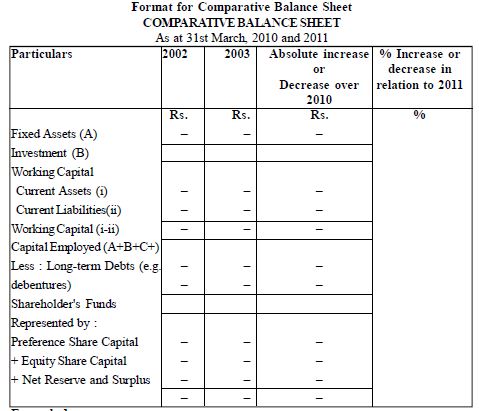
Format for Comparative Balance Sheet COMPARATIVE BALANCE SHEET
Financial Statements
Financial statements are the documents prepared to find out the profit earned or loss suffered and the position of assets and liabilities at a specific date. These form the final output of the accounting process.
According to Section 2(40) of the Companies Act, 2013, a set of financial statements includes:
(i) Balance sheet (position statement)
(ii) Statement of profit and loss (income statement)
(iii) Notes to accounts
(iv) Cash flow statement
Section 129 of the Companies Act, 2013 requires companies to prepare financial statements every year in the prescribed form, which is Schedule III of the Companies Act, 2013.
Characteristics of Financial Statements
(i) Financial statements are historical documents as they deal with past periods.
(ii) Financial statements are prepared using monetary terms.
(iii) Balance sheet shows the financial position and statement of profit and loss displays the profitability of the business organisation.
Nature of Financial Statements
(i) Recorded facts
(ii) Accounting conventions
(iii) Postulates
Objectives of Financial Statements
(i) Financial statements give information about the earning capacity of the business.
(ii) Financial statements give information about the economic resources and obligations of an enterprise.
(iii) Financial statements also give information about the cash flows.
(iv) Financial statements offer information useful for assessing the management's ability to use the resources of business effectively.
(v) Financial statements must report the activities of the business organisation affecting the society, which is important in its social environment.
Essentials of Financial Statements
(i) Accurate information
(ii) Understandability
(iii) Comparable
(iv) Verifiable
(v) Relevant
(vi) Timeliness
Uses and Importance of Financial Statements
(i) Report on stewardship function
(ii) Basis for fiscal policies
(iii) Basis of granting of credit
(iv) Basis for prospective investors
(v) Guide to the value of the investment already made
(vi) Aids trade associations in helping their members
Limitations of Financial Statements
(i) Accounting concepts and conventions involve personal judgement, so these statements contain some bias.
(ii) Qualitative aspects of financial statements are left out.
(iii) The present value of assets and liabilities and price-level changes are left out.
(iv) Financial statements are historical in nature and deal with past period only.
Users of Financial Statements
(i) Owners including shareholders and investors
(ii) Debentureholders and financial institutions (bankers)
(iii) Creditors
(iv) Management
(v) Employees
(vi) Government, tax authorities and regulators
Balance Sheet
It can be described as a statement of assets and liabilities of the company, at a specific date. It must show a true and fair view of the financial position at the close of the year. It is prepared and presented in the form given in Schedule III Part I of the Companies Act, 2013, and is broadly split into two parts: (i) Equity and liabilities and (ii) Assets.
Statement of Profit and Loss
The title of 'profit and loss account' has been changed to the statement of profit and loss. It displays the net result of business operations. Its form is given in Schedule III, Part II of the Companies Act, 2013.
Financial Statements of a Company
Basic Concepts
Meaning of Financial Statements: The term financial statements as used in accounting refers to statements which are prepared at the end of a given period of time for a business enterprise. As per Section 2(40) of the Companies Act, 2013 a set of financial statements include:
- (i) Balance Sheet, i.e., Position Statement, (ii) Statement of Profit and Loss, i.e., Income Statement, (iii) Notes to Accounts and (iv) Cash Flow Statement
Section 129 of the Companies Act, 2013 requires the companies to prepare financial statements every year in the prescribed form, i.e., as per Schedule III of the Companies Act, 2013.
Nature of Financial Statements: Following are the main features of financial statements:
(i) Recorded Facts: Financial statements are prepared on the basis of facts which are drawn from recorded facts. All the amounts relating to fixed assets, cash-in-hand, cash at bank, trade payables, trade receivables, share capital, etc. are recorded facts which are used in the preparation of financial statements.
(ii) Accounting Conventions and Concepts: Financial statements are prepared by following accounting conventions and concepts. For example, as per 'convention of conservatism', provisions are made for expected losses but not for expected profits. The use of accounting concepts and conventions makes the financial statements reliable, understandable and comparable.
(iii) Personal Judgements: Financial statements are affected by personal judgements. For example, an accountant has to make choice of selecting a method of depreciation, valuation of inventory, etc.
Objectives of Financial Statements:
- Provide information about economic resources and borrowings.
- Provide data which helps in ascertaining earning capacity of business.
- Provide information to investors to assess the potential of the business to earn a good return and hence attract investment.
- Provide information to banks and other financial institutions about the creditworthiness and credibility of the company and thus helps in securing debt.
- Provide information about cash flows of a company.
- Provide information to judge the effectiveness of management.
Contents of Annual Report: As per law, the annual report of a company must disclose the prescribed information in the form of financial statements, Report by the Board of Directors and Auditors' Report. A company's set of annual report includes:
(i) A Report by the Board of Directors
(ii) Auditor's Report to the Shareholders
(iii) Financial Statements
(iv) Notes to Accounts
Report by the Board of Directors: According to the Companies Act, 2013, companies are required to hold a shareholders' meeting every year. This meeting is known as 'Annual General Meeting'. The directors of the companies are required to attach their report to the annual report under Section 134 of the Companies Act, 2013. This report is known as Directors' Report containing (i) Report in terms of Section 134 of the Companies Act, 2013 (ii) Directors' Responsibility Statement (iii) Report on Corporate Governance (iv) Management discussion and Analysis.
Auditors' Report to the Shareholders: Act Section 143 of the Companies Act, 2013, the auditor of the company is required to present his opinions on the annual accounts on the basis of examination of books of accounts of the company.
Financial Statements
Balance Sheet: A Balance Sheet discloses the financial position of the business firm at the end of the year. It shows the amounts of various assets, equity and liabilities. Balance Sheet is also called as 'Position Statement'. It shall give a true and fair view of financial status of the company and must be in the form set out in Part I of Schedule III of the Companies Act, 2013.
Statement of Profit and Loss: Statement of profit and loss of a business firm discloses the net results of the business operations, i.e., net profit earned or net loss suffered during the accounting period. It is, also called as 'Income Statement'. Statement of Profit and Loss must comply with the requirements of Part II of Schedule III and shall give a true and fair view of the profit or loss of the company.
Cash Flow Statement: It is prepared in accordance with AS-3 (Revised) to show flow of cash and cash equivalents during an accounting period.
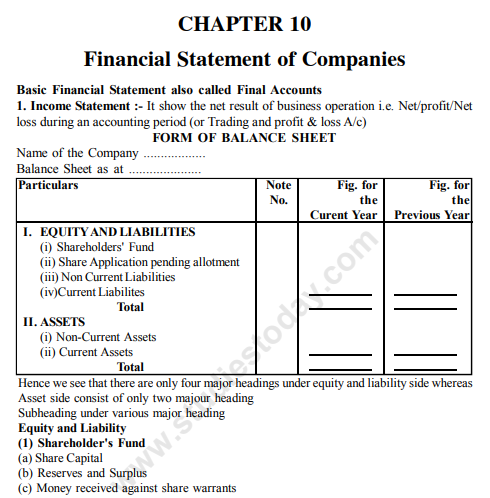
Preparation of Balance Sheet: The format of Balance Sheet as per Part I of Schedule III of the Companies Act, 2013 is as follows:
Name of the Company
Balance Sheet
as at...
| Particulars | Note No. | Figures as at the end of current reporting period | Figures as at the end of the previous reporting period |
|---|---|---|---|
| 1 | 2 | 3 | 4 |
| I. EQUITY AND LIABILITIES | |||
| (1) Shareholders' Funds | |||
| (a) Share Capital | |||
| (b) Reserves and Surplus | |||
| (c) Money Received against Share Warrants | |||
| (2) Share Application Money Pending Allotment | |||
| (3) Non-Current Liabilities | |||
| (a) Long-term Borrowings | |||
| (b) Deferred Tax Liabilities (Net) | |||
| (c) Other Long-term Liabilities | |||
| (d) Long-term Provisions | |||
| (4) Current Liabilities | |||
| (a) Short-term Borrowings | |||
| (b) Trade Payables | |||
| (c) Other Current Liabilities | |||
| (d) Short-term Provisions | |||
| Total |
II. ASSETS
(1) Non-Current Assets
(a) Fixed Assets
(i) Tangible Assets
(ii) Intangible Assets
(iii) Capital Work-in-Progress
(iv) Intangible Assets under Development
(b) Non-current Investments
(c) Deferred Tax Assets (net)
(d) Long-term Loans and Advances
(e) Other Non-current Assets
(2) Current Assets
(a) Current Investments
(b) Inventories
(c) Trade Receivables
(d) Cash and Cash Equivalents
(e) Short-term Loans and Advances
(f) Other Current Assets
Total
It should be noted that all the assets and liabilities are classified and shown in the Balance Sheet on the basis of definitions given in Schedule III of the Companies Act, 2013.
Equity and Liabilities Side
Shareholders' Funds:
(A) Share Capital:
Shares issued by the company for subscription purposes and money received against the issued shares is called 'share capital'.
As per Schedule III of Companies Act, 2013, the Balance Sheet must disclose authorised capital, issued capital and subscribed capital for each class of share capital (i.e., for both Equity and Preference shares) besides the called-up amount made by the company and paid-up amount made by the shareholders. Share capital shall be classified as:
(i) Authorised or Nominal Capital
(ii) Issued Capital
(iii) Subscribed Capital
(a) Subscribed and fully paid-up
(b) Subscribed but not fully paid-up
(iv) Called-up Share Capital
(v) Paid-up Share Capital
It is important that details required by the schedule should be given in the Notes to Accounts. In the Balance Sheet, the Share Capital will be presented as under:
Balance Sheet
| Particulars | Note No. | Figures as at the end of current reporting period | Figures as at the end of previous reporting period |
|---|---|---|---|
| I. EQUITY AND LIABILITIES | |||
| 1. Shareholders' Funds | |||
| (a) Share Capital | 1 | - | - |
Other information related to Share Capital will be disclosed in Notes to Accounts as follows:
Notes to Accounts:
| Particulars | (₹) | (₹) |
|---|---|---|
| (1) Share Capital | ||
| Authorised Capital: | ||
| ___ Equity Shares of Rs _______ each | ||
| ___ Preference Shares of Rs _______ each | - | |
| Issued Capital: | ||
| ___ Equity Shares of Rs _______ each | ||
| ___ Preference Shares of Rs _______ each | ||
| Subscribed Capital: | ||
| Subscribed and fully paid-up: | ||
| ___ Equity Shares of Rs _______ each | ||
| ___ Preference Shares of Rs _______ each | ||
| (of the above shares _____ shares are allotted as fully paid-up pursuant to a contract without payments in cash) | ||
| Subscribed but not fully paid-up: | ||
| ___ Equity Shares of Rs _______ each, Rs _______ per share called up | ||
| Less: Calls-in-Arrears | ||
| ___ Preference Shares of Rs _______ each, Rs _______ called up | ||
| Less: Calls-in-Arrears | ||
| (i) By Directors | Rs _______ | |
| (ii) By Others | Rs _______ | |
| Add: Forfeited Shares (with respect to number of shares not reissued) | - | |
| Amount to be shown in the Balance Sheet | - |
(B) Reserves and Surplus:
Reserves are the amount set aside out of profits and surpluses to meet prospective losses and future uncertainties strengthening the financial position of the company.
Surplus is the amount of accumulated profit (i.e., balance in Statement of Profit and Loss) which may be appropriated towards reserves and for payment of dividend. Surplus may have a credit or debit balance. Current year's profit or loss is adjusted to the balance brought forward from which appropriations towards other reserves and dividend are made.
Reserves and Surplus shall be classified as:
(i) Capital Reserve
(ii) Securities Premium Reserve
(iii) Capital Redemption Reserve
(iv) Debenture Redemption Reserve
(v) Revaluation Reserve
(vi) Share Options Outstanding Account
(vii) Other Reserves (specify the nature of each reserve and the amount in respect thereof)
(viii) Surplus, i.e., Balance in Statement of Profit and Loss.
A reserve specifically represented by earmarked investments must be termed as a 'fund'. Debit balance of Surplus, i.e., Balance in Statement of Profit and Loss shall be shown as a negative figure under the head 'Reserve and Surplus'. Similarly, the balance of 'Reserves and Surplus', after adjusting negative balance of surplus, if any, shall be shown under the head 'Reserves and Surplus' even if the resulting figure is in the negative.
Money Received Against Share Warrants:
A share warrant is a financial instrument which gives the holder the right to get equity shares. These are not shown as a part of share capital but must be shown as a separate line item.
Share Application Money Pending Allotment: If company has issued shares but date of allotment falls after the Balance Sheet date, such application money pending allotment will be shown in the following manner:
(i) Share application money not exceeding the issued capital and to the extent not refundable is to be disclosed under this line-item.
(ii) Share application money to the extent refundable or where minimum subscription is not met, such amount shall be shown separately under 'Other Current Liabilities'.
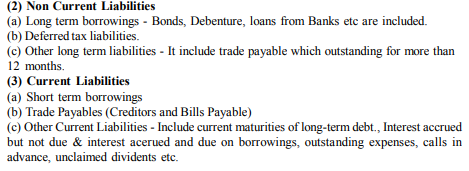
Non-Current Liabilities: According to the Companies Act, 2013, "Non-current liabilities are those liabilities which are not current liabilities."
Schedule III of the Companies Act, 2013 requires Non-current liabilities to be classified into:
(A) Long-term Borrowings
(B) Deferred Tax Liabilities (Net)
(C) Other Long-term Liabilities
(D) Long-term Provisions.
(A) Long-Term Borrowings
Long-term Borrowings are those borrowings when the loan, i.e., borrowings is repayable by the company after 12 months from the date of Balance sheet or after the operating cycle period.
(i) Long-term borrowings shall be classified as:
(a) Bonds/debentures
(b) Term Loans
- from banks
- from other parties
(c) Public deposits (due after 12 months)
(d) Loans and advances from subsidiaries/holding company/associates/business ventures
(e) Other loans and advances (nature to be specified)
(ii) Borrowings shall further be sub-classified as secured and unsecured.
(iii) Where loans have been guaranteed by directors or others, a mention thereof shall be made.
(B) Deferred Tax Liabilities (Net):
It represents the amount of tax levied on the difference between accounting income and taxable income when taxable income is less than accounting income.
Accounting Income > Taxable Income = Deferred Tax Liability
Accounting Income < Taxable Income = Deferred Tax Assets
(C) Other Long-Term Liabilities
These are of two types:
(i) Trade Payables: (Payable after one year)
Trade payables have been defined in Schedule III of Companies Act, 2013 as follows:
"Trade payables are the amounts payable for goods purchased and services taken in the normal course of business". It includes both sundry creditors and bills payable.
(ii) Other Payables: Examples - purchase of fixed assets and interest thereon, premium payable on redemption of debentures if debentures are shown as Long-term borrowings.
If goods purchased are to be paid after 12 months from the date of Balance Sheet or after the period of operating cycle, it will be shown as 'Other Long-term liability'.
(D) Long-Term Provisions: These are the provisions for which related claims are to be settled after 12 months of the date of Balance Sheet or after the period of operating cycle. For example: provision for employees benefits, provision for warranties, etc.
Current Liabilities: The term 'Current Liabilities' is defined as follows in Schedule III of the Companies Act, 2013:
(i) Expected to be settled in Company's normal operating cycle; or
(ii) Due to be settled within 12 months from the date of Balance Sheet; or
(iii) Held primarily for the purpose of being traded; or
(iv) There is no unconditional right to defer settlement for at least 12 months from the date of Balance Sheet.
Current Liabilities are classified as:
(A) Short-Term Borrowings: Short-term Borrowings are borrowings for a short duration of one year or less than one year (12 months) from the date of Balance Sheet or within the period of operating cycle.
Short-term borrowings shall be classified as:
(i) Loans repayable on demand
- from banks
- from other parties
(ii) Overdraft limit or Cash Credit limit from banks
(iii) Loans from other parties repayable within 12 months from the date of loan
(iv) Deposits
(v) Other loans and advances (specifically mentioning nature).
(B) Trade Payables: Sundry Creditors and Bills Payables
(C) Other Current Liabilities: The sub-head includes the following items:
(i) Current maturities of long-term debt
(ii) Current maturities of finance lease obligations
(iii) Interest accrued but not due on borrowings
(iv) Interest accrued and due on borrowings
(v) Income received in advance
(vi) Unpaid dividends
(vii) Application money received for allotment of securities and due for refund and interest due thereon
(viii) Unpaid matured deposits and interest accrued
(ix) Unpaid matured debentures and interest accrued
(x) Calls-in-advance
(xi) Other payables (nature to be specified)
(D) Short-Term Provisions: These are the provisions for which the related claim is expected to be settled within 12 months of the date of Balance Sheet or within the period of operating cycle. Examples - Provision for doubtful debts, provision for Discount on Debtors, provision for Depreciation, provisions for expenses (say electricity), provision for tax, etc.
Assets Side
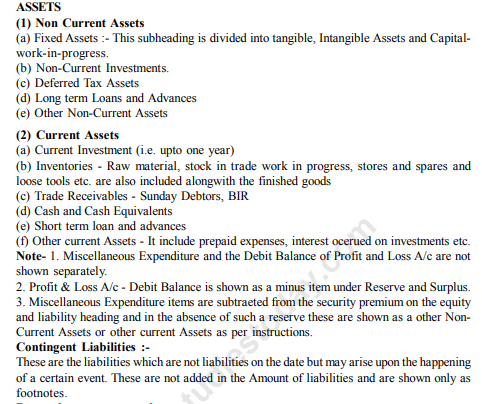
Non-Current Assets
As per the Companies Act, 2013, "Non-current assets are those assets which are not current assets."
(A) Fixed Assets: Fixed Assets are classified as follows:
(i) Tangible Assets: Examples - Land, Building, Plant and Equipments, Vehicles, etc.
(ii) Intangible Assets: Examples - Goodwill, Trademarks, Copyrights, Computer, Software, etc.
(iii) Capital Work-in-Progress: Includes those fixed assets which are in the process of being constructed by the company. Examples - Building under construction.
(iv) Intangible Assets under Development: Includes those intangible assets which are being developed by the company. Examples - Software under development.
(B) Non-Current Investments: Investments which are held not for purpose of resale but to retain them. Non-current investments shall be classified as:
(i) Investment in property
(ii) Investments in equity instruments
(iii) Investments in preference shares
(iv) Investments in Government or Trust securities
(v) Investments in debentures or bonds
(vi) Investments in Mutual funds
(vii) Investments in partnership firms
(viii) Other non-current investments (nature to be specified)
The investments held-to-maturity shall be stated separately. The following shall also be disclosed:
(i) Aggregate amount of quoted investments and market value thereof
(ii) Aggregate amount of unquoted investments
(iii) Aggregate amount partly paid-up investments.
(C) Deferred Tax Assets (Net): It represents tax levied on the difference between accounting income and taxable income when taxable income is more.
(D) Long-Term Loans and Advances: It includes those loans and advances which are receivable after 12 months from the date of Balance Sheet or after the period of operating cycle. These are classified into:
(i) Capital advances
(ii) Security Deposits
(iii) Other Loans and Advances (nature to be specified)
(E) Other Non-Current Assets: These are the non-current assets which are not included in any of the above heads, for example, Long-term trade receivable: If the amount is receivable after 12 months from the date of Balance Sheet or after the period of operating cycle.
Current Assets
As per Schedule III of the Companies Act, 2013, Current assets are those assets which are:
(i) expected to be realised in or intended for sale or consumption in the company's operating cycle.
(ii) held primarily for the purpose of trading.
(iii) expected to be realised within 12 months from the reporting date, i.e., Balance Sheet date.
(iv) cash and cash equivalents.
(A) Current Investments
Investments which are held to be converted into cash within a short period, i.e., within 12 months from the date of Balance Sheet or within the operating cycle. For example, Investments in Equity Instrument, Preference Shares, Government Securities, Debentures, Mutual Funds, etc.
(B) Inventories
Inventories include the following:
(i) Raw material
(ii) Work-in-progress
(iii) Finished goods
(iv) Goods acquired for trading (or Stock-in-trade)
(v) Stores and spares
(vi) Loose tools
(C) Trade Receivables: Sundry Debtors and Bills Receivable.
(D) Cash and Cash Equivalents: As per Schedule III of the Companies Act, 2013, following items constitute cash and cash equivalents.
(i) Balance with banks
(ii) Cheques, drafts in hand
(iii) Cash in hand
(iv) Others
(v) Earmarked balances with banks
(vi) Balances with banks held as Margin Money
(E) Short-Term Loans and Advances: Short-term loans and advances refer to loans and advances given to business associates and others which must be settled within less than a year or within the period of operating cycle. These can be of two types:
(i) Loans and advances to related parties (details to be provided)
(ii) Others (nature to be specified).
(F) Other Current Assets: These are the current assets that do not fall into any other current asset category mentioned before. For example, prepaid expenses, accrued incomes and advance taxes, etc.
Contingent Liabilities and Capital Commitments:
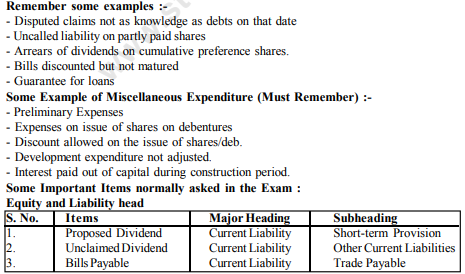
(a) Contingent Liabilities - Those liabilities which may or may not arise because they are dependent on a happening in future. It is not recorded in the books of accounts but is disclosed in the Notes to Accounts for the information of the users. (Examples - Claims against the company not acknowledged as debts, guarantees, other money for which the company is contingently liable.)
(b) Capital Commitments - A future liability for capital expenditure in respect which contracts have been made. (Examples - Uncalled liability on shares and other investments partly paid, etc.)
(c) Proposed Dividend (Current Year)
(d) Bills receivable discounted from Bank not yet due for payment.
(e) Other money for which the company is contingently liable.
Preparation of Statement of Profit and Loss: Following is the format of the Statement of Profit and Loss as put forth by the Part II of Schedule III of the Companies Act, 2013:
| Name of the Company Statement of Profit and Loss for the year ended... | (Rs in ...) | ||
|---|---|---|---|
| Particulars | Note No. | Figures for the current reporting period | Figures for the previous reporting period |
| I. Revenue from operations | xxx | xxx | |
| II. Other Income | xxx | xxx | |
| III. Total Revenue (I + II) | xxx | xxx | |
| IV. Expenses: | |||
| Cost of materials consumed | xxx | xxx | |
| Purchases of Stock-in-Trade | xxx | xxx |
Please click the link below to download pdf file for CBSE Class 12 Financial Statement of Companies.
Free study material for Accountancy
Study Material and Revision Notes for Class 12 Accountancy Part 2 Chapter 03 Financial Statements Of a Company
Key Concepts and Summary for Class 12 Accountancy Part 2 Chapter 03 Financial Statements Of a Company
Explore reliable chapter overviews for Part 2 Chapter 03 Financial Statements Of a Company tailored for Class 12 learners. Use these structured points to grasp difficult themes and ensure solid preparation for upcoming assessments.
NCERT-Aligned Chapter Summary and Notes
Each chapter summary is structured around standard CBSE textbooks, allowing students to check their understanding and clarify complex ideas early in their revision.
Next Steps in Your Exam Preparation
Follow up your revision by attempting the interactive online Accountancy MCQ test and practice worksheets for this chapter to verify your mastery. All platform resources are free to access.
FAQs
You can download the teacher prepared revision notes for CBSE Class 12 Accountancy Financial Statement Of Companies Notes from StudiesToday.com. These notes are designed as per 2026-27 academic session to help Class 12 students get the best study material for Accountancy.
Yes, our CBSE Class 12 Accountancy Financial Statement Of Companies Notes include 50% competency-based questions with focus on core logic, keyword definitions, and the practical application of Accountancy principles which is important for getting more marks in 2026 CBSE exams.
Yes, our CBSE Class 12 Accountancy Financial Statement Of Companies Notes provide a detailed, topic wise breakdown of the chapter. Fundamental definitions, complex numerical formulas and all topics of CBSE syllabus in Class 12 is covered.
These notes for Accountancy are organized into bullet points and easy-to-read charts. By using CBSE Class 12 Accountancy Financial Statement Of Companies Notes, Class 12 students fast revise formulas, key definitions before the exams.
No, all study resources on StudiesToday, including CBSE Class 12 Accountancy Financial Statement Of Companies Notes, are available for immediate free download. Class 12 Accountancy study material is available in PDF and can be downloaded on mobile.