

Revision Notes for Class 12 Accountancy: Part 2 Chapter 01 Accounting for Share Capital
Explore reliable concept summaries and revision materials through the CBSE Class 12 Accountancy Partnership Accounting For Issue Of Share Capital Notes. Tailored for Class 12 learners, utilizing these notes for Accountancy Part 2 Chapter 01 Accounting for Share Capital ensures thorough preparation and strengthens core academic definitions before final evaluations.
Review Part 2 Chapter 01 Accounting for Share Capital for Class 12 Accountancy
View or download the dedicated Part 2 Chapter 01 Accounting for Share Capital revision resource below. Engaging with these structured concept notes daily ensures continuous academic progress and mastery of the 2026-27 curriculum for Accountancy.
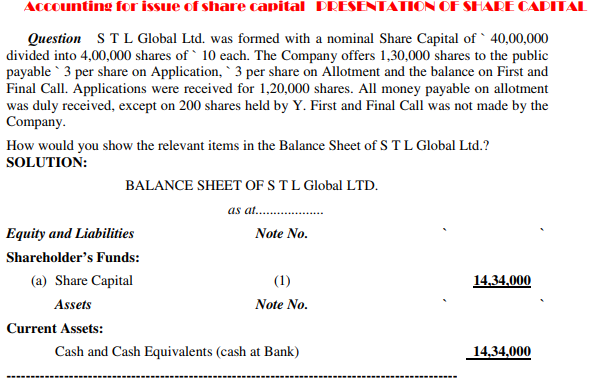

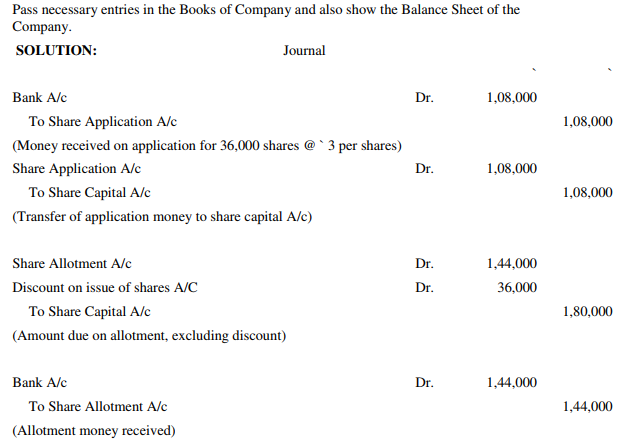

Other Current/Non-Current Assets:
Unamortized Expenses (Share Discount) 36,000
Current Assets:
Cash and Cash Equivalents (Cash at Bank) 3,24,000 3,60,000
Notes to Accounts:
` `
- Share Capital
Authorised Capital -------- Issue Capital:
40,000 Shares of ` 10 each 4,00,000
Subscribed and fully paid:
36,000 Shares of ` 10 each fully paid up 3,60,000
-----------------------------------------------------------------------------------------
Question
Cinevistaas Ltd. Issued 30,000 Preference shares of ` 100 each at a discount of 5%. Payments were to be made as — ` 25 on Application; ` 35 on Allotment and ` 35 on First and Final Call.
The applications for 28,000 shares were received and all were accepted. All the money was duly received except the first and final call on 400 shares.
Give the necessary Journal Entries and prepare Cash Book of the Company. Also give the Opening Balance Sheet of the Company.
CASH BOOK (Bank Column)
` ` To Preference Share By Balance 26,46,000
Application A/c 7,00,000
To Preference Share
Allotment A/c 9,80,000
To Preference Share First &
Final Call A/c 9,66,000
26,46,000 26,46,000
--------------------------------------------------------------------------------------------------------------
JOURNAL
Preference Share Application A/c Dr. 7,00,000
To Preference Share Capital A/c 7,00,000 (Application money transferred to capital A/c)
Preference Share Allotment A/c Dr. 9,80,000
Share Discount A/c Dr. 1,40,000
To Preference Share Capital A/c 11,20,000 (Allotment due and ` 5 per share debited to share discount A/c)
Preference Share First & Final Call A/c Dr. 9,80,000
To Preference Share Capital A/c 9,80,000 (Amount due on first & final call A/c)
Calls in Arrears A/c Dr. 14,000
To Preference Share First & Final Call A/c 14,000 (First and Final call @ `35 per share unpaid on 400 shares)
BALANCE SHEET OF Cinevistaas LTD.
As on………………
Equity and Liabilities Note No. ` ` Shareholder’s Funds:
- Share Capital 1 27,86,000
Assets Note No. ` ` Other Current/Non-Current Assets:
Unamortized Expenses (Share Discount) 1,40,000
Current Assets;
Cash and Cash Equivalents (Cash at Bank) 26,46,000
Notes to Accounts:
4. Share Capital
Issued:
30,000 Preference Shares of ` 100 each 30,00,000
Subscribed but not fully paid:
28,000 Preference Shares of ` 100 each 28,00,000
Less: Calls in Arrear 14,000 27,86,000
Note: When Cash Book Entries are asked in the question, all cash transactions are to be recorded in Cash Book, other non-cash transactions should be entered in the journal.
-----------------------------------------------------------------------------------------
Question .
Sibar Media & Entertainment Ltd. invited applications for 1,00,000 shares of `10 each at a discount of 6% payable as follows:
On Application 3
On Allotment 2.40
On First and Final Call 4
The applications were received for 90,000 shares and all of these were accepted. All money due were received except the first and final call on 2,000 shares which were forfeited. 1,000 shares were re-issued @ ` 9 per share as fully paid. Assuming that all requirements of law were complied with, pass Entries in the Journal of the company. Also show how these transactions will be reflected in the compnay’s Balance Sheet.
Sibar Media & Entertainment Ltd.
Journal
` `
Bank A/c Dr. 2,70,000
To Share Application A/c 2,70,000 (Application money received on 90,000 shares @ ` 3 per share)
Share Application A/c Dr. 2,70,000
To Share Capital A/c 2,70,000 (Application money transferred to Share Capital A/c)
Share Allotment A/c | Dr. | 2,16,000 |
Share Discount A/c | Dr. | 54,000 |
To Share Capital A/c | 2,70,000 |
(Allotment money due on 90,000 shares; ` 2.40 per share debited to
Share Allotment A/c and ` 0.60 per share debited to Share Discount A/c)
Meaning Of Company
According to Section 2(20) of the Companies Act, 2013, "Company means a company joined under this act or any previous Company law."
Features Of A Company
- Incorporation: Company is an artificial person made through the process of Law.
- Separate Legal Entity: Company is an artificial person having a legal entity separate from its shareholders.
- Artificial Person: It can own property, enter into contracts, conduct business, sue or be sued for its debts and actions.
- Perpetual Existence: Its existence is not affected by the death, lunacy or bankruptcy of its members or shareholders.
- Limited Liability: Liability of members is limited to the values of shares bought by them.
- Transferability Of Shares: Shares are freely transferable except for private companies.
- Common Seal: Company may or may not have a common seal. If it has it is affixed to all the important documents.
Kinds Of Companies
On The Basis Of Participation
1. Private Company [Section 2(68) of the Companies Act, 2013]: A private company is a company which
- (a) by its Articles of Association:
- (i) restricts the right of transfer of its shares;
- (ii) limits the number of its members to 200 which will not include present employees or ex-employees; and must have at least 2 members.
- (b) prohibits any invitation to the public to subscribe to any share or debenture of the company.
The name of every private company must end with 'Private Limited'.
2. Public Company: A public company is a company which
- is not a private company;
- has a minimum paid-up capital as may be prescribed; and
- is a private company being a subsidiary of a company which is not a private company.
A public company must have at least 7 members and there is no restriction on the maximum number of members. The name of every public company must end with the word 'Limited'.
Note: Promoters can decide the minimum paid-up share capital in case of private and public companies as it has not been prescribed.
One Person Company (OPC): An OPC means a company with only one person as its member joined as a private company. As per Rule 3 of the Companies (Incorporation) Rules, 2014, apart from forming a public or private limited company, the Act enables the establishment of a new entity 'One Person Company' (OPC).
Member Of OPC: Only natural person who is a citizen of India and resident of India can be a member of OPC.
Paid-up Share Capital: Its paid-up share capital is not more than Rs 50 lakhs. Its average annual turnover of 3 years does not exceed Rs 2 crores.
Number Of Directors: Minimum number of director is one and maximum is fifteen.
On The Basis Of Liability
1. Companies Limited By Shares [Section 2(22) of the Companies Act, 2013]: In case of companies limited by shares, the liability of its members (shareholders) is limited to the extent of unpaid value of shares possessed by them.
2. Companies Limited By Guarantee [Section 2(21) of the Companies Act, 2013]: When members of a company offer a firm assurance to bear liability to a certain extent, the company is said to be limited by guarantee.
3. Unlimited Liability Companies [Section 2(92) of the Companies Act, 2013]: An unlimited company is a company whose members bear unlimited liability towards it.
Meaning Of Share
According to Section 2(84) of the Companies Act, 2013 'Share' means a share in the share capital of a company and includes stock. The capital of a company is divided into a number of equal units. Each unit is called a share. The word share implies a unit of share capital having property rights.
Types Of Shares
As per Section 43 of the Companies Act, 2013, Share Capital of a company can be of two types or classes:
(i) Preference Shares and (ii) Equity Shares
| Types of Shares | |
|---|---|
Preference Shares
| Equity Shares
|
Preference Share [Section 43(b)]
Preference share is one which carries the following two rights:
- They have a right to receive dividend at a fixed rate before any dividend is paid on the equity shares;
- On the winding up of the company, they have the right to return of capital before anything is paid to equity shareholders.
Normally, preference shareholders do not have right to vote. However, they have the right to vote on any resolution meant for winding up of the company or for the reduction of share capital.
Types Of Preference Shares
(A) On The Basis Of Arrears Of Dividend
(1) Cumulative Preference Shares: These are the preference shares which have the right to receive arrears of dividend before the payment of dividend to equity shareholders is made.
(2) Non-Cumulative Preference Shares: These are the preference shares which don't have the right to receive arrears of dividend.
(B) On The Basis Of Share In Profits
(1) Participating Preference Shares: These are the shares which are entitled to share in the surplus profit of the company which remains after payment to equity shareholders.
(2) Non-Participating Preference Shares: Preference shares which do not have a share in surplus profits and on which only a fixed rate of dividend is paid are called non-participating preference shares.
(C) On The Basis Of Convertibility
(1) Convertible Preference Shares: Convertible preference shares are those shares which can be converted into equity shares.
(2) Non-Convertible Preference Shares: These are the preferences shares which don't have the right to be converted into equity shares.
(D) On The Basis Of Redemption
(1) Redeemable Preference Shares: The preference shares which are repayable either after a fixed period or earlier at the option of the company (as per provisions of sec. 80) are called redeemable preference shares.
(2) Irredeemable Preference Shares: Preference shares which are not redeemable are called irredeemable preference shares. The Companies Act, 2013 does not permit issue of Irredeemable Preference Shares.
Equity Share
An equity share is a share which is not a preference share. Thus, this share does not carry any preferential right or in other words, equity share is one which is entitled to dividend and repayment of capital after the claims of preference shares are satisfied. Usually, the equity shareholders control the affairs of the company and hence right to claim the profits after the preference dividend has been paid.
Difference Between Equity Shares And Preference Shares
| Points of Distinction | Preference Shares | Equity Shares |
|---|---|---|
| (1) Rate of Dividend | The rate of dividend on preference shares is fixed. | The rate of dividend on equity shares varies from year to year depending upon the profits available. |
| (2) Right to Dividend | A preference share enjoys the right to receive dividend before any dividend is paid to equity shares. | Equity shares receive dividend only if there is balance of profit after payment of dividend to preference shares. |
| (3) Redemption | Preference shares are redeemed after a stipulated period but within the period of ten years from the date of issue. | A company can buy-back its Equity shares else they can be redeemed only at the time of winding-up. |
| (4) Return of Capital | In case of winding-up of the company, preference shares enjoy the right to return of the capital before the capital of equity shareholders is returned. | In case of winding-up, equity shareholders get back capital only after paying off to preference shareholders. |
| (5) Right to Vote | Preference shares do not carry right to vote except in special circumstances. | Equity shares carry right to vote because equity shareholders are real owners of the company. |
| (6) Participation in Management | Preference shareholders have no right to participate in management. | Equity shareholders have the right to participate in management. |
| (7) Arrear of Dividends | In case of cumulative preference shares, arrears of dividends are accumulated. | In case dividend is not declared during the year it is not accumulated to be paid in coming years. |
Share Capital
Share capital refers to the amount of capital that a company can raise or has raised by the issue of shares which remains with the company till its liquidation. Share capital is the owned capital since it is contributed by the shareholders who are the owners of the company.
Nature Of Share Capital
In the case of a company, capital means the 'Share Capital'. Company requires large amount of financial resources. A company depends upon large number of outside investors. Funds from investors are raised by a company by issue of shares. A large number of individuals and institutions contribute varying amounts to the capital of the company in the form of investments in shares, yet there is no separate Capital Account for each of these investors. Hence, there is one consolidated capital account called the 'Share Capital Account'.
As per Schedule III of the Companies Act, 2013, a company is required to show for each class of Share Capital:
- Authorised Capital
- Issued Capital
- Subscribed Capital
Types Of Share Capital
The share capital of a company can be divided into following categories:
(i) Authorised Or Registered Or Nominal Capital: According to Section 2(8) of the Companies Act, 2013 "Authorised Capital or Nominal Capital means such capital as is authorised by the memorandum of a company to be the maximum amount of share capital of the company." This is the amount stated in the capital clause of the memorandum of association of a company with which the company is registered and the company is entitled to issue shares of that much amount and number.
(ii) Issued Capital: According to Section 2(50) of the Companies Act, 2013 "Issued Capital means such capital as the company issues from time to time for subscription." The part of authorised capital, which is offered to the public for subscription is called issued capital.
(iii) Subscribed Capital: According to Section 2(86) of the Companies Act, 2013, "Subscribed Capital means such part of capital which is for the time being subscribed by the members of the company." It is that part of issued capital which represents the face or nominal value of shares bought for by persons, i.e., applied by prospective shareholders and allotted by the company. The balance of issued capital not bought for by the public is called unsubscribed capital.
In the Notes to Accounts of Balance Sheet of a Company, Subscribed Capital is shown under two following heads:
- (a) Subscribed and fully paid-up: When the entire face value (nominal value) of the shares has been called by the company and is also received by the company, these shares will be classified and shown as 'Subscribed and fully paid-up' in the 'Notes to Accounts' of the Balance Sheet.
- (b) Subscribed but not fully paid-up: Sometimes, shares are classified and shown under 'Subscribed but not fully paid-up' in the Notes to Accounts, when:
- (i) the company has called-up the entire nominal value of the shares but it has not received the full amount, or
- (ii) the company has not called-up the entire nominal value of the shares.
There may also arise a situation when the company has not fully called-up the entire face value and a shareholder defaults in making payment of a call due.
(iv) Called-up Capital: According to Section 2(15) of the Companies Act, 2013 "Called-up Capital means such part of the capital, which has been called for payment." The portion of subscribed capital that the directors required the shareholders to pay on the shares allotted to them is known as called-up capital. The balance of subscribed capital which has not been called-up denotes uncalled capital.
(v) Paid-up Capital: According to Section 2(64) of the Companies Act, 2013 "Paid-up Share Capital or Share Capital Paid-up means such aggregate of money credited and paid-up as is equivalent to the amount received as paid-up in respect of shares issued and also includes any amount credited as paid-up in respect of shares of a company, but does not include any other amount received in respect of such shares by whatever name called." The amount of called-up capital which has been actually paid by the shareholders is known as paid-up capital.
(vi) Reserve Capital: According to Section 65 of the Companies Act, 2013, only an unlimited company having share capital while converting into a limited company, may have a reserve capital. The part of the uncalled capital which is never asked for or called-up by the company during its existence but only at the time of winding up or liquidation of a company, so that it remains as a cushion or additional security for making any payments to its creditors, is known as the reserve capital.
Difference Between Reserve Capital And Capital Reserve
| Point Of Distinction | Reserve Capital | Capital Reserve |
|---|---|---|
| Meaning | It refers to that portion of uncalled share capital which shall not be called up except in the event of winding up. | This reserve is created out of Capital profits such as profit on sale of fixed assets, premium on issue of shares and debentures, profit on redemption of debentures etc. These profits are not earned in the normal course of business. |
| Special Resolution | A special resolution is required for its creation. | No special resolution is required for its creation. |
| Mandatory | It is not necessary to create Reserve Capital. | It is necessary to create Capital Reserve in case of capital profit. |
| Disclosure | It is not shown in the Company's Balance Sheet. | It is shown under the head 'Reserves and Surplus' on the equity and liabilities side of the Balance Sheet. |
| Uses | It can be used only at the time of winding up of the company. | It can be used to write off capital losses or to declare bonus shares at any time during the life of the company. |
Disclosure Of Share Capital In The Company's Balance Sheet
As per Schedule III of the Companies Act, 2013, share capital is required to be disclosed in a company's Balance Sheet in the following manner:
| Balance Sheet as at .............. | |||
|---|---|---|---|
| Particulars | Note No. | Figures as at the end of current year (Rs) | Figures as at the end of previous year (Rs) |
| I. EQUITY AND LIABILITIES | |||
| 1. Shareholders' Funds (a) Share Capital (b) Reserves and Surplus (c) Money Received Against Share Warrants | 1 |
Note: According to Schedule III of the Companies Act 2013, disclosure requirements pertaining to share capital are to be provided in Notes to Accounts as given below:
Notes to Accounts
Share Capital
Authorised Capital:
- Equity Shares of Rs. _______ each
- Preference Shares of Rs. _______ each
Issued Capital:
- Equity Shares of Rs. _______ each
- Preference Shares of Rs. _______ each
Subscribed Capital:
Subscribed and fully paid-up:
- Equity Shares of Rs. _______ each
- Preference Shares of Rs. _______ each
(of the above shares _______ shares are allotted as fully paid-up pursuant to a contract without payments in cash)
Subscribed but not fully paid-up:
- Equity Shares of Rs. _______ each, Rs. _______ per share called up
Less: Calls-in-Arrears
- Preference Shares of Rs. _______ each, Rs. _______ called up
Less: Calls-in-Arrears
- (i) By Directors - Rs. _______
- (ii) By Others - Rs. _______
Add: Forfeited Shares
Amount to be shown in the Balance Sheet
Preliminary Expenses
The costs incurred when a company is formed and before the start of any business operations termed as preliminary costs. These include (i) Costs incurred for taking advice related to law and starting up the business like legal cost and professional fees, (ii) Costs incurred on the preparation and printing of various documents, etc.
As per AS-26 preliminary costs are to be written off in the year in which they incurred. They should be written off first from Securities Premium Reserve Account and in its absence from Statement of Profit and Loss in the same year.
Issue of Shares for Cash
Accounting Entries for issue of shares for cash are as follows:
1. At the time of Application:
(i) For receipt of application money:
- Bank A/c - Dr.
- To Share Application A/c
(Being application money received on __________ shares @ __________per share)
(ii) For transferring application money to Share Capital:
- Share Application A/c - Dr.
- To Share Capital A/c
(Being application money transferred to Share Capital Account)
2. At the time of Allotment:
(i) For making allotment due:
- Share Allotment A/c - Dr.
- To Share Capital A/c
(Being allotment due on ________ shares @ __________per share)
(ii) For receipt of allotment money:
- Bank A/c - Dr.
- To Share Allotment A/c
(Being allotment money received)
3. At the time of First Call:
(i) For making first call due:
- Share First Call A/c - Dr.
- To Share Capital A/c
(Being first call money due on ___________ shares @___________ per share)
(ii) For receipt of first call:
- Bank A/c - Dr.
- To Share First Call A/c
(Being first call money received)
4. At the time of Second Call:
(i) For making second call due:
- Share Second Call A/c - Dr.
- To Share Capital A/c
(Being second call money due on _________ shares @ __________per share)
(ii) For receipt of second call:
- Bank A/c - Dr.
- To Share Second Call A/c
(Being second call money received)
5. At the time of Third and Final Call:
(i) For making third and final call due:
- Share Third and Final Call A/c - Dr.
- To Share Capital A/c
(Being third and final call money due on ______ shares @ ________per share)
(ii) For receipt of Third and Final Call:
- Bank A/c - Dr.
- To Share Third and Final Call A/c
(Being third and final call money received)
Terms of Issue of Shares
1. Issue of shares at par: Issue of shares at par means that the share are issued at their face value, for example, when a share of Rs.100 is issued at Rs.100.
2. Issue of shares at premium: Issue of shares at a premium means that shares are issued at a price which is more than their face value. For example, if a share of Rs.100 is issued at Rs.120, Rs.20 will be the premium on share. As per the requirements of the Companies Act, 2013, the amount received on the securities premium shall be credited to Securities Premium Reserve Account. It is a capital receipt for the company.
According to Section 52(2) of the Companies Act, 2013, the amount of Securities Premium Reserve can be used only for the following purposes:
- To issue fully paid-up bonus shares to the shareholders.
- To write off preliminary costs of the companies.
- To write off the commission paid or discount/costs on issue of shares/debentures.
- To pay premium on the redemption of preference shares or debentures of the company.
- Buy-back of Equity Shares and other securities as per Section 68.
Journal Entries
For making Allotment due with Premium:
- Share Allotment A/c - Dr.
- To Share Capital A/c
- To Securities Premium Reserve A/c
For receipt of Allotment Money:
- Bank A/c - Dr.
- To Share Allotment A/c
Undersubscription of Shares
When the number of shares applied for is less than the number of shares offered for issue, it is known as undersubscription. This is subject to the qualification that minimum subscription has at least been received.
Oversubscription of Shares
When the number of shares applied for is more than the number of shares offered for issue, it is known as oversubscription. A company cannot allot shares more than offered for subscription.
The options available with the company to deal with money received on oversubscription are:
- Board of Directors can make full allotment to some applicants and totally reject the others.
- They can make a pro rata allotment. It means the proportion is determined by the ratio which the number of shares to be allotted bear to the number of shares applied for.
- They can adopt a combination of the above two alternatives.
Journal Entries
For Application Money Received
Bank A/c ...Dr.
To Share Application A/c
For Application Money for Allotted Shares
Share Application A/c ...Dr.
To Share Capital A/c
Excess Application Money
Refund
Share Application A/c ...Dr.
To Bank A/c
Adjustment
Share Application A/c ...Dr.
To Share Allotment A/c
To Calls-in-Advance A/c
Combined Entry
Share Application A/c ...Dr.
To Share Capital A/c
To Bank A/c
To Share Allotment A/c
To Calls-in-Advance A/c
Calls-in-Arrears
The portion of called-up capital which is not paid by the shareholders within a specified time is called as calls-in-arrears.
There are two alternative methods for dealing with the calls-in-arrears:
(1) When 'Calls-in-Arrears Account' is opened:
In this method, separate Calls-in-Arrears Account is opened. The amount of unpaid allotment and unpaid calls are transferred to newly opened 'Calls-in-Arrears A/c'. Following entries are passed:
(i) On non-receipt of call money when due:
- Calls-in-Arrears A/c - Dr.
- To Share Call A/c
(Being call money remain unpaid)
(ii) On receipt of Calls-in-Arrears at a subsequent date:
- Bank A/c - Dr.
- To Calls-in-Arrears A/c
The debit balance of 'Calls-in-Arrears Account' is shown as a deduction from the 'subscribed but not fully paid-up' under subscribed share capital on the Equity and Liabilities part of the Balance Sheet.
(2) When Calls-in-Arrears Account is not opened: Normally, it is not necessary to open a separate Calls-in-Arrears A/c. In this method, the actual amount received from the shareholders is credited to respective call account. Amount of calls in arrears will be shown as a deduction from the amount of called-up and paid-up capital on the Equity and Liabilities part of the Balance Sheet. This method is generally followed.
Interest on Calls-in-Arrears
In case of Calls-in-Arrears, if the articles of Association of a company is silent, then Table 'F' of the Companies Act, 2013 shall apply and interest @ 10% p.a. will be charged on Calls-in-Arrears.
Calls-in-Advance
When a company accepts money paid by some of its allottees for the calls not yet due, such amount is known as calls-in-advance.
Calls-in-Advance A/c is shown on the 'Equity and Liabilities' part of the Balance Sheet under the head 'Current Liabilities'.
Accounting entries passed to record this are:
(1) When Calls-in-Advance money is received:
- Bank A/c - Dr.
- To Calls-in-Advance A/c
(2) When it is adjusted against the respective call (when it becomes due):
- Calls-in-Advance A/c - Dr.
- To Share ......... Call A/c
Interest on Calls-in-Advance
In case of Calls-in-Advance, if the Articles of Association of a company are silent, then Table 'F' of the Companies Act, 2013 shall apply and interest @ 12% p.a. will be provided on Calls-in-Advance.
Note: Interest on Calls-in arrears and call in advance is not in syllabus.
Issue of Shares for Consideration Other than Cash
It is not necessary to issue shares for cash only, they can be issued as fully paid shares for consideration other than cash, in the following circumstances:
(1) Issue of Shares to Promoters: A company may issue shares without cash to its promoters for the services rendered by them. The entry in this case will be:
- Incorporation/Formation Costs A/c - Dr.
- To Promoters' A/c
(Being amount due to promoters)
- Promoters' A/c - Dr.
- To Share Capital A/c
(Being fully paid shares issued to the promoters)
Incorporation or Formation Costs Account is debited on the assumption that promoter's activities has resulted in forming the company into a profitable unit.
(2) Issue of Shares to Underwriters:
- Underwriting Commission A/c - Dr.
- To Underwriter's A/c
(Being the underwriting commission due)
- Underwriters A/c - Dr.
- To Share Capital A/c
(Being share issued to the underwriters)
(3) Issue of Shares to Vendors: When a company purchases certain assets from vendor/supplier on credit, or when it purchases a business instead of making payment to vendor in cash, the company issues fully paid shares to the vendor. Shares may be issued to vendor at par, or at premium, or at discount. Following entries are passed in this case:
(i) (a) For purchase of assets from vendor:
- Sundry Assets A/c - Dr.
- To Vendor's A/c
(Being assets purchased on credit)
(b) For purchase of business:
- Sundry Assets A/c - Dr.
- Goodwill A/c - Dr.
- To Liabilities A/c
- To Vendor's A/c
- To Capital Reserve A/c
(Being business purchased)
(ii) For issuing shares to vendor:
(a) At Par:
- Vendor's A/c - Dr.
- To Share Capital A/c
(Being fully paid shares issued to vendor)
(b) At Premium:
- Vendor's A/c - Dr.
- To Share Capital A/c
- To Securities Premium Reserve A/c
(Being shares issued to vendor at premium)
Forfeiture of Shares
If a shareholder fails to pay allotment money and call money on his shares as called upon by the company, his shares may be forfeited by giving due notice and following the procedure specified in the Articles of Association. This is known as forfeiture of shares. In simple words, to forfeit a share means to cancel the allotment to defaulting shareholders.
Procedure
The usual procedure is that the defaulting shareholders must be given a minimum 14 days notice. Inspite of this notice, if the shareholder does not pay the unpaid amount, the directors can forfeit the shares by passing a resolution and giving a notice of that resolution to the defaulting shareholders.
Please click the link below to download pdf file for CBSE Class 12 Partnership - Accounting for Issue of Share Capital Notes.
Free study material for Accountancy
Download CBSE Revision Notes: Class 12 Accountancy Part 2 Chapter 01 Accounting for Share Capital
Download Chapter Summary: Class 12 Accountancy Part 2 Chapter 01 Accounting for Share Capital
Access structured revision notes for Part 2 Chapter 01 Accounting for Share Capital designed in alignment with the latest CBSE curriculum for Class 12 Accountancy. These summaries help clarify core themes and support effective daily study.
Concept Clarification for Part 2 Chapter 01 Accounting for Share Capital
Each chapter summary is structured around standard CBSE textbooks, allowing students to check their understanding and clarify complex ideas early in their revision.
Additional Study Resources for Class 12 Accountancy
Follow up your revision by attempting the interactive online Accountancy MCQ test and practice worksheets for this chapter to verify your mastery. All platform resources are free to access.
FAQs
You can download the teacher prepared revision notes for CBSE Class 12 Accountancy Partnership Accounting For Issue Of Share Capital Notes from StudiesToday.com. These notes are designed as per 2026-27 academic session to help Class 12 students get the best study material for Accountancy.
Yes, our CBSE Class 12 Accountancy Partnership Accounting For Issue Of Share Capital Notes include 50% competency-based questions with focus on core logic, keyword definitions, and the practical application of Accountancy principles which is important for getting more marks in 2026 CBSE exams.
Yes, our CBSE Class 12 Accountancy Partnership Accounting For Issue Of Share Capital Notes provide a detailed, topic wise breakdown of the chapter. Fundamental definitions, complex numerical formulas and all topics of CBSE syllabus in Class 12 is covered.
These notes for Accountancy are organized into bullet points and easy-to-read charts. By using CBSE Class 12 Accountancy Partnership Accounting For Issue Of Share Capital Notes, Class 12 students fast revise formulas, key definitions before the exams.
No, all study resources on StudiesToday, including CBSE Class 12 Accountancy Partnership Accounting For Issue Of Share Capital Notes, are available for immediate free download. Class 12 Accountancy study material is available in PDF and can be downloaded on mobile.