

Accountancy Concept Notes for Class 12: Part 2 Chapter 02 Issue and Redemption of Debentures
Explore reliable concept summaries and revision materials through the CBSE Class 12 Accountancy Redemption Of Debenture Notes. Tailored for Class 12 learners, utilizing these notes for Accountancy Part 2 Chapter 02 Issue and Redemption of Debentures ensures thorough preparation and strengthens core academic definitions before final evaluations.
Download Part 2 Chapter 02 Issue and Redemption of Debentures Revision Notes PDF
Access the complete concept summary PDF for Part 2 Chapter 02 Issue and Redemption of Debentures below. Regular review of these targeted notes builds familiarity with complex Class 12 Accountancy themes and helps secure higher marks in final school evaluations.
CHAPTER 9
Redemption of Debenture
Meaning : Redemption of debentures means repayment of the due amount of debentures to the debenture holders. It may be at par or at premium.
Time of redemption : (a) At maturity : when repayment is made at the date of maturity of debentures which is determined at the time of issue of debentures.
(b) Before maturity : If articles of association and terms of issue mentioned in prospectus allows, then a company can redeem its debentures before maturity date. Redemption methods : (1) Redemption is Lumpsum :When redemption is made at the expiry of a specific period, as per the terms of issue.
(2) Redemtion by draw of lots :In this method a certain proportion of debentures are redeem each year, the debenture for which repayment is to be made is selected by draw.
(3) Redemtion by purchase in open market :if articles of association of a company authorize, it may purchase its own debentures from open market i.e. stock exchange. Advantage of this method :
1. When market price of own debentures is low than the redeemable value.
2. Decrease the amount of interest payable to outsiders.
3. if term of issue is provided that debentures are to be redeemed at premium then such premium can be decrease Sometimes company can purchase the debentures at more than the redeemable value
due to the following reasons :
1. To maintain the solvency ratio.
2. To utlize the surplus money or funds which are lying idle with the company.
3. When rate of interest on debentures is more than the current market rate of interest on debentures in the industry.
4. Redemption by conversion : As per the terms of issue, convertible debentures may be covert into shares or new debentures at the option of debenture holders. This option of conversion is given to the debentureholder within specific period. In this case no need to transfer profit to Debenture Redemption Reserve Account.
Sources of Redemption of debentures.
1. Proceeds from fresh issue of share capital or debenture holders.
2. From accumulated profits.
3. Proceeds from sale of fixed assets.
4. A company may purchases its own debentures out of its surplus funds.
Two terms which are used in the redemption of debentures :
1. Redemption out of capital : when a company not used its reserve or accumulated profit for redemption of its debentures. It is called redemption out of capital. So company using this method are not transfer it profit to DRR A/c. But as per SEBI guidelines it is necessary for a company to transfer 50% amount of nominal value of debentures to be redeemed in DRR A/c before redemption of debentures commence.
2. Redemption out of profit : Redemption out of profit means that adequate amount of profits are transferred to DRR A/c from P&L Appropriation A/c before the redemption of debenture commences. This reduce the amount available for dividends to shareholders.
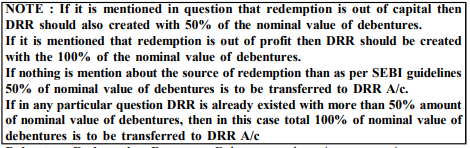
Debenture Redemption Reserve : Debenture redemption reserve is a reserve representing retentions out of profit made for the purpose of redemption of debentures. Amount of DRR to be created : Section 117 (c) of the Indian Companies Act 1956 requires that, an adequate amount of profit should be transferred to DRR before redemption commences. However the adequate amount is not specified by the companies Act.
SEBI has issued guidlines for the redemption of debentures whereby :
1. An amount equivalent to 50% of the amount of debentures issue must be transferred to DRR before redemption of debentures commences. This provision is applicable for nonconvertible debentures or nonconvertible part of party convertible debentures. After all the debentures are redeemed, this account is closed by transferring to general reserve account.
Exception to the creation of DRR as per SEBI guidlines :
1. All infrastructure companies, wholly engaged in the business related to development maintenance and operation of infrastructure facilities.
2. A company issuing debentures maturity period of not more than 18 months.
3. Debentures issued by Banking Companies.
4. Companies issuing privately placed debentures.
The above types of companies are exempted by SEBI from creating DRR. However the above types of companies can create DRR(at it option) for the redemption of debentures.
(B) Redemption At Premium : Illustration 2. Z Ltd. Redeemed its 1,00,000 10% Debentures of Rs.10 each at 5% premium on 31st March, 2011.
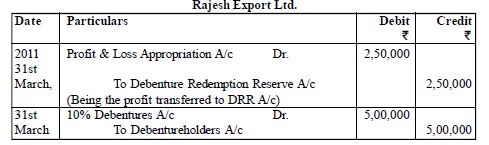
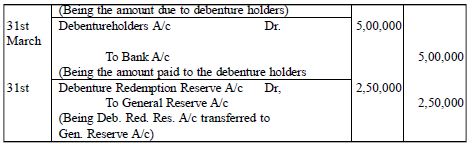
Illust. 3 : Rajesh Export Ltd. has 2,000, 9% Debentures of Rs.100 each due on redemption on 31st March 2011. Debentures redemption reserve has a balance of Rs.30,000 on that date. Record the necessary journal entries at the time of redemption of debentures
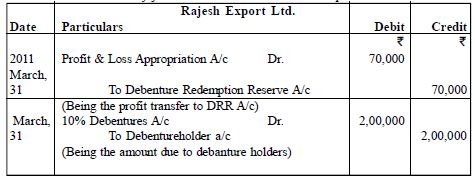
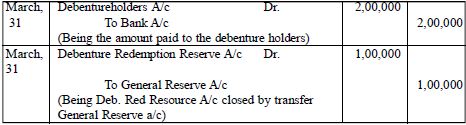
Illust. 4 : Rahul Ltd. has 50,000, 9% Debentures of Rs.50 each due on redemption on
31st March 2011. Debentures redemption reserve has a balance of Rs.15,00,000 on that date. Record the necessary journal entries at the time of redemption of debentures.
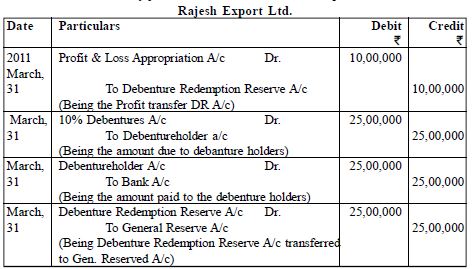
Note : In this case DRR is Already more than 50% of nominal value of debentures, then it is created upto the 100% of the nominal value of debenture
Illust.5 : Saket Ltd.(an infrastructure co.) has outstanding 10,000, 9% Debentues of Rs.50 each due on redemption on 31st March, 2011. Record the necessary journal entries at the time of redemption of debentures.
(Note : The infrastructure Companies are exempted from creating DRR as per SEBI guidlines. However these companies may create DRR at its option.)
Redemption Method : 2 Draw of lots
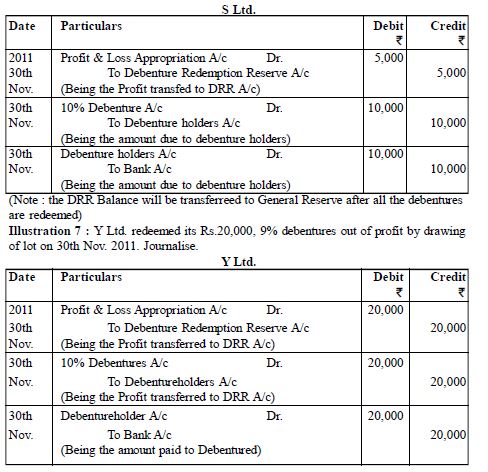
Illustration 6 : S Ltd. redeemed its Rs.10,000, 8% Debentures out of capital by drawing a Lot on 30 Nov.2011 Journalise.
Company Accounts—Issue of Debentures
Basic Concepts
Debenture: According to Section 2(30) of the Indian Companies Act, 2013, "Debenture includes debenture stock, bonds and any other instrument of the company evidencing a debt whether constituting a charge on the assets of the company or not."
Bond: Like debentures, Bond is an acknowledgment of debt issued under the seal of a company and signed by an authorised signatory. The expression 'Bond' has become synonymous with the debt instrument where the rate of interest is not pre-determined. Examples of bonds are 'Deep Discount Bond' and 'Zero Coupon Bond'.
Any Other Instrument: Any other instrument includes every instrument issued by the company that evidences debt. For example, Public Deposit being an instrument of the company is also termed as debenture.
Issue of Debentures for Cash: Debentures can be issued for cash or for any other consideration like shares. Debentures may be issued:
- (i) at par, (ii) at premium or (iii) at discount.
(1) Issue of Debentures at Par: When debentures are issued at their face value, then it is called as issue of debentures at par. For example, a debenture of Rs 100 issued for Rs 100.
(2) Issue of Debentures at Premium: When debentures are issued at a price more than their face value, they are said to have been issued at premium. For example, if a debenture of Rs 100 is issued at Rs 120, then Rs 20 is the premium.
(3) Issue of Debentures at Discount: When the company issues debentures at a price less than their face value, the debentures are said to have been issued at a discount. For example, a debenture of Rs 100 is issued for Rs 95.
Accounting Entries for Issue of Debentures for Cash:
(i) Amount Received in Lump Sum:
Following journal entries are passed when debentures are issued:
| At Par | At Premium | At Discount |
|---|---|---|
| 1. Bank A/c Dr. To Debenture Application & Allotment A/c | 1. Bank A/c Dr. To Debenture Application & Allotment A/c | 1. Bank A/c Dr. To Debenture Application & Allotment A/c |
| 2. Debenture Application & Allotment A/c Dr. To ....... % Debentures A/c | 2. Debenture Application & Allotment A/c Dr. To ....... % Debentures A/c To Securities Premium Reserve A/c | 2. Debenture Application and Allotment A/c Dr. Discount on Issue of Debentures A/c Dr. To ....... % Debentures A/c |
(ii) Amount Received in Instalments:
Following journal entries are passed when debentures are issued:
| At Par | At Premium | At Discount |
|---|---|---|
| 1. Bank A/c Dr. To Debenture Application A/c | 1. Bank A/c Dr. To Debenture Application A/c | 1. Bank A/c Dr. To Debenture Application A/c |
| 2. Debenture Application A/c Dr. To .... % Debentures A/c | 2. Debenture Application A/c Dr. To .... % Debentures A/c | 2. Debenture Application A/c Dr. To .... % Debentures A/c |
| 3. Debenture Allotment A/c Dr. To .... % Debentures A/c | 3. Debenture Allotment A/c Dr. To ....% Debentures A/c To Securities Premium Reserve A/c | 3. Debenture Allotment A/c.... Dr. Discount on Issue of Debentures A/c Dr. To .... % Debentures A/c |
| 4. Bank A/c .... Dr. To Debenture Allotment A/c | 4. Bank A/c Dr. To Debenture Allotment A/c | 4. Bank A/c Dr. To Debenture Allotment A/c |
| 5. Debenture Call(s) A/c Dr. To .... % Debentures A/c | 5. Debenture Call(s) A/c Dr. To .... % Debentures A/c | 5. Debenture Call(s) A/c Dr. To .... % Debentures A/c |
| 6. Bank A/c Dr. To Debenture Call(s) A/c | 6. Bank A/c Dr. To Debenture Call(s) A/c | 6. Bank A/c Dr. To Debenture Call(s) A/c |
Notes: (1) In case of oversubscription of debenture excess money can either be refunded or can be adjusted towards allotment and calls or both can be done by passing the following journal entry.
Debenture Application A/c ... Dr.
To % Debentures A/c
To Debenture Allotment A/c
To Calls in advance A/c (excess amount after allotment)
To Bank A/c (excess amount after calls)
(2) In case of Lumpsum issue excess debenture money has to be returned back only.
Issue of Debentures for Consideration other than cash: Debentures can be issued for consideration other than cash too. In this case, there are two situations: issue of debentures to the vendor for purchase of assets and issue of debentures for purchase consideration.
(1) Issue of Debentures to the Vendor for Purchase of Assets: If a company purchases some assets from a vendor then in such case instead of making payment in cash, it can issue fully paid debentures to the vendor if the latter agrees.
Following entries will be passed for this purpose:
(i) For purchase of assets
Assets A/c
Dr.
To Vendor's A/c
(Being assets purchased from vendor)
(ii) For issue of debentures to vendor
(a) At Par
Vendor's A/c
Dr.
To .... % Debentures A/c
(Being debentures issued to vendor at par)
(b) At Premium
Vendor's A/c
Dr.
To .... % Debentures A/c
To Securities Premium Reserve A/c
(Being debentures issued to vendor at premium)
(c) At Discount
Vendor's A/c
Dr.
Discount on Issue of Debentures A/c
Dr.
To ....% Debentures A/c
(Being debentures issued to vendor at discount)
(2) Issue of Debentures for Purchase of Business: Sometimes a company purchases a running business (its assets and liabilities both) and issues debentures to vendor, as purchase consideration. In this case, there are three situations:
(a) When Purchase consideration is equal to Net Assets:
Sundry Assets A/c
Dr.
To Sundry Liabilities A/c
To Vendor's A/c
(Being purchase of business from the vendor company)
(b) When purchase consideration is more than Net Assets: In this case, difference between purchase consideration and net assets is treated as goodwill, which can be calculated as:
(i) Net Assets = Sundry assets taken - Sundry liabilities
(ii) Goodwill = Purchase consideration - Net Assets
Journal Entry:
Sundry Assets A/c
Dr.
Goodwill A/c (Amount of difference) Dr.
To Sundry Liabilities A/c
To Vendor Company A/c
(Being purchase of business from vendor company)
(c) When purchase consideration is less than Net Assets: If purchase consideration is less than the net assets, the difference is treated as Capital Reserve, which can be calculated as:
(i) Net Assets = Sundry assets taken - Sundry liabilities assumed
(ii) Capital Reserve = Net assets - Purchase consideration
Journal Entry:
Sundry Assets A/c
Dr.
To Sundry Liabilities A/c
To Capital Reserve A/c (Amount of difference)
To Vendor Company A/c
(Being business purchased from vendor company)
Issue of Debentures as Collateral Security: Collateral security means an additional security or subsidiary security given to the lender in addition to the prime or principal security. Sometimes, a company issues debentures as collateral security against loans taken from banks or other agencies. Collateral security is to be realised only when the principal security fails to meet the amount of loan.
Recording of Debentures as Collateral Security
Ist Method: Journal entry for issue of debentures as collateral security is not passed in the books of accounts.
(a) Debentures issued as collateral security for long term loan from Bank:
Balance Sheet (Relevant extract)
| Particulars | Note No. | Current Year (Rs) | Previous Year (Rs) |
|---|---|---|---|
| I. EQUITY AND LIABILITIES | |||
| Non-Current Liabilities | |||
| Long-term Borrowings | 1 | x x | |
| Total | x x |
Notes to Accounts
| Particulars | (Rs) |
|---|---|
| 1. Long-term Borrowings | |
| Term Loan from Bank (Secured by issue of...... .% debentures of Rs ...each as collateral security) | x x |
(b) Debentures issued as collateral security for short-term loan from Bank:
Balance Sheet as at (Relevant extract)
| Particulars | Note No. | Current Year (Rs) | Previous Year (Rs) |
|---|---|---|---|
| I. EQUITY AND LIABILITIES | |||
| Current Liabilities | |||
| Short-term Borrowings | 1 | x x | |
| Total | x x |
Notes to Accounts
| Particulars | (Rs) |
|---|---|
| 1. Short-term Borrowings | |
| Loan from Bank (Secured by issue of......; .% debentures of Rs ...each as collateral security) | x x |
IInd Method: Debentures issued as collateral security are recorded in the books of accounts.
Following journal entry is passed:
Debenture Suspense A/c.....Dr.
To .......% Debentures A/c
When Loan is repaid, the above entry is cancelled by passing a reverse entry.
Please click the link below to download pdf file for CBSE Class 12 Redemption of Debenture.
Free study material for Accountancy
Download CBSE Revision Notes: Class 12 Accountancy Part 2 Chapter 02 Issue and Redemption of Debentures
Key Concepts and Summary for Class 12 Accountancy Part 2 Chapter 02 Issue and Redemption of Debentures
Access structured revision notes for Part 2 Chapter 02 Issue and Redemption of Debentures designed in alignment with the latest CBSE curriculum for Class 12 Accountancy. These summaries help clarify core themes and support effective daily study.
NCERT-Aligned Chapter Summary and Notes
Built using the official NCERT book for Class 12 Accountancy, these notes provide reliable academic guidance. Pair your summary review with our recommended NCERT solutions to master optimal problem-solving approaches.
Next Steps in Your Exam Preparation
Follow up your revision by attempting the interactive online Accountancy MCQ test and practice worksheets for this chapter to verify your mastery. All platform resources are free to access.
FAQs
You can download the teacher prepared revision notes for CBSE Class 12 Accountancy Redemption Of Debenture Notes from StudiesToday.com. These notes are designed as per 2026-27 academic session to help Class 12 students get the best study material for Accountancy.
Yes, our CBSE Class 12 Accountancy Redemption Of Debenture Notes include 50% competency-based questions with focus on core logic, keyword definitions, and the practical application of Accountancy principles which is important for getting more marks in 2026 CBSE exams.
Yes, our CBSE Class 12 Accountancy Redemption Of Debenture Notes provide a detailed, topic wise breakdown of the chapter. Fundamental definitions, complex numerical formulas and all topics of CBSE syllabus in Class 12 is covered.
These notes for Accountancy are organized into bullet points and easy-to-read charts. By using CBSE Class 12 Accountancy Redemption Of Debenture Notes, Class 12 students fast revise formulas, key definitions before the exams.
No, all study resources on StudiesToday, including CBSE Class 12 Accountancy Redemption Of Debenture Notes, are available for immediate free download. Class 12 Accountancy study material is available in PDF and can be downloaded on mobile.