

Accountancy Concept Notes for Class 12: Part 2 Chapter 04 Analysis of Financial Statements
Access comprehensive revision notes for Part 2 Chapter 04 Analysis of Financial Statements using the CBSE Class 12 Accountancy Partnership Common Size And Comparative Statements Notes. Designed to align with the 2026-27 academic syllabus for Class 12 Accountancy, these concept summaries help students streamline their exam preparation and review complex topics efficiently.
Download Part 2 Chapter 04 Analysis of Financial Statements Revision Notes PDF
Access the complete concept summary PDF for Part 2 Chapter 04 Analysis of Financial Statements below. Regular review of these targeted notes builds familiarity with complex Class 12 Accountancy themes and helps secure higher marks in final school evaluations.
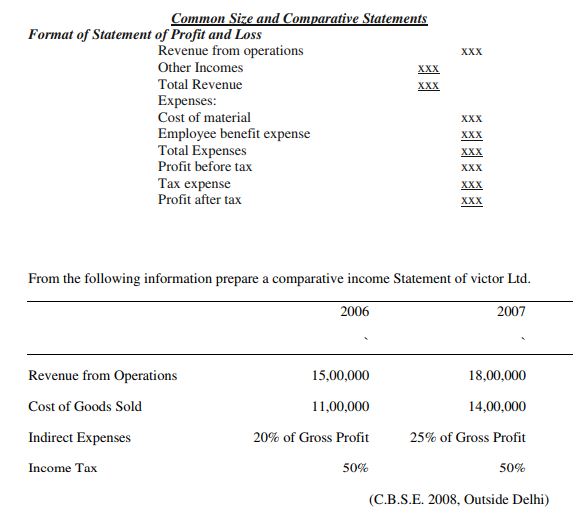
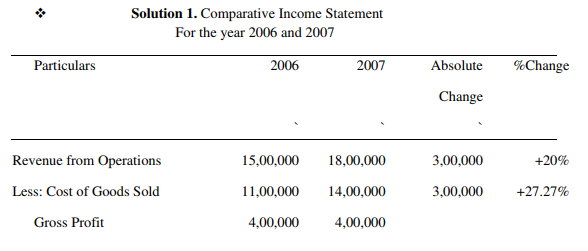
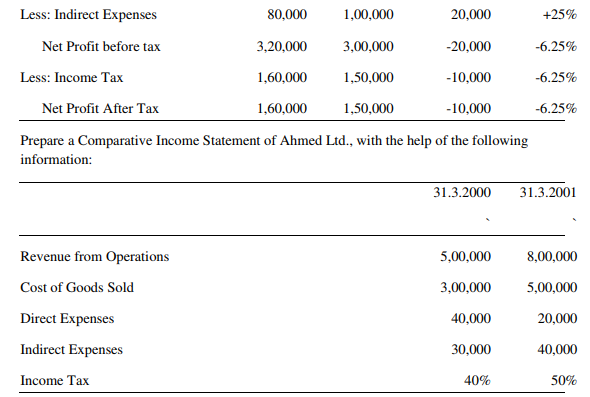
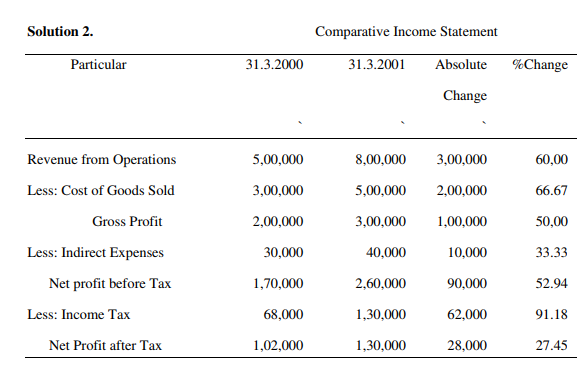
Hint: Direct expenses are ignored since they are already included in the cost of goods sold.
Prepare a Comparative Income Statement from the following information
Question--
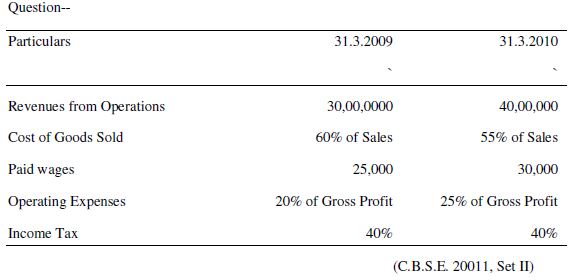
Solution 3.
Comparative Income Statement
for the years ended on 31st March 2009 and 2010
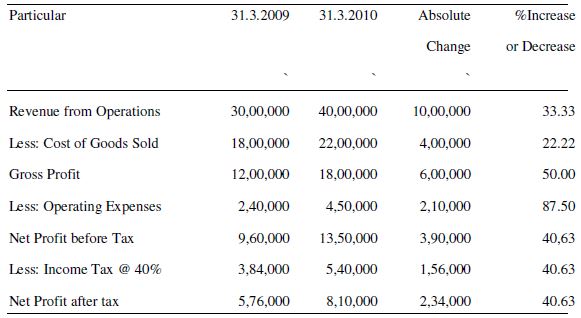
Note: Wages is a direct expense. It is ignored because it is already included in the cost of goods sold.
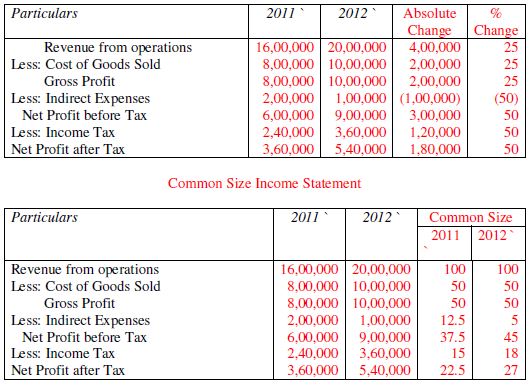
1. From the following details make out a comparative and common size statements:
Particulars 2011 ` 2012 `
Revenue from operations 16,00,000 20,00,000
Cost of Goods Sold 8,00,000 10,00,000
Indirect Expenses 2,00,000 1,00,000
Tax rate 40%
Solution:
Comparative Income Statement
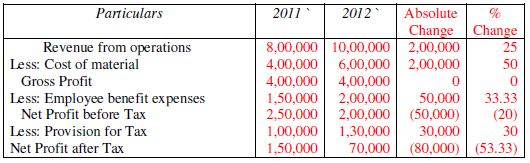
2. Prepare a comparative and common size income statement with the help of the following information:
Particulars 2011 ` 2012 `
Revenue from operations 8,00,000 10,00,000
Cost of material 4,00,000 6,00,000
Employee benefit expense 1,50,000 2,00,000
Provision for Tax 1,00,000 1,30,000
Solution:
Comparative Income Statement
For Financial Analysis
Basic Concepts
Analysis of Financial Statements: An analysis of financial statement means a thorough, systematic, comprehensive and critical examination of the information contained in the financial statements in order to understand them better, base decisions on them after drawing meaningful conclusions, take planned steps towards development and secure the future of the organisation.
Objectives of Financial Statements Analysis
- Financial Statements Analysis presents financial data in a simplified and understandable form, so that meaningful conclusions can be drawn from it.
- Financial analysis helps in assessing the profitability position and operational efficiency of the firm as a whole as well as its various departments so as to judge the financial health of the organisation.
- Financial analysis helps in ascertaining the relative importance of different components of financial position (such as assets, liabilities, owners' equity, etc.) of the firm.
- It helps in making intra-firm and inter-firm comparisons.
- It helps in identifying the causes of change in profitability or financial positions of the firm.
- Financial Statements Analysis helps in assessing future trends and thus helps in forecasting and preparation of budgets.
Limitations of Financial Statements Analysis
- The financial statements analysis suffers from such limitations as financial statements suffer. This ignores the qualitative informations like quality of management and labour force, public relations, etc.
- The analysis of financial statements do not disclose the current worth of the business. The financial statements of the company are prepared on cost principle.
- In many situations, accountant has to make a choice out of various alternatives available. He may choose that alternative which may be beneficial to the company. In such case, the financial statements are not free from bias.
- Different firms may follow different accounting policies. This may create difficulty in comparing the results of two companies.
Tools for Analysis of Financial Statements: Analysis of Financial Statements can be carried out by using the following tools:
- Comparative Statements (Horizontal Analysis)
- Common-size Statements (Vertical Analysis)
- Ratio Analysis
- Cash Flow Statement
Comparative Statement: Comparative statements compare financial data at two points of time and help in deriving meaningful conclusions regarding the changes in financial position and operating results. Statements showing financial data for two or more than two years, placed side by side to facilitate comparison are called 'Comparative Financial Statements.'
(A) Comparative Balance Sheet
According to Faulke, "Comparative Balance Sheet analysis is the study of the trend of the same items or group of items and computed items in two or more Balance Sheets of the same business enterprise of different dates."
The Comparative Balance Sheet shows increase and decrease in absolute terms as well as in percentages, in various assets, liabilities and capital and thus provides information regarding progress of the business firm.
Format of Comparative Balance Sheet
Comparative Balance Sheet of ............... Ltd.
as at 31st March, 2018 and 2019
| Particulars | Note No. | Previous Year (₹) 2017-18 | Current Year (₹) 2018-19 | Absolute Change (₹) | Percentage Change (%) |
|---|---|---|---|---|---|
| 1. | 2. | 3. | 4. | 5. | |
| A | B | (B - A) = C | C/Ax100 = D | ||
| I. EQUITY AND LIABILITIES | |||||
| 1. Shareholders' Funds | |||||
| (a) Share Capital | |||||
| (i) Equity Share Capital | |||||
| (ii) Preference Share Capital | |||||
| (b) Reserves and Surplus | |||||
| 2. Non-Current Liabilities | |||||
| (a) Long-term Borrowings | |||||
| (b) Other Long-term Liabilities | |||||
| (c) Long-term Provisions | |||||
| 3. Current Liabilities | |||||
| (a) Short-term Borrowings | |||||
| (b) Trade Payables | |||||
| (c) Other Current Liabilities | |||||
| (d) Short-term Provisions | |||||
| Total | |||||
| II. ASSETS | |||||
| 1. Non-Current Assets | |||||
| (a) Fixed Assets | |||||
| (i) Tangible Assets | |||||
| (ii) Intangible Assets | |||||
| (b) Non-current Investments | |||||
| (c) Long-term Loans and Advances | |||||
| (d) Other Non-current Assets | |||||
| 2. Current Assets | |||||
| (a) Current Investments | |||||
| (b) Inventories | |||||
| (c) Trade Receivables | |||||
| (d) Cash and Cash Equivalents | |||||
| (e) Short-term Loans and Advances | |||||
| (f) Other Current Assets | |||||
| Total |
(B) Comparative Statement of Profit and Loss or Comparative Income Statement: Comparative Statement of Profit and Loss is the income statement which is prepared in such a form so as to reflect the operating activities of the business for two or more accounting periods. It helps in assessing and reviewing the operational efficiency, deciding future course of action and formulating effective planning. The generally accepted format of the Comparative Income Statement is given below:
Format of Comparative Statement of Profit and Loss
Comparative Statement of Profit and Loss
for the years ended 31st March, 2018 and 2019
| Particulars | Note No. | Previous Year (₹) (2017-18) | Current Year (₹) (2018-19) | Absolute Change (₹) | Percentage Change (%) |
|---|---|---|---|---|---|
| A | B | (B - A) = C | C/Ax100 = D | ||
| I. Revenue from Operations | |||||
| II. Other Income | |||||
| III. Total Revenue (I + II) | |||||
| IV. Expenses: | |||||
| Cost of material consumed | |||||
| Purchases of Stock-in-Trade | |||||
| Changes in inventories of Finished Goods, Work-in-Progress and Stock-in-Trade | |||||
| Employees Benefit Expenses | |||||
| Finance Costs | |||||
| Depreciation and Amortization Expenses | |||||
| Other Expenses | |||||
| Total Expenses | |||||
| V. Profit before tax (III - IV) | |||||
| VI. Less: Income Tax | |||||
| VII. Profit after Tax (V - VI) |
Note: If current year's value has decreased, show the absolute change and percentage change in brackets to reflect negative item.
Common Size Statements: According to Kohler, "Common Size Statements are accounting statements expressed in percentages of some base rather than rupees."
(A) Common Size Balance Sheet: In a Common Size Balance Sheet each item of assets is converted into percentages to total assets (i.e., 100) and each item of equity and liabilities is converted into percentages to total equity and liabilities (i.e., 100). Thus, the Balance Sheet is converted into percentage form and the converted Balance Sheet is called as 'Common Size Balance Sheet'.
Format of Common Size Balance Sheet
Common Size Balance Sheet
as at 31st March, 2018 and 2019
| Particulars | Note No. | Absolute Amounts 2017-18 (₹) | Absolute Amounts 2018-19 (₹) | Percentage of Balance Sheet Total 2017-18 (%) | Percentage of Balance Sheet Total 2018-19 (%) |
|---|---|---|---|---|---|
| I. EQUITY AND LIABILITIES | |||||
| 1. Shareholders' Funds | |||||
| (a) Share Capital | |||||
| (i) Equity Share Capital |
(B) Common Size Statement of Profit and Loss: In a Common Size Statement of Profit and Loss or Income Statement each item is shown as percentage to Revenue from Operations (Net Sales). It reflects as to what part of revenue from operations has been absorbed by each individual item of expense.
Format of a Common Size Statement of Profit and Loss
Common Size Statement of Profit and Loss
for the years ended 2018 and 2019
| Particulars | Note No. | Absolute Amounts 2017-18 (₹) | Absolute Amounts 2018-19 (₹) | Percentage of Revenue from Operations 2017-18 (%) | Percentage of Revenue from Operations 2018-19 (%) |
|---|---|---|---|---|---|
| I. Revenue from Operations | 100 | 100 | |||
| II. Other Income | |||||
| III. Total Revenue (I + II) | |||||
| IV. Expenses: | |||||
| Cost of Materials Consumed | |||||
| Purchases of Stock-in-Trade | |||||
| Changes in inventories of Finished Goods, Work-in-Progress and Stock-in-Trade | |||||
| Employees Benefit Expenses |
Please click the link below to download pdf file for CBSE Class 12 Partnership - Common Size and Comparative Statements Notes.
Free study material for Accountancy
Study Material and Revision Notes for Class 12 Accountancy Part 2 Chapter 04 Analysis of Financial Statements
About Part 2 Chapter 04 Analysis of Financial Statements Revision Notes
Review targeted chapter notes for Class 12 Accountancy Part 2 Chapter 04 Analysis of Financial Statements. Built according to official CBSE guidelines, these summaries highlight high-yield topics frequently tested in school evaluations.
How to Use These Revision Notes
Cross-reference your comprehension with comprehensive NCERT solutions for Class 12 to ensure absolute clarity across all sub-topics in this chapter.
Enhance Practice with MCQs and Worksheets
Wrap up your chapter revision by testing your knowledge against standard question formats. Everything on our platform is provided free of charge.
FAQs
You can download the teacher prepared revision notes for CBSE Class 12 Accountancy Partnership Common Size And Comparative Statements Notes from StudiesToday.com. These notes are designed as per 2026-27 academic session to help Class 12 students get the best study material for Accountancy.
Yes, our CBSE Class 12 Accountancy Partnership Common Size And Comparative Statements Notes include 50% competency-based questions with focus on core logic, keyword definitions, and the practical application of Accountancy principles which is important for getting more marks in 2026 CBSE exams.
Yes, our CBSE Class 12 Accountancy Partnership Common Size And Comparative Statements Notes provide a detailed, topic wise breakdown of the chapter. Fundamental definitions, complex numerical formulas and all topics of CBSE syllabus in Class 12 is covered.
These notes for Accountancy are organized into bullet points and easy-to-read charts. By using CBSE Class 12 Accountancy Partnership Common Size And Comparative Statements Notes, Class 12 students fast revise formulas, key definitions before the exams.
No, all study resources on StudiesToday, including CBSE Class 12 Accountancy Partnership Common Size And Comparative Statements Notes, are available for immediate free download. Class 12 Accountancy study material is available in PDF and can be downloaded on mobile.