

Revision Notes for Class 12 Accountancy: Part 2 Chapter 05 Accounting Ratios
Review targeted revision notes for Class 12 Accountancy with the CBSE Class 12 Accountancy Accounting Ratios. Built according to official educational guidelines for the 2026-27 academic year, these downloadable summaries for Part 2 Chapter 05 Accounting Ratios support daily study and last-minute exam readiness.
Review Part 2 Chapter 05 Accounting Ratios for Class 12 Accountancy
View or download the dedicated Part 2 Chapter 05 Accounting Ratios revision resource below. Engaging with these structured concept notes daily ensures continuous academic progress and mastery of the 2026-27 curriculum for Accountancy.
Accounting Ratio : It is arithmetical relationship between two accounting variables.
Ratio Analysis : A tool used by individuals to conduct a quantitative analysis of infomation in a company's financial statements
Expression of ratios : Ratios are expressed in
1. Pure form like 2:1 all current ratios are expressed in pure form.
2. Percentage e.g. 15% all profitability ratios are presented in percentage form
3. Times like 4 times all turnonver ratios are presented in no. of times
4. Fraction like 3/4 or .75 all solvency ratios are presented in fractions except Interest Coverage Ratio which is presented in Number of times :
Classification or types of ratios
Ratios are classified into 4 categories
1. Liquidity Ratios also called as short term solvency ratios.
2. Solvency Ratios
3. Activity ratios also known as Turnover ratios or Performance ratios
4. Profitability ratios
Note : For Calculation of ratios Formula must be written as it carries marks Liquidity Ratios : Thesemeasure short term solvency, i.e. the firm's ability to pay current dues. These are
1. Current Ratio also called as working capital ratio
2. Liquid Ratio also called as quick ratio or acid test ratio.
Current ratio is relationship of current assets with current liabilities.
1. CURRENT RATIO = CURRENT ASSETS/CURRENT LIABILITIES
Current assets are assets that can be converted into cash or cash equivalent within short period of time usually a year and current liabilities are those are to be paid in short period.
Example : Current assets are : Cash, Bank, Debtor, Stock (also called as Inventory), Perpaid Expenses and Marketable Securities (highly liquid investment with very little risk of changes in value), Accrued income.
Current Liabilities are : Creditors, Bills Payable, Bank Overdraft, Outstanding Expenses,Advance Income, Unclaimed Dividend, Provision for taxation.
Significance : It assesses ability of business to pay short term liability promptly. Ideal Ratio : 2:1 Low ratio indicates cannot meet short term liability. High ratio indicates funds not used effciently and lying idle or poor investment (important for Project work)
Example : XYZ Company's total current assets are Rs.10,000,000 and its total current liabilities are Rs.8,000,000 then its current ratio would be Rs.10,000,000 divided by Rs.8,00,000 which is equal to 1.25 XYZ Company would be in relatively good shortterm financial standing.
Computation of ratio
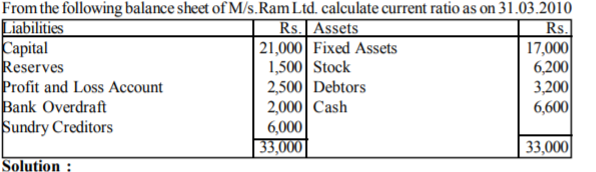
Current Ratio = Current Assets/ Current Liabilities
= Stock+Debtors+Cash/Bank Overdraft+ Sundry Creditors
= Rs.6,200+Rs.3,200+Rs.6,600
= Rs.16,000/Rs.8,000= 2:1
Alternatively current assets can be calculated as
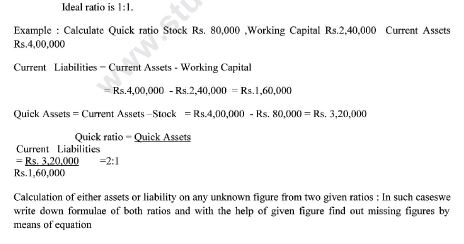
Current Assets = Working Capital + Current Liabilities
Current Assets = Total Assets Fixed Assets
Current Liabilities = Total AssetsCapital Employed
Indirect question
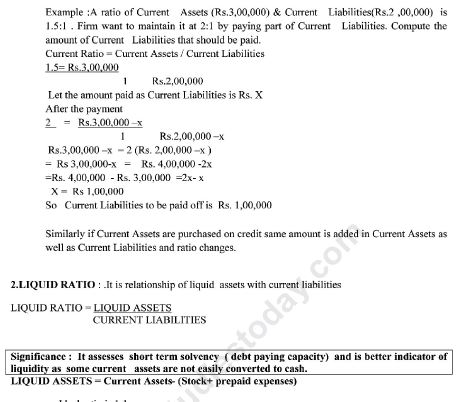
On payment of current liablity Current Assets and Current Liability reduce to same extent, in such cases ratio change e.g. If current assets are Rs.40,000 and current liabilities are Rs.20,000 on payment of Rs.10,000 to creditors the cash (current asset) will decrease to Rs.30,000 (Rs.40,000 Rs. 10,000) & current liabilities will decrease to Rs.10,000 (Rs.20,000 -Rs.10,000)
In first case current ratio is 2:1 Rs.40,000/Rs.20,000
And is second case it is 3:1 Rs.30,000/Rs.10,000
Ratio
Ratio is an arithmetical relationship between two interdependent or related items.
Accounting Ratios
It is a mathematical expression that shows the relationship between various items or groups of items shown in financial statements. When ratios are calculated on the basis of accounting information, they are called accounting ratios.
Ratio Analysis
It is a technique which involves re-grouping of data by application of arithmetical relationship.
Forms of Expressing Ratios
There are several forms of expressing ratios as per the chapter on accounting ratios class 12. Let's have a look:
- Pure: Ratios are expressed as quotient
- Percentage: Ratios are expressed as percentage
- Times: Ratios are expressed in number of times
- Fraction: Ratios are expressed in fraction
Ratio Analysis
- It studies the various financial factors in a business.
- It analyses financial statements using accounting ratios.
- It helps determine and interpret relationships between items of financial statements and provides a meaningful understanding of the position and performance of an enterprise.
Objectives of Ratio Analysis
- To know the areas of an enterprise which need more attention.
- To know about the potential areas which can be improved on.
- Helpful in comparative analysis of the performance.
- Helpful in budgeting and forecasting.
- To provide analysis of the liquidity, solvency, activity and profitability of an enterprise.
- To provide information useful for making estimates and preparing the plans for the future.
Advantages of Ratio Analysis
- It is an essential tool for analysis of Financial Statements.
- It simplifies the information on the accounting data.
- It assists in business planning and forecasting
- It helps identify and interpret the favourable and unfavourable ratios which can be used to identify the weak areas in the enterprise.
- It facilitates Inter-firm and Intra-firm Comparison.
Limitations of Ratio Analysis
- Accounting ratios ignore qualitative factors.
- Absence of universally accepted terminology.
- Ratios are affected by window-dressing.
- Effects of inherent limitations of accounting.
- Misleading results in the absence of absolute data.
- Price level changes ignored.
- Affected by personal bias and ability of the analyst.
Classification of Accounting Ratios
Types of Accounting Ratios include Liquidity Ratios, Profitability Ratios, Activity Ratios, and Leverage Ratios. Under Liquidity Ratios are Current Ratio, Quick Ratio, and Cash Ratio. Under Profitability Ratios are Gross Profit Ratio, Net Profit Ratio, Operating Expense Ratio, and Return on Capital. Under Activity Ratios are Inventory Turnover Ratio, Debtors Turnover Ratio, Total Assets Turnover Ratio, and Fixed Assets Turnover Ratio. Under Leverage Ratios are Debt Equity Ratio, Debt Ratio, and Proprietary Ratio.
Items Included in Current Assets
- Current investments
- Inventories (Excluding loose tools, stores and spares)
- Trade receivables (bills receivable and sundry debtors less provision for doubtful debts)
- Cash and cash equivalents (cash in hand, cash at bank, cheques/drafts in hand)
- Short-term loans and advances
- Other current assets (prepaid expenses, interest receivable, etc.)
Items Included in Current Liabilities
- Short-term borrowings
- Trade payables (bills payable and sundry creditors)
- Other current liabilities (current maturities of long-term debts, interest, accrued but not due on borrowings, interest accrued and due on borrowings, outstanding expenses, unclaimed dividend, calls-in-advance, etc)
- Short-term provisions
Current Ratio
It calculates the relationship between the current assets and current liabilities and measures the relationship between the current assets and current liabilities.
Steps to Be Taken to Determine the Effect of a Transaction on Current Ratio
- Step 1: Amounts of Current Assets and Current Liabilities are to be assumed.
- Step 2: Consider the effects of a transaction and put it in the assumed amounts of Current Assets and Current Liabilities. After accommodating such effects in the assumed amounts, new amounts of Current Assets and Current Liabilities are to be calculated.
- Step 3: Using these new amounts, a new ratio is to be calculated. Such a new/revised ratio is to be compared with the old ratio to determine its effect on the Current Ratio, i.e., increase, decrease or no change in the ratio.
Liquid or Quick or Acid Test Ratio
It is a liquidity ratio that measures the enterprise's ability to meet its short-term financial obligations, i.e., Current Liabilities, and indicates the short-term debt-paying capacity of an enterprise and is, therefore, a better indicator of liquidity.
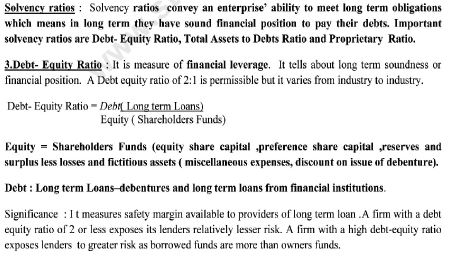
Debt-to Equity Ratio
- It is a relationship between long-term external equities, i.e., external debts (includes long-term borrowings and long-term provisions) and internal equities (Shareholders' Funds) of the enterprise.
- It measures the proportion of external funds and shareholders invested in the company.
- It assesses the enterprise's long-term financial soundness and indicates the extent to which the enterprise depends on borrowed funds for its business.
- It is expressed as a Pure Ratio.
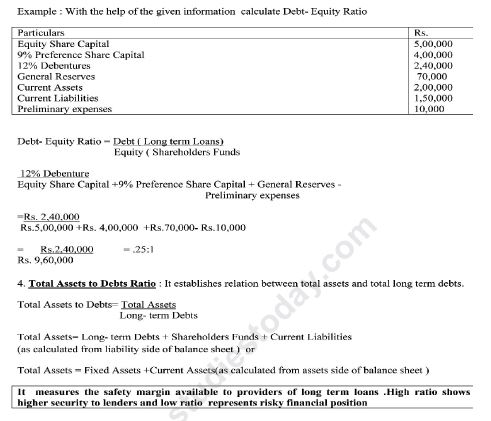
Total Assets to Debt Ratio
- It is a relationship between total assets and long-term debts of the enterprise.
- It measures the extent to which debt (Long-term) is covered by the assets.
- It measures the 'Safety Margin' available to the lenders of the long-term debts.
- A higher ratio means higher safety for lenders and a lower ratio means lower safety for lenders.
- It is expressed as a Pure Ratio
Proprietary Ratio
- It is a relationship between the proprietor's fund and total assets.
- It shows the financial strength of the entity.
- It is used to find the proportion of total assets financed by Proprietors' Funds.
- It is an important ratio for the creditors. It helps them identify the portion of shareholders' funds in the total assets employed in the firm and the safety margin available to them.
- A very high ratio indicates an improper mix of proprietors' funds and loan funds that result in a lower return on investment. A higher ratio means adequate safety for creditors and lenders. On the other hand, a lower ratio means inadequate safety for creditors and lenders.
- It can be expressed either as 'Pure Ratio' or a 'Percentage Ratio'.
Interest Coverage Ratio
- It is a relationship between Net Profit before Interest and Tax and Interest on Long Term Debts.
- It is calculated to ascertain the amount of profit available to cover the interest on long term debts.
- A higher Interest Coverage Ratio is considered better for lenders as it signifies a higher margin to meet interest cost.
Inventory Turnover Ratio
- It is a relationship between Cost of Revenue from Operations, i.e., Cost of Goods Sold and average inventory carried during that period.
- It ascertains whether the stock investment is appropriate and that only the required amount is invested in the stock.
- It measures the number of times an enterprise sells and replaces its inventory. Therefore, it is an activity and efficiency ratio that measures the efficiency of inventory management.
- A high ratio shows that more sales are being produced by a rupee of investment in the inventories. A very high ratio indicates overtrading, which may result in a working capital shortage. Only an optimum Inventory Turnover Ratio ensures adequate working capital and helps firms earn a reasonable margin.
Trade Receivables Turnover Ratio
- The relationship between Credit Revenue from Operations (i.e., Net Credit Sales) and Average Trade Receivables (i.e., Average of debtors and bills receivable of the year).
- It indicates the number of times trade receivables are turned over in a year about credit sales.
- It identifies how quickly trade receivables are converted into Cash and Cash Equivalents and, therefore, indicates the efficiency in collecting amounts due against trade receivables.
- A higher ratio shows that debts are collected more promptly, and a lower ratio shows inefficiency in the collection or increased credit period or more investment in debtors.
- It should be computed that provision for doubtful debts is not deducted from trade receivables since the purpose is to calculate the number of days for which sales are tied up in trade receivables and not to ascertain the realizable value of debtors.
Trade Payables Turnover Ratio
- It is a relationship between the net credit purchases and total payables or average payables.
- It identifies the number of times the creditors are turned over in relation to credit purchases.
- A high ratio indicates that the enterprise is not availing a full credit period, which boosts up the credit worthiness of the enterprise. It is expressed in Times.
Working Capital Turnover Ratio
- It is a relationship between working capital and revenue from operations.
- It shows the number of times a unit of Rupee invested in working capital produces sales.
- It helps to ascertain whether or not working capital has been effectively used in generating revenue.
- A higher ratio is considered as an ideal ratio, whereas a very high ratio indicates overtrading.
Gross Profit Ratio
- It is a relationship between the Gross Profit and Revenue from Operations (i.e., Net Sales).
- A change either in Revenue from Operations (i.e., Net Sales) or Cost of Revenue from Operations (i.e., Cost of goods sold) or both will have an impact on this ratio.
- It shows the average margin on goods sold.
- It determines the efficiency with which production and/or purchase operations and selling operations are carried on.
- It is a reliable guide for fixing selling prices.
- It is useful in determining the efficiency of trading activities.
- It can be compared with the ratio of earlier years or with that of other firms to compare the efficiency and growth of the business.
Operating Profit Ratio
- It is the relationship between Operating Profit and Revenue from Operations i.e., Net Sales.
- It determines the operational efficiency of the business.
- An increase in the ratio shows improvement in the operational efficiency of the entity.
Net Profit Ratio
- It is a relationship between Net Profit and Revenue from Operations, i.e., Net Sales.
- It helps in determining the operational efficiency of the business.
- It indicates the business's actual status, as the higher the Net Profit Ratio, the better the business.
- An increase in the ratio over the past period shows improvement in operational efficiency.
- A decline in the ratio over the past period shows a fall in operational efficiency.
- It facilitates comparison of operation efficiency with that of industry standards.
Return on Capital Employment and Investment
- It shows the relationship between Net Profit/Earnings before interest and tax with capital employed.
- It measures how efficiently the resources of the business are being used.
- It is a fair measure of the profitability of any concern with the result that the performance of different industries can be compared.
- It indicates whether the company or business is giving satisfactory returns.
- It assesses the overall performance of the enterprise.
Please click the link below to download pdf file for CBSE Class 12 Accounting Ratios.
Free study material for Accountancy
Study Material and Revision Notes for Class 12 Accountancy Part 2 Chapter 05 Accounting Ratios
Key Concepts and Summary for Class 12 Accountancy Part 2 Chapter 05 Accounting Ratios
Explore reliable chapter overviews for Part 2 Chapter 05 Accounting Ratios tailored for Class 12 learners. Use these structured points to grasp difficult themes and ensure solid preparation for upcoming assessments.
NCERT-Aligned Chapter Summary and Notes
Cross-reference your comprehension with comprehensive NCERT solutions for Class 12 to ensure absolute clarity across all sub-topics in this chapter.
Next Steps in Your Exam Preparation
Follow up your revision by attempting the interactive online Accountancy MCQ test and practice worksheets for this chapter to verify your mastery. All platform resources are free to access.
FAQs
You can download the teacher prepared revision notes for CBSE Class 12 Accountancy Accounting Ratios from StudiesToday.com. These notes are designed as per 2026-27 academic session to help Class 12 students get the best study material for Accountancy.
Yes, our CBSE Class 12 Accountancy Accounting Ratios include 50% competency-based questions with focus on core logic, keyword definitions, and the practical application of Accountancy principles which is important for getting more marks in 2026 CBSE exams.
Yes, our CBSE Class 12 Accountancy Accounting Ratios provide a detailed, topic wise breakdown of the chapter. Fundamental definitions, complex numerical formulas and all topics of CBSE syllabus in Class 12 is covered.
These notes for Accountancy are organized into bullet points and easy-to-read charts. By using CBSE Class 12 Accountancy Accounting Ratios, Class 12 students fast revise formulas, key definitions before the exams.
No, all study resources on StudiesToday, including CBSE Class 12 Accountancy Accounting Ratios, are available for immediate free download. Class 12 Accountancy study material is available in PDF and can be downloaded on mobile.