

Official Class 12 Accountancy Revision Material: CBSE Class 12 Accountancy Cash Flow Statement Notes Set 02
Explore reliable concept summaries and revision materials through the CBSE Class 12 Accountancy Cash Flow Statement Notes Set 02. Tailored for Class 12 learners, utilizing these notes for Accountancy Part 2 Chapter 06 Cash Flow Statement ensures thorough preparation and strengthens core academic definitions before final evaluations.
Chapter-wise Concept Summaries: Part 2 Chapter 06 Cash Flow Statement
Navigate directly to the revision notes for Part 2 Chapter 06 Cash Flow Statement using the digital viewer below. Each summary is structured to highlight high-weightage sections, allowing students to instantly access critical definitions and focus on core exam topics.
CHAPTER 12
CASH FLOW STATEMENT
Meaning : It is a statement that shows flow (inflow or outflow) of cash and cash equivalents during a given period of time. As per Accounting Standard3
(Revised) the changes resulting in the flow of cash & cash equivalents arises on account of three types of activities i.e.
(1) Cash flow from Operating Activities.
(2) Cash flow from Investing Activities.
(3) Cash flow from Financing Activities.
Cash : Cash comprises cash in hand and demad deposits with bank.
Cash equivalents : Cash equivalents are shortterm higly liquid investment that are readily convertible into known amount of cash and which are subject to an insignificant risk of change in the value (of shotterm investment). Generally theses investment have a maturity period of less than three months.
Some example of cash equivalent : Bank overdraft, cash credit, shortterm deposits, maketable securities, treasury bills, commercial papers, money market funds (mutual fund), investment in preference shares if redeemable within three months and ensure that there is no risk of the failure of the company. Some type of transaction which are considered movement between cash and cash equivaletns are given below :
1. Cash deposited into bank.
2. Cash withdrawn from bank.
3. Sale of cash equivalent securities (e.g. sale of short term investment, sale of commercial papers)
4. Purchase of cash equivalent securities (e.g. Purchase of shortterm investment, Purchase of Treasury bills).
The above types of transaction are part of cash and cash equivaltens, so these are included in opening and closing cash and cash equivalent only. So these types of transanction not be included in cash from different activities like operating, investing, financing activities.
Preparation of cash flow statement :
Cash flow from operating activities _______
Cash flow from investing activities _______
Cash flow from financing activities _______
Net increase/decrease in cash & cash equivalent (Total of the above three activities) Add : Cash & Cash equivalent in the
beginning of the year (Given in opening balance sheet) _______
Cash & Cash equivalent at the end of the year _______
Note : The student should ensure that the cash & Cash equivalent at the end of the year as calculated above will be same as cash & cash equivalent given in closing balance sheet
OBJECTIVES OF CASH FLOW STATMEMENT :
1. To ascertain how mach cash or cash equivalents have been generated or used in different activities i.e. operating/investing/financing activity.
2. To ascertain the net changes in cash and cash equivalents.
3. To assesss the causes of difference between actual cash & cash equivalent and related net earning/income.
4. To help in formulation of financial policies such as dividend policy, fixed assests policy, capital structure related policy.
5. To help in shortterm financial planing.
6. To ascertain the liquidity of enterprises
LIMITATIONS OF CASH FLOW STATEMENT
1. Non cash transaction are not taken into consideration like sahres or debentures issued to vendores, deprecaition charged during the year.
2. It is a statement related with past data.
3. It is not used for judging the profitability of enterprises.
4. Accrual accounting concept is ignored in this statement e.g. credi sales, credit purchases, outstanding expesnes, accrued income are not included. Computation of Cash flow from different activities.
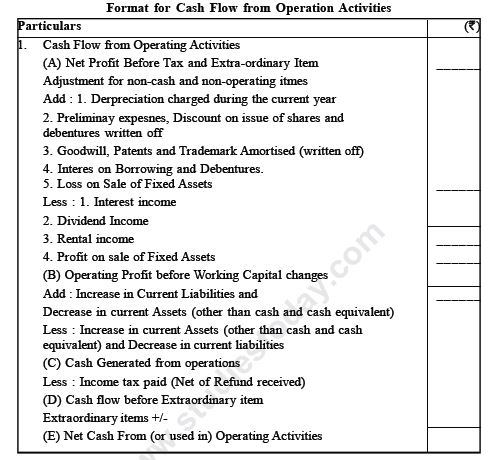
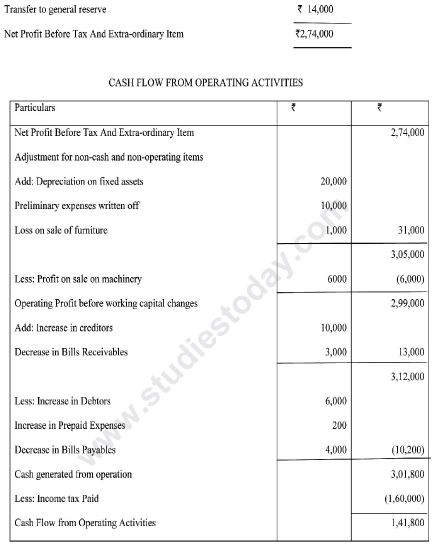
(1) Cash flow from operating activities : operating activities are the main revenue generating activities of the enterprises. It includes tha transaction also which are not included in investing and financing activities. Accounting standard 3 (Revised) has suggested two methods of computing net cash from operating activities (A) Direct Method (B) Indirect Method. (C) Indirect Method of calculating the cash flow from Operating Activities :
Under this method Net Profit Before Tax and Extraordinary Item is the starting point further calculations.
Calculations of Net Profit Before Tax Extra ordinary Item :
Difference between closing balance and opening balance of profit & loss A/c ____
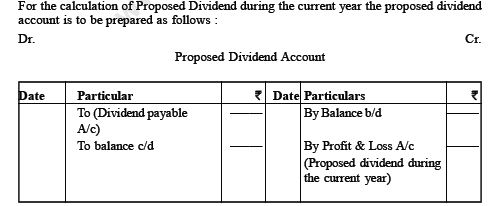
Add : 1. Proposes divident for current year ____
2. Interim Divident paid during the year. ____
3. Profit Transferred to Reserve
(If reserve of current year increased from previous year) ____
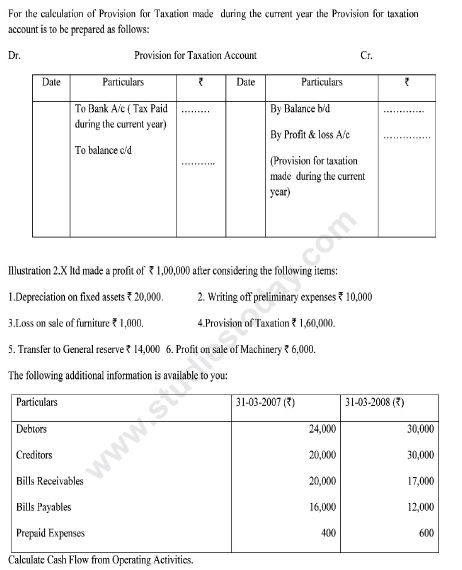
4. Provision for Taxation made durning the year ____
Less : 1 Refund of Tax credited to P & L A/c ____
2. Extraordinary item if any Credited to P & L A/c ____
Net Profit Before Tax and Extraordinary Item Extraordinary items : These items are not related to normal business operation and not included in investing and financing activities
Please click the link below to download pdf file for CBSE Class 12 Cash Flow Statement
Free study material for Accountancy
Download CBSE Revision Notes: Class 12 Accountancy Part 2 Chapter 06 Cash Flow Statement
Key Concepts and Summary for Class 12 Accountancy Part 2 Chapter 06 Cash Flow Statement
Explore reliable chapter overviews for Part 2 Chapter 06 Cash Flow Statement tailored for Class 12 learners. Use these structured points to grasp difficult themes and ensure solid preparation for upcoming assessments.
NCERT-Aligned Chapter Summary and Notes
Each chapter summary is structured around standard CBSE textbooks, allowing students to check their understanding and clarify complex ideas early in their revision.
Next Steps in Your Exam Preparation
Explore our broader library of printable assignments, chapter notes, and mock tests designed to support continuous revision and secure higher marks in CBSE assessments.
FAQs
You can download the teacher prepared revision notes for CBSE Class 12 Accountancy Cash Flow Statement Notes Set 02 from StudiesToday.com. These notes are designed as per 2026-27 academic session to help Class 12 students get the best study material for Accountancy.
Yes, our CBSE Class 12 Accountancy Cash Flow Statement Notes Set 02 include 50% competency-based questions with focus on core logic, keyword definitions, and the practical application of Accountancy principles which is important for getting more marks in 2026 CBSE exams.
Yes, our CBSE Class 12 Accountancy Cash Flow Statement Notes Set 02 provide a detailed, topic wise breakdown of the chapter. Fundamental definitions, complex numerical formulas and all topics of CBSE syllabus in Class 12 is covered.
These notes for Accountancy are organized into bullet points and easy-to-read charts. By using CBSE Class 12 Accountancy Cash Flow Statement Notes Set 02, Class 12 students fast revise formulas, key definitions before the exams.
No, all study resources on StudiesToday, including CBSE Class 12 Accountancy Cash Flow Statement Notes Set 02, are available for immediate free download. Class 12 Accountancy study material is available in PDF and can be downloaded on mobile.