

Download Class 12 Accountancy Concept Summaries: CBSE Class 12 Accountancy Accounting For Share Capital Notes
Explore reliable concept summaries and revision materials through the CBSE Class 12 Accountancy Accounting For Share Capital Notes. Tailored for Class 12 learners, utilizing these notes for Accountancy Part 2 Chapter 01 Accounting for Share Capital ensures thorough preparation and strengthens core academic definitions before final evaluations.
Access Part 2 Chapter 01 Accounting for Share Capital Notes and Study Material
Navigate directly to the revision notes for Part 2 Chapter 01 Accounting for Share Capital using the digital viewer below. Each summary is structured to highlight high-weightage sections, allowing students to instantly access critical definitions and focus on core exam topics.
Accounting for Share Capital
Company: It is
1. A Form of business organization
2. It is an Association of persons who provide capital
3. Is an artificial, invisible and intangible
4. Has separate legal identity
5. Has Perpetual existence
6. Has Common seal
7. is not affected by death , insolvency or insanity of individual
Private company:
According to section 3(1)(iii)
1. Has paid up capital of one lakh
2. Maximum number of members is 50
3. It restricts the right to transfer of shares
4. Prohibits any invitation to public to subscribe for shares and Debentures
5. Prohibits any invitation or acceptance of deposits from persons other than its members , directors or their relatives
PUBLIC COMPANY:
According to section 3(1)(iv)
1. Is not a private company
2. Has minimum paid up capital of 5 lakhs or higher as may be prescribed
3. Is a private company which is subsidiary of a company which is not a private company
GOVERNMENT COMPANY
As per section 617 is a company in which more than 50% of paid up capital is held by Central or State Government or both
FOREIGN COMPANY
Section 591of Act states this type of company is incorporated outside India but has established business in India.
Incorporation of company
There are 4 stages
1. Promotion -conceiving an idea of business
2. Incorporation or registration
3. Capital subscription which means raising capital
4. Commencement of business for which certificate of Commencement of business is to be obtained.
Some important definitions(theory questions)
MINIMUM SUBSCRIPTION : It is number of shares on which amount received is sufficient to commence business .
PROSPECTUS : It is an invitation to public for subscription of shares or debentures.
PRELIMINARY EXPENSES : are expenses incurred for incorporating the company are carried in balance sheet unless these are written off.
CAPITAL : means amount invested in the business for the purpose of earning revenue. In case of company money is contributed by public and people who contribute money are called shareholders.
SHARE CAPITAL: capital raised by issue of shares is called share capital.
AUTHORISED CAPITAL : Also Called as Nominal or registered capital .It is the maximum amount of capital a company can issue . It is stated in Memorandum of Association.
ISSUED CAPITAL : this is part of authorized capital which is offered to public for subscription. It cannot exceed authorized capital .
SUBSCRIBED CAPITAL : It is part of issued capital subscribed or applied by public.
CALLED UP CAPITAL : It is the amount of nominal value of shares that has been called up by the company for payment by the subscriber towards the share.
PAID UP CAPITAL : It is part of called up capital that the members of company or shareholders have paid.
Example : X Ltd. is registered with the following share capital 1,25,000 equity shares of Rs. 10 each, payable in the following manner 10% on application,20% on allotment ,30% on first call the balance on final call .
The company offered for subscription 80,000 equity shares .The public applied for 75,000 share The company duly allotted these shares .It made only first call by 31st March 2010.The first call was received on all shares except 300 equity shares. Prepare Balance Sheet of Company.
Disclosure of share capital in Company’s Balance Sheet
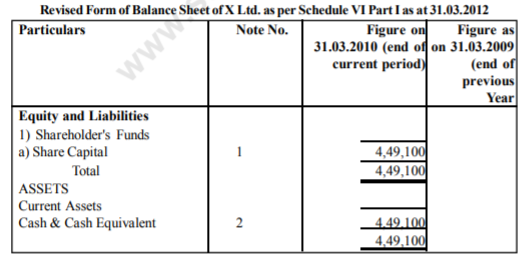
Note No. :1
Authorised Captial
1,25,000 equity shares @ ` 10 each 12,50,000
Issued Capital
80000 Equity Shares @ ` 10 each 8,00,000
Subscribed & Paid up
75000 eq. shares of @ ` 10 each
issued to public @ ` 6 4,50,000
Less : Unpaid calls 900 4,49,100
4,49,100
Note No. 2 : Amount received on application
75000 @ ` 1(10%) 75,000
Amount received on allotment 1,50,000
75000 sh @ ` 2(20%)
Amount Received on call 2,24,100
74700 Shares @ ` 3(30%)
4,49,100
RESERVE CAPITAL : It is that part of uncalled capital which the company reserve to be called only upon winding up of company. For this a special resolution has to be passed
CAPITAL RESERVE : It is capital profit not available for distribution as dividend.
It is represented in balance sheet of company as Reserves and Surplus under the heading Shareholders' Funds
CLASSES OF SHARES : There are two classes of shares
1. Preference shares
2. Equity shares

Equity shares : The shares which are not preference shares are called equity shares and do not get preference in above respect.
ISSUE OF SHARES
Shares can be issued in two ways
1. for cash
2. for consideration other than cash
Terms of issue of share : shares can be issued in three ways
1. Issue of shares at Par
2. Issue of shares at Premium
3. Issue of shares at Discount
Shares payable in Instalments
1. First instalment paid along with application is called as application money.
2. Second instalment paid on allotment is called as allotment money.
3. Subsequent instalment paid are called as call money calls can be more than one and called First call, second call or as the case may be
ISSUE OF SHARES FOR CASH AT PAR : This means shares are issued at face value Journal entries
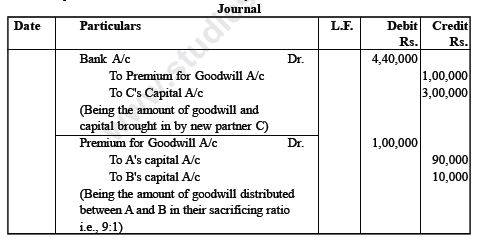
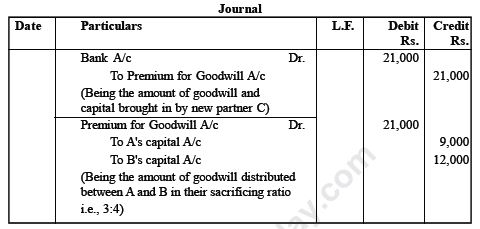
NOTE : For each entry narration is compulsory as given in example below and carries marks columns are compulsory table should be made in proper format ( all columns are compulsory) after each entry in column of particulars line must be drawn.
Example : X Ltd. invited application for 10,000 shares of the value of Rs.10 each. The amount is payable as Rs.2 on application and Rs.5 on allotment and balance on First and Final call. Teh whole of the above issue was applied and cash duly recived. Give Journal entries for the above transaction.
In the Books of X Ltd.
Solution
ISSUES OF SHARES AT PREMIUM : It is issue of share at more than face value. (Section 78)
This premium can be utilised for
1. Issue of bonus shares
2. Write off preliminary expenses, discount, commission on issue of shares
3. Buy back of shares
4. Redemption of debentures o preference shares
Please click the link below to download pdf file for CBSE Class 12 Accounting for Share Capital.
Free study material for Accountancy
Study Material and Revision Notes for Class 12 Accountancy Part 2 Chapter 01 Accounting for Share Capital
Quick Revision Notes: Part 2 Chapter 01 Accounting for Share Capital (CBSE)
Review targeted chapter notes for Class 12 Accountancy Part 2 Chapter 01 Accounting for Share Capital. Built according to official CBSE guidelines, these summaries highlight high-yield topics frequently tested in school evaluations.
Expert Study Material for Class 12 Accountancy
Built using the official NCERT book for Class 12 Accountancy, these notes provide reliable academic guidance. Pair your summary review with our recommended NCERT solutions to master optimal problem-solving approaches.
Complete Your Chapter Revision
Wrap up your chapter revision by testing your knowledge against standard question formats. Everything on our platform is provided free of charge.
FAQs
You can download the teacher prepared revision notes for CBSE Class 12 Accountancy Accounting For Share Capital Notes from StudiesToday.com. These notes are designed as per 2026-27 academic session to help Class 12 students get the best study material for Accountancy.
Yes, our CBSE Class 12 Accountancy Accounting For Share Capital Notes include 50% competency-based questions with focus on core logic, keyword definitions, and the practical application of Accountancy principles which is important for getting more marks in 2026 CBSE exams.
Yes, our CBSE Class 12 Accountancy Accounting For Share Capital Notes provide a detailed, topic wise breakdown of the chapter. Fundamental definitions, complex numerical formulas and all topics of CBSE syllabus in Class 12 is covered.
These notes for Accountancy are organized into bullet points and easy-to-read charts. By using CBSE Class 12 Accountancy Accounting For Share Capital Notes, Class 12 students fast revise formulas, key definitions before the exams.
No, all study resources on StudiesToday, including CBSE Class 12 Accountancy Accounting For Share Capital Notes, are available for immediate free download. Class 12 Accountancy study material is available in PDF and can be downloaded on mobile.