

Revision Notes for Class 12 Accountancy: Part 2 Chapter 01 Accounting for Share Capital
Review targeted revision notes for Class 12 Accountancy with the CBSE Class 12 Accountancy Accounting For Share Capital Chapter Notes. Built according to official educational guidelines for the 2026-27 academic year, these downloadable summaries for Part 2 Chapter 01 Accounting for Share Capital support daily study and last-minute exam readiness.
Review Part 2 Chapter 01 Accounting for Share Capital for Class 12 Accountancy
Access the complete concept summary PDF for Part 2 Chapter 01 Accounting for Share Capital below. Regular review of these targeted notes builds familiarity with complex Class 12 Accountancy themes and helps secure higher marks in final school evaluations.


Accounting For Share Capital
Definition Of A Company
A company may be defined as an artificial person created by law, having a corporate and legal personality distinct and separate from its members, perpetual succession, and a common seal.
Characteristics (Features) Of A Company
- It is a voluntary association of persons for profit.
- It is a separate legal entity - its legal existence is different from that of its members.
- The members have limited liability.
- It has perpetual succession.
- It has a common seal which signifies the sign of the company.
- The shares of a public limited company can be freely transferable.
- It can enter into contracts and can enforce contractual rights against others. Similarly, the company can be sued by others if there is a breach of contract by the company.
Types Of Companies
1. Private Company
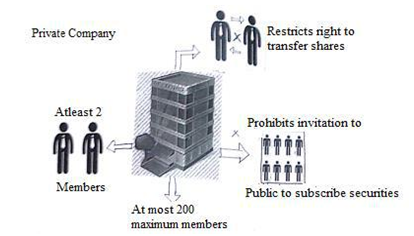
Section 2 (68) of the Companies Act, 2013 defines a private company as a company which has a minimum paid up capital of Rs. 100,000 and which by its Articles of Association -
- Restricts the right to transfer its shares.
- Limits the number of its members to 200 excluding its part or present employee members.
- Prohibits any invitation to the public to subscribe for any of its securities.
2. Public Company
According to section 2 (71) of the Companies Act, 2013 a public company means a company which is not a private company and has a minimum paid up capital of Rs. 500,000 or higher capital as may be prescribed. A private company which is a subsidiary of a company not being a private company shall be deemed a public company.
3. One Person Company
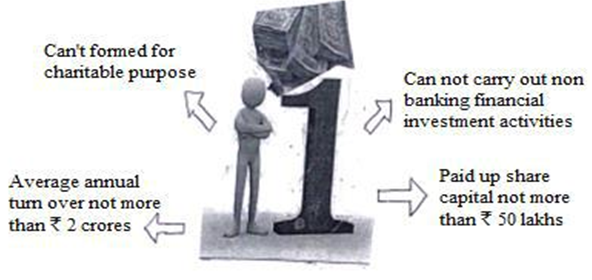
Section 2 (62) of the Companies Act, 2013 states one person company is a company which has only one person as a member. Rule 3 of the Companies (In Corporation) Rules, 2014 provides that -
- Only an Indian citizen resident in India can form one person company.
- Its paid up capital is not more than 50 lakhs.
- Its average annual turnover should not exceed Rs. 2 crores.
- It cannot carry out non-banking financial investment activities.
Kinds Of A Company
On The Basis Of Liability Of Its Members
1. Companies Limited By Shares
In this case, the liability of the members is limited to the extent of the nominal value of shares held by them.
2. Companies Limited By Guarantee
In this case, the liability of its members is limited to the extent of the guarantee given by them in the event of the company being wound up.
3. Unlimited Companies
When there is no limit on the liability of its members, such companies are called unlimited companies.
On The Basis Of Number Of Members
1. Public Company
A public company means a company that is not a private company.
2. Private Company
A private company is one which by its Articles of Association -
- Restricts the right to transfer its shares.
- Limits the number of its members to fifty.
- Prohibits any invitation to the public to subscribe for any shares in or debentures of the company.
Class / Types Of Shares
There are two classes of shares:
1. Preference Shares
The shares which get preferential right in respect of:
- Right of dividend
- Repayment of capital on winding up of the company.
2. Equity Shares
The shares which are not preference shares are called equity shares and do not get preference in the above respect.
Distinction Between Equity Share And Preference Share
| Basic | Equity Share | Preference Share |
|---|---|---|
| 1. Refund of capital | On winding up, the equity share capital is paid after the preference share capital is paid or equity shareholder receives residual amount. | On winding up, the preference share capital is paid before the equity share capital is paid or preference shareholders have preference to get refund of capital over equity shareholders. |
| 2. Right of dividend | Dividend is paid on equity shares after payment of dividend on preference shares. | Dividend is paid on preference share before payment of dividend on equity shares. |
| 3. Right of dividend | No fixed rate of dividend. It is decided by the board of directors every year and varies periodically. | Fixed rate of dividend prescribed on the face of preference shares e.g. 9% Preference - in this case rate of dividend is 9%. |
| 4. Right to vote | Equity shareholders have the right to vote in meetings of shareholders and they elect directors for managing the company. | In the normal course of business, preference shareholders do not enjoy the right to vote in the meetings of shareholders. But they have it only in special circumstances. |
| 5. Redemption | Equity shares are not redeemable, however, a company may buy back its equity shares as condition prescribed in section 68 of the Companies Act, 2013. | Preference shares are always redeemable. Now a company cannot issue irredeemable preference shares. |
Types Or Classes Of Preference Shares
(A) With Reference To Dividend
1. Cumulative Preference Shares
Cumulative preference shares are those preference shares, the holders of which are entitled to get arrears of dividend before any dividend is paid on equity shares.
2. Non-Cumulative Preference Shares
Non-cumulative preference shares are those preference shares, the holders of which do not have the right to get arrear or dividend. If no dividend is declared in any year due to any reason, such shareholders get nothing, nor can they claim unpaid dividends in any subsequent years.
(B) With Reference To Participation
1. Participating Preference Shares
Such shares, in addition to the fixed preference dividend, carry a right to participate in the surplus profit, if any, after providing dividend at a stipulated rate to equity shareholders.
2. Non-Participating Preference Shares
Such shares get only a fixed rate of dividend every year and do not have a right to participate in the surplus profit.
(C) With Reference To Convertibility
1. Convertible Preference Shares
These are those preference shares which have the right or option to be converted into equity shares.
2. Non-Convertible Preference Shares
These are those preference shares which do not have the right or option to be converted into equity shares.
(D) With Reference To Redemption
1. Redeemable Preference Shares
These are those preference shares the amount of which can be redeemed by the company at the time specified for their repayment or earlier.
2. Irredeemable Preference Shares
These are those preference shares the amount of which cannot be refunded by the company unless the company is wound up. Now a company cannot issue irredeemable preference shares.
Some Important Terms Used In Accounting For Share Capital
Minimum Subscription (Section 39)
It is the minimum amount stated in the prospectus that must be subscribed by the public before an allotment of any security is made.
Prospectus
It is an invitation to the public for subscription of shares or debentures.
Capital
Capital means amount invested in the business for the purpose of earning revenue. In the case of a company, money is contributed by the public and people who contributed money are called shareholders.
Share Capital
Capital raised by issue of shares is called share capital.
Authorised Capital
An authorised capital refers to that amount that is stated in the Memorandum of Association as the share capital of the company. It is the maximum amount with which the company is registered and which it is authorized to raise from the public by the issue of shares. The amount is also called the registered or nominal capital.
Subscribed Capital
It is that part of the issued capital which has been actually subscribed by the public. When the shares offered for public subscription were subscribed fully by the public, in such a case the issued capital and subscribed capital would be the same.
Issued Capital
This is part of authorised capital which is offered to the public for subscription. It cannot exceed authorised capital.
Called Up Capital
It is the amount of nominal value of shares that has been called up by the company for payment by the subscriber towards the share.
Paid Up Capital
It is part of called up capital that the members of a company or shareholders have paid.
Reserve Capital
It is part of increased capital and or portion of uncalled share capital of an unlimited company which can be called only in case of winding up of the company.
Capital Reserve
It is capital profit not available for distribution as dividend. It is represented in the balance sheet of the company as Reserves and Surplus under the heading Shareholder's Funds.
Issues Of Shares At Premium
It is an issue of shares at more than face value.
This Premium Can Be Utilized For (Section 52)
- Issue of fully paid bonus shares to the shareholders.
- Write off preliminary expenses of the company.
- Writing off securities issue expenses commission paid discount on issue of securities.
- For providing the premium payable on redemption of redeemable preference shares or debentures of the company.
- For buy back of its own shares as per Section 68.
Journal Entries For Accounting Of Securities Premium
The securities premium may be collected by the company with application money, allotment money, first call or final call depending upon the terms of issue of shares. If questions are silent regarding the securities premium amount due, it is assumed that securities premium money is due with the allotment money. Following are the various situations of securities premium received with application, allotment and call.
| Situation | Particulars | Details |
|---|---|---|
| 1. For Application Money | Bank Account Dr. To Share Application A/c | (No. of Application x application amount per share) |
| On Acceptance Of Applications | Share Application A/c Dr. To Share Capital A/c To Securities Premium A/c | (No. of share allotted x application amount called on cash) (Amount of Securities Premium Received if any) |
| 2. For Allotment Money Due | Share Allotment A/c Dr. To Share Allotment A/c To Securities Premium A/c | (No. of Shares Allotted x amount called on allotment for each share (Securities Premium due) |
| On Receipt Of Allotment Money | Bank Account Dr. To Share Allotment A/c | (No. of allotment share x amount received on allotment for each share) or actual amount received) |
| 3. For All Money Due | Share Call A/c Dr. To Share Capital A/c To Securities Premium A/c | (No. of shares allotted x amount called on each call share (Securities Premium due) |
| On Receipt Of Calls Money | Bank A/c Dr. To Share Call A/c | (No. of application allotted x amount received on each share) |
Issue Of Shares At Discount (Section 53)
A company cannot issue shares at discount other than sweat equity shares.
Shares Issue For Consideration Other Than Cash
When a company purchases any fixed asset or business and makes the payment to the vendor in form of issue of shares in place of cash it is called the issue of shares for consideration other than cash.
Shares can be issued at par, at premium.
Journal Entries For Issue Of Shares To Vendors Or Consideration Other Than Cash
| Date | Particulars | L.F | Debit (Rs.) | Credit (Rs.) |
|---|---|---|---|---|
| On Purchases Of Asset: | Amount of purchase price | |||
| Sundry Asset Account Dr. | ||||
| To vendor | ||||
| On Purchases Of Business: | ||||
| When Purchases Consideration Is More Than Net Asset | ||||
| Sundry Asset Account Dr. | Agreed Value | |||
| Goodwill Account (B/F) | Value | |||
| To Sundry Liabilities | Consideration Agreed Value | |||
| To Vendor | -Net assets Purchase Consideration | |||
| When Purchase Consideration Is Less Than Net Asset | ||||
| Sundry Assets Account | Agreed Value | Agreed | ||
| To Sundry Liabilities | Value | |||
| To Vendor | Purchases | |||
| To capital Reserve A/c (B/F) | Consideration Difference | |||
| On Issue Of Shares (A) At Par | ||||
| Vendor Dr. | ||||
| To share Capital | ||||
| (B) On Issue Of Share At Premium | ||||
| Vendor Dr. | ||||
| To Share Capital A/c | ||||
| To Securities Premium Reserve A/c | ||||
Private Placement Of Shares (Section 42)
This is an issue of shares to institutional investors or some selected group of persons subject to prior approval of existing shareholders. There is no need of issuing formal prospectus and it is a cost and time saving method of raising capital.
Under Subscription
When the number of share applications received is less than the number of shares offered to the public it is under subscription.
Over Subscription
When the number of share application received is more than the number of shares offered to public it is over subscription.
In Case Of Over Subscription, The Company Can:
- Either reject the excess applications
- Make pro-rata allotment
- Partially refund amount and on other applications pro-rata allotment is made.
Calls In Arrear
Any amount which has been called or demanded by company from shareholders but not paid by the shareholder till the last date mentioned in call letter is called as call in arrear. Company can charge interest on this at rate mentioned in Article of Association or 10% p.a. as per Table F.
Calls In Advance
Any amount paid in excess of what they have asked to pay is called as call in advance. Interest is paid on this at a rate mentioned in the Article of Association or 12% p.a. as per Table F.
Forfeiture Of Shares
If any shareholder fails to pay the amount on any call, his money is forfeited or withheld by the company; this is called forfeiture of shares.
Forfeiture of shares refers to the cancellation or termination of membership of a shareholder by taking away the shares and rights of membership.
Forfeiture Of Shares Issued At Par
| Date | Particulars | L.F. | Debit (Rs.) | Credit (Rs.) |
|---|---|---|---|---|
| Share Capital A/c Dr. | Amount Called up | |||
| To various Calls or calls in Arrear A/c | Unpaid Amt. | |||
| To Forfeited share A/c | Amount Received |
Please click on below link to download CBSE Class 12 Accountancy Accounting For Share Capital Chapter Notes
Free study material for Accountancy
Part 2 Chapter 01 Accounting for Share Capital Concepts and Summary for Class 12 Accountancy
Quick Revision Notes: Part 2 Chapter 01 Accounting for Share Capital (CBSE)
Explore reliable chapter overviews for Part 2 Chapter 01 Accounting for Share Capital tailored for Class 12 learners. Use these structured points to grasp difficult themes and ensure solid preparation for upcoming assessments.
Expert Study Material for Class 12 Accountancy
Each chapter summary is structured around standard CBSE textbooks, allowing students to check their understanding and clarify complex ideas early in their revision.
Complete Your Chapter Revision
Wrap up your chapter revision by testing your knowledge against standard question formats. Everything on our platform is provided free of charge.
FAQs
You can download the teacher prepared revision notes for CBSE Class 12 Accountancy Accounting For Share Capital Chapter Notes from StudiesToday.com. These notes are designed as per 2026-27 academic session to help Class 12 students get the best study material for Accountancy.
Yes, our CBSE Class 12 Accountancy Accounting For Share Capital Chapter Notes include 50% competency-based questions with focus on core logic, keyword definitions, and the practical application of Accountancy principles which is important for getting more marks in 2026 CBSE exams.
Yes, our CBSE Class 12 Accountancy Accounting For Share Capital Chapter Notes provide a detailed, topic wise breakdown of the chapter. Fundamental definitions, complex numerical formulas and all topics of CBSE syllabus in Class 12 is covered.
These notes for Accountancy are organized into bullet points and easy-to-read charts. By using CBSE Class 12 Accountancy Accounting For Share Capital Chapter Notes, Class 12 students fast revise formulas, key definitions before the exams.
No, all study resources on StudiesToday, including CBSE Class 12 Accountancy Accounting For Share Capital Chapter Notes, are available for immediate free download. Class 12 Accountancy study material is available in PDF and can be downloaded on mobile.