

Get the newest CBSE Class 12 Accountancy Syllabus, updated for 2026-27. It covers the complete course structure, chapter weightage, and internal assessment rules for Class 12 Accountancy. Following this official syllabus keeps your prep in line with the current CBSE pattern and books.
Marks Distribution - Class 12 Accountancy Syllabus
Here is the official CBSE Class 12 Accountancy curriculum for 2026-27. Following the current curriculum, and knowing how marks are split across topics, makes exam prep more focused and effective.
Class 12 Accountancy Syllabus, 2026-27
Stay current with any Class 12 Accountancy curriculum changes for the 2026-27 session.
|
CBSE Class 12 Accountancy Syllabus - Unit Marks & Course Breakdown Check the official unit-wise marks allocation, practical project guidelines, and evaluation scheme. 📊 Annual Course Weightage Overview:
📌 Part A Detailed Syllabus Breakdown:
• Partnership Fundamentals: Fixed vs Fluctuating Capital, P&L Appropriation, Interest on Capital/Drawings, Past Adjustments, Guarantee.
• Reconstitution & Dissolution: Admission, Retirement, Death of Partner (Calculation of deceased partner share of profit), Dissolution (Realisation Account and Settlement). • Accounting for Share Capital: Issue, Forfeiture, Reissue of Shares, Pro-rata allotment, Disclosure in Balance Sheet. • Issue of Debentures: Issue for cash and non-cash, Collateral security, Terms of redemption, Writing off discount/loss on issue. 📌 Part B Detailed Syllabus Breakdown:
• Financial Statements of a Company: Balance Sheet and Statement of Profit & Loss as per Schedule III to the Companies Act, 2013.
• Financial Statement Analysis: Meaning, significance, and limitations. • Accounting Ratios: Liquidity (Current, Quick), Solvency (Debt to Equity, Total Assets to Debt, Proprietary, Interest Coverage), Activity (Inventory, Trade Receivables, Trade Payables, Working Capital Turnover), Profitability (Gross Profit, Operating, Operating Profit, Net Profit, Return on Investment). • Cash Flow Statement: Calculation of Cash Flows from Operating, Investing, and Financing activities as per Accounting Standard 3 (Revised). 📌 Project Work (20 Marks) Assessment Matrix:
• Project File: 4 Marks (Comprehensive case study of a real/hypothetical company).
• Written Test: 12 Marks (1 hour duration testing ratio analysis and cash flow problems). • Viva Voce: 4 Marks (Conducted by the External Examiner). | |||||||||||||||||||||
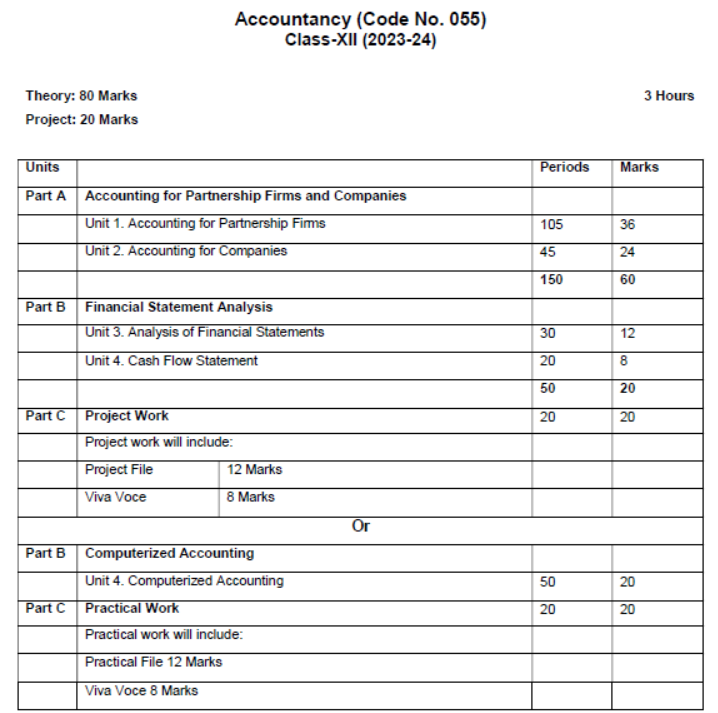
Course Structure
| Parts/Units | Topics | Marks |
|---|---|---|
| Part A | Accounting for Partnership Firms & Companies | 60 |
| Unit 1 | Accounting for Partnership Firms | 35 |
| Unit 2 | Accounting for Companies | 25 |
| Part B | Financial Statement Analysis | 20 |
| Unit 3 | Analysis of Financial Statements | 12 |
| Unit 4 | Cash Flow Statement | 8 |
| Part C | Project Work | 20 |
| OR | ||
| Part B | Computerized Accounting | 20 |
| Unit 3 | Computerized Accounting | |
| Part C | Project Work | 20 |
| Total | 100 | |
AD
Course Syllabus
Part A: Accounting for Partnership Firms and Companies
Unit 1: Accounting for Partnership Firms
-
Partnership − Features, Partnership Deed
-
Provisions of the Indian Partnership Act 1932 in the absence of partnership deed
-
Fixed v/s fluctuating capital accounts
-
Preparation of Profit and Loss Appropriation account- division of profit among partners, guarantee of profits
-
Past adjustments (relating to interest on capital, interest on drawing, salary and profit sharing ratio)
-
Goodwill − nature, factors affecting and methods of valuation - average profit, super profit and capitalization
Accounting for Partnership firms - Reconstitution and Dissolution
-
Change in the Profit Sharing Ratio among the existing partners − Sacrificing ratio, Gaining ratio,
-
Accounting for revaluation of assets and reassessment of liabilities and treatment of reserves and accumulated profits
-
Preparation of revaluation account and balance sheet
-
-
Admission of a partner −
-
Effect of admission of a partner on change in the profit sharing ratio
-
Treatment of goodwill (as per as 26)
-
Treatment for revaluation of assets and reassessment of liabilities
-
Treatment of reserves and accumulated profits
-
Adjustment of capital accounts and preparation of balance sheet
-
-
Retirement and death of a partner −
-
Effect of retirement / death of a partner on change in profit sharing ratio
-
Treatment of goodwill (as per as 26)
-
Treatment for revaluation of assets and reassessment of liabilities
-
Adjustment of accumulated profits and reserves
-
Adjustment of capital accounts and preparation of balance sheet
-
Preparation of loan account of the retiring partner
-
Calculation of deceased partner’s share of profit till the date of death
-
Preparation of deceased partner’s capital account
-
executor’s account and preparation of balance sheet
-
-
Dissolution of a partnership firm −
-
Types of dissolution of a firm
-
Settlement of accounts - preparation of realization account, and other related accounts
-
Capital accounts of partners and cash/bank a/c (excluding piecemeal distribution, sale to a company and insolvency of partner(s)
-
Unit-2 Accounting for Companies
Accounting for Share Capital
-
Share and share capital − Nature, Types
-
Accounting for share capital −
-
Issue and allotment of equity shares
-
Private placement of shares
-
Employee Stock Option Plan (ESOP)
-
Public subscription of shares - over subscription and under subscription of shares
-
Issue at par and at premium
-
Calls in advance and arrears (excluding interest)
-
Issue of shares for consideration other than cash
-
-
Accounting treatment of forfeiture and re-issue of shares
-
Disclosure of share capital in company’s Balance Sheet.
Accounting for Debentures
-
Debentures −
-
Issue of debentures at par, at a premium and at a discount
-
Issue of debentures for consideration other than cash
-
Issue of debentures with terms of redemption
-
Debentures as collateral security-concept, interest on debentures
-
-
Redemption of debentures −
-
Lump sum, draw of lots and purchase in the open market (excluding exinterest and cum-interest)
-
Creation of Debenture Redemption Reserve
-
Part B: Financial Statement Analysis
Unit 3: Analysis of Financial Statements
-
Financial statements of a company − Statement of Profit and Loss and Balance Sheet in the prescribed form with major headings and sub headings (as per Schedule III to the Companies Act, 2013)
-
Financial Statement Analysis − Objectives, Importance, Limitations
-
Tools for Financial Statement Analysis − Comparative statements, Common size statements, Cash flow analysis, Ratio analysis,
-
Accounting Ratios − Objectives, Classification, Computation
-
Liquidity Ratios − Current ratio, Quick ratio
-
Solvency Ratios − Debt to Equity Ratio, Total Asset to Debt Ratio, Proprietary Ratio, Interest Coverage Ratio
-
Activity Ratios − Inventory Turnover Ratio, Trade Receivables Turnover Ratio, Trade Payables Turnover Ratio and Working Capital Turnover Ratio
-
Profitability Ratios − Gross Profit Ratio, Operating Ratio, Operating Profit Ratio, Net Profit Ratio and Return on Investment
Unit 4: Cash Flow Statement
- Meaning
- Objectives
- Preparation (as per AS 3 (Revised) (Indirect Method only)
Part B: Computerised Accounting
Unit 3: Computerised Accounting
-
Overview of Computerised Accounting System −
- Introduction: Application in Accounting
- Features of Computerised Accounting System
- Structure of CAS
- Software Packages: Generic; Specific; Tailored
-
Accounting Application of Electronic Spreadsheet −
-
Concept of electronic spreadsheet
-
Features offered by electronic spreadsheet
-
Application in generating accounting information - bank reconciliation statement; asset accounting; loan
-
repayment of loan schedule, ratio analysis
-
Data representation - graphs, charts and diagrams
-
-
Using Computerized Accounting System
-
Steps in installation of CAS, codification and Hierarchy of account heads, creation of accounts
-
Data − Entry, validation and verification
-
Adjusting entries, preparation of balance sheet, profit and loss account with closing entries and opening entries
-
Need and security features of the system
-
-
Database Management System (DBMS)
-
Concept and Features of DBMS
-
DBMS in Business Application
-
Generating Accounting Information – Payroll
-
Detailed syllabus with Notes
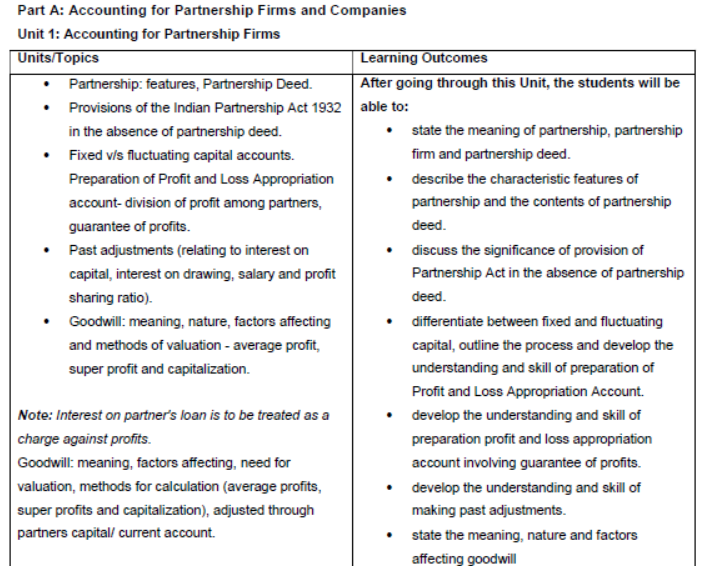
Part A – Accounting for Partnership Firms and Companies
Unit 1: Accounting for Partnership Firms
-
Partnership: features, Partnership Deed.
- Provisions of the Indian Partnership Act 1932 in the absence of partnership deed.
- Fixed v/s fluctuating capital accounts. Preparation of Profit and Loss Appropriation account- division of profit among partners, guarantee of profits.
- Past adjustments (relating to interest on capital, interest on drawing, salary and profit sharing ratio).
- Goodwill: meaning, nature, factors affecting and methods of valuation – average profit, super profit and capitalization.
Note: Interest on partner’s loan is to be treated as a charge against profits.
Goodwill: meaning, factors affecting, need for valuation, methods for calculation (average profits, super profits and capitalization), adjusted through partners capital/ current account.
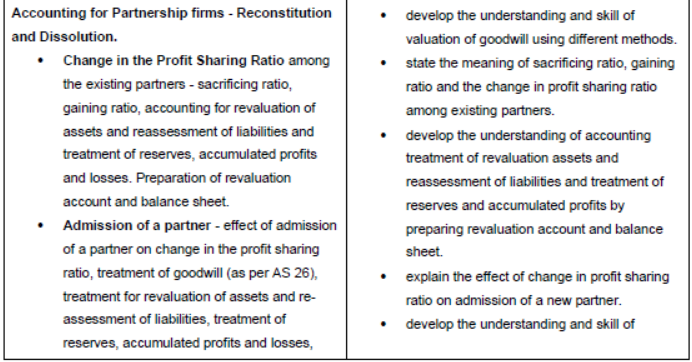
Accounting for Partnership firms – Reconstitution and Dissolution
- Change in the Profit Sharing Ratio among the existing partners – sacrificing ratio, gaining ratio, accounting for revaluation of assets and reassessment of liabilities and treatment of reserves, accumulated profits and losses. Preparation of revaluation account and balance sheet.
- Admission of a partner – effect of admission of a partner on change in the profit sharing ratio, treatment of goodwill (as per AS 26), treatment for revaluation of assets and reassessment of liabilities, treatment of reserves, accumulated profits and losses, adjustment of capital accounts and preparation of capital, current account and balance sheet.
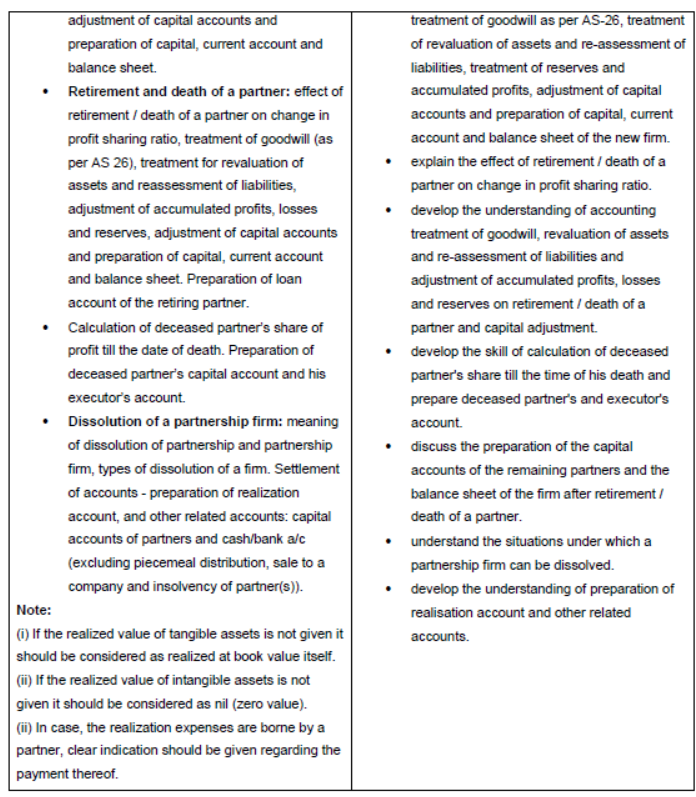
- Retirement and death of a partner: effect of retirement / death of a partner on change in profit sharing ratio, treatment of goodwill (as per AS 26), treatment for revaluation of assets and reassessment of liabilities,
adjustment of accumulated profits, losses and reserves, adjustment of capital accounts and preparation of capital, current account and balance sheet. Preparation of loan account of the retiring partner. - Calculation of deceased partner’s share of profit till the date of death. Preparation of deceased partner’s capital account and his executor’s account.
- Dissolution of a partnership firm: meaning of dissolution of partnership and partnership firm, types of dissolution of a firm. Settlement of accounts – preparation of realization account, and other related accounts: capital accounts of partners and cash/bank a/c (excluding piecemeal distribution, sale to a company and insolvency of partner(s)).
Note:
(i) If the realized value of tangible assets is not given it should be considered as realized at book value itself.
(ii) If the realized value of intangible assets is not given it should be considered as nil (zero value).
(ii) In case, the realization expenses are borne by a partner, clear indication should be given regarding the payment thereof.
Unit-3 Accounting for Companies
Accounting for Share Capital
- Features and types of companies.
- Share and share capital: nature and types.
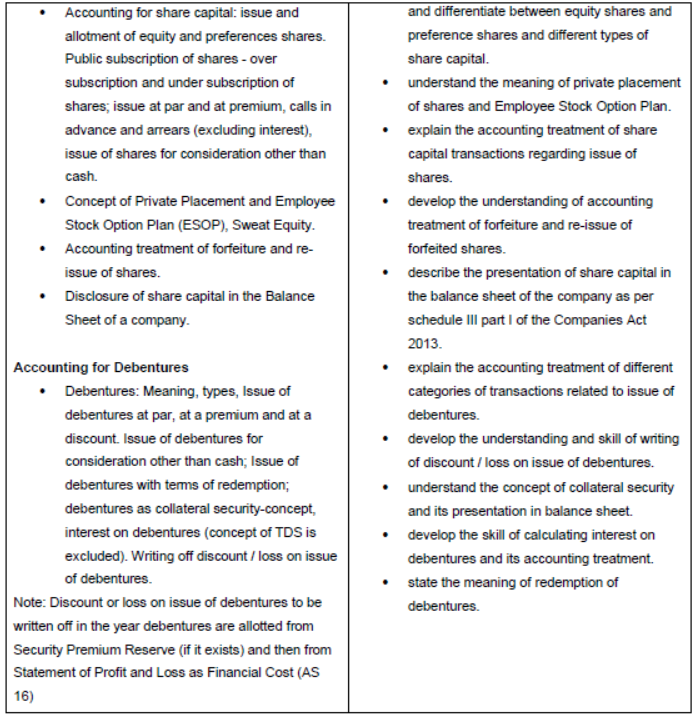
- Accounting for share capital: issue and allotment of equity and preferences shares. Public subscription of shares – over subscription and under subscription of shares; issue at par and at premium, calls in advance and arrears (excluding interest), issue of shares for consideration other than cash.
- Concept of Private Placement and Employee Stock Option Plan (ESOP), Sweat Equity.
- Accounting treatment of forfeiture and reissue of shares.
- Disclosure of share capital in the Balance Sheet of a company.
Accounting for Debentures
- Debentures: Meaning, types, Issue of debentures at par, at a premium and at a discount. Issue of debentures for consideration other than cash; Issue of debentures with terms of redemption; debentures as collateral security-concept, interest on debentures (concept of TDS is excluded). Writing off discount / loss on issue
of debentures.
Note: Discount or loss on issue of debentures to be written off in the year debentures are allotted from Security Premium Reserve (if it exists) and then from Statement of Profit and Loss as Financial Cost (AS 16)
Part B: Financial Statement Analysis
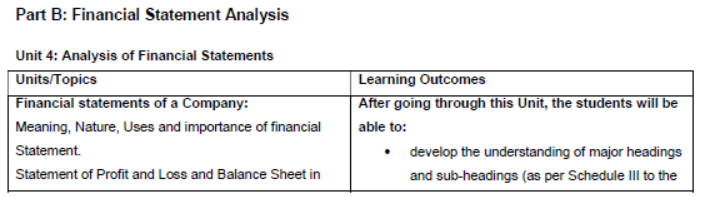
Unit 4: Analysis of Financial Statements
Financial Statements of a Company: Meaning, Nature, Uses and importance of financial Statement
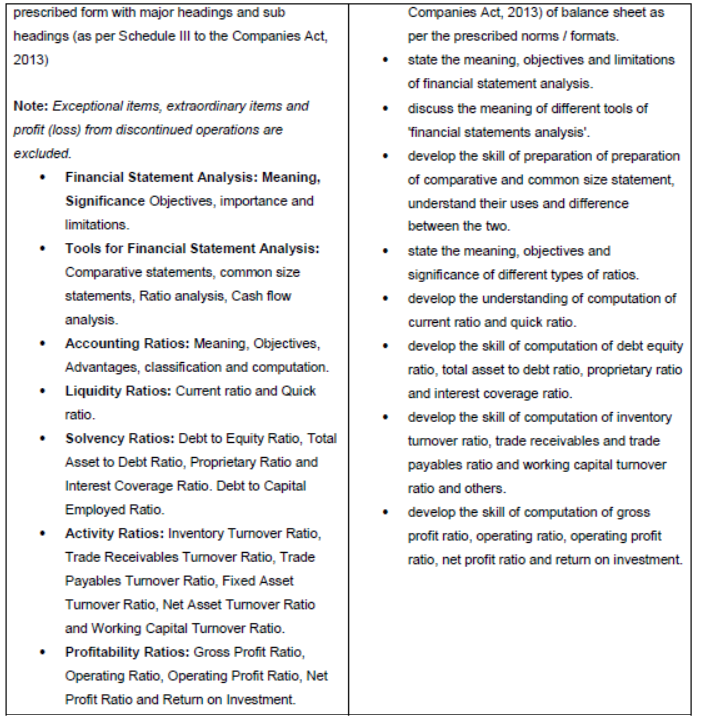
Statement of Profit and Loss and Balance Sheet in prescribed form with major headings and sub headings (as per Schedule III to the Companies Act, 2013)
Note: Exceptional items, extraordinary items and profit (loss) from discontinued operations are excluded.
- Financial Statement Analysis: Meaning, Significance Objectives, importance and limitations.
- Tools for Financial Statement Analysis: Comparative statements, common size statements, Ratio analysis, Cash flow analysis.
- Accounting Ratios: Meaning, Objectives, Advantages, classification and computation.
- Liquidity Ratios: Current ratio and Quick ratio.
- Solvency Ratios: Debt to Equity Ratio, Total Asset to Debt Ratio, Proprietary Ratio and Interest Coverage Ratio. Debt to Capital Employed Ratio.
- Activity Ratios: Inventory Turnover Ratio, Trade Receivables Turnover Ratio, Trade Payables Turnover Ratio, Fixed Asset Turnover Ratio, Net Asset Turnover Ratio and Working Capital Turnover Ratio.
- Profitability Ratios: Gross Profit Ratio, Operating Ratio, Operating Profit Ratio, Net Profit Ratio and Return on Investment.
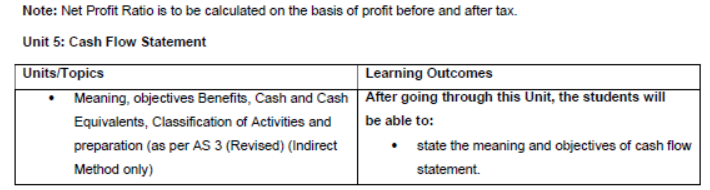
Note: Net Profit Ratio is to be calculated on the basis of profit before and after tax.
Unit 5: Cash Flow Statement
Meaning, objectives Benefits, Cash and CashEquivalents, Classification of Activities and preparation (as per AS 3 (Revised) (Indirect Method only)
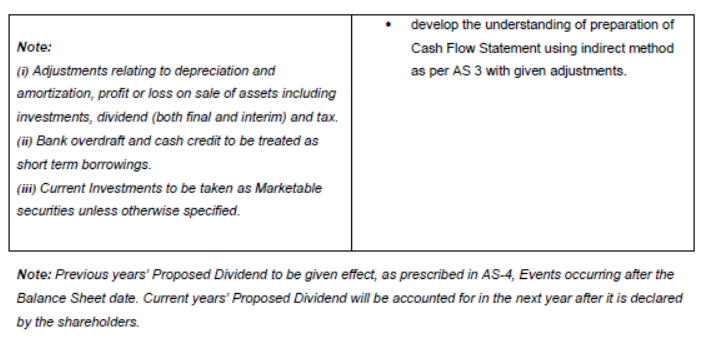
Note:
(i) Adjustments relating to depreciation and amortization, profit or loss on sale of assets including investments, dividend (both final and interim) and tax.
(ii) Bank overdraft and cash credit to be treated as short term borrowings.
(iii) Current Investments to be taken as Marketable securities unless otherwise specified.
Note: Previous years’ Proposed Dividend to be given effect, as prescribed in AS-4, Events occurring after the
Balance Sheet date. Current years’ Proposed Dividend will be accounted for in the next year after it is declared
by the shareholders.
Project Work
One specific project based on financial statement analysis of a company covering any two aspects from the
following:
1. Comparative and common size financial statements
2. Accounting Ratios
3. Segment Reports
4. Cash Flow Statements
OR
Part B: Computerised Accounting
Unit 4: Computerised Accounting
Overview of Computerised Accounting System
- Introduction: Application in Accounting.
- Features of Computerised Accounting System.
- Structure of CAS.
- Software Packages: Generic; Specific; Tailored.
Accounting Application of Electronic Spreadsheet
- Concept of electronic spreadsheet.
- Features offered by electronic spreadsheet.
- Application in generating accounting information – bank reconciliation statement; asset accounting; loan repayment of loan schedule, ratio analysis
- Data representation- graphs, charts and diagrams.
Using Computerized Accounting System.
- Steps in installation of CAS, codification and Hierarchy of account heads, creation of accounts.
- Data: Entry, validation and verification.
- Adjusting entries, preparation of balance sheet, profit and loss account with closing entries and opening entries.
- Need and security features of the system.
Snapshot from CBSE Issued Syllabus Pdf

Project Work
One specific project based on financial statement analysis of a company covering any two aspects from the following:
1. Comparative and common size financial statements
2. Accounting Ratios
3. Segment Reports
4. Cash Flow Statements
OR
Part B: Computerised Accounting
Unit 4: Computerised Accounting
Overview of Computerised Accounting System
- Introduction: Application in Accounting.
- Features of Computerised Accounting System.
- Structure of CAS.
- Software Packages: Generic; Specific; Tailored.
Accounting Application of Electronic Spreadsheet.
- Concept of electronic spreadsheet.
- Features offered by electronic spreadsheet.
- Application in generating accounting information - bank reconciliation statement; asset accounting;
loan repayment of loan schedule, ratio analysis
- Data representation- graphs, charts and diagrams.
Using Computerized Accounting System.
- Steps in installation of CAS, codification and Hierarchy of account heads, creation of accounts.
- Data: Entry, validation and verification.
- Adjusting entries, preparation of balance sheet, profit and loss account with closing entries and opening entries.
- Need and security features of the system.
Part C: Practical Work
Prescribed Books:
Financial Accounting -I Class XI NCERT Publication
Accountancy -II Class XI NCERT Publication
Accountancy -I Class XII NCERT Publication
Accountancy -II Class XII NCERT Publication
Accountancy – Class XII NCERT Publication
Computerised Accounting System
Free study material for Accountancy

FAQs
The complete and updated syllabus for Class 12 Accountancy for the 2026-27 academic session is available on StudiesToday.com with detailed chapter-wise marks issued by CBSE.
Yes, several topics have been rationalized to reduce the academic load on Class 12 students. The Accountancy syllabus highlights the deleted topics section and is as per 2026 Exam format.
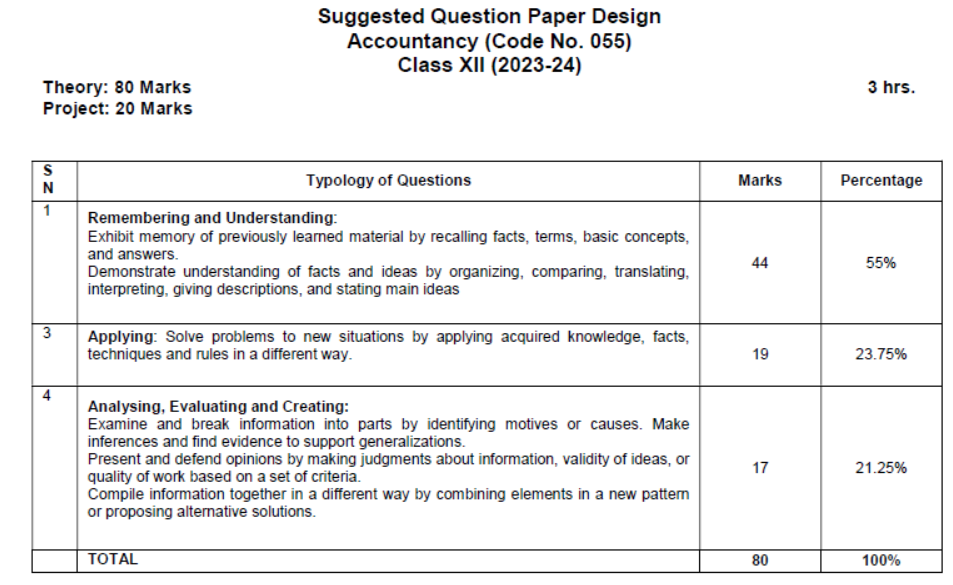
For Class 12 Accountancy, the evaluation is split into an 80-mark theory paper and a 20-mark internal assessment (Project/ASL).
The Class 12 Accountancy curriculum focuses on 50% competency-based questions.
We have provided the Class 12 Accountancy curriculum in a bilingual format where applicable for 2026-27 session.
Our team has carefully updated all resources based on the latest circulars from the official CBSE website. The Class 12 Accountancy syllabus is 100% authentic and aligned with the 2026-27 academic calendar.