

Here's the updated CBSE Class 12 Economics Syllabus for 2026-27, covering course structure, chapter-wise weightage, and assessment guidelines. Class 12 students should use this official version to match the current CBSE pattern and books.
Economics Curriculum and Weightage - Class 12
Below is the official CBSE Class 12 Economics curriculum for the current 2026-27 academic year. Studying as per this latest curriculum, and understanding the marks breakup by topic, helps you prepare properly for the exam ahead.
Economics Syllabus for Class 12 (2026-27)
Stay updated with the most recent curriculum changes for Class 12 Economics in the 2026-27 session.
Part A: Introductory Macroeconomics
Unit 1: National Income and Related Aggregates 30 Periods
What is Macroeconomics?
Basic concepts in macroeconomics: consumption goods, capital goods, final goods,intermediate goods; stocks and flows; gross investment and depreciation.
Circular flow of income (two sector model); Methods of calculating National Income -Value Added or Product method, Expenditure method, Income method.
Aggregates related to National Income:
Gross National Product (GNP), Net National Product (NNP), Gross Domestic Product (GDP) and Net Domestic Product (NDP) - at market price, at factor cost; Real and Nominal GDP
GDP Deflator, GDP and Welfare
Unit 2: Money and Banking 15 Periods
Money – meaning and functions, supply of money - Currency held by the public and net demand deposits held by commercial banks.
Money creation by the commercial banking system.
Central bank and its functions (example of the Reserve Bank of India): Bank of issue,
Govt. Bank, Banker's Bank, Control of Credit through Bank Rate, Cash Reserve Ratio (CRR), Statutory Liquidity Ratio (SLR), Repo Rate and Reverse Repo Rate, Open Market Operations, Margin requirement.
Unit 3: Determination of Income and Employment 30 Periods
Aggregate demand and its components.
Propensity to consume and propensity to save (average and marginal).
Short-run equilibrium output; investment multiplier and its mechanism.
Meaning of full employment and involuntary unemployment.
Problems of excess demand and deficient demand; measures to correct them -
changes in government spending, taxes and money supply.
Unit 4: Government Budget and the Economy 17 Periods
Government budget - meaning, objectives and components.
Classification of receipts - revenue receipts and capital receipts;
Classification of expenditure – revenue expenditure and capital expenditure.
Balanced, Surplus and Deficit Budget – measures of government deficit.
Unit 5: Balance of Payments 18 Periods
Balance of payments account - meaning and components;
Balance of payments – Surplus and Deficit
Foreign exchange rate - meaning of fixed and flexible rates and managed floating.
Determination of exchange rate in a free market, Merits and demerits of flexible and fixed exchange rate.
Managed Floating exchange rate system
Part B: Indian Economic Development
Unit 6: Development Experience (1947-90) and Economic Reforms since 1991: 28 Periods
A brief introduction of the state of Indian economy on the eve of independence.
Indian economic system and common goals of Five Year Plans.
Main features, problems and policies of agriculture (institutional aspects and new agricultural strategy), industry (IPR 1956; SSI – role & importance) and foreign trade.
Economic Reforms since 1991:
Features and appraisals of liberalisation, globalisation and privatisation (LPG policy); Concepts of demonetization and GST
Unit 7: Current challenges facing Indian Economy 60 Periods
Human Capital Formation: How people become resource; Role of human capital in economic development; Growth of Education Sector in India
Rural development: Key issues - credit and marketing - role of cooperatives; agricultural diversification; alternative farming - organic farming
Employment: Growth and changes in work force participation rate in formal and informal sectors; problems and policies
Sustainable Economic Development: Meaning, Effects of Economic Development on Resources and Environment, including global warming
Unit 8: Development Experience of India: 12 Periods
A comparison with neighbours
India and Pakistan
India and China
Issues: economic growth, population, sectoral development and other Human
Development Indicators
Part C: Project in Economics 20 Periods
Prescribed Books:
1. Statistics for Economics, NCERT
2. Indian Economic Development, NCERT
3. Introductory Microeconomics, NCERT
4. Macroeconomics, NCERT
5. Supplementary Reading Material in Economics, CBSE
Note: The above publications are also available in Hindi Medium.
Free study material for Economics
FAQs
The complete and updated syllabus for Class 12 Economics for the 2026-27 academic session is available on StudiesToday.com with detailed chapter-wise marks issued by CBSE.
Yes, several topics have been rationalized to reduce the academic load on Class 12 students. The Economics syllabus highlights the deleted topics section and is as per 2026 Exam format.
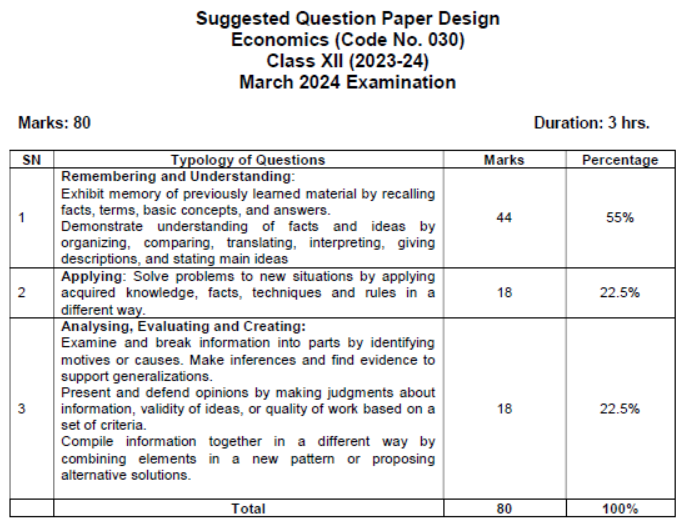
For Class 12 Economics, the evaluation is split into an 80-mark theory paper and a 20-mark internal assessment (Project/ASL).
The Class 12 Economics curriculum focuses on 50% competency-based questions.
We have provided the Class 12 Economics curriculum in a bilingual format where applicable for 2026-27 session.
Our team has carefully updated all resources based on the latest circulars from the official CBSE website. The Class 12 Economics syllabus is 100% authentic and aligned with the 2026-27 academic calendar.