

Get the newest CBSE Class 12 Entrepreneurship Syllabus, updated for 2026-27. It covers the complete course structure, chapter weightage, and internal assessment rules for Class 12 Entrepreneurship. Following this official syllabus keeps your prep in line with the current CBSE pattern and books.
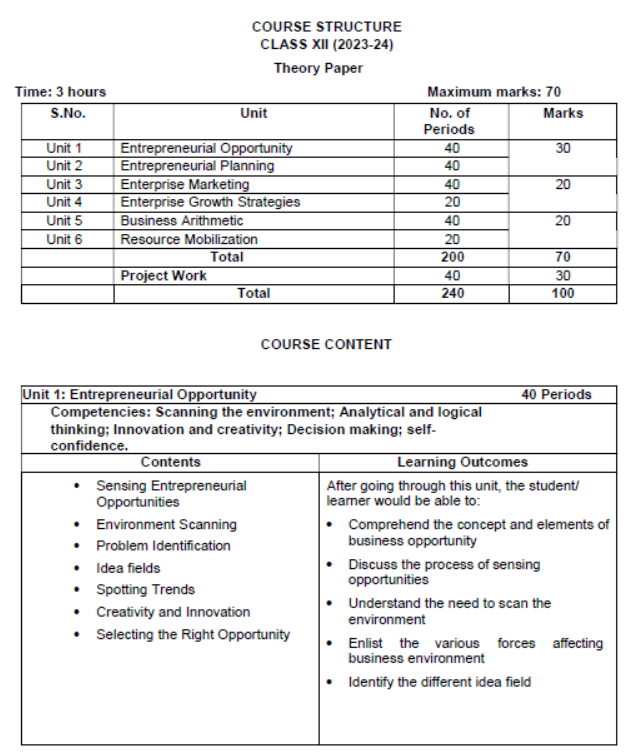
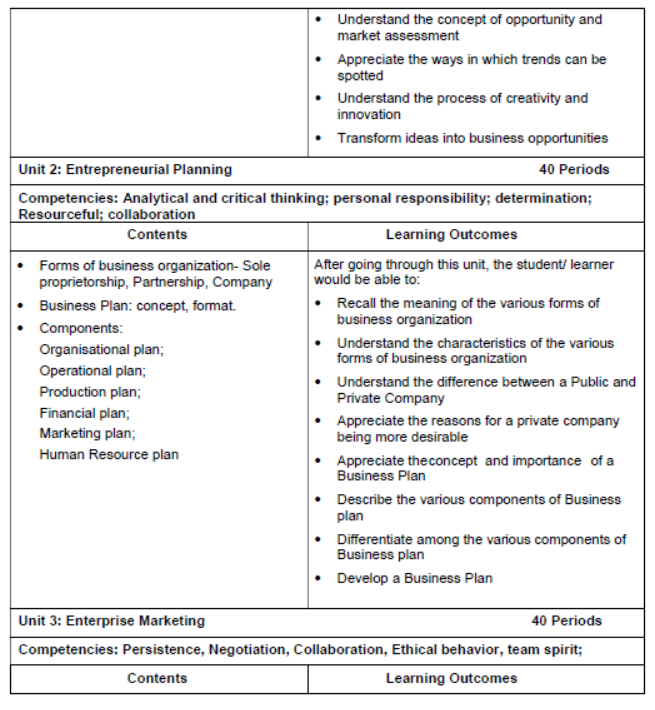
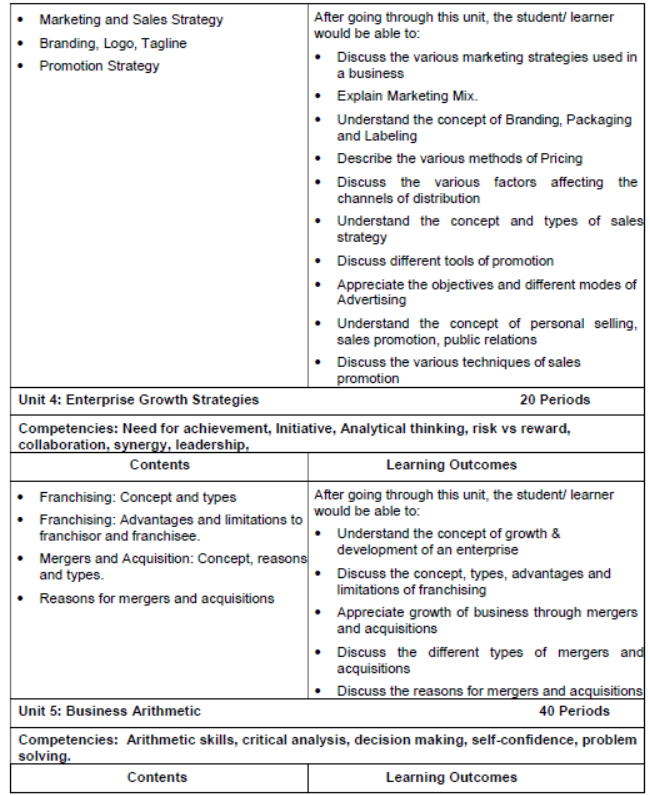
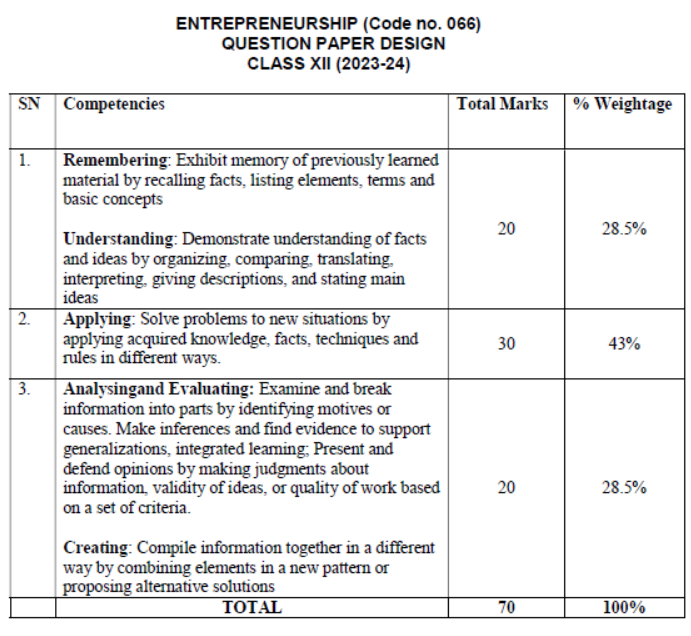
Entrepreneurship Syllabus for Class 12 - Marks Breakup
Here is the official CBSE Class 12 Entrepreneurship curriculum for 2026-27. Following the current curriculum, and knowing how marks are split across topics, makes exam prep more focused and effective.
Class 12 Entrepreneurship Syllabus, 2026-27
Stay on top of Class 12 Entrepreneurship curriculum changes for the 2026-27 session.
PROJECT WORK
Students have to do TWO projects in the entire academic session.
TOPICS FOR THE PROJECT:
1. Business Plan
2. Market Survey
- 10 Marks each for 02 Projects
- 5 Marks for Numerical Assessment
- 5 Marks for Viva
Note: Students need to complete both the projects. Guidelines for both projects are given in the CBSE Textbook.
1.The objectives of the project work:
Objectives of project work are to enable learners to:
- probe deeper into personal enquiry, initiate action and reflect on knowledge and skills, views etc. acquired during the course of class XI-XII.
- analyse and evaluate real world scenarios using theoretical constructs and arguments
- demonstrate the application of critical and creative thinking skills and abilities to produce an independent and extended piece of work
- follow up aspects in which learners have interest
- develop the communication skills to argue logically
2. Role of the teacher:
The teacher plays a critical role in developing thinking skills of the learners. A teacher should:
- help each learner select the topic after detailed discussions and deliberations of the topic;
- play the role of a facilitator to support and monitor the project work of the learner through periodic discussions;
- guide the research work in terms of sources for the relevant data;
- ensure that students must understand the relevance and usage of primary evidence and other sources in their projects and duly acknowledge the same;
- ensure that the students are able to derive a conclusion from the content; cite the limitations faced during the research and give appropriate references used in doing the research work.
- educate learner about plagiarism and the importance of quoting the source of the information to ensure authenticity of research work.
- prepare the learner for the presentation of the project work.
- arrange a presentation of the project file.
3. Steps involved in the conduct of the project:
Students may work upon the following lines as a suggested flow chart:
Choose a title/topic
↓
Collection of the research material
↓
Organization of material/data
↓
Present material/data
↓
Analysing the material/data for conclusion
↓
Draw the relevant conclusion
↓
Presentation of the Project Work
4. Expected Checklist for the Project Work:
- Introduction of topic/title
- Identifying the product/service
- Various stakeholders and effect on each of them
- Use of different tools for market assessment and it’s analysis
- Implication of 4P’s in the process of marketing
- Calculation of various costs involved in the business planning process
- Validity, reliability, appropriateness and relevance of data used for research work and for presentation in the project file
- Presentation and writing that is succinct and coherent in project file
- Citation of the materials referred to, in the file in footnotes, resources section, bibliography etc.
5. Viva-Voce
- At the end of the academic session, each learner will present the research work in the Project File to the External examiner.
- The questions should be asked from the Research Work/ Project File of the learner.
- The Internal Examiner should ensure that the study submitted by the learner is his/her own original work.
- In case of any doubt, authenticity should be checked and verified.
Guidelines to do the project is given in the textbook
Prescribed Books:
1. Entrepreneurship - Class XI- C.B.S.E, Delhi
2. Entrepreneurship - Class XII - C.B.S.E., Delhi
3. Udyamita (in Hindi) by Dr. MMP. Akhouri and S.P Mishra, pub. By National Institute for
Entrepreneurship and Small Business Development (NIESBUD), NSIC-PATC Campus,Okhla
Magazines
1. Udyamita Samachar Patra (Monthly, Hindi), Pub. By Centre for Entrepreneurship Development, M.P. (CEDMAP), 60 Jail Road, Jhangerbad, Bhopal-462008.
2. Science Tec. Entrepreneur (A Bi Monthly Publication), Centre for Entrepreneurship Development, M.P (CEDMAP), 60 Jail Road, Jhangerbad, Bhopal -462008
3. Laghu Udhyog Samachar
4. Project Profile by DCSSI
Free study material for Entrepreneurship
FAQs
The complete and updated syllabus for Class 12 Entrepreneurship for the 2026-27 academic session is available on StudiesToday.com with detailed chapter-wise marks issued by CBSE.
Yes, several topics have been rationalized to reduce the academic load on Class 12 students. The Entrepreneurship syllabus highlights the deleted topics section and is as per 2026 Exam format.
For Class 12 Entrepreneurship, the evaluation is split into an 80-mark theory paper and a 20-mark internal assessment (Project/ASL).
The Class 12 Entrepreneurship curriculum focuses on 50% competency-based questions.
We have provided the Class 12 Entrepreneurship curriculum in a bilingual format where applicable for 2026-27 session.
Our team has carefully updated all resources based on the latest circulars from the official CBSE website. The Class 12 Entrepreneurship syllabus is 100% authentic and aligned with the 2026-27 academic calendar.