

Official Class 7 Mathematics Worksheets: Chapter 01 Integers
Access comprehensive chapter-wise worksheets for Chapter 01 Integers using the CBSE Class 7 Mathematics Integers Worksheet Set 04. Designed to align with the 2026-27 academic syllabus for Class 7 Mathematics, these printable practice sets help students reinforce key concepts and improve their overall exam readiness.
Solved Practice Worksheets for Mathematics
Navigate directly to the solved Mathematics worksheets using the digital viewer below. Each practice set includes detailed step-by-step solutions, allowing students to instantly cross-check their work and identify areas requiring further revision.
INTEGERS (MULTIPLICATION)
Multiplication of Integers
Multiplication is basically repeated addition. Therefore multiplication of integers is the repeated addition as: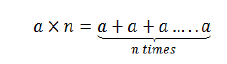
Properties of Multiplication of Integers
Distributive Property According to the distributive property of multiplication of integers, if a, b and c are three integers then,
a× (b + c) = (a × b) + (a × c)
Example -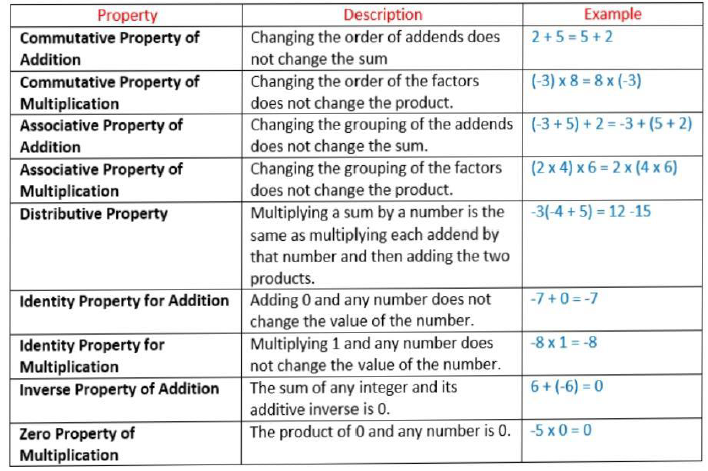
QUESTIONS :-
Q1. SIMPLIFY :-
(i) (−8) × 9 + (−8) × 7
Solution.
(−8) ×× (9 + 7) [using the distributive law]
= (−8) ×× 16
= −128
(ii) 9 × (−13) + 9 × (−7)
Solution.
9 ×× (−13 + (−7)) [using the distributive law]
= 9 ×× (−20)
= −180
(iii) 20 × (−16) + 20 × 14
Solution.
20 ×× (−16 + 14) [using the distributive law]
= 20 ×× (−2)
= −40
(iv) (−16) × (−15) + (−16) × (−5)
Solution.
(−16) ×X (−15 + (−5)) [using the distributive law]
= (−16) ×X(−20)
= 320
(v) (−11) × (−15) + (−11) × (−25)
Solution.
(−11) ×X(−15 +(−25)) [using the distributive law]
= (−11) ×X (−40)
= 440
(vi) 10 × (−12) + 5 × (−12)
Solution.
(−12) ×× (10 + 5) [using the distributive law]
= (−12) ×× 15
= −180
(vii) (−16) × (−8) + (−4) × (−8)
Solution.
(−16 + (−4)) ×× (−8) [using the distributive law]
= (−20) ×× (−8)
= 160
(viii) (−26) × 72 + (−26) × 28
Solution.
(−26) ×× (72 + 28) [using the distributive law]
= (−26) ××100
= −2600
Q2. Fill in the blanks :-
(i) (−6) × (......) = 6
(ii) (−18) × (......) = (−18)
(iii) (−8) × (−9) = (−9) × (......)
(iv) 7 × (−3) = (−3) × (......)
(v) {(−5)×3} × (−6) = (......) × {3×(−6)}
(vi) (−5) × (......) = 0
Answer.
(i) (−6) × (x) = 6 x = 6−6 = −66= −1x = 6-6 = -66= -1 Thus, x = (−1)
(ii) 1 [∵ Multiplicative identity]
(iii) (−8) [∵ Commutative law]
(iv) 7 [∵ Commutative law]
(v) (−5) [∵ Associative law]
(vi) 0 [∵ Property of zero]
Q3. Prove that :- i). (-3) × {4 × (-5)} = (- 3) × {4 × (-5)}
Solution.
(-3) × {4 × (-5)} = (-3) × (-20) = 3 × 20 = 60
and, {(-3) × 4} × (-5) = (-12) × (-5) = 12 × 5 = 60
Therefore, (- 3) × {4 × (-5)} = {(-3) × 4} × (-5)
(ii) (-2) × {(-3) × (-5)} = (- 2) × {(-3) × (-5)}
Solution.
(-2) × {(-3) × (-5)} = (-2) × 15 = -(2 × 15)= -30
and, {(-2) × (-3)} × (-5) = 6 × (-5) = -(6 × 5) = -30
Therefore, (- 2) × {(-3) × (-5)} = {-2) × (-3)} × (-5)
Q4. Solve that :-7 × (-3) = (-3) × 7
Solution.
7 × (-3) = -(7 × 3) = -21 and (-3) × 7
= -(3 × 7) = -21 Therefore, 7 × (-3)
= (-3) × 7
Q5. Prove that (-5) × (-8) = (-8) × (-5)
Solution.
(-5) × (-8) = 5 × 8 = 40 and (-8) × (-5) = 8 × 5 = 40
Therefore, (-5) × (-8) = (-8) × (-5).
Question 1) Verify a—(—b) = a + b for the following values of ‘a’ and ‘b’.
(a) a = 75, b = 84
(b) a = 118, b = 125
(c) a = 25, b = 30
Answer:
(a) For a = 75 and b = 84:
L.H.S. = \( a - (-b) = 75 - (-84) = 75 + 84 = 159 \)
R.H.S. = \( a + b = 75 + 84 = 159 \)
L.H.S. = R.H.S., so the statement is verified.
(b) For a = 118 and b = 125:
L.H.S. = \( a - (-b) = 118 - (-125) = 118 + 125 = 243 \)
R.H.S. = \( a + b = 118 + 125 = 243 \)
L.H.S. = R.H.S., so the statement is verified.
(c) For a = 25 and b = 30:
L.H.S. = \( a - (-b) = 25 - (-30) = 25 + 30 = 55 \)
R.H.S. = \( a + b = 25 + 30 = 55 \)
L.H.S. = R.H.S., so the statement is verified.
In simple words: Subtracting a negative number is exactly the same as adding that number. In all three cases, both sides of the equation give the same final value.
Exam Tip: Always show L.H.S. and R.H.S. calculations separately in verification questions to ensure you get full marks.
Question 2) Write down a pair of integers whose
(a) Sum is -3
(b) Sum is 0
(c) Difference is 2
(d) Difference is -5
Answer:
(a) A pair of integers whose sum is -3: \( -1 \) and \( -2 \) because \( (-1) + (-2) = -3 \).
(b) A pair of integers whose sum is 0: \( 5 \) and \( -5 \) because \( 5 + (-5) = 0 \).
(c) A pair of integers whose difference is 2: \( 7 \) and \( 5 \) because \( 7 - 5 = 2 \).
(d) A pair of integers whose difference is -5: \( -2 \) and \( 3 \) because \( (-2) - 3 = -5 \).
In simple words: We can choose simple numbers like -1 and -2 to add up to -3, or opposite numbers like 5 and -5 to cancel each other out to zero.
Exam Tip: For a sum of zero, choose any integer and its negative counterpart, as they are additive inverses of each other.
Question 3) Verify the following :
a) (-21) x [(-4) + (-6)] = [(-21) x (-4)] + [(-21) x (-6)]
b) 15 x [6 + (-3)] = [15 x 6] + [15 x (-3)]
c) (-15) x [(-8) + (-6)] = [(-15) x (-8)] + [(-15) x (-6)]
Answer:
(a) L.H.S. = \( (-21) \times [(-4) + (-6)] = (-21) \times (-10) = 210 \)
R.H.S. = \( [(-21) \times (-4)] + [(-21) \times (-6)] = 84 + 126 = 210 \)
L.H.S. = R.H.S., so the statement is verified.
(b) L.H.S. = \( 15 \times [6 + (-3)] = 15 \times 3 = 45 \)
R.H.S. = \( [15 \times 6] + [15 \times (-3)] = 90 + (-45) = 45 \)
L.H.S. = R.H.S., so the statement is verified.
(c) L.H.S. = \( (-15) \times [(-8) + (-6)] = (-15) \times (-14) = 210 \)
R.H.S. = \( [(-15) \times (-8)] + [(-15) \times (-6)] = 120 + 90 = 210 \)
L.H.S. = R.H.S., so the statement is verified.
In simple words: Multiplying a number by a sum is the same as multiplying it by each number separately and then adding the results. This is called the distributive property.
Exam Tip: Be extra careful with signs when multiplying negative numbers: multiplying two negative integers always produces a positive result.
Question 4) Evaluate :
a) (-100) \div 5
b) (-36) \div (-4)
c) (-41) \div [(-40) + (-1)]
d) 0 \div (-18)
e) [(-36) \div 12] \div 3
f) (-50) \div (50)
g) 60 \div (-6)
h) (-48) \div - 48
i) (-13) \div (13)
Answer:
(a) \( (-100) \div 5 = -20 \)
(b) \( (-36) \div (-4) = 9 \)
(c) \( (-41) \div [(-40) + (-1)] = (-41) \div (-41) = 1 \)
(d) \( 0 \div (-18) = 0 \)
(e) \( [(-36) \div 12] \div 3 = (-3) \div 3 = -1 \)
(f) \( (-50) \div 50 = -1 \)
(g) \( 60 \div (-6) = -10 \)
(h) \( (-48) \div (-48) = 1 \)
(i) \( (-13) \div 13 = -1 \)
In simple words: When dividing integers, if the signs are the same, the result is positive. If the signs are different, the result is negative.
Exam Tip: Always work out operations inside brackets first according to the BODMAS rule before doing the final division.
Question 5) Do as directed :
1. In a test (+5) marks are given for every correct answer and (-2) marks are given every incorrect answer.
(i) Radhika answered all the questions and scored 30 marks though she got 10 correct answers.
(ii) Jay also answered all the questions and scored (-12) marks though he got 4 correct answers. How many incorrect answers had they attempted ?
Answer:
(i) Marks for 1 correct answer = +5
Marks for 10 correct answers = \( 10 \times 5 = 50 \) marks.
Let \( x \) be the number of incorrect answers.
Marks scored for incorrect answers = \( -2x \)
Total marks scored by Radhika = 30
\( \implies 50 + (-2x) = 30 \)
\( \implies -2x = 30 - 50 \)
\( \implies -2x = -20 \)
\( \implies x = 10 \)
So, Radhika attempted 10 incorrect answers.
(ii) Marks for 4 correct answers = \( 4 \times 5 = 20 \) marks.
Let \( y \) be the number of incorrect answers.
Marks scored for incorrect answers = \( -2y \)
Total marks scored by Jay = -12
\( \implies 20 + (-2y) = -12 \)
\( \implies -2y = -12 - 20 \)
\( \implies -2y = -32 \)
\( \implies y = 16 \)
So, Jay attempted 16 incorrect answers.
In simple words: Radhika scored 50 marks from correct answers, but since her final score was 30, she must have lost 20 marks from 10 wrong answers. Jay scored 20 marks from correct answers but ended up with -12, meaning he lost 32 marks from 16 wrong answers.
Exam Tip: Set up a simple algebraic equation using the given scores to find the number of incorrect answers accurately.
Question 6) In a class test containing 15 questions 4 marks are given for every correct answer and (-2) marks are given for every incorrect answers :
i) Gurupreet attempts all question but only 9 of her answers are correct. What is her total score ?
ii) One of her friends gets only 5 answers correct. What will be her score ?
Answer:
(i) Total questions = 15
Gurupreet's correct answers = 9
Gurupreet's incorrect answers = \( 15 - 9 = 6 \)
Marks for correct answers = \( 9 \times 4 = 36 \) marks.
Marks for incorrect answers = \( 6 \times (-2) = -12 \) marks.
Total score = \( 36 + (-12) = 24 \) marks.
(ii) Gurupreet's friend's correct answers = 5
Incorrect answers = \( 15 - 5 = 10 \)
Marks for correct answers = \( 5 \times 4 = 20 \) marks.
Marks for incorrect answers = \( 10 \times (-2) = -20 \) marks.
Total score = \( 20 + (-20) = 0 \) marks.
In simple words: Gurupreet got 36 marks from 9 correct answers but lost 12 marks from her 6 wrong answers, giving her 24 marks. Her friend got 20 marks but lost all of them due to 10 wrong answers, ending up with 0 marks.
Exam Tip: Remember to calculate the number of incorrect questions by subtracting the correct ones from the total questions when the student attempts all of them.
Question 7) Write five pairs of integers (a, b) such that a \(\div\) b = -6.
Answer:
Five pairs of integers \( (a, b) \) such that \( a \div b = -6 \) are:
1. \( (-6, 1) \) because \( (-6) \div 1 = -6 \)
2. \( (6, -1) \) because \( 6 \div (-1) = -6 \)
3. \( (-12, 2) \) because \( (-12) \div 2 = -6 \)
4. \( (12, -2) \) because \( 12 \div (-2) = -6 \)
5. \( (-18, 3) \) because \( (-18) \div 3 = -6 \)
In simple words: Any division where one number is negative and six times the other number will give a result of -6.
Exam Tip: To find these pairs quickly, pick any small integer as \( b \) and multiply it by -6 to get \( a \).
Question 8) Find
i) (-3) x (-6) x (-2) x (-1)
ii) (-12) x (-11) x (10)
iii) (-320) x (-1)
iv) (-18) x 0 x (-16)
v) 9 x (-5) x (-3)
vi) (-41) x 10
vii) (-21) x (-30)
viii) (-1) x 225
ix) (-22) x (-1)
x) (-20) x (-2) x (-5) x 7
Answer:
(i) \( (-3) \times (-6) \times (-2) \times (-1) = 18 \times 2 = 36 \)
(ii) \( (-12) \times (-11) \times 10 = 132 \times 10 = 1320 \)
(iii) \( (-320) \times (-1) = 320 \)
(iv) \( (-18) \times 0 \times (-16) = 0 \)
(v) \( 9 \times (-5) \times (-3) = -45 \times (-3) = 135 \)
(vi) \( (-41) \times 10 = -410 \)
(vii) \( (-21) \times (-30) = 630 \)
(viii) \( (-1) \times 225 = -225 \)
(ix) \( (-22) \times (-1) = 22 \)
(x) \( (-20) \times (-2) \times (-5) \times 7 = 40 \times (-35) = -1400 \)
In simple words: Count the number of negative signs. An even number of negative signs gives a positive answer, while an odd number of negative signs gives a negative answer.
Exam Tip: If any factor in a multiplication chain is 0, the entire product is instantly 0. Don't waste time multiplying the other numbers.
Question 9) Use the sign >, <, =
i) 29 + (-18) - 15 [box] 36 - (-15) + 28
ii) -241 + 76 + 86 [box] -399 + 163 + 45
iii) (-3) + 7 - (-18) [box] 18 - 9 + (-6)
iv) (-8) + (-6) [box] (-8) - (-6)
v) (-18) + (18) [box] (-31) + (31)
vi) 86 - 45 + 23 [box] -36 - (-20) - (-8)
Answer:
(i) LHS = \( 29 - 18 - 15 = 11 - 15 = -4 \)
RHS = \( 36 + 15 + 28 = 51 + 28 = 79 \)
Since \( -4 < 79 \), we have \( \mathbf{29 + (-18) - 15 < 36 - (-15) + 28} \).
(ii) LHS = \( -241 + 162 = -79 \)
RHS = \( -399 + 208 = -191 \)
Since \( -79 > -191 \), we have \( \mathbf{-241 + 76 + 86 > -399 + 163 + 45} \).
(iii) LHS = \( -3 + 7 + 18 = 4 + 18 = 22 \)
RHS = \( 18 - 9 - 6 = 9 - 6 = 3 \)
Since \( 22 > 3 \), we have \( \mathbf{(-3) + 7 - (-18) > 18 - 9 + (-6)} \).
(iv) LHS = \( -8 - 6 = -14 \)
RHS = \( -8 + 6 = -2 \)
Since \( -14 < -2 \), we have \( \mathbf{(-8) + (-6) < (-8) - (-6)} \).
(v) LHS = \( -18 + 18 = 0 \)
RHS = \( -31 + 31 = 0 \)
Since \( 0 = 0 \), we have \( \mathbf{(-18) + (18) = (-31) + (31)} \).
(vi) LHS = \( 86 - 45 + 23 = 41 + 23 = 64 \)
RHS = \( -36 + 20 + 8 = -36 + 28 = -8 \)
Since \( 64 > -8 \), we have \( \mathbf{86 - 4 5 + 23 > -36 - (-20) - (-8)} \).
In simple words: Work out the final number on both sides. Remember that on a number line, a smaller negative value is actually larger than a bigger negative value.
Exam Tip: Be careful with comparisons involving negative numbers; for example, -2 is greater than -14, not less.
Question 10) In a quiz, positive marks are given for correct answers and negative marks are given for incorrect answers. If Jack’s scores in five successive rounds were 65, -10, -15, 20, 30 . What was his total score at the end.
Answer:
Jack's scores in the five rounds are: 65, -10, -15, 20, and 30.
To find his total score at the end, we add all his scores together:
Total score = \( 65 + (-10) + (-15) + 20 + 30 \)
\( = 65 - 10 - 15 + 20 + 30 \)
\( = 55 - 15 + 20 + 30 \)
\( = 40 + 20 + 30 \)
\( = 90 \)
Therefore, Jack's total score at the end of the quiz was 90.
In simple words: Add up all of Jack's positive scores and subtract his negative scores to get his final total of 90 marks.
Exam Tip: Group all positive numbers and negative numbers separately before adding them to keep your calculations clean.
Question 11) In a quiz, team A scored -50, 30, 0 and team B scored 60, 30, -40 in three successive rounds. Which team scored more?
Answer:
First, find the total score for Team A:
Score of Team A = \( -50 + 30 + 0 = -20 \)
Next, find the total score for Team B:
Score of Team B = \( 60 + 30 + (-40) = 90 - 40 = 50 \)
Now, compare the two total scores:
Since \( 50 > -20 \), Team B scored more than Team A.
In simple words: Team A got a total of -20 marks, while Team B got 50 marks. This means Team B did better and scored more.
Exam Tip: Clearly show the calculation steps for both teams before making the final comparison statement.
Question 12) The temperature at 12 noon was 100C above zero. If it decreases at the rate of 20C per hour until midnight, at what time would the temperature be 80C below zero? What would be the temperature at mid-night ?
Answer:
Let us represent temperatures above zero as positive and below zero as negative.
Initial temperature at 12 noon = \( 10^\circ\text{C} \)
Rate of temperature decrease = \( 2^\circ\text{C} \) per hour
(i) We need to find the time when the temperature is \( 8^\circ\text{C} \) below zero, which is \( -8^\circ\text{C} \).
Total change in temperature = \( 10^\circ\text{C} - (-8^\circ\text{C}) = 18^\circ\text{C} \)
Number of hours taken = \( \frac{18^\circ\text{C}}{2^\circ\text{C}\text{ per hour}} = 9 \) hours.
Adding 9 hours to 12 noon gives 9 p.m.
So, the temperature will be \( 8^\circ\text{C} \) below zero at 9 p.m.
(ii) We need to find the temperature at midnight (12 hours after 12 noon).
Total decrease in 12 hours = \( 12 \times 2^\circ\text{C} = -24^\circ\text{C} \)
Temperature at midnight = \( 10^\circ\text{C} + (-24^\circ\text{C}) = -14^\circ\text{C} \)
So, the temperature at midnight will be \( 14^\circ\text{C} \) below zero.
In simple words: It takes 9 hours for the temperature to drop from 10 degrees to -8 degrees, which happens at 9 p.m. By midnight, the temperature drops by 24 degrees in total, reaching 14 degrees below zero.
Exam Tip: Be careful with the difference calculation: \( 10 - (-8) \) is \( 18 \), not \( 2 \), because we are finding the total distance between these two levels.
Question 13) Replace the blank with an integer to make it a true statement.
a) ________ x (-12) = -60
b) 5 x _______ = -35
c) (-8) x _________ = 72
d) ________ \div (-3) = 9
e) (-20) \div ________ = 5
Answer:
a) \( \mathbf{5} \times (-12) = -60 \) (since \( 5 \times 12 = 60 \), and positive times negative is negative)
b) \( 5 \times \mathbf{(-7)} = -35 \) (since \( 5 \times 7 = 35 \), and positive times negative is negative)
c) \( (-8) \times \mathbf{(-9)} = 72 \) (since \( 8 \times 9 = 72 \), and negative times negative is positive)
d) \( \mathbf{(-27)} \div (-3) = 9 \) (since \( 27 \div 3 = 9 \), and negative divided by negative is positive)
e) \( (-20) \div \mathbf{(-4)} = 5 \) (since \( 20 \div 4 = 5 \), and negative divided by negative is positive)
In simple words: Fill in the missing numbers by using standard multiplication and division facts, keeping the positive or negative signs correct.
Exam Tip: To find the blank in multiplication, divide the product by the given factor; for division, multiply the quotient by the divisor.
Free study material for Mathematics
CBSE Class 7 Mathematics Worksheets for Chapter 01 Integers
Practice Exercises for Class 7 Mathematics Chapter 01 Integers
Review targeted practice exercises for Class 7 Mathematics Chapter 01 Integers. Curated to match official CBSE guidelines, these printable problem sets support daily revision and improve overall test readiness.
Step-by-Step Solutions and Practice Guidelines
Built using official NCERT guidelines for Class 7 Mathematics, these practice sheets provide reliable academic support. Cross-reference your completed work with our detailed solutions to learn standard answer-writing formats for CBSE exams.
Enhance Speed with Online Practice
Follow up your worksheet practice by attempting the interactive online MCQ tests for Chapter 01 Integers to evaluate your execution speed. All printable assignments and revision sheets on our platform are updated for the 2026 session and available free of charge.
FAQs
You can download the latest chapter-wise printable worksheets for Class 7 Mathematics Chapter 01 Integers for free from StudiesToday.com. These have been made as per the latest CBSE curriculum for this academic year.
Yes, Class 7 Mathematics worksheets for Chapter 01 Integers focus on activity-based learning and also competency-style questions. This helps students to apply theoretical knowledge to practical scenarios.
Yes, we have provided solved worksheets for Class 7 Mathematics Chapter 01 Integers to help students verify their answers instantly.
Yes, our Class 7 Mathematics test sheets are mobile-friendly PDFs and can be printed by teachers for classroom.
For Chapter 01 Integers, regular practice with our worksheets will improve question-handling speed and help students understand all technical terms and diagrams.