

Download Class 7 Mathematics Practice Worksheets
Explore structured practice materials through the CBSE Class 7 Mathematics Fractions And Decimals Worksheet Set 08. Tailored for Class 7 learners, utilizing these Mathematics worksheets ensures thorough preparation and strengthens problem-solving accuracy before final school evaluations.
Access Chapter 02 Fractions and Decimals Practice Papers and Solutions
Access the complete worksheet PDF for Class 7 Mathematics below. Regular practice with these targeted academic tasks builds familiarity with standard question patterns and helps secure higher marks in final school examinations.
Question 1. A biscuit factory puts 4/5 of a barrel of flour into each batch of biscuits. How much flour will the factory use for 10 batches?
Simplify your answer and write it as a proper fraction or as a whole or mixed number.
Answer: Flour used for one batch = \( \frac{4}{5} \) of a barrel.
Number of batches = 10.
Total flour used = \( \frac{4}{5} \times 10 = 4 \times 2 = 8 \) barrels.
So, the factory uses 8 barrels of flour in total.
In simple words: Multiplying \( \frac{4}{5} \) by 10 batches gives us 8 full barrels of flour.
Exam Tip: Remember to multiply the whole number by the numerator and divide the result by the denominator to simplify.
Question 2. Ed's milkshake recipe calls for 3/4 of a scoop of ice cream and Molly's recipe calls for 1/4 of a scoop. How many more scoops of ice cream are used in Ed's recipe than in Molly's recipe?
Answer: Ed's milkshake ice cream quantity = \( \frac{3}{4} \) scoop.
Molly's milkshake ice cream quantity = \( \frac{1}{4} \) scoop.
Difference in scoops = \( \frac{3}{4} - \frac{1}{4} = \frac{2}{4} = \frac{1}{2} \) scoop.
So, Ed's recipe uses \( \frac{1}{2} \) scoop more than Molly's recipe.
In simple words: Ed uses half a scoop more of ice cream than Molly.
Exam Tip: Since both fractions have the same denominator, you can directly subtract the numerators to find the difference.
Question 3. Rohan and Ronit went to the sea shore during their vacations they stood at a point and decided it to be the starting point. For every step Ronit moved forward Rohan took three steps backward . If the distance covered between the starting point and Ronit is +96 then find out Rohan’s position and the distance between Ronit and Rohan .
Answer: Let the starting point be 0.
Ronit's position is given as +96 (96 steps forward).
For every step Ronit moves forward, Rohan moves 3 steps backward (-3 steps).
Rohan's position = \( 96 \times (-3) = -288 \).
Distance between Ronit and Rohan = Ronit's position - Rohan's position
\( \implies 96 - (-288) = 96 + 288 = 384 \) units.
So, Rohan is at position -288 and the distance between them is 384 units.
In simple words: Ronit is 96 steps ahead and Rohan is 288 steps behind. The total distance between them is 384 steps.
Exam Tip: Be careful with signs. Remember that "distance" is always positive, even when comparing positions on opposite sides of zero.
Question 4. A water tank has steps inside it. A monkey is sitting on the topmost step (ie the first step ) .The water level is at the ninth step.
(i) He jumps 3 steps down and then jumps back 2 steps. In how many jumps will he reach the water level ?
(ii) After drinking water , he wants to go back. For this, he jumps 4 steps up and then jumps back 2 steps down in every move. In how many jumps will he reach back the top step ?
(iii) If the number of steps moved down is represented by negative integers and the number of steps moved up by positive integers , represent his moves in part (i) and (ii) so what will be the sum of (i) and (ii).
Answer: Let's analyze each part:
(i) The monkey starts at Step 1 and needs to reach Step 9.
Let's write down the step after each jump:
Jump 1 (down 3): \( 1 + 3 = 4 \)
Jump 2 (up 2): \( 4 - 2 = 2 \)
Jump 3: \( 2 + 3 = 5 \)
Jump 4: \( 5 - 2 = 3 \)
Jump 5: \( 3 + 3 = 6 \)
Jump 6: \( 6 - 2 = 4 \)
Jump 7: \( 4 + 3 = 7 \)
Jump 8: \( 7 - 2 = 5 \)
Jump 9: \( 5 + 3 = 8 \)
Jump 10: \( 8 - 2 = 6 \)
Jump 11: \( 6 + 3 = 9 \) (Monkey reaches water level)
So, the monkey takes 11 jumps to reach the water level.
(ii) After drinking water, the monkey is at Step 9 and wants to reach Step 1:
Jump 1 (up 4): \( 9 - 4 = 5 \)
Jump 2 (down 2): \( 5 + 2 = 7 \)
Jump 3: \( 7 - 4 = 3 \)
Jump 4: \( 3 + 2 = 5 \)
Jump 5: \( 5 - 4 = 1 \) (Monkey reaches the top step)
So, the monkey takes 5 jumps to reach back the top step.
(iii) Representation of moves:
In part (i), steps moved down are negative (\(-3\)) and steps moved up are positive (\(+2\)):
\( (-3) + 2 - 3 + 2 - 3 + 2 - 3 + 2 - 3 + 2 - 3 = -8 \)
This shows the monkey moved 8 steps down.
In part (ii), steps moved up are positive (\(+4\)) and steps moved down are negative (\(-2\)):
\( +4 - 2 + 4 - 2 + 4 = +8 \)
This shows the monkey moved 8 steps up.
The sum of displacements in part (i) and (ii) is:
\( (-8) + 8 = 0 \)
In simple words: The monkey reaches the water in 11 jumps and climbs back in 5 jumps. Since he ended up where he started, the sum of his movements is zero.
Exam Tip: Be systematic. Write down the step number after each jump to avoid getting confused by the forward and backward movements.
Question 5. Renu bought two pieces of ribbon measuring 7 1/6 and 6 ¾ metres respectively . She used these pieces to make the border of a painting rectangular in shape . Find out the expected sides of the painting
Answer: Total length of the two ribbons = \( 7\frac{1}{6} + 6\frac{3}{4} \) metres.
Convert to improper fractions:
\( \frac{43}{6} + \frac{27}{4} \)
LCM of 6 and 4 is 12:
\( \frac{43 \times 2}{12} + \frac{27 \times 3}{12} = \frac{86 + 81}{12} = \frac{167}{12} = 13\frac{11}{12} \) metres.
The total ribbon is used as the perimeter of the rectangular painting:
\( \text{Perimeter} = 2 \times (\text{Length} + \text{Breadth}) = 13\frac{11}{12} \) metres.
\( \implies \text{Length} + \text{Breadth} = \frac{167}{24} = 6\frac{23}{24} \) metres.
Therefore, the length and breadth can be any values that add up to \( 6\frac{23}{24} \) metres.
For example, if the length is 4 metres, the breadth will be:
\( 6\frac{23}{24} - 4 = 2\frac{23}{24} \) metres.
In simple words: The total boundary length of the painting is \( 13\frac{11}{12} \) meters, meaning the length and width must add up to \( 6\frac{23}{24} \) meters.
Exam Tip: Show the steps to find the sum of mixed numbers first, then relate that sum to the perimeter formula of a rectangle.
Question 6. The two missing numbes shown with an asterisk in the equation 5 3 / * x * 1/2 = 19 are ?
Answer: Let the first missing number (denominator) be \( x \) and the second (whole number) be \( y \).
The equation is:
\( 5\frac{3}{x} \times y\frac{1}{2} = 19 \)
By substituting small integer values, let's test \( y = 3 \):
\( 5\frac{3}{x} \times 3\frac{1}{2} = 19 \)
\( \implies 5\frac{3}{x} \times \frac{7}{2} = 19 \)
\( \implies 5\frac{3}{x} = 19 \times \frac{2}{7} = \frac{38}{7} = 5\frac{3}{7} \)
This gives \( x = 7 \).
So, the two missing numbers are 7 and 3.
In simple words: The first missing number is 7 and the second is 3, which makes \( 5\frac{3}{7} \times 3\frac{1}{2} = 19 \).
Exam Tip: Convert mixed numbers to improper fractions before testing values to make solving the algebraic equation easier.
Division by fractions
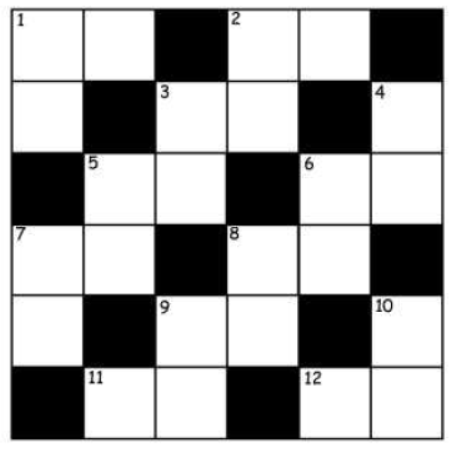
Across
1. 5 divided by one third = \( 5 \div \frac{1}{3} = 15 \)
2. 10 divided by two fifths = \( 10 \div \frac{2}{5} = 25 \)
3. 10 divided by two thirds = \( 10 \div \frac{2}{3} = 15 \)
5. 5 divided by one sixth = \( 5 \div \frac{1}{6} = 30 \)
6. 1 divided by one fiftieth = \( 1 \div \frac{1}{50} = 50 \)
7. 5 divided by one fifteenth = \( 5 \div \frac{1}{15} = 75 \)
8. 3 divided by one fifth = \( 3 \div \frac{1}{5} = 15 \)
9. 8 divided by two fifths = \( 8 \div \frac{2}{5} = 20 \)
11. 4 divided by four tenths = \( 4 \div \frac{4}{10} = 10 \)
12. 10 divided by one third = \( 10 \div \frac{1}{3} = 30 \)
Down
1. 1 divided by one tenth = \( 1 \div \frac{1}{10} = 10 \)
2. 15 divided by three fifths = \( 15 \div \frac{3}{5} = 25 \)
3. 2 divided by one fifth = \( 2 \div \frac{1}{5} = 10 \)
4. 3 divided by 6 twentieth = \( 3 \div \frac{6}{20} = 10 \)
5. 7 divided by one fifth = \( 7 \div \frac{1}{5} = 35 \)
6. 11 divided by one fifth = \( 11 \div \frac{1}{5} = 55 \)
7. 14 divided by one fifth = \( 14 \div \frac{1}{5} = 70 \)
8. 5 divided by one half = \( 5 \div \frac{1}{2} = 10 \)
9. 5 divided by one fourth = \( 5 \div \frac{1}{4} = 20 \)
10. 2 divided by four hundredths = \( 2 \div \frac{4}{100} = 50 \)
Multiplication of Integers
Coloring Rules:
1. Light Green (Positive Products): Any multiplication of two positive numbers or two negative numbers. Examples:
- \( 5 \times 5 = 25 \) (Positive \( \times \) Positive)
- \( -5 \times -5 = 25 \) (Negative \( \times \) Negative)
2. Light Blue (Negative Products): Any multiplication of one positive number and one negative number. Examples:
- \( 5 \times -5 = -25 \) (Positive \( \times \) Negative)
- \( -5 \times 5 = -25 \) (Negative \( \times \) Positive)
3. Red (Zero Products): Any multiplication where at least one of the numbers is 0. Examples:
- \( 5 \times 0 = 0 \)
- \( 0 \times -5 = 0 \)
Free study material for Mathematics
Free CBSE Practice Worksheets: Class 7 Mathematics Chapter 02 Fractions and Decimals
Practice Exercises for Class 7 Mathematics Chapter 02 Fractions and Decimals
Access structured practice worksheets for Chapter 02 Fractions and Decimals aligned with the 2026 CBSE curriculum. These downloadable exercises for Class 7 Mathematics help students build accuracy and reinforce core concepts for upcoming school tests.
Step-by-Step Solutions and Practice Guidelines
Built using official NCERT guidelines for Class 7 Mathematics, these practice sheets provide reliable academic support. Cross-reference your completed work with our detailed solutions to learn standard answer-writing formats for CBSE exams.
Enhance Speed with Online Practice
Consistent engagement with these exercises builds familiarity with recurring exam themes. If specific areas within Chapter 02 Fractions and Decimals cause trouble, utilize our dedicated NCERT solutions for Class 7 Mathematics to clear up doubts immediately.
FAQs
You can download the latest chapter-wise printable worksheets for Class 7 Mathematics Chapter 02 Fractions and Decimals for free from StudiesToday.com. These have been made as per the latest CBSE curriculum for this academic year.
Yes, Class 7 Mathematics worksheets for Chapter 02 Fractions and Decimals focus on activity-based learning and also competency-style questions. This helps students to apply theoretical knowledge to practical scenarios.
Yes, we have provided solved worksheets for Class 7 Mathematics Chapter 02 Fractions and Decimals to help students verify their answers instantly.
Yes, our Class 7 Mathematics test sheets are mobile-friendly PDFs and can be printed by teachers for classroom.
For Chapter 02 Fractions and Decimals, regular practice with our worksheets will improve question-handling speed and help students understand all technical terms and diagrams.