

Official Class 7 Mathematics Worksheets: Chapter 02 Fractions and Decimals
Explore structured practice materials through the CBSE Class 7 Mathematics Fractions And Decimals Worksheet Set 07. Tailored for Class 7 learners, utilizing these Mathematics worksheets ensures thorough preparation and strengthens problem-solving accuracy before final school evaluations.
Solved Practice Worksheets for Mathematics
Navigate directly to the solved Mathematics worksheets using the digital viewer below. Each practice set includes detailed step-by-step solutions, allowing students to instantly cross-check their work and identify areas requiring further revision.
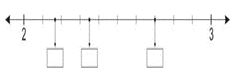
Question. The points 2.17, 2.7 and 2.35 have to be put in the empty boxes in the number line.
From left to right, the numbers that go into the empty boxes are
(a) 2.7, 2.17, 2.35
(b) 2.17, 2.7, 2.35
(c) 2.17, 2.35, 2.7
(d) 2.7, 2.35, 2.17
Answer : C
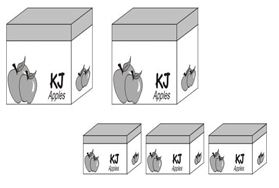
Question. Each big box shown below contains 100 apples and each small box contains 10 apples. In all, how many apples are there in the boxes?
(a) 500
(b) 230
(c) 320
(d) 50
Answer : B
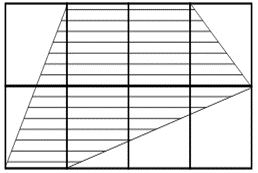
Question. What fraction of the figure is shaded?
(a) 1/2
(b) 3/8
(c) 5/8
(d) 7/16
Answer : C
Question. 6 out of a thousand is the same as
(a) 6%
(b) 0.60%
(c) 0.01%
(d) 0.06%
Answer : B
Question. 46 tenth is a number between
(a) 0 and 4
(b) 4 and 5
(c) 40 and 50
(d) 400 and 500
Answer : B
Question. A students' hostel has 60 rooms. One-fifth of the rooms can accommodate 1 student per room, one-fifth can accommodate 2 students per room and the rest can accommodate 3 students per room. What is the MAXIMUM number of students that can be accommodated in the hostel?
(a) 60
(b) 72
(c) 144
(d) 180
Answer : C
Question. What fraction of the viewers who voted chose the dog as their favourite animal?

(a) 1/2
(b) 1/5
(c) 1/10
(d) 1/30
Answer : B
Question. 0.5 x 0.20 equals
(a) 0.01
(b) 0.1
(c) 1
(d) 100
Answer : B
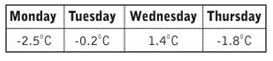
Question. The table below shows the average daily temperature on four consecutive days in a village in Himachal Pradesh. The four days in order from the coldest to the warmest are
(a) Monday, Thursday, Wednesday, Tuesday
(b) Tuesday, Wednesday, Thursday, Monday
(c) Tuesday, Thursday, Monday, Wednesday
(d) Monday, Thursday, Tuesday, Wednesday
Answer : B
Question. The figure below shows a view of a long jump pit, take off line and pit-side indicator board at a long jump competition. The distance between the take off line and the nearer edge of the pit is 1 m. A jump is always measured from the TAKE OFF LINE. The cross on the pit marks the place where Anju lands after a jump. Assuming that she took off from the proper place, about how long was Anju's jump?

(a) 5.60 m
(b) 5.3 m
(c) 5.06 m
(d) 5.03 m
Answer : A
Question. Which of the following will be equal to 1/4 ?
(a) one hundredth of 250
(b) 50% of 5
(c) 100% of 0.25
(d) 140% of 1
Answer : C
Question. Which of these can be expressed as 5/3?
(a) 2/3+3/3
(b) 5 + 5 + 5
(c) 3 X 3 X 3 X3 x3
(d) (7 - 2) X (7 - 2) X (7 - 2)
Answer : A
Question. 90 for every 100 is the same as_____for every 200.
(a) 210
(b) 190
(c) 180
(d) 90
Answer : C
Question. If 1.225 x 1.55 = 1.89875, then which of the following numbers would 122.5 x 15.5 be closest to?
(a) 190
(b) 1900
(c) 18000
(d) 19000
Answer : B
Question. What should be added to 7(4/15) to get 8(2/5) ?
Answer : 1(2/15)
Question. Each side of a square is 2.5m in length. Find the perimeter of the square.
Answer : 10m
Question. Each side of a regular polygon of six sides is 3.5 cm in length. Find the perimeter of the polygon.
Answer : 21 cm
Question. Multiply : 100.01 × 1.1.
Answer : 110.011
Question. The cost of 20 pens is Rs. 298.80. Find the cost of one pen.
Answer : Rs. 14.94
Question. Solve : 5(3/7) ÷ 2(5/7)
Answer : 2.
Question. Find 7/8 of a kilogram.
Answer : 875 g
Question. If the cost of a book is Rs. 75.50, find the cost of 50 such books.
Answer : Rs. 3775
Question. Find 4/5 of an hour.
Answer : 48 min
Question. The product of two numbers is 2.56. If one of them is 1.6, find the other number.
Answer : 1.6
Question. If 1 kg of pure milk contains 0.245 kg of fat, how much fat is there in 100 kg of milk?
Answer : 24.5 kg.
Question. Divide 432.8 by 1000.
Answer : 0.4328
Question. Simplify : 12/25 x 15/28 x 35/36
Answer : 1/4
Question. Sapna bought a shirt for Rs. 125.50 and a jeans for Rs. 550.75. She paid Rs. 1000 in all. How much money did she get back?
Answer : Rs. 323.75
Question. A vehicle covers a distance 48 km in 2.4 litres of petrol. How much distance will it cover in a litre of petrol?
Answer : 20 km
Question. Simplify : 11.2 x 0.15 ÷ 4/5
Answer : 2.1
Question. How much less is 58 km than 98.6 km?
Answer : 40.6
Question. By how much should 32.67 be increased to make it 40.00?
Answer : 7.33
Question. What should be added to 63.58 to get 90?
Answer : 26.42
Question. Rohit purchased a notebook for Rs. 13.65, a pencil for Rs. 2.00 and a pen for Rs. 14.35.
How much did he pay in all?
Answer : Rs. 30
Question. Shilpa cuts 25 metres of rope into pieces of 1.25 m each. How many pieces does she get?
Answer : 20 pieces
Question. Find the value : 30.94 ÷ 0.07.
Answer : 442
Question. Multiply : 156.1 × 1000.
Answer : 156100
Question. Total weight of some bags of wheat is 1743 kg. If each bag contains 49.8 kg. How many bags are there in all?
Answer : 35 Bags.
Question. Find the average of 4.2, 3.8 and 4.6.
Answer : 4.2
Adding and Subtracting Fractions (A)
Find the value of each expression in lowest terms.
Question 1. \( 2\frac{5}{6} - \left( 4\frac{1}{3} - \frac{3}{2} \right) \)
Answer: We change the mixed numbers into improper fractions first.
\( 2\frac{5}{6} = \frac{17}{6} \)
\( 4\frac{1}{3} = \frac{13}{3} \)
Now, solve the part inside the bracket.
\( \frac{13}{3} - \frac{3}{2} \)
The common denominator is 6.
\( \frac{26}{6} - \frac{9}{6} = \frac{17}{6} \)
Next, subtract this result from the first fraction.
\( \frac{17}{6} - \frac{17}{6} = 0 \)
In simple words: The number inside the bracket is the same as the first number. Subtracting them gives 0.
Exam Tip: Solve the terms inside the brackets first to keep your calculations correct and organized.
Question 2. \( \frac{1}{2} + \frac{13}{8} - \frac{11}{12} \)
Answer: First, find the common denominator for 2, 8, and 12.
The least common multiple of these numbers is 24.
Now, change each fraction so they all match.
\( \frac{1}{2} = \frac{12}{24} \)
\( \frac{13}{8} = \frac{39}{24} \)
\( \frac{11}{12} = \frac{22}{24} \)
Next, add and subtract the top numbers.
\( \frac{12 + 39 - 22}{24} = \frac{29}{24} \)
Convert this to a mixed fraction.
\( \frac{29}{24} = 1\frac{5}{24} \)
In simple words: Make the bottom numbers equal to 24. Then add and subtract the top numbers to get \( 1\frac{5}{24} \).
Exam Tip: Convert your final improper fraction back into a mixed fraction if it is greater than one.
Question 3. \( \frac{3}{10} - \frac{1}{6} + 3\frac{4}{5} \)
Answer: Convert the mixed fraction into an improper fraction.
\( 3\frac{4}{5} = \frac{19}{5} \)
The expression is now:
\( \frac{3}{10} - \frac{1}{6} + \frac{19}{5} \)
The common denominator for 10, 6, and 5 is 30.
Convert each fraction:
\( \frac{3}{10} = \frac{9}{30} \)
\( \frac{1}{6} = \frac{5}{30} \)
\( \frac{19}{5} = \frac{114}{30} \)
Now, solve the top numbers.
\( \frac{9 - 5 + 114}{30} = \frac{118}{30} \)
Divide both the top and bottom by 2 to simplify.
\( \frac{118}{30} = \frac{59}{15} \)
Change this into a mixed fraction.
\( \frac{59}{15} = 3\frac{14}{15} \)
In simple words: Change the mixed fraction to an improper fraction first. Use 30 as the common bottom number to get \( 3\frac{14}{15} \).
Exam Tip: Always check if you can simplify the final fraction to its lowest terms before converting it to a mixed fraction.
Question 4. \( \frac{3}{4} + \frac{2}{7} - \frac{2}{7} \)
Answer: Look closely at the numbers in the expression.
Subtracting \( \frac{2}{7} \) from \( \frac{2}{7} \) leaves 0.
The remaining term is:
\( \frac{3}{4} \)
So, the final value is \( \frac{3}{4} \).
In simple words: Subtracting a number from itself gives 0. Only \( \frac{3}{4} \) is left as the answer.
Exam Tip: Always look for terms that cancel each other out before starting any calculations.
Question 5. \( 1\frac{1}{5} + \frac{17}{2} - \frac{3}{2} \)
Answer: First, convert the mixed fraction.
\( 1\frac{1}{5} = \frac{6}{5} \)
Notice that the last two fractions have the same bottom number.
Let's simplify that part first.
\( \frac{17}{2} - \frac{3}{2} = \frac{14}{2} = 7 \)
Now, add the two parts together.
\( \frac{6}{5} + 7 = 1\frac{1}{5} + 7 = 8\frac{1}{5} \)
In simple words: Solve the fractions with 2 at the bottom to get 7. Add \( 1\frac{1}{5} \) to get \( 8\frac{1}{5} \).
Exam Tip: Grouping fractions that already have matching denominators saves you from finding a larger common denominator.
Question 6. \( \frac{17}{6} + \frac{5}{3} - 3\frac{1}{2} \)
Answer: Start by converting the mixed fraction.
\( 3\frac{1}{2} = \frac{7}{2} \)
The expression becomes:
\( \frac{17}{6} + \frac{5}{3} - \frac{7}{2} \)
The common denominator for 6, 3, and 2 is 6.
Convert the fractions to match:
\( \frac{17}{6} \)
\( \frac{5}{3} = \frac{10}{6} \)
\( \frac{7}{2} = \frac{21}{6} \)
Now, calculate the top numbers.
\( \frac{17 + 10 - 21}{6} = \frac{6}{6} = 1 \)
In simple words: Use 6 as the common bottom number for all fractions. This gives \( \frac{6}{6} \), which equals 1.
Exam Tip: Any fraction where the numerator and denominator are the same is always equal to 1.
Question 7. \( \frac{5}{2} + 1\frac{7}{9} + \frac{1}{3} \)
Answer: Convert the mixed fraction first.
\( 1\frac{7}{9} = \frac{16}{9} \)
The expression is now:
\( \frac{5}{2} + \frac{16}{9} + \frac{1}{3} \)
The common denominator for 2, 9, and 3 is 18.
Change each fraction:
\( \frac{5}{2} = \frac{45}{18} \)
\( \frac{16}{9} = \frac{32}{18} \)
\( \frac{1}{3} = \frac{6}{18} \)
Now, add the top numbers.
\( \frac{45 + 32 + 6}{18} = \frac{83}{18} \)
Convert this into a mixed fraction.
\( \frac{83}{18} = 4\frac{11}{18} \)
In simple words: Use 18 as the common bottom number. Add the top numbers together to get \( 4\frac{11}{18} \).
Exam Tip: Double check your addition steps when summing up three different numerators.
Question 8. \( 1\frac{11}{12} - \left( 1\frac{3}{4} - \frac{1}{8} \right) \)
Answer: First, convert the mixed fractions.
\( 1\frac{11}{12} = \frac{23}{12} \)
\( 1\frac{3}{4} = \frac{7}{4} \)
Now, solve the bracket.
\( \frac{7}{4} - \frac{1}{8} \)
The common denominator for 4 and 8 is 8.
\( \frac{14}{8} - \frac{1}{8} = \frac{13}{8} \)
Now, perform the main subtraction.
\( \frac{23}{12} - \frac{13}{8} \)
The common denominator for 12 and 8 is 24.
\( \frac{46}{24} - \frac{39}{24} = \frac{7}{24} \)
In simple words: Solve the terms inside the bracket first to get \( \frac{13}{8} \). Subtract this from \( \frac{23}{12} \) to get \( \frac{7}{24} \).
Exam Tip: Be careful to find the correct common denominator for the final subtraction step.
Question 9. \( \frac{11}{2} - \left( \frac{5}{7} + \frac{3}{2} \right) \)
Answer: Solve the addition inside the bracket first.
\( \frac{5}{7} + \frac{3}{2} \)
The common denominator is 14.
\( \frac{10}{14} + \frac{21}{14} = \frac{31}{14} \)
Now, perform the subtraction.
\( \frac{11}{2} - \frac{31}{14} \)
The common denominator is 14.
\( \frac{77}{14} - \frac{31}{14} = \frac{46}{14} \)
Simplify by dividing the top and bottom by 2.
\( \frac{46}{14} = \frac{23}{7} \)
Change this into a mixed fraction.
\( \frac{23}{7} = 3\frac{2}{7} \)
In simple words: Add the numbers inside the bracket first to get \( \frac{31}{14} \). Subtract that from \( \frac{11}{2} \) to get \( 3\frac{2}{7} \).
Exam Tip: Simplifying your improper fraction to its lowest terms first makes finding the mixed fraction much easier.
Question 10. \( 3\frac{1}{3} + 1\frac{3}{4} - 1\frac{2}{3} \)
Answer: First, change all mixed numbers to improper fractions.
\( 3\frac{1}{3} = \frac{10}{3} \)
\( 1\frac{3}{4} = \frac{7}{4} \)
\( 1\frac{2}{3} = \frac{5}{3} \)
Notice that two fractions have a denominator of 3. Let's combine them first.
\( \frac{10}{3} - \frac{5}{3} = \frac{5}{3} \)
Now, add the other fraction.
\( \frac{5}{3} + \frac{7}{4} \)
The common denominator is 12.
\( \frac{20}{12} + \frac{21}{12} = \frac{41}{12} \)
Convert this to a mixed fraction.
\( \frac{41}{12} = 3\frac{5}{12} \)
In simple words: Combine the fractions with 3 at the bottom first. Then add \( \frac{7}{4} \) to get \( 3\frac{5}{12} \).
Exam Tip: Reordering terms with like denominators is a great shortcut to save time and reduce errors during exams.
Question 11. \( \frac{4}{3} - \left( 1\frac{11}{12} - \frac{5}{4} \right) \)
Answer: Start by converting the mixed fraction.
\( 1\frac{11}{12} = \frac{23}{12} \)
Now, calculate inside the bracket.
\( \frac{23}{12} - \frac{5}{4} \)
The common denominator is 12.
\( \frac{23}{12} - \frac{15}{12} = \frac{8}{12} \)
Simplify this fraction by dividing the top and bottom by 4.
\( \frac{8}{12} = \frac{2}{3} \)
Now, subtract this from the first fraction.
\( \frac{4}{3} - \frac{2}{3} = \frac{2}{3} \)
In simple words: Solve inside the bracket to get \( \frac{2}{3} \). Subtracting this from the first number leaves \( \frac{2}{3} \).
Exam Tip: Always simplify intermediate fractions when possible to keep your numbers small and easy to work with.
Question 12. \( 2\frac{1}{3} - \frac{2}{3} + 1\frac{1}{9} \)
Answer: Convert all mixed fractions to improper fractions first.
\( 2\frac{1}{3} = \frac{7}{3} \)
\( 1\frac{1}{9} = \frac{10}{9} \)
Solve the first subtraction since the denominators match.
\( \frac{7}{3} - \frac{2}{3} = \frac{5}{3} \)
Now, add the last fraction.
\( \frac{5}{3} + \frac{10}{9} \)
The common denominator is 9.
\( \frac{15}{9} + \frac{10}{9} = \frac{25}{9} \)
Change this into a mixed fraction.
\( \frac{25}{9} = 2\frac{7}{9} \)
In simple words: Subtract \( \frac{2}{3} \) from \( \frac{7}{3} \) to get \( \frac{5}{3} \). Then add \( 1\frac{1}{9} \) to get \( 2\frac{7}{9} \).
Exam Tip: Be sure to convert mixed numbers to improper fractions before attempting to add or subtract them.
Free study material for Mathematics
Free CBSE Practice Worksheets: Class 7 Mathematics Chapter 02 Fractions and Decimals
Practice Exercises for Class 7 Mathematics Chapter 02 Fractions and Decimals
Explore reliable practice questions for Chapter 02 Fractions and Decimals tailored for Class 7 Mathematics learners. Use these structured worksheets to evaluate exam preparedness and strengthen problem-solving skills throughout the 2026 academic session.
Step-by-Step Solutions and Practice Guidelines
Built using official NCERT guidelines for Class 7 Mathematics, these practice sheets provide reliable academic support. Cross-reference your completed work with our detailed solutions to learn standard answer-writing formats for CBSE exams.
Enhance Speed with Online Practice
Follow up your worksheet practice by attempting the interactive online MCQ tests for Chapter 02 Fractions and Decimals to evaluate your execution speed. All printable assignments and revision sheets on our platform are updated for the 2026 session and available free of charge.
FAQs
You can download the latest chapter-wise printable worksheets for Class 7 Mathematics Chapter 02 Fractions and Decimals for free from StudiesToday.com. These have been made as per the latest CBSE curriculum for this academic year.
Yes, Class 7 Mathematics worksheets for Chapter 02 Fractions and Decimals focus on activity-based learning and also competency-style questions. This helps students to apply theoretical knowledge to practical scenarios.
Yes, we have provided solved worksheets for Class 7 Mathematics Chapter 02 Fractions and Decimals to help students verify their answers instantly.
Yes, our Class 7 Mathematics test sheets are mobile-friendly PDFs and can be printed by teachers for classroom.
For Chapter 02 Fractions and Decimals, regular practice with our worksheets will improve question-handling speed and help students understand all technical terms and diagrams.