

Class 7 Mathematics Practice Sheet: CBSE Class 7 Mathematics Fractions And Decimals Worksheet Set 02
Review targeted academic worksheets with the CBSE Class 7 Mathematics Fractions And Decimals Worksheet Set 02. Built according to official educational standards for the 2026-27 term, these downloadable Class 7 Mathematics resources support effective daily practice and detailed self-evaluation for Chapter 02 Fractions and Decimals.
Download Chapter 02 Fractions and Decimals Worksheet PDF with Answers
View or download the dedicated CBSE Class 7 Mathematics Fractions And Decimals Worksheet Set 02 resource below. Engaging with these practice papers under focused study conditions ensures continuous academic progress and mastery of the 2026-27 curriculum for Chapter 02 Fractions and Decimals.
DECIMAL (MULTIPLICATION)
Multiplication of Fractions
1. Fractions multiplication is similar to the multiplication of any two real numbers. Or you can say, we apply the simple method to multiply fractions here. Simply, we can write the formula for multiplication of fraction as;
The product of Fraction = Product of numerator/Product of denominator
2. To multiply fractions, simplify it first and then multiply the numerators and denominators separately.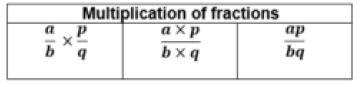
Questions based on MULTIPLICATION OF FRACTIONS:-
Question. Find the product: (i) (3/5) × (7/11)
Solution:
By the rule Multiplication of fraction,
Product of fraction = (product of numerator)/ (product of denominator)
Then,
= (3 × 7)/ (5 × 11)
= (21/55)
(ii) (5/8) × (4/7)
Solution:
By the rule Multiplication of fraction,
Product of fraction = (product of numerator)/ (product of denominator)
Then,
= (5 × 4)/ (8 × 7)
= (20/56) … [÷ by 4]
= (5/14)
(iii) (4/9) × (15/16)
Solution:
By the rule Multiplication of fraction,
Product of fraction = (product of numerator)/ (product of denominator)
Then,
= (4 × 15)/ (9 × 16)
= (60/144) … [ by 12]
= (5/12)
(iv) (2/5) × 15
Solution:
By the rule Multiplication of fraction,
Product of fraction = (product of numerator)/ (product of denominator)
Then,
= (2 × 15)/ (5 × 1)
= (30/5) … [÷ by 5]
= 6
Question. Simplify: (i) (2/3) × (5/44) × (33/35)
Solution:
By the rule Multiplication of fraction,
Product of fraction = (product of numerator)/ (product of denominator)
Then,
= (2×5×33)/ (3×44×35)
On simplifying we get,
= (1×1×11) / (1×22×7)
= (11/154)
= (1/14)
(ii) (12/25) × (15/28) × (35/36)
Solution:
By the rule Multiplication of fraction,
Product of fraction = (product of numerator)/ (product of denominator)
Then,
= (12×15×35)/ (25×28×36)
On simplifying we get,
= (1×3×5) / (5×4×3)
Again simplifying we get,
= (1×1×1)/ (1×4×1)
= (1/4)
(iii) [1(4/7)] × [1(13/22)] × [1(1/15)]
Solution:
By the rule Multiplication of fraction,
Product of fraction = (product of numerator)/ (product of denominator)
Then,
By Converting mixed fraction into improper fraction we get,
= (11/7) × (35/22) × (16/15)
= (11×35×16)/ (7×22×15)
On simplifying we get,
= (1×5×16) / (1×2×15)
Again simplifying we get,
= (1×1×8)/ (1×1×3)
= (8/3)
= [2(2/3)]
Question. Find : (i) (1/3) of 24
Solution:
We have:
= (1/3) of (24/1)
This can be written as,
= (24/1) × (1/3)
By the rule Multiplication of fraction,
Product of fraction = (product of numerator)/ (product of denominator)
Then,
= (24 × 1)/ (1 × 3)
= (24/3)
= 8
(ii) (3/4) of 32
Solution:
We have:
= (3/4) of (32/1)
This can be written as,
= (32/1) × (3/4)
By the rule Multiplication of fraction,
Product of fraction = (product of numerator)/ (product of denominator)
Then,
= (32 × 3)/ (1 × 4)
On simplifying we get,
= (8×3)/ (1×1)
= 24
Question. Apples are sold at ₹ [48(4/5)] per kg. What is the cost of [3(3/4)] kg of apples?
Solution:
From the question,
The cost of 1 kg of apples = [48(4/5)] = (244/5)
Therefore, the cost of [3(3/4)] kg of apples = (15/4)
Then,
= (244/5) × (15/4)
= (244 × 15) / (5 × 4)
On simplifying we get,
= (61 × 3) / (1 × 1)
= ₹ 183
Hence, the cost of [3(3/4)] kg is ₹ 183
Question. Cloth is being sold at ₹ [42(1/2)] per meter. What is the cost of [5(3/5)] meters of this cloth?
Solution:
From the question,
The cost of 1 meter of cloth = ₹ [42(1/2)] = (85/2)
Therefore, the cost of [5(3/5)] meters of cloth = (28/5)
Then,
= (85/2) × (28/5)
= (85 × 28) / (2 × 5)
On simplifying we get,
= (17 × 14) / (1 × 1)
= ₹ 238
Hence, the cost of [5(3/5)] meters of cloth is ₹ 238.
Question. A car covers a certain distance at a uniform speed of [66(2/3)] km per hour. How much distance will it cover in 9 hours?
Solution:
From the question,
The total distance covered by a car in 1 hour = [66(2/3)] km = (200/3)
Therefore, the distance covered by a car in 9 hour = (200/3) × 9
Then,
= (200/3) × (9/1)
= (200 × 9) / (3 × 1)
On simplifying we get,
= (200× 3) / (1 × 1)
= 600 km
Hence, the distance covered by a car in 9 hour is 600 km.
Question. One tin holds [12(3/4)] liters of oil. How many liters of oil can 26 such tins hold?
Solution:
From the question,
The total amount of oil in 1 tin = [12(3/4)] liters = (51/4)
Therefore, the amount of oil in 26 such tins = (51/4) × 26
Then,
= (51/4) × (26/1)
= (51 × 26) / (4 × 1)
On simplifying we get,
= (51× 13) / (2 × 1)
= (663/2)
= [331(1/2)] liters
Hence, the amount of oil in 26 such tins is [331(1/2)] liters.
Question. Find the product:
(i) 4.74 × 10
(ii) 0.45 × 10
(iii) 0.0215 × 10
Solution:
(i) Given 4.74 × 10
Here we have to do normal multiplication with shifting the decimal point by one place to the right
Therefore 4.74 × 10 = 47.4
(ii) Given 0.45 × 10
Here we have to do normal multiplication with shifting the decimal point by one place to the right
Therefore 0.45 × 10 = 4.5
(iii) Given 0.0215 × 10
Here we have to do normal multiplication with shifting the decimal point by one place to the right
Therefore 0.0215 × 10 = 0.215
Question. Find the product:
(i) 35.853 × 100
(ii) 42.5 × 100
Solution:
(i) Given 35.853 × 100
Here we have to do normal multiplication with shifting the decimal point by two places to the right
Therefore 35.853 × 100 = 3585.3
(ii) Given 42.5 × 100
Here we have to do normal multiplication with shifting the decimal point by two places to the right
Therefore 42.5 × 100 = 4250
Question. Find the product:
(i) 2.506 × 1000
(ii) 20.708 × 1000
Solution:
(i) Given 2.506 × 1000
Here we have to do normal multiplication with shifting the decimal point by three places to the right
Therefore 2.506 × 1000 = 2506
(ii) Given 20.708 × 1000
Here we have to do normal multiplication with shifting the decimal point by three places to the right
Therefore 20.708 × 1000 = 20708
Question. Find the product:
(i) 3.14 × 17
(ii) 0.745 × 12
Solution:
(i) Given 3.14 × 17
First multiply as usual without looking at the decimal point
3.14 × 17 = 578
Now mark the decimal point in the product to have one place of decimal as there in the given decimal
3.14 × 17 = 57.8
(ii) Given 0.745 × 12
First multiply as usual without looking at the decimal point
0.745 × 12 = 894
Now mark the decimal point in the product to have three places of decimal as there in the given decimal
0.745 × 12 = 8.94
Question. Find:
(i) 1.07 × 0.02
(ii) 211.9 × 1.13
Solution:
(i) Given 1.07 × 0.02
First multiply as usual without looking at the decimal point
1.07 × 0.02 = 00214
Sum of the decimals is 4
Now mark the decimal point in the product to have four places of decimal as there in the given decimal
1.07 × 0.02 = 0.0214
(ii) Given 211.9 × 1.13
First multiply as usual without looking at the decimal point
211.9 × 1.13 = 239447
Sum of the decimals is 3
Now mark the decimal point in the product to have three places of decimal as there in the given decimal
211.9 × 1.13 = 239.447
Question. Find the area of a rectangle whose length is 5.5m and breadth is 3.4m.
Solution:
Given length of rectangle = 5.5m
Breadth of rectangle = 3.4 m
Area of rectangle = length × breadth
= 5.5 × 3.4
= 18.7 m2
Question. If the cost of a book is Rs 25.57, find the cost 0f 24 such books.
Solution:
Given cost of a book is Rs 25.57
Cost of 24 books = 25.57 × 24
= Rs 618.00
Question. A car covers a distance of 14.75km in one liter of petrol. How much distance it will cover in 15.5 liters of petrol?
Solution:
Given that distance covered by car in 1 liter of petrol = 14.75 km
Distance covered by car in 15.5 liters of petrol = 14.75 × 15.5
= 228.625 km
Question. One kg of rice costs Rs 42.65. What will be the cost of 18.25 kg of rice?
Solution:
Given cost of 1kg of rice = 42.65
Cost of 18.25kg of rice = 42.65 × 18.25
= Rs 778.3625
Question. One meter of cloth costs Rs 152.50. What is the cost of 10.75 meters of cloth?
Solution:
Given that cost of 1m cloth = Rs 152.50
Cost of 10.75 m of cloth = 152.50 × 10.75
= Rs 1639.375
Students must free download and practice these worksheets to gain more marks in exams. CBSE Class 7 Maths Worksheet - Fractions and Decimals (1)
Free study material for Mathematics
Download Class 7 Mathematics Chapter 02 Fractions and Decimals Practice Worksheets
Practice Exercises for Class 7 Mathematics Chapter 02 Fractions and Decimals
Access structured practice worksheets for Chapter 02 Fractions and Decimals aligned with the 2026 CBSE curriculum. These downloadable exercises for Class 7 Mathematics help students build accuracy and reinforce core concepts for upcoming school tests.
Step-by-Step Solutions and Practice Guidelines
Designed around the official curriculum for Class 7 Mathematics, these practice sheets guarantee standard compliance. Reviewing step-by-step solutions after completion sharpens your accuracy and clarifies complex sub-topics within Chapter 02 Fractions and Decimals.
Enhance Speed with Online Practice
Consistent engagement with these exercises builds familiarity with recurring exam themes. If specific areas within Chapter 02 Fractions and Decimals cause trouble, utilize our dedicated NCERT solutions for Class 7 Mathematics to clear up doubts immediately.
FAQs
You can download the latest chapter-wise printable worksheets for Class 7 Mathematics Chapter 02 Fractions and Decimals for free from StudiesToday.com. These have been made as per the latest CBSE curriculum for this academic year.
Yes, Class 7 Mathematics worksheets for Chapter 02 Fractions and Decimals focus on activity-based learning and also competency-style questions. This helps students to apply theoretical knowledge to practical scenarios.
Yes, we have provided solved worksheets for Class 7 Mathematics Chapter 02 Fractions and Decimals to help students verify their answers instantly.
Yes, our Class 7 Mathematics test sheets are mobile-friendly PDFs and can be printed by teachers for classroom.
For Chapter 02 Fractions and Decimals, regular practice with our worksheets will improve question-handling speed and help students understand all technical terms and diagrams.