

Official Class 7 Mathematics Worksheets: Chapter 10 Practical Geometry
Access comprehensive chapter-wise worksheets for Chapter 10 Practical Geometry using the CBSE Class 7 Mathematics Practical Geometry Worksheet. Designed to align with the 2026-27 academic syllabus for Class 7 Mathematics, these printable practice sets help students reinforce key concepts and improve their overall exam readiness.
Solved Practice Worksheets for Mathematics
Access the complete worksheet PDF for Class 7 Mathematics below. Regular practice with these targeted academic tasks builds familiarity with standard question patterns and helps secure higher marks in final school examinations.
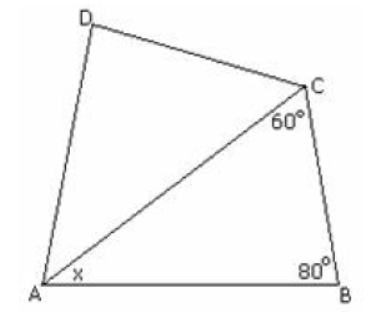
Question 1. In the given figure find the value of x.
(A) 50°
(B) 40°
(C) 60°
(D) 45°
Answer: (B) 40°
In triangle ABC, using the angle sum property of a triangle:
\( \implies x + 80^\circ + 60^\circ = 180^\circ \)
\( \implies x + 140^\circ = 180^\circ \)
\( \implies x = 180^\circ - 140^\circ \)
\( \implies x = 40^\circ \)
In simple words: The three inside corners of the bottom triangle must add up to \( 180^\circ \). Since two corners add up to \( 140^\circ \), the missing corner \( x \) is \( 40^\circ \).
Exam Tip: Always look at the specific triangle containing the variable \( x \) and apply the angle sum property directly.
Question 2. Fill in the blank:
The perpendicular bisectors of the sides of a triangle are……….
Answer: concurrent
The perpendicular bisectors of the sides of a triangle meet at a single common point, which means they are concurrent. This point of concurrency is called the circumcentre of the triangle.
In simple words: Perpendicular bisectors of a triangle are concurrent, meaning they all cross each other at the exact same point.
Exam Tip: Remember the terms for concurrency: perpendicular bisectors meet at the circumcentre, while angle bisectors meet at the incentre.
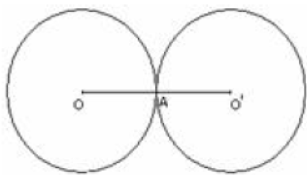
Question 3. What is the measure of line segment OO' in the given figure? If OA and AO' are both 3 cm.
(A) 6 cm
(B) 4 cm
(C) 8 cm
(D) 2 cm
Answer: (A) 6 cm
Since the two circles touch each other externally at point A, the line segment connecting their centers is the sum of their radii:
\( \implies OO' = OA + AO' \)
\( \implies OO' = 3\text{ cm} + 3\text{ cm} = 6\text{ cm} \)
In simple words: The distance between the centers of the two touching circles is found by adding the radius of the first circle to the radius of the second circle, which is \( 3 + 3 = 6\text{ cm} \).
Exam Tip: When circles touch externally, the distance between their centers is always equal to the sum of their radii.
Question 4. In triangle ABC, AB = 3 cm, BC = 9 cm and CA = 4 cm. triangle ABC can be construct?
(A) Yes
(b) No
(C) Might be
(D) None of these
Answer: (B) No
According to the triangle inequality property, the sum of the lengths of any two sides of a triangle must always be strictly greater than the third side.
Here, the sum of the two smaller sides is:
\( \implies AB + CA = 3\text{ cm} + 4\text{ cm} = 7\text{ cm} \)
Since \( 7\text{ cm} < 9\text{ cm} \) (which is side BC), a triangle cannot be formed with these side lengths.
In simple words: No, because the two shorter sides added together (\( 3 + 4 = 7\text{ cm} \)) are still shorter than the longest side (\( 9\text{ cm} \)). The sides will not be able to reach each other to close the triangle.
Exam Tip: To quickly test if side lengths can form a triangle, check if the sum of the two smallest values is greater than the largest value.
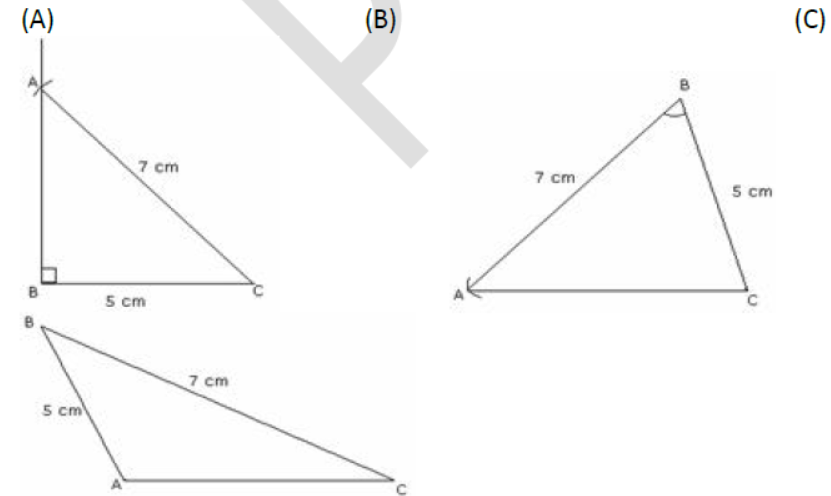
Question 5. "A right-angled triangle, whose hypotenuse is 7 cm long and one of the other legs is 5 cm long". Which of the figure is satisfied the above statement?
(D) None of these
Answer: (A)
Figure (A) correctly shows a right-angled triangle with a right angle symbol (\( 90^\circ \)) at vertex B, a hypotenuse (the longest side opposite the right angle) of 7 cm, and one leg of 5 cm.
In simple words: Figure (A) matches the description because it clearly shows the square-shaped right angle at the bottom corner, a base of 5 cm, and the slanted side (hypotenuse) of 7 cm.
Exam Tip: Always make sure the hypotenuse is represented as the longest slanted side opposite the right-angle corner.
Question 6. If two angles and one side are given in a triangle, then is it possible to construct a triangle?
(A) No
(B) Yes
(C) Might be
(D) None of these
Answer: (B) Yes
Yes, it is possible to construct a triangle if two angles and one side are specified, by using either the ASA (Angle-Side-Angle) or AAS (Angle-Angle-Side) criterion.
In simple words: Yes, if you are given two angles and any one side, you have enough information to construct the triangle.
Exam Tip: Remember that if two angles are given, you can always find the third angle using the angle sum property before starting the construction.
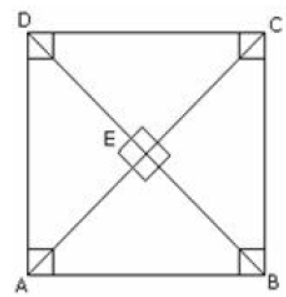
Question 7. How many right triangles in the given figure
(A) 4
(B) 8
(C) 2
(D) 6
Answer: (B) 8
Since ABCD is a square and its diagonals AC and BD intersect perpendicularly at E:
1. There are 4 small right-angled triangles formed around the intersection point E: \( \Delta AEB \), \( \Delta BEC \), \( \Delta CED \), and \( \Delta DEA \).
2. There are also 4 larger right-angled triangles formed by the corners of the square: \( \Delta ABC \), \( \Delta BCD \), \( \Delta CDA \), and \( \Delta DAB \).
The total number of right-angled triangles is \( 4 + 4 = 8 \).
In simple words: There are 8 right-angled triangles in total: 4 small ones created where the diagonals cross in the center, and 4 large ones at the corners of the square.
Exam Tip: When counting shapes in a symmetric figure, look for both the smaller sub-divided triangles and the larger combined ones.
Question 8. How many equal right triangles which have maximum area cut out from a square sheet?
(A) 2
(B) 3
(C) 4
(D) 8
Answer: (A) 2
To cut out equal right-angled triangles of maximum area from a square sheet, we should cut directly along any one diagonal of the square. This splits the square into exactly 2 equal right-angled triangles of maximum possible size.
In simple words: Cutting a square sheet from corner to corner along its diagonal gives us exactly 2 matching right-angled triangles of the largest possible size.
Exam Tip: Cutting along one diagonal divides a square into two congruent right-angled isosceles triangles.
Question 9. Which of the construction of triangle XYZ is true in the following figure, given that XY = 6 cm, \( m \angle ZXY = 30^\circ \) and \( m \angle XYZ = 100^\circ \).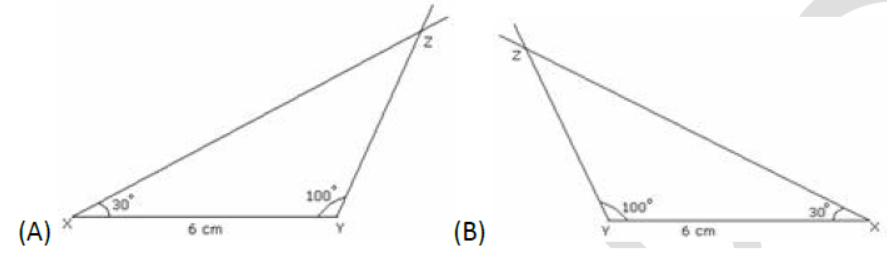
(C) Both of (1) and (2)
(D) None of them
Answer: (C) Both of (1) and (2)
Both figures (A) and (B) correctly show triangle XYZ with the given dimensions: a base side XY of length 6 cm, an acute angle of 30° at vertex X, and an obtuse angle of 100° at vertex Y. Since they are simply mirrored orientations of the same triangle, both constructions are valid.
In simple words: Both pictures are correct because they both have a base of 6 cm with the 30-degree and 100-degree angles in the proper places. One is just a flipped version of the other.
Exam Tip: A geometric construction remains valid even if it is rotated or mirrored, as long as all measurements are correct.
Question 10. In the given figure radius of the circle is…….
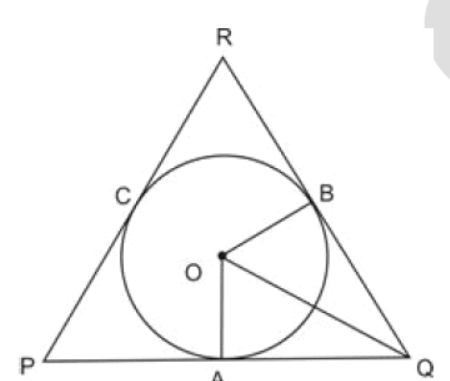
(A) OA
(B) OQ
(C) OB
(D) Both (1) and (3)
Answer: (D) Both (1) and (3)
In the given inscribed circle with center O, the line segments connecting the center O to the contact points on the sides of the triangle (A, B, and C) represent the radii. Therefore, both OA and OB are radii of the circle.
In simple words: The lines going from the center O to the edge of the circle (OA and OB) are both radii, so the correct option is (D).
Exam Tip: A radius is any straight line segment connecting the center of a circle to any point on its outer edge.
Question 11. Which statement is true in the following statements?
(A) Opposite vertically angles are not equal.
(B) Angle sum property hold in triangle.
(C) Sum of two sides of a triangle less than the third side.
(D) None of these
Answer: (B) Angle sum property hold in triangle.
Statement (B) is true because the angle sum property (that the interior angles of a triangle add up to \( 180^\circ \)) always holds true for any triangle.
In simple words: Statement (B) is the only true statement because the inside corners of any triangle must add up to \( 180^\circ \).
Exam Tip: Review the basic theorems of triangles: vertically opposite angles are always equal, and the sum of two sides must be greater than the third side.
Question 12. Which of the following statement is true in the following statements?
(A) Pyramid is 2-dimension figure and triangle is 3-dimension figure.
(B) Pyramid has 4 vertices and triangle has 3 vertices.
(C) Pyramid is 3-dimension solid figure and triangle is 2-dimension plane figure.
(D) Pyramid has 4 sides and triangle has 3 sides.
Answer: (C) Pyramid is 3-dimension solid figure and triangle is 2-dimension plane figure.
Statement (C) is true because a pyramid is a solid 3D shape containing volume, whereas a triangle is a flat 2D shape drawn on a plane.
In simple words: Statement (C) is correct because a pyramid is a solid 3D object that you can hold, while a triangle is a flat 2D shape.
Exam Tip: Always make sure to differentiate between flat, two-dimensional figures and solid, three-dimensional geometric objects.
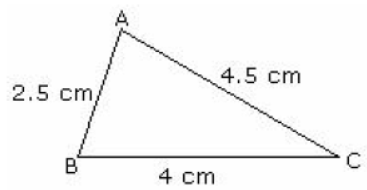
Question 13. Find the perimeter of the given triangle.
(A) 10 cm
(B) 9 cm
(C) 11 cm
(D) 12 cm
Answer: (C) 11 cm
The perimeter of a triangle is the sum of its three side lengths:
\( \implies \text{Perimeter} = AB + BC + CA \)
\( \implies \text{Perimeter} = 2.5\text{ cm} + 4\text{ cm} + 4.5\text{ cm} = 11\text{ cm} \)
In simple words: Adding all three side lengths of the triangle (\( 2.5 + 4 + 4.5 \)) gives us a total perimeter of \( 11\text{ cm} \).
Exam Tip: Perimeter simply means the total length of the outer boundary of any closed shape.
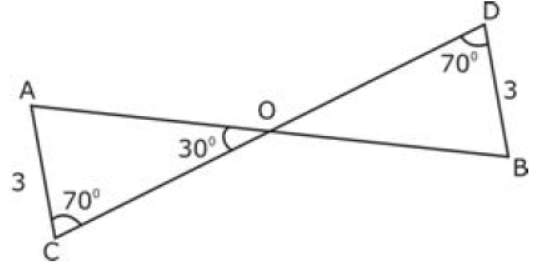
Question 14. In the given figure find the angle DBO.
(A) 90°
(B) 60°
(C) 80°
(D) 35°
Answer: (C) 80°
Since lines AD and BC intersect at point O:
- The vertically opposite angles are equal, so \( \angle BOD = \angle AOC = 30^\circ \).
Now, using the angle sum property in triangle BDO:
\( \implies \angle DBO + \angle BOD + \angle BDO = 180^\circ \)
\( \implies \angle DBO + 30^\circ + 70^\circ = 180^\circ \)
\( \implies \angle DBO + 100^\circ = 180^\circ \)
\( \implies \angle DBO = 180^\circ - 100^\circ = 80^\circ \).
In simple words: The angle at the crossing point O is \( 30^\circ \) on both sides. To make the angles in the right-side triangle add up to \( 180^\circ \), the missing angle must be \( 80^\circ \).
Exam Tip: Remember that vertically opposite angles at any intersection point are always equal.
Question 15. Find the measure angle of x in the given triangle.
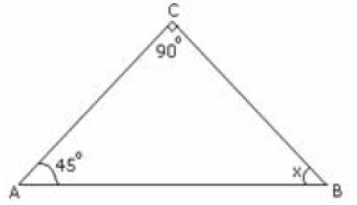
(A) 35 degree
(B) 45 degree
(C) 60 degree
(D) 25 degree
Answer: (B) 45 degree
By applying the angle sum property in right-angled triangle ABC:
\( \implies x + 45^\circ + 90^\circ = 180^\circ \)
\( \implies x + 135^\circ = 180^\circ \)
\( \implies x = 180^\circ - 135^\circ = 45^\circ \).
In simple words: In this right-angled triangle, the three angles must add up to \( 180^\circ \). Since two angles are \( 90^\circ \) and \( 45^\circ \), the missing angle \( x \) is \( 45^\circ \).
Exam Tip: In any right-angled triangle, the two acute angles must always add up to exactly \( 90^\circ \).
Question 16. Which is the longest chord in the given figure? If O is the centre of the circle?
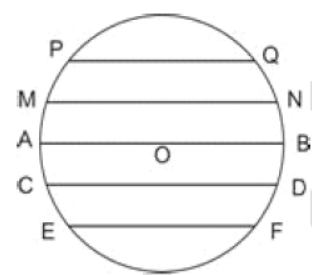
(A) AB
(B) CD
(C) MN
(D) PQ
Answer: (A) AB
The diameter of a circle is the longest chord. Since chord AB passes directly through the center O, it is the diameter and thus the longest chord.
In simple words: The longest chord is always the line that goes straight through the center of the circle, which is the diameter AB.
Exam Tip: Any chord that passes through the center of a circle is called its diameter, and it is always the longest chord.
Question 17. Which statement is true in the following statement?
(A) The total measure of the three angles of a triangle is greater than 180°
(b) The sum of the lengths of any two sides of a triangle is less than the length of the third side.
(C) In any right-angled triangle, the square of the length of hypotenuse is equal to the sum of the square of the length of the other two sides.
(D) None of these
Answer: (C) In any right-angled triangle, the square of the length of hypotenuse is equal to the sum of the square of the length of the other two sides.
Statement (C) is true because it is the definition of Pythagoras' theorem, which holds true for all right-angled triangles.
In simple words: Statement (C) is the only correct statement because it describes Pythagoras' rule for right-angled triangles.
Exam Tip: Be sure to write the formula \( c^2 = a^2 + b^2 \) when stating the Pythagorean theorem in tests.
Question 18. Which of the following figure represent an isosceles right-angled triangle ABC? where angle ACB = 90° and AC = 6 cm.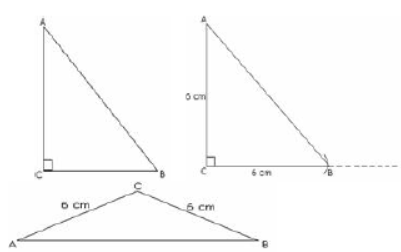
(D) None of these
Answer: (A)
Figure (A) correctly shows a right-angled triangle with the right angle at vertex C, vertical side AC of length 6 cm, and horizontal side BC of length 6 cm. Since two sides are equal and it contains a right angle, it is a right-angled isosceles triangle.
In simple words: Figure (A) is correct because it has the square corner at C and two equal sides of 6 cm.
Exam Tip: An isosceles right-angled triangle will always have two perpendicular sides of equal length.
Question 19. In \(\Delta ABC\), the side included between \(\angle B\) and \(\angle C\) is AB.
Answer: False
The side included between \( \angle B \) and \( \angle C \) of triangle ABC is side BC, not side AB. Therefore, the statement is false.
In simple words: This statement is false because the side that connects corner B and corner C is side BC.
Exam Tip: The included side between two angles is the side that joins the vertices of those two angles.
Question 20. If AB = QP, \(\angle B\) = \(\angle P\), BC = PR, then by ………. Congruence condition \(\Delta ABC \cong \Delta QPR\).
Answer: SAS
Since two sides and the included angle of triangle ABC are equal to two sides and the included angle of triangle QPR, the triangles are congruent by the **SAS (Side-Angle-Side)** congruence condition.
In simple words: Since we have two matching sides with a matching angle in between them, the triangles are congruent by the SAS rule.
Exam Tip: Make sure the equal angle is strictly located between the two equal sides to apply the SAS rule.
Question 21. The in-centre of a triangle lies in the …….. of the triangle.
Answer: interior
The incentre of any triangle is the center of its inscribed circle and always lies completely inside the interior of the triangle.
In simple words: The in-center of any triangle is always located on the inside of the triangle.
Exam Tip: Remember that while the circumcentre can lie outside, the incentre is always inside the triangle.
Question 22. The point of concurrence of the Medians of a triangle is called median of the triangle. (True/False)
Answer: False
The point of concurrence of the medians of a triangle is called the centroid, not the median. Therefore, the statement is false.
In simple words: This statement is false. The point where all three medians cross is called the centroid.
Exam Tip: Memorize the concurrency points: medians meet at the centroid, while altitudes meet at the orthocentre.
Question 23. State true or false:
The angle bisectors of a triangle are concurrent.
Answer: True
The three angle bisectors of any triangle meet at a single common point (the incentre), so they are concurrent. Thus, the statement is true.
In simple words: This statement is true because the three lines that divide the corners in half always cross at the exact same point.
Exam Tip: Any set of three or more lines that cross at a single point is described as concurrent.
Question 24. In triangle DEF, given that DE = 4.5 cm, EF = 5.5 cm and DF = 4 cm, can triangle DEF be construct?
(A) No
(B) Yes
(C) Might be
(D) None of these
Answer: (B) Yes
According to the triangle inequality property, the sum of any two sides must be greater than the third side. Here, the sum of the two smaller sides is:
\( \implies DE + DF = 4.5\text{ cm} + 4\text{ cm} = 8.5\text{ cm} \)
Since \( 8.5\text{ cm} > 5.5\text{ cm} \) (the longest side EF), the triangle can be constructed.
In simple words: Yes, because the two shorter sides added together are longer than the third side, so the lines can easily connect to make a triangle.
Exam Tip: Verify the inequality condition using the two smallest sides to save time.
Question 25. 60° angle constructed by……………
(A) Compass
(B) Protractor
(C) Both (1) and (2)
(D) None of them
Answer: (C) Both (1) and (2)
A \( 60^\circ \) angle is a standard angle that can be drawn precisely using either a compass and ruler or measured directly with a protractor.
In simple words: You can draw a 60-degree angle using either a compass or a protractor, so the correct option is (C).
Exam Tip: Using a compass to draw a 60-degree angle is a basic geometric construction skill that is highly recommended for practical geometry.
Question 26. Which of the circles having the same centre in the following figures?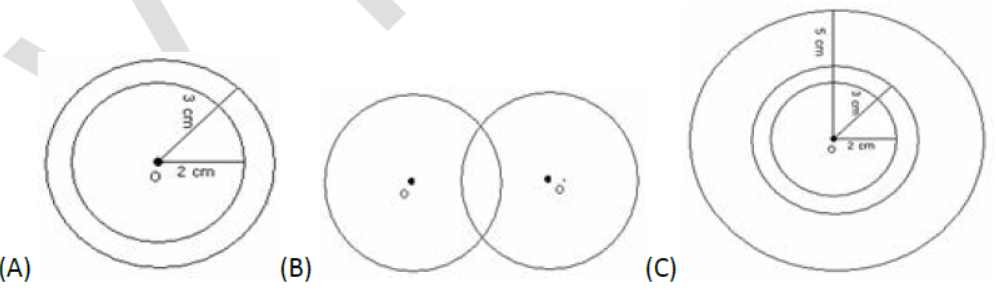
(D) Both (1) and (3)
Answer: (D) Both (1) and (3)
Circles that share the exact same center point are called concentric circles. Since both figures (A) and (C) show concentric circles, option (D) is correct.
In simple words: Both figure (A) and (C) show circles drawn around the exact same center point, so the correct choice is (D).
Exam Tip: Concentric circles have different radii but share the exact same center point.
Question 27. Which angle is of \( 90^\circ \) in the following angles?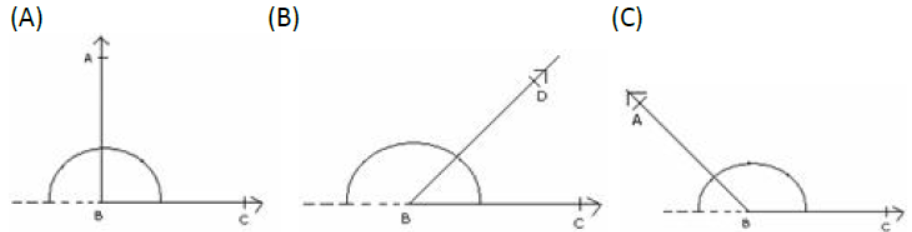
(D) none of these
Answer: (A)
Figure (A) shows a straight vertical line meeting a horizontal line to form a square corner, which represents a right angle of \( 90^\circ \).
In simple words: Figure (A) represents a 90-degree angle because it makes a perfect square corner.
Exam Tip: A perpendicular line always forms an angle of exactly \( 90^\circ \) with its base line.
Question 28. In triangle ABC, \(\angle ABC\) = 90°, \(\angle BCA\) = 30° and \(\angle BCA\) = 70° \(\angle BAC\) = 70° The figure of triangle ABC is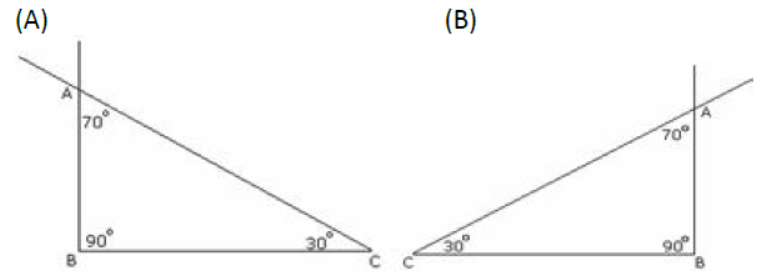
(C) Both of them
(D) can not be construct.
Answer: (D) can not be construct.
According to the angle sum property of a triangle, the sum of all three interior angles must be exactly \( 180^\circ \). Here, the sum of the given angles is:
\( \implies 90^\circ + 30^\circ + 70^\circ = 190^\circ \)
Since \( 190^\circ \neq 180^\circ \), such a triangle cannot be constructed.
In simple words: The three given angles add up to \( 190^\circ \), which is larger than the required \( 180^\circ \). Therefore, this triangle cannot be constructed.
Exam Tip: Always sum the given angles first to verify if they equal exactly \( 180^\circ \).
Question 29. How many circles can be drawn from one centre?
(A) 1
(b) 2
(C) 3
(D) Countless
Answer: (D) Countless
We can draw infinitely many concentric circles of different radii around a single center point.
In simple words: You can draw endlessly many circles of different sizes around the same center point, so the answer is countless.
Exam Tip: Circles sharing the same center point but with different radii are described as concentric circles.
Question 30. 40° angle can be construct by ………….
(A) Compass
(B) Protractor
(C) Divider
(D) Set-square
Answer: (B) Protractor
While angles like \( 60^\circ \), \( 30^\circ \), and \( 90^\circ \) are easily constructed with a ruler and compass, a \( 40^\circ \) angle cannot be constructed using standard compass methods and must be drawn using a protractor.
In simple words: A 40-degree angle cannot be drawn with a standard compass, so you must use a protractor to draw it.
Exam Tip: Angles that are not multiples of 15 degrees are generally drawn using a protractor rather than constructed with a compass.
Question 31. Which statement is true in the following statement?
(A) An equilateral triangle has each angle 60°.
(b) All sides are not equal in equilateral triangle.
(C) Both (a) and (b)
(D) None of them
Answer: (A) An equilateral triangle has each angle 60°.
An equilateral triangle contains three equal sides and three equal angles, and each angle measures exactly \( 60^\circ \). Therefore, statement (A) is true.
In simple words: Statement (A) is correct because every corner of an equilateral triangle must measure exactly \( 60^\circ \).
Exam Tip: Since all sides are equal in an equilateral triangle, all three of its angles are also equal.
Question 32. Which angle is acute angle in following angles?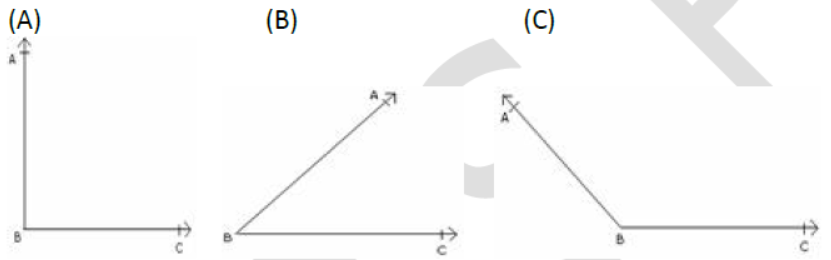
(D) None of these
Answer: (B)
An acute angle is any angle that measures less than \( 90^\circ \). Figure (B) clearly shows an acute angle.
In simple words: Figure (B) is correct because it shows a sharp corner that is smaller than a square corner.
Exam Tip: Remember: acute angles are less than \( 90^\circ \), right angles are exactly \( 90^\circ \), and obtuse angles are greater than \( 90^\circ \).
Question 33. In triangle ABC, given that AB = 3 cm, BC = 4 cm and AC = 5 cm triangle ABC is
(A) Isosceles triangle
(B) Right triangle
(C) Scalene triangle
(D) None of them
Answer: (B) Right triangle
By applying Pythagoras' theorem:
\( \implies AB^2 + BC^2 = 3^2 + 4^2 = 9 + 16 = 25 \)
\( \implies AC^2 = 5^2 = 25 \)
Since \( AB^2 + BC^2 = AC^2 \), the triangle satisfies the Pythagoras theorem and is a right-angled triangle.
In simple words: Since \( 3^2 + 4^2 = 5^2 \), this triangle satisfies Pythagoras' rule, which means it is a right-angled triangle.
Exam Tip: Remember that 3 - 4 - 5 is the most common Pythagorean triple and always forms a right-angled triangle.
Question 34. In \(\Delta ABC\), BC = CA. Which of its two angles are equal?
Answer: \(\angle A\) and \(\angle B\)
In a triangle, angles opposite to equal sides are also equal.
- The angle opposite to side BC is \( \angle A \).
- The angle opposite to side CA is \( \angle B \).
Therefore, **\( \angle A = \angle B \)**.
In simple words: Since sides BC and CA are equal, the corners opposite to them (\(\angle A\) and \(\angle B\)) must also be equal.
Exam Tip: This property is the converse of the angle-side relationship in isosceles triangles.
Question 35. In triangle DEF angle E = angle F . Which of its two sides are equal?
Answer: DF and DE
In any triangle, the sides opposite to equal angles are also equal in length.
- The side opposite to \( \angle E \) is DF.
- The side opposite to \( \angle F \) is DE.
Therefore, **DF = DE**.
In simple words: Since corner E and corner F are equal, the sides opposite to them (DF and DE) must also be equal in length.
Exam Tip: This fundamental property is used to prove that a triangle with two equal angles is always isosceles.
Question 36. Construct a right triangle PQR in which \(\angle Q\) = 90°, PR = 6cm andQR = 4cm.
Answer:
Here are the step-by-step construction steps:
1. Draw a straight line segment QR of length 4 cm.
2. At point Q, draw a perpendicular ray making an angle of 90° with QR.
3. With R as the center and a radius of 6 cm on your compass, draw an arc that cuts the perpendicular ray at point P.
4. Join point P to point R to complete the right-angled triangle PQR.
In simple words: Draw a base line of 4 cm. Draw a straight vertical line up from one end, and then use your compass set to 6 cm from the other end to cross it.
Exam Tip: Make sure to set your compass precisely to 6 cm for the hypotenuse arc to get full marks on accuracy.
Question 37. Construct a \(\Delta ABC\), in which \(\angle B\) = 90°, AB = 4.8cm and BC = 5.2cm.
Answer:
Here are the step-by-step construction steps:
1. Draw a straight line segment BC of length 5.2 cm.
2. At point B, draw a perpendicular ray making an angle of 90° with BC.
3. With B as the center and a radius of 4.8 cm, draw an arc on the perpendicular ray to mark point A.
4. Join point A to point C to complete the right-angled triangle ABC.
In simple words: Draw a bottom line of 5.2 cm. Draw a vertical line up from B, measure 4.8 cm up to find point A, and then draw a line from A to C.
Exam Tip: Always double-check your right angle using a protractor after drawing it with a compass.
Question 38. Construct \(\Delta XYZ\) in which XY = 4.5cm, YZ = 5cm and ZX = 6cm.
Answer:
Here are the step-by-step construction steps:
1. Draw a straight line segment YZ of length 5 cm.
2. With Y as the center and a compass radius of 4.5 cm, draw an arc above the line.
3. With Z as the center and a compass radius of 6 cm, draw another arc intersecting the first arc at point X.
4. Join point X to point Y and point X to point Z to complete the triangle XYZ.
In simple words: Draw a bottom line of 5 cm. Draw one arc of 4.5 cm from one end, and another arc of 6 cm from the other end. Where they cross is point X.
Exam Tip: Label all side lengths clearly with their dimensions in centimeters after finishing your construction.
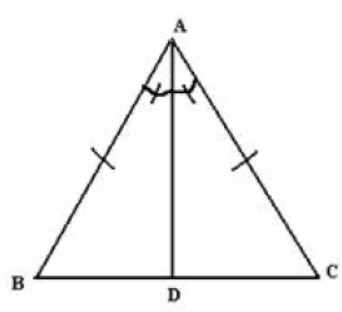
Question 39. \(\Delta ABC\) is isosceles with AB = AC as shown in figure. Line segment AD bisects \(\angle A\) and meets base BC in D. Find the three pairs of corresponding parts which make \(\Delta ADB \cong \Delta ADC\) by SAS congruence condition.
Is it true to say that BD = DC?
Answer:
The three pairs of corresponding parts for triangles ADB and ADC are:
1. **AB = AC** (Given equal sides)
2. **\( \angle BAD = \angle CAD \)** (Since AD bisects \( \angle A \))
3. **AD = AD** (Common side)
Therefore, by SAS (Side-Angle-Side) congruence condition, we have:
\( \implies \Delta ADB \cong \Delta ADC \)
Since the triangles are congruent, their corresponding parts must be equal (CPCT):
Therefore, **BD = DC** is indeed true.
In simple words: The two triangles share a side, have equal outer sides, and have the same angle in between. This makes them identical, so the bottom bases BD and DC must be equal.
Exam Tip: State "By CPCT" (Corresponding Parts of Congruent Triangles) to justify why BD = DC after proving congruence.
Question 40. In \(\Delta PQR\), QP = QR. If \(\angle P\) = 36°, what is the measure of \(\angle Q\)?
Answer: 108°
Since QP = QR in triangle PQR, the angles opposite to these sides must be equal:
\( \implies \angle R = \angle P = 36^\circ \)
Now, applying the angle sum property in triangle PQR:
\( \implies \angle P + \angle Q + \angle R = 180^\circ \)
\( \implies 36^\circ + \angle Q + 36^\circ = 180^\circ \)
\( \implies \angle Q + 72^\circ = 180^\circ \)
\( \implies \angle Q = 180^\circ - 72^\circ = 108^\circ \).
The measure of \( \angle Q \) is 108°.
In simple words: Since two sides are equal, the two base angles are both \( 36^\circ \). Subtracting their sum (\( 72^\circ \)) from \( 180^\circ \) leaves \( 108^\circ \) for the top corner \( \angle Q \).
Exam Tip: First identify which sides are equal to correctly identify the matching base angles.
Question 41. Draw a line, say AB, take a point C outside it. Through C, draw a line parallel to AB using ruler and compass only.
Answer:
Here are the step-by-step construction steps:
1. Draw a straight line AB and mark a point C outside it.
2. Take any point D on the line AB and join point C to point D.
3. With D as the center and any convenient radius, draw an arc cutting AB at P and CD at Q.
4. With C as the center and the exact same radius, draw an arc cutting the line CD at R.
5. Measure the distance PQ with your compass.
6. With R as the center and the radius equal to PQ, draw an arc cutting the previous arc at S.
7. Draw a straight line passing through C and S. This line will be parallel to AB.
In simple words: Draw line AB and point C. Connect C to a point D on AB. Copy the angle formed at D up to point C on the opposite side to draw the parallel line.
Exam Tip: This construction is based on making alternate interior angles equal to create parallel lines.
Question 42. find which of the following are sides of a right triangle. All dimensions are in cm. 1) 0.25, 0.6, 0.65 2) 1, 1, 2 3) 12, 35, 37
Answer:
We check each set of side lengths using the Pythagoras property (\( a^2 + b^2 = c^2 \)):
1) **0.25, 0.6, 0.65**
\( \implies 0.25^2 + 0.6^2 = 0.0625 + 0.36 = 0.4225 \)
\( \implies 0.65^2 = 0.4225 \)
Since \( 0.25^2 + 0.6^2 = 0.65^2 \), these **are sides of a right triangle**.
2) **1, 1, 2**
\( \implies 1^2 + 1^2 = 1 + 1 = 2 \)
\( \implies 2^2 = 4 \)
Since \( 2 \neq 4 \), these **are not sides of a right triangle**.
3) **12, 35, 37**
\( \implies 12^2 + 35^2 = 144 + 1225 = 1369 \)
\( \implies 37^2 = 1369 \)
Since \( 12^2 + 35^2 = 37^2 \), these **are sides of a right triangle**.
In simple words: Only the first and third groups of numbers follow the square-corner rule, so they are the only ones that can form right-angled triangles.
Exam Tip: The longest value must always be used as the potential hypotenuse (\( c \)) when testing the Pythagorean formula.
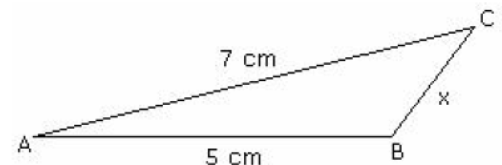
Question 43. The perimeter of the given triangle is 14 cm, then find the value of x.
(A) 3 cm
(B) 4 cm
(C) 6 cm
(D) 2 cm
Answer: (D) 2 cm
The perimeter of the triangle is the sum of all three sides:
\( \implies \text{Perimeter} = 7\text{ cm} + 5\text{ cm} + x = 14\text{ cm} \)
\( \implies 12 + x = 14 \)
\( \implies x = 14 - 12 = 2\text{ cm} \).
The value of \( x \) is 2 cm.
In simple words: Adding the sides gives \( 7 + 5 + x = 14\text{ cm} \). This means \( x \) must be \( 2\text{ cm} \) to reach the total perimeter of \( 14\text{ cm} \).
Exam Tip: Always make sure to write the formula for the perimeter of a triangle as the sum of its three sides before solving.
Question 44. construct a right -angled triangle in which base is 5.5 cm and the hypotenuse makes an angle of 30° with the base. Measure the other sides of the triangle.
Answer:
Here are the step-by-step construction steps:
1. Draw a base line segment AB of length 5.5 cm.
2. At point A, construct a ray making an angle of 30° with the base AB.
3. At point B, draw a perpendicular ray making an angle of 90° with the base AB.
4. The point where these two rays intersect is point C. Triangle ABC is the required right-angled triangle.
5. By measuring the other sides:
- The perpendicular side BC is approximately 3.18 cm.
- The hypotenuse side AC is approximately 6.35 cm.
In simple words: Draw a base line of 5.5 cm. Draw a 30-degree line up from one end, and a straight vertical line up from the other end. Where they cross is the third corner.
Exam Tip: You can verify your constructed side lengths using basic trigonometry: \( \text{BC} = 5.5 \times \tan(30^\circ) \).
Question 45. Construct \(\Delta LMN\), right-angled at M, given that LN = 5cm and MN = 3cm.
Answer:
Here are the step-by-step construction steps:
1. Draw a straight line segment MN of length 3 cm.
2. At point M, draw a perpendicular ray making an angle of 90° with MN.
3. With N as the center and a compass radius of 5 cm, draw an arc that cuts the perpendicular ray at point L.
4. Join point L to point N to complete the right-angled triangle LMN.
In simple words: Draw a base of 3 cm. Draw a vertical line up from M, and use your compass set to 5 cm from N to cross it to find point L.
Exam Tip: Be sure to write down the steps of construction clearly in numbered points during exams.
Question 46. A ladder 17m long when set against the wall of a house just reaches a window at a height of 15m from the ground. How far is the lower end of the ladder from the base of the wall?
Answer: 8 m
The ladder, wall, and ground form a right-angled triangle. The ladder (17 m) is the hypotenuse, and the window height (15 m) is the vertical side. Let \( d \) be the distance of the ladder's foot from the wall.
Using the Pythagoras theorem:
\( \implies d^2 + 15^2 = 17^2 \)
\( \implies d^2 + 225 = 289 \)
\( \implies d^2 = 289 - 225 \)
\( \implies d^2 = 64 \)
\( \implies d = \sqrt{64} = 8\text{ m} \).
The foot of the ladder is 8 meters away from the base of the wall.
In simple words: The ladder and wall make a square-corner triangle. Squaring the lengths and using the rule shows that the ladder's base is exactly \( 8\text{ m} \) from the wall.
Exam Tip: Draw a simple right-angled triangle sketch to help visualize the problem and label the sides correctly.
Question 47. In Fig. AB || DC and AB = DC.
a. Is \(\angle BAC\) = \(\angle DCA\)? Why?
b. Is \(\Delta ABC \cong \Delta CDA\) by SAS congruence condition?
c. State the three facts you have used to answer (ii).
Answer:
**a.** Yes, \( \angle BAC = \angle DCA \) because AB || DC and AC is a transversal, which makes these alternate interior angles.
**b.** Yes, \( \Delta ABC \cong \Delta CDA \) by the SAS congruence condition.
**c.** The three facts used are:
1. **AB = CD** (Given equal sides)
2. **\( \angle BAC = \angle DCA \)** (Alternate interior angles proven above)
3. **AC = CA** (Common side shared by both triangles)
In simple words: Yes, because the two parallel lines make alternate angles equal. This gives us two matching sides with the same angle in between them, making the triangles identical.
Exam Tip: Alternate interior angles formed by parallel lines are a key tool for proving congruent triangles in geometry.
Question 48. construct a \(\Delta ABC\) in which AC = CB = 4 cm and B = 45°. Is this a right -angled triangle?
Answer: Yes, it is a right-angled triangle.
Since AC = CB = 4 cm, triangle ABC is an isosceles triangle.
Therefore, the angles opposite to these equal sides are equal:
\( \implies \angle A = \angle B = 45^\circ \).
Using the angle sum property of a triangle:
\( \implies \angle A + \angle B + \angle C = 180^\circ \)
\( \implies 45^\circ + 45^\circ + \angle C = 180^\circ \)
\( \implies 90^\circ + \angle C = 180^\circ \)
\( \implies \angle C = 90^\circ \).
Since one angle (\( \angle C \)) is \( 90^\circ \), this is indeed a right-angled triangle.
**Construction Steps:**
1. Draw a line segment BC of length 4 cm.
2. At point B, draw a ray making an angle of 45° with BC.
3. With C as the center and a compass radius of 4 cm, draw an arc intersecting the ray at point A.
4. Join point A to point C to complete the triangle ABC.
In simple words: Since two sides are equal, the two base angles are both \( 45^\circ \). This means the third corner must be \( 90^\circ \), so it is a right-angled triangle.
Exam Tip: If the base angles of an isosceles triangle are each \( 45^\circ \), the triangle is always right-angled at its vertex.
Free study material for Mathematics
Chapter 10 Practical Geometry Printable Worksheets and Exercises for Class 7 Mathematics
Practice Exercises for Class 7 Mathematics Chapter 10 Practical Geometry
Access structured practice worksheets for Chapter 10 Practical Geometry aligned with the 2026 CBSE curriculum. These downloadable exercises for Class 7 Mathematics help students build accuracy and reinforce core concepts for upcoming school tests.
Step-by-Step Solutions and Practice Guidelines
Built using official NCERT guidelines for Class 7 Mathematics, these practice sheets provide reliable academic support. Cross-reference your completed work with our detailed solutions to learn standard answer-writing formats for CBSE exams.
Enhance Speed with Online Practice
Consistent engagement with these exercises builds familiarity with recurring exam themes. If specific areas within Chapter 10 Practical Geometry cause trouble, utilize our dedicated NCERT solutions for Class 7 Mathematics to clear up doubts immediately.
FAQs
You can download the latest chapter-wise printable worksheets for Class 7 Mathematics Chapter 10 Practical Geometry for free from StudiesToday.com. These have been made as per the latest CBSE curriculum for this academic year.
Yes, Class 7 Mathematics worksheets for Chapter 10 Practical Geometry focus on activity-based learning and also competency-style questions. This helps students to apply theoretical knowledge to practical scenarios.
Yes, we have provided solved worksheets for Class 7 Mathematics Chapter 10 Practical Geometry to help students verify their answers instantly.
Yes, our Class 7 Mathematics test sheets are mobile-friendly PDFs and can be printed by teachers for classroom.
For Chapter 10 Practical Geometry, regular practice with our worksheets will improve question-handling speed and help students understand all technical terms and diagrams.