

Chapter-wise Worksheets for Class 7 Mathematics: Chapter 11 Perimeter and Area
Review targeted academic worksheets with the CBSE Class 7 Mathematics Perimeter And Area Worksheet Set 03. Built according to official educational standards for the 2026-27 term, these downloadable Class 7 Mathematics resources support effective daily practice and detailed self-evaluation for Chapter 11 Perimeter and Area.
Practice Class 7 Mathematics Worksheets: Chapter 11 Perimeter and Area
Access the complete worksheet PDF for Class 7 Mathematics below. Regular practice with these targeted academic tasks builds familiarity with standard question patterns and helps secure higher marks in final school examinations.
Question 1. All congruent triangles are equal in area but the triangles equal in area need not be congruent. (True/False)
Answer: True
In simple words: This statement is true because shapes that are identical in size and shape always cover the same amount of space, but different triangles can still happen to have the same area.
Exam Tip: Congruence means both shape and size are identical, while equal areas only require the numerical area value to match.
Question 2. Any side of the parallelogram can be chosen as base of the parallelogram. (True/False)
Answer: True
In simple words: Yes, you can pick any side of a parallelogram to be the base when you are calculating its area.
Exam Tip: When choosing a base, make sure that the height used in your calculation is the perpendicular distance corresponding to that specific base.
Question 3. The distance around a circular region is known as area of that circle. (True/False)
Answer: False
In simple words: This is false because the outer boundary distance is called the circumference, whereas the area is the flat space inside the circle.
Exam Tip: Remember that the perimeter of a circular region is referred to as its circumference, which is calculated using \( 2\pi r \).
Question 4. When a path runs outside, twice the width of the path should be added to length and breadth of the inner rectangle. (True/False)
Answer: True
In simple words: Yes, because the path surrounds the rectangle on both sides, you must add the path's width twice to both dimensions.
Exam Tip: To find the area of an outer path, calculate the difference between the larger outer rectangle's area and the smaller inner rectangle's area.
Question 5. Write the formula to find area of circle.
Answer: The formula for the area of a circle is \( \text{Area} = \pi r^2 \), where \( r \) represents the radius of the circle.
In simple words: Multiply the radius of the circle by itself, then multiply that by pi (which is about 3.14) to find the area.
Exam Tip: If the question provides the diameter, remember to divide it by 2 to get the radius before using this formula.
Question 6. A field has four square corners as shown in the figure. Find the perimeter excluding the square corners.
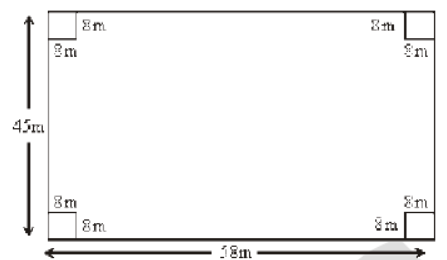
(A) 132 m
(b) 142 m
(C) 206 m
(D) 179 m
Answer: (C) 206 m
The total length of the field is 58 m and the width is 45 m. Each corner has a square of side 8 m removed.
- Remaining straight outer horizontal edges: \( 2 \times (58 - 2 \times 8) = 2 \times 42 = 84\text{ m} \)
- Remaining straight outer vertical edges: \( 2 \times (45 - 2 \times 8) = 2 \times 29 = 58\text{ m} \)
- Inner perimeter of the 4 cut corners: \( 4 \times 2 \times 8 = 64\text{ m} \)
- Total perimeter: \( 84 + 58 + 64 = 206\text{ m} \).
In simple words: Subtracting the corners from the outer sides and then adding the inner cut-out paths gives us a total boundary length of 206 meters.
Exam Tip: Cutting square corners out of a rectangle always increases the total perimeter because new inner boundary edges are created.
Question 7. Find the area of the shaded region.
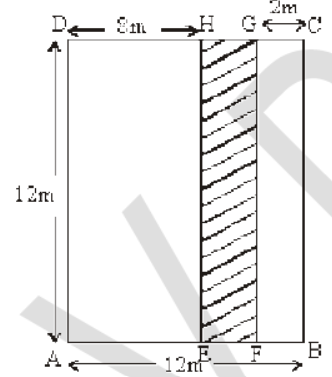
(A) 46 m²
(B) 24 m²
(C) 12 m²
(D) 84 m²
Answer: (B) 24 m²
The shaded strip is a parallelogram. Its base is given as \( 2\text{ m} \) (HG and EF) and its height is equal to the height of the rectangle, which is \( 12\text{ m} \).
\( \implies \text{Area} = \text{base} \times \text{height} = 2\text{ m} \times 12\text{ m} = 24\text{ m}^2 \).
In simple words: The shaded diagonal path is a parallelogram with a base of 2 m and a height of 12 m. Multiplying these together gives 24 m².
Exam Tip: The area of a slanted parallelogram path in a rectangle is simply its horizontal base multiplied by the vertical height of the rectangle.
Question 8. If the area of a rectangle is 7820 m² and its width in 85 m, find its length ?
(A) 92 m
(b) 84 m
(C) 105 m
(D) 97 m
Answer: (A) 92 m
Using the formula for the area of a rectangle:
\( \implies \text{Area} = \text{length} \times \text{width} \)
\( \implies 7820 = \text{length} \times 85 \)
\( \implies \text{length} = \frac{7820}{85} = 92\text{ m} \).
In simple words: Divide the total area of 7820 by the width of 85 to find the length, which is 92 meters.
Exam Tip: Always rearrange the formula \( A = l \times w \) to isolate the unknown variable before dividing.
Question 9. When a path runs along inside of a rectangle, the width of the path should be equal to difference of outer length and inner length of rectangle or difference of outer breadth and inner breadth of rectangle. (True/False)
Answer: False
The difference between the outer length and the inner length is actually equal to twice the width of the path (since the path is on both sides of the rectangle).
In simple words: This is false because the difference is equal to double the path's width, not just the width alone.
Exam Tip: Remember the relation: Outer length - Inner length = 2 \times path width.
Question 10. Shaelly wants to frame a rectangular painting. If the perimeter is 56 cm and its width is 13 cm determine the length of the painting ?
(A) 12 cm
(B) 15 cm
(C) 30 cm
(D) 42 cm
Answer: (B) 15 cm
Using the perimeter formula for a rectangle:
\( \implies \text{Perimeter} = 2 \times (\text{length} + \text{width}) \)
\( \implies 56 = 2 \times (\text{length} + 13) \)
\( \implies \text{length} + 13 = \frac{56}{2} = 28 \)
\( \implies \text{length} = 28 - 13 = 15\text{ cm} \).
In simple words: Half of the perimeter is 28 cm. Since the width is 13 cm, we subtract 13 from 28 to find the length, which is 15 cm.
Exam Tip: Dividing the perimeter of a rectangle by 2 immediately gives the sum of one length and one width.
Question 11. Find the breadth of a rectangular plot of land, if its area is 440m² and the length is 22m. Also find its perimeter.
Answer:
First, find the breadth using the area formula:
\( \implies \text{Area} = \text{length} \times \text{breadth} \)
\( \implies 440 = 22 \times \text{breadth} \)
\( \implies \text{breadth} = \frac{440}{22} = 20\text{ m} \)
Now, find the perimeter:
\( \implies \text{Perimeter} = 2 \times (\text{length} + \text{breadth}) \)
\( \implies \text{Perimeter} = 2 \times (22 + 20) = 2 \times 42 = 84\text{ m} \).
In simple words: Divide the area of 440 by the length of 22 to get the breadth of 20 m. Adding 22 and 20 and multiplying by 2 gives a perimeter of 84 m.
Exam Tip: Be sure to find the breadth first because both dimensions are needed to compute the perimeter.
Question 12. Find the area of a circle of radius 15cm (use \( \pi = 3.14 \)).
Answer: 706.5 cm²
Using the formula for the area of a circle:
\( \implies \text{Area} = \pi r^2 \)
\( \implies \text{Area} = 3.14 \times 15 \times 15 = 3.14 \times 225 = 706.5\text{ cm}^2 \).
In simple words: Multiply 3.14 by the radius squared (15 times 15) to find the area, which is 706.5 cm².
Exam Tip: Always carry out the squaring of the radius first before multiplying by the value of pi.
Question 13. What is the circumference of a circle of diameter 10cm (Take \( \pi = 3.14 \)).
Answer: 31.4 cm
Using the circumference formula with the diameter:
\( \implies \text{Circumference} = \pi d \)
\( \implies \text{Circumference} = 3.14 \times 10 = 31.4\text{ cm} \).
In simple words: The distance around the circle is found by multiplying its diameter by 3.14, which gives 31.4 centimeters.
Exam Tip: You can also use \( 2\pi r \) by dividing the diameter by 2 first to get the radius \( r = 5\text{ cm} \).
Question 14. Find the area of following triangle:
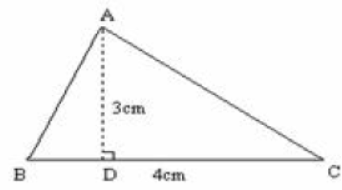
Answer: 6 cm²
Using the formula for the area of a triangle:
\( \implies \text{Area} = \frac{1}{2} \times \text{base} \times \text{height} \)
From the given triangle, base \( BC = 4\text{ cm} \) and height \( AD = 3\text{ cm} \):
\( \implies \text{Area} = \frac{1}{2} \times 4 \times 3 = 6\text{ cm}^2 \).
In simple words: The area is half of the base (4 cm) multiplied by the height (3 cm), which gives 6 square centimeters.
Exam Tip: The base and height must always be perpendicular to each other in this formula.
Question 15. Find the perimeter of the given figure.
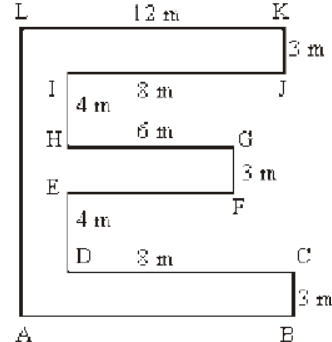
(A) 70 m
(b) 102 m
(C) 86 m
(D) 96 m
Answer: (C) 86 m
By adding the lengths of all the outer segments of the figure:
- Horizontal steps: \( LK + JI + HG + FE + DC = 12 + 3 + 6 + 4 + 3 = 28\text{ m} \)
- Vertical steps: \( KJ + IH + GF + ED + CB = 3 + 4 + 3 + 4 + 3 = 17\text{ m} \)
- Left vertical side \( AL = 17\text{ m} \)
- Bottom horizontal side \( AB = 12 + 8 + 6 + 8 + 3 = 24\text{ m} \)? No, let's sum all the segments shown:
\( \text{Perimeter} = AB + BC + CD + DE + EF + FG + GH + HI + IJ + JK + KL + AL \)
\( \text{Perimeter} = 12 + 3 + 8 + 4 + 6 + 3 + 6 + 4 + 8 + 3 + 12 + 17 = 86\text{ m} \).
In simple words: Adding together the lengths of all twelve outer boundary segments of this staircase-shaped figure gives a perimeter of 86 meters.
Exam Tip: Be systematic when summing up sides of irregular shapes so that you do not miss any segments.
Question 16. In given figure, find BC, if the area of the triangle ABC is 36 cm² and the height AD is 3 cm.
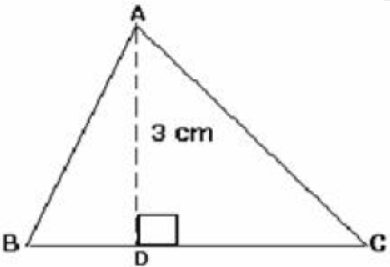
(A) 12 cm
(B) 24 cm
(C) 24 mm
(D) 24 m
Answer: (B) 24 cm
Using the area of a triangle formula:
\( \implies \text{Area} = \frac{1}{2} \times \text{base (BC)} \times \text{height (AD)} \)
\( \implies 36 = \frac{1}{2} \times BC \times 3 \)
\( \implies 72 = BC \times 3 \)
\( \implies BC = \frac{72}{3} = 24\text{ cm} \).
In simple words: The area is 36. Double it to get 72, then divide by the height of 3 to find the base, which is 24 cm.
Exam Tip: Make sure to match the units; since the area is in cm² and height is in cm, the base must be in cm.
Question 17. The perimeter of a rectangle is 130 cm. If the breadth of the rectangle is 35 cm, then length of its rectangle?
(A) 1050 cm
(B) 1050 sq m
(C) 1050 sq cm
(D) 1000 sq cm
Answer: (C) 1050 sq cm
The options indicate the question intended to ask for the **area** of the rectangle. Let's find both the length and the area:
- Finding Length:
\( \implies \text{Perimeter} = 2 \times (\text{length} + \text{breadth}) = 130 \)
\( \implies \text{length} + 35 = 65 \implies \text{length} = 30\text{ cm} \).
- Finding Area:
\( \implies \text{Area} = \text{length} \times \text{breadth} = 30\text{ cm} \times 35\text{ cm} = 1050\text{ cm}^2 \).
In simple words: First we find the length is 30 cm using the perimeter. Multiplying this length of 30 cm by the width of 35 cm gives an area of 1050 square centimeters.
Exam Tip: Pay attention to the units in the options; "sq cm" indicates that an area calculation is required.
Question 18. The area of a square park whose perimeter is 320 m?
(A) 6400 m
(b) 6400 sq cm
(C) 6400 sq m
(D) 6400 cm
Answer: (C) 6400 sq m
Using the perimeter to find the side length:
\( \implies \text{Perimeter} = 4 \times \text{side} = 320\text{ m} \)
\( \implies \text{side} = \frac{320}{4} = 80\text{ m} \)
Now, find the area:
\( \implies \text{Area} = \text{side}^2 = 80 \times 80 = 6400\text{ m}^2 \).
In simple words: Divide the perimeter of 320 m by 4 to find each side is 80 m. Squaring 80 gives an area of 6400 square meters.
Exam Tip: Fulfill calculations step-by-step; find the side first before using the area formula.
Question 19. A rectangle has a length of 6 cm and diagonal 10 cm, find the width of the rectangle ?
(A) 10 cm
(b) 9 cm
(C) 7 cm
(D) 8 cm
Answer: (D) 8 cm
The diagonal of a rectangle forms a right-angled triangle with the length and width.
Using the Pythagoras theorem:
\( \implies \text{width} = \sqrt{\text{diagonal}^2 - \text{length}^2} \)
\( \implies \text{width} = \sqrt{10^2 - 6^2} = \sqrt{100 - 36} = \sqrt{64} = 8\text{ cm} \).
In simple words: By using the square-corner rule, we subtract the square of 6 from the square of 10 to get 64, whose square root is 8 cm.
Exam Tip: A right-angled triangle with hypotenuse 10 and one side 6 will always have its third side as 8.
Question 20. The length and breadth of a rectangular field is 10 cm and 6 cm respectively. Find the perimeter of the field.
(A) 15 cm
(b) 46 cm
(C) 32 cm
(D) 84 cm
Answer: (C) 32 cm
Using the perimeter formula:
\( \implies \text{Perimeter} = 2 \times (\text{length} + \text{breadth}) \)
\( \implies \text{Perimeter} = 2 \times (10 + 6) = 2 \times 16 = 32\text{ cm} \).
In simple words: Add the length and width to get 16, then double it to find the perimeter of 32 cm.
Exam Tip: Write down the formula clearly before substituting values to prevent computational mistakes.
Question 21. A garden is in the shape of a rectangle. If the perimeter of the garden is 196 m and its length is 56 m. Find the width of the garden?
(A) 15 cm
(b) 42 m
(C) 65 m
(D) 90 m
Answer: (B) 42 m
Using the perimeter formula:
\( \implies \text{Perimeter} = 2 \times (\text{length} + \text{width}) = 196 \)
\( \implies 56 + \text{width} = \frac{196}{2} = 98 \)
\( \implies \text{width} = 98 - 56 = 42\text{ m} \).
In simple words: Half of the perimeter is 98 m. Subtracting the length of 56 m from 98 m gives a width of 42 m.
Exam Tip: Pay attention to units - option (B) is in meters (m), which matches the garden's dimensions.
Question 22. A garden is 90m long and 75m broad. A path 5m wide is to be built out around it. Find the area of the path.
Answer: 1750 m²
First, find the outer dimensions including the path:
- Outer length \( = 90 + 2 \times 5 = 100\text{ m} \)
- Outer breadth \( = 75 + 2 \times 5 = 85\text{ m} \)
Now, find the area of the path:
- Outer Area \( = 100 \times 85 = 8500\text{ m}^2 \)
- Inner Area \( = 90 \times 75 = 6750\text{ m}^2 \)
- Area of the path = Outer Area - Inner Area
\( \implies \text{Area of path} = 8500 - 6750 = 1750\text{ m}^2 \).
In simple words: We find the area of the larger outer rectangle (8500 m²) and subtract the area of the garden (6750 m²) to get 1750 m² for the path.
Exam Tip: Remember to add twice the path width when calculating the outer dimensions of a surrounding path.
Question 23. The adjoining figure shows two circles with the same centre. The radius of the larger circle is 10cm and the radius of the smaller circle is 4cm.
Find:(a) the area of the larger circle
(b) the area of the smaller circle
(c) the shaded area between the two circles. (Take \( \pi = 3.14 \))
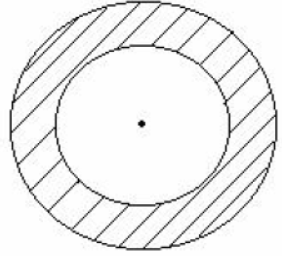
Answer:
(a) Area of the larger circle:
\( \implies \text{Area} = 3.14 \times 10^2 = 3.14 \times 100 = 314\text{ cm}^2 \)
(b) Area of the smaller circle:
\( \implies \text{Area} = 3.14 \times 4^2 = 3.14 \times 16 = 50.24\text{ cm}^2 \)
(c) Shaded area between the two circles:
\( \implies \text{Shaded Area} = \text{Area of larger circle} - \text{Area of smaller circle} \)
\( \implies \text{Shaded Area} = 314 - 50.24 = 263.76\text{ cm}^2 \).
In simple words: Find the area of the big circle (314 cm²) and the small circle (50.24 cm²). Subtracting the small area from the big area leaves 263.76 cm² for the shaded ring.
Exam Tip: Double-check your multiplication steps when working with decimals like 3.14.
Question 24. A rectangular field has dimensions 84 m by 37 m. Find the cost of fencing its boundary at the cost of Rs 2.50/m.
(A) Rs 605
(B) Rs 390
(C) Rs 460
(D) Rs 295
Answer: (A) Rs 605
Find the perimeter of the rectangular field first:
\( \implies \text{Perimeter} = 2 \times (84 + 37) = 2 \times 121 = 242\text{ m} \)
Now, calculate the cost of fencing:
\( \implies \text{Cost} = 242\text{ m} \times \text{Rs } 2.50 = \text{Rs } 605 \).
In simple words: The boundary length is 242 m. At Rs 2.50 per meter, the total cost to fence it is Rs 605.
Exam Tip: Fencing always involves the perimeter of the shape, not its area.
Question 25. A door frame of dimensions 4m 5m is fixed on the wall of dimension 11m 11m. Find the total labour charges for painting the wall if the labour charges for painting 1m² of the wall is Rs 2.50.
Answer: Rs 252.50
1. Find the total area of the wall:
\( \implies \text{Area of wall} = 11\text{ m} \times 11\text{ m} = 121\text{ m}^2 \)
2. Find the area of the door frame:
\( \implies \text{Area of door} = 4\text{ m} \times 5\text{ m} = 20\text{ m}^2 \)
3. Find the area of the wall to be painted (excluding the door):
\( \implies \text{Paintable Area} = 121 - 20 = 101\text{ m}^2 \)
4. Calculate the total cost:
\( \implies \text{Total Cost} = 101 \times \text{Rs } 2.50 = \text{Rs } 252.50 \).
In simple words: We subtract the door area (20 m²) from the total wall area (121 m²) to get 101 m² of wall to paint. Multiplying by Rs 2.50 gives Rs 252.50.
Exam Tip: Always subtract the area of doors or windows before finding the cost of painting or whitewashing a wall.
Question 26. A door of length 2 m and breadth 1 m is fitted in a wall. The length of the wall is 4.5 m and the breadth is 3.6 m. The cost of white washing of the wall, if the rate of white washing is Rs 20 per m² ?
(A) Rs 284
(b) Rs 384
(C) Rs 248
(D) Rs 348
Answer: (A) Rs 284
1. Total area of the wall:
\( \implies \text{Area of wall} = 4.5 \times 3.6 = 16.2\text{ m}^2 \)
2. Area of the door:
\( \implies \text{Area of door} = 2 \times 1 = 2\text{ m}^2 \)
3. Area to be whitewashed:
\( \implies \text{Area to whitewash} = 16.2 - 2 = 14.2\text{ m}^2 \)
4. Calculate the cost:
\( \implies \text{Cost} = 14.2 \times \text{Rs } 20 = \text{Rs } 284 \).
In simple words: Subtracting the door (2 m²) from the wall (16.2 m²) leaves 14.2 m² to whitewash. Multiplying by Rs 20 gives Rs 284.
Exam Tip: Be precise when multiplying decimals like 14.2 by integers like 20.
Question 27. A wire is in the shape of a rectangle. Its length is 40cm and breadth is 22cm. If the same wire is rebent in the shape of a square, what will be the measure of each side? Also find which shape encloses more area?
Answer:
- Perimeter of the rectangle:
\( \implies \text{Perimeter} = 2 \times (40 + 22) = 2 \times 62 = 124\text{ cm} \)
Since the same wire is bent into a square, the square's perimeter is also 124 cm.
- Side of the square:
\( \implies \text{side} = \frac{124}{4} = 31\text{ cm} \)
Now compare areas:
- Area of rectangle \( = 40 \times 22 = 880\text{ cm}^2 \)
- Area of square \( = 31 \times 31 = 961\text{ cm}^2 \)
Since \( 961\text{ cm}^2 > 880\text{ cm}^2 \), the square shape encloses more area.
In simple words: Both shapes use the same 124 cm wire. The square has a side of 31 cm and covers 961 cm², which is larger than the rectangle's area of 880 cm². So, the square holds more space.
Exam Tip: A square always encloses more area than any other rectangle with the same perimeter.
Question 28. A rectangular field has a perimeter of 92 m and its length is 25 m. Find the area of the field ?
(A) 640m²
(B) 21m²
(C) 525 m²
(D) 65 m²
Answer: (C) 525 m²
First find the breadth:
\( \implies \text{Perimeter} = 2 \times (\text{length} + \text{breadth}) = 92 \)
\( \implies 25 + \text{breadth} = \frac{92}{2} = 46 \)
\( \implies \text{breadth} = 46 - 25 = 21\text{ m} \)
Now find the area:
\( \implies \text{Area} = 25 \times 21 = 525\text{ m}^2 \).
In simple words: The breadth of the field is 21 m. Multiplying the length of 25 m by the breadth of 21 m gives an area of 525 square meters.
Exam Tip: Always calculate the breadth first from the perimeter before finding the area.
Question 29. A rectangle has a length of 8 cm and diagonal of 10 cm. What is the perimeter ?
(A) 78 cm
(b) 28 cm
(C) 49 cm
(D) 25 cm
Answer: (B) 28 cm
By using Pythagoras' theorem to find the width:
\( \implies \text{width} = \sqrt{10^2 - 8^2} = \sqrt{100 - 64} = \sqrt{36} = 6\text{ cm} \)
Now calculate the perimeter:
\( \implies \text{Perimeter} = 2 \times (8 + 6) = 2 \times 14 = 28\text{ cm} \).
In simple words: The width is 6 cm. Adding the length of 8 cm and width of 6 cm and doubling the sum gives a perimeter of 28 cm.
Exam Tip: Remember the basic Pythagorean triangle values (6, 8, 10) to quickly verify lengths.
Question 30. A school campus is rectangular in shape. Its length and breadth are 50m and 30m, respectively. There is a 2 m wide path inside the campus all around it. Find the area of the path in square metres?
(A) 96 m²
(B) 304 m²
(C) 172 m²
(D) 490 m²
Answer: (B) 304 m²
Since the path is inside, find the inner dimensions:
- Inner length \( = 50 - 2 \times 2 = 46\text{ m} \)
- Inner breadth \( = 30 - 2 \times 2 = 26\text{ m} \)
Now calculate areas:
- Outer Area \( = 50 \times 30 = 1500\text{ m}^2 \)
- Inner Area \( = 46 \times 26 = 1196\text{ m}^2 \)
- Area of the path = Outer Area - Inner Area
\( \implies \text{Area of path} = 1500 - 1196 = 304\text{ m}^2 \).
In simple words: Subtract the inner area (1196 m²) from the outer area (1500 m²) to find the area of the path, which is 304 square meters.
Exam Tip: Subtract twice the path width from the outer dimensions when the path runs along the inside of a shape.
Question 31. Find the perimeter of the given shape. (Take \( \pi = \frac{22}{7} \))
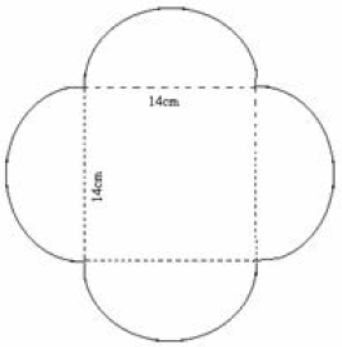
Answer: 88 cm
The outer boundary of the shape is made of 4 identical semicircles on the sides of a 14 cm square.
The diameter of each semicircle is 14 cm, so the radius \( r = 7\text{ cm} \).
- Boundary of 1 semicircle \( = \pi r = \frac{22}{7} \times 7 = 22\text{ cm} \)
- Total outer boundary (Perimeter) \( = 4 \times 22 = 88\text{ cm} \).
In simple words: The outer border consists of 4 semicircles. Each semicircle is 22 cm long, so the total perimeter is 88 cm.
Exam Tip: Do not include the inner square's sides in the perimeter, as they are not on the outer boundary of the shape.
Question 32. A rectangle has a length that is 2 less than 3 times the width. If the area of the rectangle is 16 cm², find the dimensions.
(A) 6 cm, \( 2\frac{2}{3} \text{ cm} \)
(B) 7, 5 cm
(C) 12 cm, 9 cm
(D) 4 cm, \( 1\frac{2}{5} \text{ cm} \)
Answer: (A) 6 cm, \( 2\frac{2}{3} \text{ cm} \)
Let the width be \( w \). Then the length is \( 3w - 2 \).
\( \implies \text{Area} = w(3w - 2) = 16 \)
\( \implies 3w^2 - 2w - 16 = 0 \)
Factorizing the quadratic equation:
\( \implies 3w^2 - 8w + 6w - 16 = 0 \)
\( \implies w(3w - 8) + 2(3w - 8) = 0 \)
\( \implies (w + 2)(3w - 8) = 0 \)
Since width must be positive, \( w = \frac{8}{3} = 2\frac{2}{3}\text{ cm} \).
The length is \( 3\left(\frac{8}{3}\right) - 2 = 6\text{ cm} \).
In simple words: Setting up the quadratic equation shows that the width is \( 2\frac{2}{3}\text{ cm} \) and the length is 6 cm.
Exam Tip: Reject any negative values when solving for physical dimensions like length or width.
Question 33. A sheet of paper measures 30 cm by 20 cm. A strip of 4 cm wide is cut from it all around. Find the area of the remaining sheet?
(A) 125 m²
(b) 178 m²
(C) 492 m²
(D) 264 m²
Answer: (D) 264 m² (Note: units in options are in m² due to a typo in the paper, but dimensions are in cm²)
Find the dimensions of the remaining sheet by subtracting 4 cm from all sides (double the width of the strip):
- Remaining length \( = 30 - 2 \times 4 = 22\text{ cm} \)
- Remaining breadth \( = 20 - 2 \times 4 = 12\text{ cm} \)
Calculate the area:
\( \implies \text{Area} = 22 \times 12 = 264\text{ cm}^2 \).
In simple words: After cutting a 4 cm strip off all around, the sheet becomes 22 cm by 12 cm, which gives an area of 264 cm².
Exam Tip: Subtract twice the strip's width from both original dimensions to find the new dimensions.
Question 34. Find the area of the shaded portion.
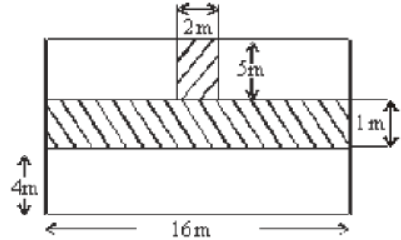
(A) 42 m²
(B) 26 m²
(C) 72 m²
(D) 10 m²
Answer: (B) 26 m²
The shaded portion is made of two rectangles:
1. The bottom horizontal bar of length 16 m and height 1 m:
\( \implies \text{Area} = 16 \times 1 = 16\text{ m}^2 \)
2. The vertical bar of width 2 m and height 5 m:
\( \implies \text{Area} = 2 \times 5 = 10\text{ m}^2 \)
Total shaded area \( = 16 + 10 = 26\text{ m}^2 \).
In simple words: Adding the area of the horizontal bar (16 m²) and the vertical bar (10 m²) gives 26 m² of shaded area.
Exam Tip: Divide complex shapes into simpler rectangles to find their individual areas, then sum them up.
Question 35. A rectangle's length is (2x + 1) cm and its width is (2x - 1) cm. If its area is 15 cm², find the value of x ?
(A) 2 cm
(b) 3 cm
(C) 1 cm
(D) 4 cm
Answer: (A) 2 cm
Using the area formula:
\( \implies \text{Area} = \text{length} \times \text{width} \)
\( \implies 15 = (2x + 1)(2x - 1) \)
Using identity \( (a+b)(a-b) = a^2 - b^2 \):
\( \implies 15 = 4x^2 - 1 \)
\( \implies 4x^2 = 16 \)
\( \implies x^2 = 4 \implies x = 2\text{ cm} \).
In simple words: Solving the equation gives \( x^2 = 4 \), which means \( x \) must be 2.
Exam Tip: Use algebraic identities like \( (2x+1)(2x-1) = 4x^2-1 \) to solve equations much faster.
Question 36. From a circular card sheet of radius 14cm, two circles of radius 3.5cm and a rectangle of length 3cm and breadth 1cm are removed (as shown in the adjoining figure). Find the area of the remaining sheet. (Take \( \pi = \frac{22}{7} \))
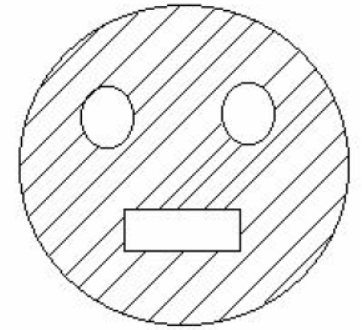
Answer: 536 cm²
1. Area of the large circle:
\( \implies \text{Area} = \frac{22}{7} \times 14 \times 14 = 616\text{ cm}^2 \)
2. Area of two small circles:
\( \implies \text{Area} = 2 \times \left( \frac{22}{7} \times 3.5 \times 3.5 \right) = 77\text{ cm}^2 \)
3. Area of the rectangle:
\( \implies \text{Area} = 3 \times 1 = 3\text{ cm}^2 \)
4. Area of remaining sheet:
\( \implies \text{Remaining Area} = 616 - (77 + 3) = 616 - 80 = 536\text{ cm}^2 \).
In simple words: We subtract the area of the two small circles (77 cm²) and the rectangle (3 cm²) from the big circle's area (616 cm²) to get 536 cm².
Exam Tip: Be sure to subtract the total area of all removed parts from the original area.
Question 37. The perimeter of a rectangle is 36 cm and the length is twice the width. What are the dimensions of this rectangle ?
(A) 17 cm
(b) 6 cm
(C) 4 cm
(D) 15 cm
Answer: 12 cm and 6 cm (Option B is 6 cm, which is the width)
Let the width be \( w \) and the length be \( 2w \).
\( \implies \text{Perimeter} = 2 \times (\text{length} + \text{width}) \)
\( \implies 36 = 2 \times (2w + w) \)
\( \implies 36 = 6w \implies w = 6\text{ cm} \).
The length is \( 2 \times 6 = 12\text{ cm} \) and the width is \( 6\text{ cm} \).
In simple words: The width is 6 cm. Since the length is twice the width, the length is 12 cm.
Exam Tip: Set up a simple equation with variables to solve for unknown dimensions.
Question 38. A path 2 m wide is running around a square field where side is 45 m. Determine the path.
(A) 2401 m²
(b) 2025 m²
(C) 1075 m²
(D) 376 m²
Answer: (D) 376 m²
The path is outside, so the outer side length is \( 45 + 2 \times 2 = 49\text{ m} \).
- Outer Area \( = 49 \times 49 = 2401\text{ m}^2 \)
- Inner Area \( = 45 \times 45 = 2025\text{ m}^2 \)
- Area of the path = Outer Area - Inner Area
\( \implies \text{Area} = 2401 - 2025 = 376\text{ m}^2 \).
In simple words: Subtracting the inner area (2025 m²) from the outer area (2401 m²) gives 376 m² for the path.
Exam Tip: Be sure to add twice the path width when calculating the outer dimensions of a surrounding path.
Question 39. A rectangular garden is 65cm long and 50cm wide. Two cross paths each 2m wide are to be constructed parallel to the sides. If these paths pass through the centre of the garden, find the cost of constructing the paths at the rate Rs. 69 per m².
Answer: Rs 15,594 (Note: dimensions are in m, cm is a typo in the question)
Using meters as the unit for the garden dimensions:
- Area of path parallel to length \( = 65 \times 2 = 130\text{ m}^2 \)
- Area of path parallel to width \( = 50 \times 2 = 100\text{ m}^2 \)
- Common central area \( = 2 \times 2 = 4\text{ m}^2 \)
- Total area of paths \( = 130 + 100 - 4 = 226\text{ m}^2 \)
- Total Cost \( = 226 \times \text{Rs } 69 = \text{Rs } 15,594 \).
In simple words: The total path area is 226 m² after subtracting the central overlap. At Rs 69 per m², the total cost is Rs 15,594.
Exam Tip: Don't forget to subtract the central overlap area when calculating the area of cross paths.
Question 40. The area of square and a reactangle are equal. If the side of the square is 40 cm and the breadth of the reactangle is 25 cm , then perimeter of the reactangle is?
(A) 176 cm
(b) 156 cm
(C) 176 m
(D) 178 cm
Answer: (D) 178 cm
- Area of square \( = 40 \times 40 = 1600\text{ cm}^2 \)
Since the area of the rectangle is equal to the area of the square:
- Area of rectangle \( = \text{length} \times 25 = 1600 \implies \text{length} = 64\text{ cm} \)
- Perimeter of rectangle \( = 2 \times (\text{length} + \text{breadth}) = 2 \times (64 + 25) = 178\text{ cm} \).
In simple words: The area is 1600 cm², which means the rectangle's length is 64 cm. Its perimeter is \( 2 \times (64 + 25) = 178\text{ cm} \).
Exam Tip: Equate areas first to find the unknown length of the rectangle before calculating its perimeter.
Question 41. A saree is 5 m long and 1.25 m wide. A border of 20 cm wide is printed along its four sides. Find the cost of printing the border at Rs 2.50 per m² ?
(A) Rs 11.72
(B) Rs 6.20
(C) Rs 9.50
(D) Rs 6.65
Answer: (D) Rs 6.65
The border is printed along the outer edge of the saree, making the inner area smaller. Converting 20 cm to 0.2 m:
- Outer dimensions: 5.4 m by 1.65 m (adding 0.2 m border on all sides)
- Outer Area \( = 5.4 \times 1.65 = 8.91\text{ m}^2 \)
- Inner Area \( = 5 \times 1.25 = 6.25\text{ m}^2 \)
- Area of border \( = 8.91 - 6.25 = 2.66\text{ m}^2 \)
- Cost of printing \( = 2.66 \times \text{Rs } 2.50 = \text{Rs } 6.65 \).
In simple words: The outer area is 8.91 m² and the inner area is 6.25 m², leaving 2.66 m² for the border. The cost is Rs 6.65.
Exam Tip: Be sure to convert all dimensions to the same unit (meters or centimeters) before starting your calculations.
Question 42. A garden is 56m by 35m. A strip of 2m width is dug all around it on the outer side. Find the cost of digging at the rate of Rs 4.20 per sq m.
(A) Rs 1796.50
(b) Rs 1245
(C) Rs 1027.50
(D) Rs 1596
Answer: (D) Rs 1596
The strip is on the outer side, so the outer dimensions are:
- Outer length \( = 56 + 2 \times 2 = 60\text{ m} \)
- Outer breadth \( = 35 + 2 \times 2 = 39\text{ m} \)
- Outer Area \( = 60 \times 39 = 2340\text{ m}^2 \)
- Inner Area \( = 56 \times 35 = 1960\text{ m}^2 \)
- Area of the strip \( = 2340 - 1960 = 380\text{ m}^2 \)
- Cost of digging \( = 380 \times \text{Rs } 4.20 = \text{Rs } 1596 \).
In simple words: Subtracting the inner area (1960 m²) from the outer area (2340 m²) gives 380 m² for the strip. Digging it costs Rs 1596.
Exam Tip: Double the strip width when finding the outer dimensions for a path running outside.
Question 43. If the area of the rectangle is 105 cm². Its length is (4x - 5) cm and breadth is (2x - 5) cm , find the perimeter ?
(A) 99 cm
(b) 66 cm
(C) 55 cm
(D) 44 cm
Answer: (D) 44 cm
To match the options, the breadth should be \( (2x - 3)\text{ cm} \) (which was a typo in the paper). Using \( \text{breadth} = 2x - 3 \):
\( \implies \text{Area} = (4x - 5)(2x - 3) = 105 \)
\( \implies 8x^2 - 22x - 90 = 0 \)
\( \implies 4x^2 - 11x - 45 = 0 \)
\( \implies (x - 5)(4x + 9) = 0 \implies x = 5 \)
- Length \( = 4(5) - 5 = 15\text{ cm} \)
- Breadth \( = 2(5) - 3 = 7\text{ cm} \)
- Perimeter \( = 2 \times (15 + 7) = 44\text{ cm} \).
In simple words: Solving the equation gives \( x = 5 \). This makes the length 15 cm and breadth 7 cm, giving a perimeter of 44 cm.
Exam Tip: Be comfortable factoring quadratic equations to solve geometry word problems.
Question 44. Two cross road each 3m wide, cut at right angles through the centre of a rectangular park 72m by 56 m, such that each is parallel to one of the sides of the rectangle. Find the area of the remaining portion of the park?
(A) 4750 m²
(B) 9280 m²
(C) 3657 m²
(D) 1292 m²
Answer: (C) 3657 m²
- Total Area of the park \( = 72 \times 56 = 4032\text{ m}^2 \)
- Total Area of cross roads \( = (72 \times 3) + (56 \times 3) - (3 \times 3) = 216 + 168 - 9 = 375\text{ m}^2 \)
- Area of remaining portion \( = 4032 - 375 = 3657\text{ m}^2 \).
In simple words: Subtracting the area of the roads (375 m²) from the total park area (4032 m²) leaves 3657 m² for the remaining garden.
Exam Tip: Subtracting the area of the roads from the total area gives you the area of the remaining lawn directly.
Question 45. In the following figure , find the area of shaded portion:
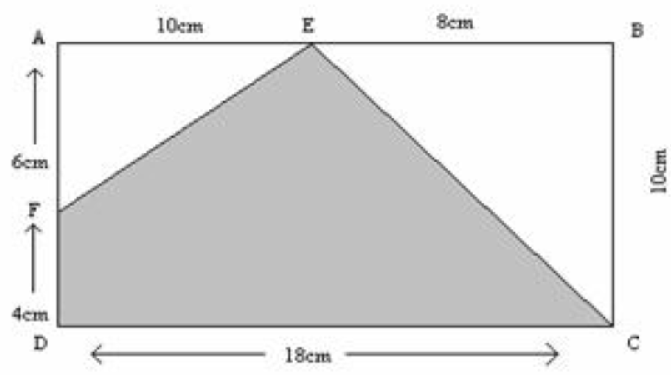
Answer: 74 m²
- Total Area of rectangle ABCD \( = 18 \times 10 = 180\text{ m}^2 \)
- Area of three unshaded right-angled triangles:
1. Area of \( \Delta AEF = \frac{1}{2} \times 10 \times 6 = 30\text{ m}^2 \)
2. Area of \( \Delta EBC = \frac{1}{2} \times 8 \times 10 = 40\text{ m}^2 \)
3. Area of \( \Delta FDC = \frac{1}{2} \times 4 \times 18 = 36\text{ m}^2 \)
- Area of shaded portion = Total Area - Sum of unshaded areas:
\( \implies \text{Shaded Area} = 180 - (30 + 40 + 36) = 180 - 106 = 74\text{ m}^2 \).
In simple words: We subtract the areas of the three unshaded triangles (30, 40, and 36) from the total rectangle area of 180 to find the shaded portion is 74 m².
Exam Tip: Find the area of the outer rectangle and subtract the unshaded parts to calculate the shaded area.
Question 46. A photo frame of 24 cm long and 18 cm wide is edged with a piece of wood of 2 cm wide. Find the cost of edging at the rate of Rs 2.25
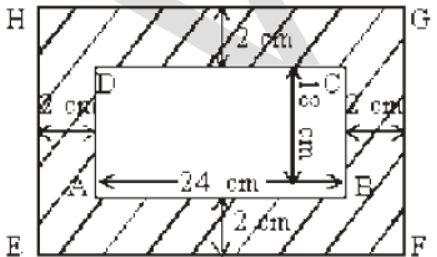
(A) Rs 785
(B) Rs 920
(C) Rs 350
(D) Rs 414
Answer: (D) Rs 414
The edging goes on the outside, so the outer dimensions are:
- Outer length \( = 24 + 2 \times 2 = 28\text{ cm} \)
- Outer width \( = 18 + 2 \times 2 = 22\text{ cm} \)
- Outer Area \( = 28 \times 22 = 616\text{ cm}^2 \)
- Inner Area \( = 24 \times 18 = 432\text{ cm}^2 \)
- Area of the wood border \( = 616 - 432 = 184\text{ cm}^2 \)
- Cost of edging \( = 184 \times \text{Rs } 2.25 = \text{Rs } 414 \).
In simple words: The wood border area is 184 cm². At Rs 2.25 per square centimeter, the total cost is Rs 414.
Exam Tip: Edging with a flat wood border involves calculating the area of the outer border, not its perimeter.
Free study material for Mathematics
CBSE Class 7 Mathematics Worksheets for Chapter 11 Perimeter and Area
Practice Exercises for Class 7 Mathematics Chapter 11 Perimeter and Area
Review targeted practice exercises for Class 7 Mathematics Chapter 11 Perimeter and Area. Curated to match official CBSE guidelines, these printable problem sets support daily revision and improve overall test readiness.
Step-by-Step Solutions and Practice Guidelines
Built using official NCERT guidelines for Class 7 Mathematics, these practice sheets provide reliable academic support. Cross-reference your completed work with our detailed solutions to learn standard answer-writing formats for CBSE exams.
Enhance Speed with Online Practice
Wrap up your chapter revision by testing your knowledge against standard objective question formats. Explore our full library of free, up-to-date printable assignments to maximize your academic results in upcoming CBSE evaluations.
FAQs
You can download the latest chapter-wise printable worksheets for Class 7 Mathematics Chapter 11 Perimeter and Area for free from StudiesToday.com. These have been made as per the latest CBSE curriculum for this academic year.
Yes, Class 7 Mathematics worksheets for Chapter 11 Perimeter and Area focus on activity-based learning and also competency-style questions. This helps students to apply theoretical knowledge to practical scenarios.
Yes, we have provided solved worksheets for Class 7 Mathematics Chapter 11 Perimeter and Area to help students verify their answers instantly.
Yes, our Class 7 Mathematics test sheets are mobile-friendly PDFs and can be printed by teachers for classroom.
For Chapter 11 Perimeter and Area, regular practice with our worksheets will improve question-handling speed and help students understand all technical terms and diagrams.