

Chapter-wise Worksheets for Class 7 Mathematics: Chapter 13 Exponents and Powers
Access comprehensive chapter-wise worksheets for Chapter 13 Exponents and Powers using the CBSE Class 7 Mathematics Exponents And Powers Worksheet Set 03. Designed to align with the 2026-27 academic syllabus for Class 7 Mathematics, these printable practice sets help students reinforce key concepts and improve their overall exam readiness.
Practice Class 7 Mathematics Worksheets: Chapter 13 Exponents and Powers
View or download the dedicated CBSE Class 7 Mathematics Exponents And Powers Worksheet Set 03 resource below. Engaging with these practice papers under focused study conditions ensures continuous academic progress and mastery of the 2026-27 curriculum for Chapter 13 Exponents and Powers.
Question. Evaluate: (16/81)3/4
(A) 9/2
(B) 2/9
(C) 8/27
(D) 27/8
Answer : C
Question. What is the value of (512)-2/9?
(A) 1/2
(B) 2
(C) 4
(D) 1/4
Answer : D
Question. Simplify (32)-2/5 + (125)-2/3.
(A) 4/25
(B) 25/4
(C) 2/5
(D) 5/2
Answer : B
Question. If xY = yx, find the value of (x/y)x/y
(A) Xx/Y
(B) Xx/Y - 1
(C) Xy/x
(D) Xy/x - 1
Answer : B
Question. Evaluate (5)0.25 X (125)0.25/( 256)010 x (256)0.15 .
(A) √5/2
(B) 5/4
(C) 25/2
(D) 25/16
Answer : B
Question. What is the value of (67.542)2 - (32.458)2 / 75.458 - 40.374 ?.
(A) 1
(B) 10
(C) 100
(D) -10
Answer : C
Question. Which of the following values are equal?
I. 14 II. 4°
Ill. 04 IV. 41
(A) I and II
(B) II and Ill
(C) I and Ill
(D) I and IV
Answer : A
Question. Find the sum of the powers of the prime factors in 108 x 192.
(A) 5
(B) 7
(C) 8
(D) 12
Answer : D
Question. What is the value of (3°- 4°) X 5-3?
(A) 25
(B) 0
(C) -25
(D) -125
Answer : B
Question. What is the solution of 33x-5 = 1/9X ?
(A) 5/2
(B) 5
(C) 1
(D) 7/3
Answer : C
Question. Find the value of [(- 3)( -2)](-3)
(A) 729
(B) 32
(C) 64
(D) -729
Answer : A
Question. Compute (64)-1/6 x (216)-1/3 x (81)1/4 / (512)-1/3 x (16)1/4 x (9)-1/2
(A) 3
(B) 6
(C) 1
(D) -6
Answer : A
Question. Find the value of 33√2 X 73√6 X 53√18.
(A) 545
(B) 500
(C) 630
(D) 360
Answer : C
Question. Find the value of (-3)0 - (- 3)3 - (- 3)-1 +(-3)4 -(-3)-2.
(A) 109(2/9)
(B) 102(2/9)
(C) 109
(D) 110
Answer : A
Question. Evaluate

(A) 3(173/440)
(B) 3(17/44)
(C) 3(137/322)
(D) 3(21/440)
Answer : A
Question. What is the simplified form of
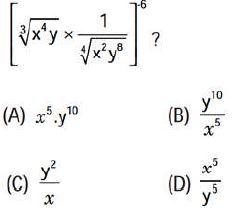
Answer : B
Question. If 3n = 729, find the value of 33n + 1.
(A) 321
(B) 310
(C) 319
(D) 315
Answer : C
Question. If 27x + 1 = 9x + 3 = 3Y, find the respective values of 'x' and y
(A) 3 and 12
(B) 12 and 3
(C) 6 and 6
(D) 4 and 9
Answer : A
Question. Find (0.000064) 514 x (0.04)514.
(A) 210.1010
(B) 210.10-10
(C) 2-10.1010
(D) 2-10 10-10
Answer : B
Question. Find the value of 1/1+x +1/1+xm
(A) 0
(B) xm
(C) 1
(D) x-m
Answer : C
Question. Give the simplified form of 3a 4a-2 25a+1 / 9a-12a+15a-2
(A) 3a-2 . 2a-5 . 5a+4
(B) 2a-s . 3a+2 . 5a+4
(C) 2a+5 . 3-a+2. 5a+4
(D) 2a-5 . 3-a+2 . 5a+4
Answer : B
Question. Which is greater of 212 and 38?
(A) 38
(B) 212
(C) Both are equal.
(D) Cannot be compared.
Answer : A
Question. What is the simplified form of (Xa+b)3 . (Xb+c)3 . (Xc+a)3/(Xa . Xb . Xc) ?
(A) 0
(B) 1
(C) Xa+b+c
(D) X
Answer : B
Question. By what number should we multiply 4-3 so that the product may be equal to 64?
(A) 45
(B) 212
(C) 26
(D) 1
Answer : B
Question. What is the number to be multiplied by (-7)-1 so as to get 10-1 as the product?
(A) -7/10
(B) 7/10
(C) 9/10
(D) -3/10
Answer : A
Question. What is the value of (6-1- 8-1) + (2-1- 3-1)-1?
(A) 25
(B) 30
(C) 35
(D) 40
Answer : B
Question. If (25)x = (125)Y, find X : y.
(A) 1 : 1
(B) 2 : 3
(C) 3 : 2
(D) 1 : 3
Answer : C
Question. What is the standard form of 6020000000000000?
(A) 6.02 X 10¹⁵
(B) 6.02 X 10¹³
(C) 602 X 1013
(D) 602 X 10-15
Answer : A
Question. What is the usual form of 1.0001 x 1 09?
(A) 100010000
(B) 1000100000
(C) 10001000000000
(D) 10001000000
Answer : B
Question. The size of a plant cell is 0.0000127 5 m .
Express this size in standard form.
(A) 1.25 X 10⁸ m
(B) 1.275 x 10⁵ m
(C) 1.275 x 10⁻⁸ m
(D) 1.275 x 10⁻⁵ m
Answer : D
Question. Evaluate {(3/4)-1 (1/4)-1}-1
(A) 3/16
(B) -3/8
(C) 16/3
(D) -8/3
Answer : B
Question. A box has 5 books, each 20 mm thick and 5 cards each 0.016 mm thick. What is the total thickness?
(A) 1.0008 x 104 mm
(B) 1.008 x 103 mm
(C) 1.0008 x 102 mm
(D) 1.0008 x 105 mm
Answer : C
Question. The size of a red blood cell is 0.000007 m.
The size of a plant cell is 0.0000127 5 m.
Compare them.
(A) 2
(B) 4
(C) 5
(D) -5
Answer : A
Question. By what number should (-8)-1 be divided to get 10-1?
(A) 4/5
(B) -5/4
(C) -4/5
(D) 5/4
Answer : B
Mark tick against the correct answer in each of the following:
1. (6-1– 8-1)-1 =?
(a) (-1/2) (b)-2 (c) (1/24) (d) 24
Solution:- (D) 24
We know that, = (6)-1= (1/6)1 … [∵ (a/b)-n
= (b/a) n] = (8)-1
= (1/8)1 … [∵ (a/b)-n
= (b/a) n] Now subtract,
= {(1/6) – (1/8)}-1
= {(4-3)/24}-1 … [LCM of 6 and 8 is 24]
= {1/24}-1
= {24/1} = 24
2. (5-1 × 3 -1)-1
(a)(1/15) (b)(-1/15) (c) 15 (d)-15
Solution:- (c)15
We know that,
= (5)-1= (1 /5)1 … [∵ (a/b)-n
= (b/a) n] = (3)-1
= (1/3)1 … [∵ (a/b)-n
= (b/a) n] Now multiply,
= {(1/5) × (1/3)}-1
= {(1×1)/ (5×3)}-1
= {1/15}-1
= {15/1}
= 15
3. (2-1 – 4-1)2 (a) 4 (b)-4 (c) (1/16) (d) (-1/16)
Solution:- (c) (1/16)
We know that, = (2)-1
= (1/2)1 … [∵ (a/b)-n
= (b/a) n]
= (4)-1
= (1/4)1 … [∵ (a/b)-n
= (b/a) n]
Now subtract,
= {(1/2) – (1/4)} 2
= {(2-1)/4}2 … [LCM of 2 and 4 is 4]
= {1/4}2
= {12/42}
= {1/16}
4. (1/2)-2 + (1/3)-2 + (1/4)-2 =?
(a)(61/144) (b) 29 (c) (144/61) (d) none of these
Solution:- (b) 29
We know that,
= (1/2)-2= (2/1)2 … [∵ (a/b)-n = (b/a) n]
= (1/3)-2
= (3/1)2 … [∵ (a/b)-n = (b/a) n]
= (1/4)-2 = (4/1)2 … [∵ (a/b)-n
= (b/a) n] Now add,
= (2)2+ (3)2+ (4)2
= 4 + 9 + 16
= 29
5.{6-1+(3/2)-1}-1
(a)(2/3) (b)(5/6) (c)(6/5) (d) None of these
Solution:- (c)(6/5)
We know that, = (6)-1
= (1/6) … [∵ (a/b)-n
= (b/a) n]
= (3/2)-1
= (2/3) … [∵ (a/b)-n
= (b/a) n] Now add,
= {(1/6) + (2/3)}-1
= {(1+4)/ 6}-1 … [LCM of 6 and 3 is 6]
= {5/6}-1
= {6/5}
6. (-1/2)-6 =?
(a)-64 (b) 64 (c) (1/64) (d) (-1/64)
Solution:- (b) 64
We know that,
= (-1/2)-6
= (-2/1)6 … [∵ (a/b)-n= (b/a) n]
= (-2)6 = 64
7. {(3/4)-1 – (1/4)-1}-1=?
(a)(3/8) (b)(-3/8) (c)(8/3) (d)(-8/3)
Solution:- (b)(-3/8) We know that,
= (3/4)-1
= (4/3)1 … [∵ (a/b)-n = (b/a) n]
= (1/4)-1
= (4/1)1 … [∵ (a/b)-n = (b/a) n]
Now subtract,
= {(4/3) – (4/1)} -1
= {(4-12)/3}-1 … [LCM of 3 and 1 is 3]
= {-8/3}-1 = {-3/8}
8. [{(-1/2)2}-2]-1=?
(a) (1/16) (b)16 (c)(-1/16) d)-16
Solution:- (a) [{(-1/2)2}-2]-1
= [{(-12/22)}-2]-1
= [{1/4}-2]-1
= [{4} 2]-1
= [16]-1
= [1/16]
9. (5/6)0 =?
(a) 5/6 (b) 0 (c)1 (d)none of these
Solution:- (c) (5/6)0
=1 By definition,
we have a0= 1 for every integer.
10. (2/3)-5=?
(a)(32/243) (b)(243/32) (c)(-32/243) (d)(-243/32)
Solution:- (b) (2/3)-5
= (3/2)5
= (35/25)
= (243/32)
Question 1. Find the value of each of the following
a. \( 13^2 \)
b. \( 5^3 \)
c. \( 2^4 \)
d. \( 11^2 \)
e. \( (-3)^3 \)
f. \( (-1)^6 \)
Answer:
a. \( 13 \times 13 = 169 \)
b. \( 5 \times 5 \times 5 = 125 \)
c. \( 2 \times 2 \times 2 \times 2 = 16 \)
d. \( 11 \times 11 = 121 \)
e. \( (-3) \times (-3) \times (-3) = -27 \)
f. \( (-1) \times (-1) \times (-1) \times (-1) \times (-1) \times (-1) = 1 \)
In simple words: Multiply the number by itself as many times as the top number shows.
Exam Tip: A negative number multiplied an even number of times always gives a positive result.
Question 2. Simplify
a. \( 3 \times 10^2 \)
b. \( 2^2 \times 5^3 \)
c. \( 0 \times 10^4 \)
d. \( \left(\frac{3}{4}\right)^3 \)
e. \( \left(\frac{-2}{3}\right)^4 \)
Answer:
a. Solve the power first: \( 3 \times 100 = 300 \).
b. Solve each power first: \( 4 \times 125 = 500 \).
c. Any number multiplied by 0 is 0. So, \( 0 \times 10000 = 0 \).
d. Solve the top and bottom: \( \frac{3 \times 3 \times 3}{4 \times 4 \times 4} = \frac{27}{64} \).
e. Solve the top and bottom: \( \frac{(-2) \times (-2) \times (-2) \times (-2)}{3 \times 3 \times 3 \times 3} = \frac{16}{81} \).
In simple words: Work out the values of the powers first, then do the multiplication.
Exam Tip: Always raise both the top and bottom numbers of a fraction to the given power.
Question 3. Express each of the following in exponential form
a. \( \left(\frac{-5}{7}\right) \times \left(\frac{-5}{7}\right) \times \left(\frac{-5}{7}\right) \times \left(\frac{-5}{7}\right) \)
b. \( -5 \times -5 \times -5 \)
c. \( x \times x \times x \times x \times a \times a \times b \times b \times b \)
d. \( (-2) \times (-2) \times (-2) \times (-2) \times a \times a \times a \)
Answer:
a. The fraction is multiplied 4 times: \( \left(\frac{-5}{7}\right)^4 \).
b. The number -5 is multiplied 3 times: \( (-5)^3 \).
c. Group and count each term: \( x^4 \times a^2 \times b^3 \).
d. Group and count each term: \( (-2)^4 \times a^3 \).
In simple words: Count how many times a term repeats, then write that count on top.
Exam Tip: Keep negative bases inside parentheses when writing them in exponential form.
Question 4. Express each of the following numbers as a product of powers of their prime factors.
a. \( 36 \)
b. \( 675 \)
c. \( 392 \)
d. \( 864 \)
e. \( 450 \)
f. \( 1800 \)
Answer:
a. Divide 36 into primes: \( 36 = 2 \times 2 \times 3 \times 3 = 2^2 \times 3^2 \).
b. Divide 675 into primes: \( 675 = 3 \times 3 \times 3 \times 5 \times 5 = 3^3 \times 5^2 \).
c. Divide 392 into primes: \( 392 = 2 \times 2 \times 2 \times 7 \times 7 = 2^3 \times 7^2 \).
d. Divide 864 into primes: \( 864 = 2 \times 2 \times 2 \times 2 \times 2 \times 3 \times 3 \times 3 = 2^5 \times 3^3 \).
e. Divide 450 into primes: \( 450 = 2 \times 3 \times 3 \times 5 \times 5 = 2 \times 3^2 \times 5^2 \).
f. Divide 1800 into primes: \( 1800 = 2 \times 2 \times 2 \times 3 \times 3 \times 5 \times 5 = 2^3 \times 3^2 \times 5^2 \).
In simple words: Break each number down into prime factors, then write them with powers.
Exam Tip: Use a factor tree or division method to find all the prime factors step-by-step.
Question 5. Using laws of exponents , simplify
(i) \( 3^6 \times 3^5 \)
(ii) \( (7^2)^3 \div 7^3 \)
(iii) \( 2^{20} \div 2^5 \)
(iv) \( 2^4 \times 5^4 \)
(v) \( (2^0 + 3^0)(4^0 + 6^0) \)
(vi) \( \frac{7^3}{5^3} \)
Answer:
(i) Add the powers: \( 3^{6+5} = 3^{11} \).
(ii) Multiply the powers first, then subtract: \( 7^6 \div 7^3 = 7^{6-3} = 7^3 \).
(iii) Subtract the powers for division: \( 2^{20-5} = 2^{15} \).
(iv) Multiply the bases since the powers match: \( (2 \times 5)^4 = 10^4 \).
(v) Since any number to power 0 is 1: \( (1 + 1)(1 + 1) = 2 \times 2 = 4 \).
(vi) Combine under the same power: \( \left(\frac{7}{5}\right)^3 \).
In simple words: Use exponent laws like adding or subtracting powers to simplify.
Exam Tip: Always remember that any non-zero number raised to the power of 0 equals 1.
Question 6. Simplify and express each of the following in exponential form :
(i) \( \frac{2^{15}}{2^7 \times 2^3} \)
(ii) \( (3^5 \times 3^2)^3 \)
(iii) \( [(2^3)^4 \times 2^8] \div 2^{12} \)
(iv) \( \frac{5^4 \times x^{10} y^5}{5^4 \times x^7 y^4} \)
(v) \( \left(\frac{2}{3}\right)^5 \times \left(\frac{3}{5}\right)^5 \)
(vi) \( \frac{9^8 \times (x^2)^5}{(27)^4 \times (x^3)^2} \)
(vii) \( \frac{3^2 \times 7^8 \times 13^6}{21^2 \times 91^3} \)
(viii) \( \frac{10 \times 5^{n+1} + 25 \times 5^n}{3 \times 5^{n+2} + 10 \times 5^{n+1}} \)
Answer:
(i) Add bottom powers: \( \frac{2^{15}}{2^{10}} \). Subtract them: \( 2^{15-10} = 2^5 \).
(ii) Add inside first: \( (3^7)^3 \). Multiply powers: \( 3^{21} \).
(iii) Solve the power of a power: \( [2^{12} \times 2^8] \div 2^{12} = 2^{20} \div 2^{12} = 2^8 \).
(iv) Cancel \( 5^4 \). Subtract matching powers: \( x^{10-7} y^{5-4} = x^3 y \).
(v) Multiply bases under one power: \( \left(\frac{2}{3} \times \frac{3}{5}\right)^5 = \left(\frac{2}{5}\right)^5 \).
(vi) Write 9 and 27 as powers of 3: \( \frac{3^{16} \times x^{10}}{3^{12} \times x^6} = 3^4 x^4 = (3x)^4 \).
(vii) Expand the bases: \( \frac{3^2 \times 7^8 \times 13^6}{3^2 \times 7^2 \times 7^3 \times 13^3} = \frac{7^8 \times 13^6}{7^5 \times 13^3} = 7^3 \times 13^3 \).
(viii) Group the terms: \( \frac{5^n(50 + 25)}{5^n(75 + 50)} = \frac{75}{125} = \frac{3}{5} \).
In simple words: Match bases first, then apply adding or subtracting rules to clean up the fraction.
Exam Tip: When bases are different, check if they can be written using matching prime bases like 2, 3, or 5.
Question 7. Write the numbers in expanded forms :
a) 20068
(b) 423719
(c) 680071
(d) 5004132
Answer:
a) \( 2 \times 10^4 + 0 \times 10^3 + 0 \times 10^2 + 6 \times 10^1 + 8 \times 10^0 \)
(b) \( 4 \times 10^5 + 2 \times 10^4 + 3 \times 10^3 + 7 \times 10^2 + 1 \times 10^1 + 9 \times 10^0 \)
(c) \( 6 \times 10^5 + 8 \times 10^4 + 0 \times 10^3 + 0 \times 10^2 + 7 \times 10^1 + 1 \times 10^0 \)
(d) \( 5 \times 10^6 + 0 \times 10^5 + 0 \times 10^4 + 4 \times 10^3 + 1 \times 10^2 + 3 \times 10^1 + 2 \times 10^0 \)
In simple words: Write out each digit multiplied by its correct place value using powers of 10.
Exam Tip: Start from the rightmost digit with power 0 and increase the power by 1 for each place to the left.
Question 8. Find the number :
(a) \( 5 \times 10^5 + 4 \times 10^4 + 2 \times 10^3 + 3 \times 10^0 \)
(b) \( 9 \times 10^6 + 8 \times 10^4 + 7 \times 10^2 + 6 \times 10^0 \)
(c) \( 3 \times 10^4 + 4 \times 10^3 + 5 \times 10^0 \)
Answer:
(a) Write out and add: \( 500000 + 40000 + 2000 + 3 = 542003 \).
(b) Write out and add: \( 9000000 + 80000 + 700 + 6 = 9080706 \).
(c) Write out and add: \( 30000 + 4000 + 5 = 34005 \).
In simple words: Put the digits into their correct place values. Use 0 for any missing power of 10.
Exam Tip: Be careful with missing powers of 10. If a power is skipped, make sure to write a 0 in that place.
Question 9. Express in the standard form :
(a) 3,18,65,00,000
(b) \( 786.3 \times 10^4 \)
(c) 5,00,00,000
(b) 42634.7
(d) 4786. 3460
Answer:
(a) Shift the decimal point 9 places to the left: \( 3.1865 \times 10^9 \).
(b) Shift the decimal point 2 places to the left: \( 7.863 \times 10^6 \).
(c) Shift the decimal point 7 places to the left: \( 5.0 \times 10^7 \).
(b) Shift the decimal point 4 places to the left: \( 4.26347 \times 10^4 \).
(d) Shift the decimal point 3 places to the left: \( 4.7863460 \times 10^3 \).
In simple words: Place the decimal after the first non-zero digit, then multiply by 10 raised to the correct power.
Exam Tip: Standard form must always have exactly one non-zero digit to the left of the decimal point.
Question 10. Write the numbers in the usual form :
(a) \( 4.83 \times 10^7 \)
(b) \( 3.64 \times 10^5 \)
(c) \( 7.3 \times 10^3 \)
Answer:
(a) Shift the decimal 7 places to the right: \( 48300000 \).
(b) Shift the decimal 5 places to the right: \( 364000 \).
(c) Shift the decimal 3 places to the right: \( 7300 \).
In simple words: Move the decimal point to the right as many times as the exponent shows.
Exam Tip: Add zeros at the end of the number when you run out of digits while moving the decimal point.
Free study material for Mathematics
Chapter 13 Exponents and Powers Printable Worksheets and Exercises for Class 7 Mathematics
Download Chapter Worksheets: Class 7 Mathematics
Explore reliable practice questions for Chapter 13 Exponents and Powers tailored for Class 7 Mathematics learners. Use these structured worksheets to evaluate exam preparedness and strengthen problem-solving skills throughout the 2026 academic session.
Concept Clarification for Chapter 13 Exponents and Powers
Designed around the official curriculum for Class 7 Mathematics, these practice sheets guarantee standard compliance. Reviewing step-by-step solutions after completion sharpens your accuracy and clarifies complex sub-topics within Chapter 13 Exponents and Powers.
Effective Revision Strategies for School Exams
Consistent engagement with these exercises builds familiarity with recurring exam themes. If specific areas within Chapter 13 Exponents and Powers cause trouble, utilize our dedicated NCERT solutions for Class 7 Mathematics to clear up doubts immediately.
FAQs
You can download the latest chapter-wise printable worksheets for Class 7 Mathematics Chapter 13 Exponents and Powers for free from StudiesToday.com. These have been made as per the latest CBSE curriculum for this academic year.
Yes, Class 7 Mathematics worksheets for Chapter 13 Exponents and Powers focus on activity-based learning and also competency-style questions. This helps students to apply theoretical knowledge to practical scenarios.
Yes, we have provided solved worksheets for Class 7 Mathematics Chapter 13 Exponents and Powers to help students verify their answers instantly.
Yes, our Class 7 Mathematics test sheets are mobile-friendly PDFs and can be printed by teachers for classroom.
For Chapter 13 Exponents and Powers, regular practice with our worksheets will improve question-handling speed and help students understand all technical terms and diagrams.