

Official Class 7 Mathematics Worksheets: Chapter 02 Fractions and Decimals
Access comprehensive chapter-wise worksheets for Chapter 02 Fractions and Decimals using the CBSE Class 7 Mathematics Fractions And Decimals Worksheet Set 03. Designed to align with the 2026-27 academic syllabus for Class 7 Mathematics, these printable practice sets help students reinforce key concepts and improve their overall exam readiness.
Solved Practice Worksheets for Mathematics
Navigate directly to the solved Mathematics worksheets using the digital viewer below. Each practice set includes detailed step-by-step solutions, allowing students to instantly cross-check their work and identify areas requiring further revision.
DECIMAL (DIVISION)
1. Divide:
(i) 142.45 by 10
(ii) 54.25 by 10
Solution:
(i) Given 142.45 by 10 Now shifting the decimal point by one place to the left we can get the result
142.45/10 = 14.245
(ii) Given 54.25 by 10 Now shifting the decimal point by one place to the left we can get the result
54.25/10 = 5.425
2. Divide:
(i) 459.5 by 100
(ii) 74.3 by 100
Solution:
(i) Given 459.5 by 100 Now shifting the decimal point by two places to the left we can get the result
459.5/100 = 4.595
(ii) Given 74.3 by 100 Now shifting the decimal point by two places to the left we can get the result
74.3/100 = 0.743
3. Divide:
(i) 235. 41 by 1000
(ii) 29.5 by 1000
Solution:
(i) Given 235. 41 by 1000 Now shifting the decimal point by three places to the left we can get the result
235. 41/1000 = 0.23541
(ii) Given 29.5 by 1000 Now shifting the decimal point by three places to the left we can get the result
29.5/1000 = 0.0295
4. Divide:
(i) 0.45 by 9
(ii) 217.44 by 18
(iii) 319.2 by 2.28
Solution:
(i) Given 0.45 by 9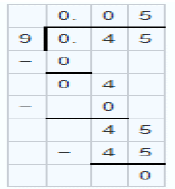
0.45 by 9 = 0.05
(ii) Given 217.44 by 18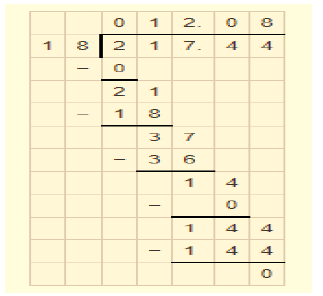
217.44 by 18 = 12.08
iii. Given 319.2 by 2.28
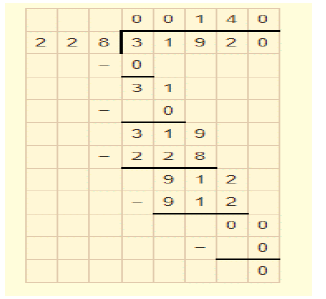
319.2 by 2.28 = 140
5. Divide:
(i) 16.64 by 20
(ii) 0.192 by 12
(iii) 72 by 576
Solution:
(i) Given 16.64 by 20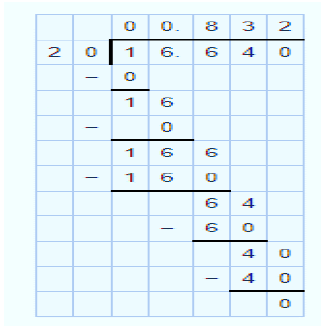
16.64 by 20 = 0.832
(ii) Given 0.192 by 12
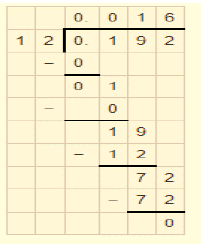
0.192 by 12 = 0.016
(iii) Given 72 by 576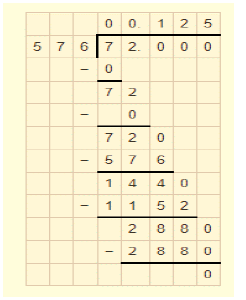
72 by 576 = 0.125
Question 1. Write five equivalent fractions of \( \frac{2}{7} \).
Answer: To find equivalent fractions, we multiply both the numerator and the denominator by the same whole numbers such as 2, 3, 4, 5, and 6:
\( \frac{2 \times 2}{7 \times 2} = \frac{4}{14} \)
\( \frac{2 \times 3}{7 \times 3} = \frac{6}{21} \)
\( \frac{2 \times 4}{7 \times 4} = \frac{8}{28} \)
\( \frac{2 \times 5}{7 \times 5} = \frac{10}{35} \)
\( \frac{2 \times 6}{7 \times 6} = \frac{12}{42} \)
Therefore, the five equivalent fractions are \( \frac{4}{14}, \frac{6}{21}, \frac{8}{28}, \frac{10}{35}, \text{ and } \frac{12}{42} \).
In simple words: Multiplying the top and bottom of \( \frac{2}{7} \) by the same number gives you fractions that have the exact same value.
Exam Tip: Always multiply the numerator and denominator by consecutive small numbers like 2, 3, and 4 to quickly find equivalent fractions without mistakes.
Question 2. Solve:
(a) \( 2 - \frac{3}{5} \)
(b) \( 7\frac{1}{2} + 3\frac{1}{4} - 2\frac{1}{4} \)
(c) \( \frac{8}{3} - 1 \)
(d) \( \frac{2}{9} + \frac{3}{15} + \frac{5}{27} \)
Answer:
(a) \( 2 - \frac{3}{5} = \frac{2 \times 5}{5} - \frac{3}{5} = \frac{10 - 3}{5} = \frac{7}{5} = 1\frac{2}{5} \)
(b) First, turn the mixed numbers into improper fractions:
\( 7\frac{1}{2} = \frac{15}{2} \), \( 3\frac{1}{4} = \frac{13}{4} \), and \( 2\frac{1}{4} = \frac{9}{4} \)
Now solve the expression:
\( \frac{15}{2} + \frac{13}{4} - \frac{9}{4} \)
Take the LCM of 2 and 4, which is 4:
\( \frac{30}{4} + \frac{13}{4} - \frac{9}{4} = \frac{30 + 13 - 9}{4} = \frac{34}{4} = \frac{17}{2} = 8\frac{1}{2} \)
(c) \( \frac{8}{3} - 1 = \frac{8}{3} - \frac{3}{3} = \frac{5}{3} = 1\frac{2}{3} \)
(d) Take the LCM of the denominators 9, 15, and 27, which is 135:
\( \frac{2 \times 15}{135} + \frac{3 \times 9}{135} + \frac{5 \times 5}{135} = \frac{30 + 27 + 25}{135} = \frac{82}{135} \)
In simple words: To add or subtract fractions, find a common bottom number first. Then combine the top numbers and simplify your answer.
Exam Tip: Always convert mixed numbers into improper fractions as your very first step to make addition and subtraction much simpler.
Question 3. Arrange \( \frac{4}{9}, \frac{3}{7}, \frac{5}{21} \) in ascending order.
Answer: First, find the LCM of the denominators 9, 7, and 21, which is 63.
Next, convert each fraction so they all have 63 as their denominator:
\( \frac{4}{9} = \frac{4 \times 7}{63} = \frac{28}{63} \)
\( \frac{3}{7} = \frac{3 \times 9}{63} = \frac{27}{63} \)
\( \frac{5}{21} = \frac{5 \times 3}{63} = \frac{15}{63} \)
Now compare the numerators: 15 < 27 < 28.
This gives: \( \frac{15}{63} < \frac{27}{63} < \frac{28}{63} \)
So, the ascending order is \( \frac{5}{21}, \frac{3}{7}, \frac{4}{9} \).
In simple words: Make all the bottom numbers the same using the LCM. Then arrange the fractions by looking at their top numbers from smallest to largest.
Exam Tip: Do not just compare the numerators directly when denominators are different. You must find a common denominator first.
Question 4. Sahil solved \( \frac{2}{7} \) part of an exercise while Rahim solved \( \frac{3}{5} \) of it. who solved lesser part? By how much?
Answer: First, compare the two fractions by finding a common denominator for 7 and 5, which is 35.
Sahil's portion: \( \frac{2}{7} = \frac{2 \times 5}{35} = \frac{10}{35} \)
Rahim's portion: \( \frac{3}{5} = \frac{3 \times 7}{35} = \frac{21}{35} \)
Comparing the portions, \( \frac{10}{35} < \frac{21}{35} \), which shows that Sahil solved the lesser part.
To find out by how much:
\( \frac{21}{35} - \frac{10}{35} = \frac{11}{35} \)
Thus, Sahil solved less by \( \frac{11}{35} \).
In simple words: Convert both portions to have a bottom number of 35. Sahil solved \( \frac{10}{35} \) and Rahim solved \( \frac{21}{35} \), meaning Sahil did less by \( \frac{11}{35} \).
Exam Tip: Be sure to answer both parts of the question: state who solved the smaller amount and show the subtraction steps to get the final difference.
Question 5. A rectangular table top is \( 2\frac{1}{2}\text{ m} \) long and \( 1\frac{3}{4}\text{ m} \) wide. Find its perimeter.
Answer: Given the dimensions of the rectangular table top:
Length \( (l) = 2\frac{1}{2}\text{ m} = \frac{5}{2}\text{ m} \)
Width \( (w) = 1\frac{3}{4}\text{ m} = \frac{7}{4}\text{ m} \)
The formula for the perimeter of a rectangle is:
\( \text{Perimeter} = 2 \times (l + w) \)
\( \implies 2 \times \left(\frac{5}{2} + \frac{7}{4}\right) \)
Find a common denominator for the terms inside the parentheses:
\( \implies 2 \times \left(\frac{10}{4} + \frac{7}{4}\right) = 2 \times \frac{17}{4} = \frac{17}{2} = 8\frac{1}{2}\text{ m} \)
So, the perimeter is \( 8\frac{1}{2}\text{ m} \).
In simple words: Add the length and the width together, then multiply the result by 2 to find the total boundary length, which is \( 8\frac{1}{2}\text{ meters} \).
Exam Tip: Always remember to write down the final units (like meters) with your answer to ensure you do not lose any marks.
Question 6. Find:
(a) \( \frac{5}{8} \) of \( 8\frac{4}{7} \)
(b) \( \frac{3}{5} \) of \( \frac{5}{9} \)
(c) \( \frac{1}{2} \) of 102
(d) \( \frac{3}{4} \) of 224
Answer:
(a) \( \frac{5}{8} \text{ of } 8\frac{4}{7} = \frac{5}{8} \times \frac{60}{7} = \frac{5 \times 15}{2 \times 7} = \frac{75}{14} = 5\frac{5}{14} \)
(b) \( \frac{3}{5} \text{ of } \frac{5}{9} = \frac{3}{5} \times \frac{5}{9} = \frac{3}{9} = \frac{1}{3} \)
(c) \( \frac{1}{2} \text{ of } 102 = \frac{1}{2} \times 102 = 51 \)
(d) \( \frac{3}{4} \text{ of } 224 = \frac{3}{4} \times 224 = 3 \times 56 = 168 \)
In simple words: The word "of" in mathematics means multiplication. Simply multiply the numbers together and simplify the fraction.
Exam Tip: Simplify the numbers by cross-cancelling common factors before multiplying to make your calculations easier.
Question 7. Multiply:
(a) \( 28 \times 2\frac{3}{7} \)
(b) \( 3\frac{1}{4} \times 16 \)
(c) \( \frac{2}{9} \times \frac{81}{3} \)
(d) \( 7\frac{2}{3} \times 3\frac{3}{4} \)
(e) \( 9\frac{1}{4} \times \frac{16}{5} \)
Answer:
(a) \( 28 \times 2\frac{3}{7} = 28 \times \frac{17}{7} = 4 \times 17 = 68 \)
(b) \( 3\frac{1}{4} \times 16 = \frac{13}{4} \times 16 = 13 \times 4 = 52 \)
(c) \( \frac{2}{9} \times \frac{81}{3} = \frac{2}{9} \times 27 = 2 \times 3 = 6 \)
(d) \( 7\frac{2}{3} \times 3\frac{3}{4} = \frac{23}{3} \times \frac{15}{4} = \frac{23 \times 5}{4} = \frac{115}{4} = 28\frac{3}{4} \)
(e) \( 9\frac{1}{4} \times \frac{16}{5} = \frac{37}{4} \times \frac{16}{5} = \frac{37 \times 4}{5} = \frac{148}{5} = 29\frac{3}{5} \)
In simple words: Convert mixed fractions into improper fractions, multiply the top numbers and bottom numbers, and then simplify.
Exam Tip: Convert your final improper fraction back into a mixed fraction if the starting numbers in the question were mixed fractions.
Question 8. A cyclist covers \( 4\frac{1}{2}\text{ km} \) in 1 hour. How far does he go in \( 3\frac{1}{2}\text{ hours} \)?
Answer: Distance covered in 1 hour \( = 4\frac{1}{2}\text{ km} = \frac{9}{2}\text{ km} \)
Total cycling time \( = 3\frac{1}{2}\text{ hours} = \frac{7}{2}\text{ hours} \)
Total distance covered \( = \text{Distance in 1 hour} \times \text{Total hours} \)
\( \implies \frac{9}{2} \times \frac{7}{2} = \frac{63}{4} = 15\frac{3}{4}\text{ km} \)
So, the cyclist covers \( 15\frac{3}{4}\text{ km} \) in \( 3\frac{1}{2}\text{ hours} \).
In simple words: Multiply the speed of \( 4\frac{1}{2}\text{ km} \) per hour by \( 3\frac{1}{2}\text{ hours} \) to find the total distance, which is \( 15\frac{3}{4}\text{ km} \).
Exam Tip: Write down the multiplication of improper fractions clearly before performing any simplification steps.
Question 9. Which is greater: \( \frac{3}{5} \) of \( \frac{3}{4} \) or \( \frac{1}{2} \) of \( \frac{1}{5} \)
Answer: First, calculate the value of both products:
\( \frac{3}{5} \text{ of } \frac{3}{4} = \frac{3}{5} \times \frac{3}{4} = \frac{9}{20} \)
\( \frac{1}{2} \text{ of } \frac{1}{5} = \frac{1}{2} \times \frac{1}{5} = \frac{1}{10} = \frac{2}{20} \)
Now, compare the two fractions:
Since \( \frac{9}{20} > \frac{2}{20} \), the first value is larger.
Therefore, \( \frac{3}{5} \text{ of } \frac{3}{4} \) is greater.
In simple words: Solve both multiplications first. Comparing \( \frac{9}{20} \) and \( \frac{2}{20} \) shows that the first one is much larger.
Exam Tip: Convert the final fractions to have a common denominator so you can easily compare their numerators.
Question 10. Provide the number in the box \( \Box \), such that \( \frac{3}{5} \times \Box = \frac{24}{145} \)
Answer: Let the unknown number inside the box be \( x \).
\( \frac{3}{5} \times x = \frac{24}{145} \)
To solve for \( x \), divide \( \frac{24}{145} \) by \( \frac{3}{5} \):
\( x = \frac{24}{145} \times \frac{5}{3} \)
\( x = \frac{24}{3} \times \frac{5}{145} = 8 \times \frac{1}{29} = \frac{8}{29} \)
So, the missing number in the box is \( \frac{8}{29} \).
In simple words: Divide the final answer by the first fraction to find the missing number, which is \( \frac{8}{29} \).
Exam Tip: You can quickly check your answer by multiplying \( \frac{3}{5} \times \frac{8}{29} \) and verifying if it equals \( \frac{24}{145} \).
Question 11. Rasheed bought 45 kg of rice for SR 270. What is the cost of 1 kg rice.
Answer: Total quantity of rice purchased = 45 kg
Total cost of the rice = SR 270
Cost of 1 kg of rice = \( \frac{\text{Total Cost}}{\text{Total Quantity}} \)
\( \implies \frac{270}{45} = \text{SR } 6 \)
So, the price of 1 kg of rice is SR 6.
In simple words: Divide the total money spent (SR 270) by the total weight of rice (45 kg) to get the price for one kg, which is SR 6.
Exam Tip: Be sure to write the local currency symbol "SR" clearly in your final step.
Question 12. Find:
(a) \( 18 \div \frac{3}{5} \)
(b) \( 12 \div 2\frac{3}{4} \)
(c) \( 2\frac{2}{5} \div 1\frac{1}{10} \)
(d) \( \frac{7}{5} \div 14 \)
(e) \( 12\frac{3}{4} \div 17 \)
(f) \( \frac{144}{5} \div \frac{12}{5} \)
Answer:
(a) \( 18 \div \frac{3}{5} = 18 \times \frac{5}{3} = 6 \times 5 = 30 \)
(b) \( 12 \div 2\frac{3}{4} = 12 \div \frac{11}{4} = 12 \times \frac{4}{11} = \frac{48}{11} = 4\frac{4}{11} \)
(c) \( 2\frac{2}{5} \div 1\frac{1}{10} = \frac{12}{5} \div \frac{11}{10} = \frac{12}{5} \times \frac{10}{11} = \frac{12 \times 2}{11} = \frac{24}{11} = 2\frac{2}{11} \)
(d) \( \frac{7}{5} \div 14 = \frac{7}{5} \times \frac{1}{14} = \frac{1}{5 \times 2} = \frac{1}{10} \)
(e) \( 12\frac{3}{4} \div 17 = \frac{51}{4} \div 17 = \frac{51}{4} \times \frac{1}{17} = \frac{3}{4} \)
(f) \( \frac{144}{5} \div \frac{12}{5} = \frac{144}{5} \times \frac{5}{12} = \frac{144}{12} = 12 \)
In simple words: To divide by a fraction, multiply by its flipped version (reciprocal). Remember to turn mixed numbers into improper fractions first.
Exam Tip: Always cross-cancel numbers during multiplication to make calculations much simpler and prevent large arithmetic mistakes.
Question 13. Which is greater ? 3.05 or 3.50
Answer: Compare the digits starting from the left of the decimal point:
The whole number parts are equal since both have 3.
Now compare the digits in the tenths place:
In 3.05, the tenth digit is 0.
In 3.50, the tenth digit is 5.
Since 5 is greater than 0, 3.50 is larger than 3.05.
In simple words: 3.50 is larger because its first digit after the decimal point (5) is bigger than the first digit in 3.05 (0).
Exam Tip: If you get confused comparing decimals, add placeholder zeros so that both numbers have the same number of digits after the decimal point.
Question 14. Express 49 mm in cm, m and Km
Answer: We use the standard conversion factors to express 49 mm in other units:
To convert mm to cm (divide by 10):
\( 49\text{ mm} = \frac{49}{10} = 4.9\text{ cm} \)
To convert mm to m (divide by 1000):
\( 49\text{ mm} = \frac{49}{1000} = 0.049\text{ m} \)
To convert mm to km (divide by 1,000,000):
\( 49\text{ mm} = \frac{49}{1000000} = 0.000049\text{ km} \)
In simple words: Divide by 10 to get centimeters, divide by 1,000 to get meters, and divide by 1,000,000 to get kilometers.
Exam Tip: Carefully count the number of zeros when dividing by large powers of ten to avoid decimal point displacement errors.
Question 15. How much less is 42 km than 81.9 km?
Answer: To find how much smaller 42 km is compared to 81.9 km, we subtract:
\( 81.9\text{ km} - 42.0\text{ km} = 39.9\text{ km} \)
Therefore, 42 km is 39.9 km less than 81.9 km.
In simple words: Subtract 42 from 81.9 to find the difference, which is 39.9 km.
Exam Tip: Line up the decimal points of both numbers vertically before you subtract. Write 42 as 42.0 to make subtraction easier.
Question 16. Express in kg:
(a) 7 kg 5 g
(b) 7492 g
(c) 315 g
Answer: We know that \( 1\text{ kg} = 1000\text{ g} \).
(a) \( 7\text{ kg } 5\text{ g} = 7\text{ kg} + \frac{5}{1000}\text{ kg} = 7\text{ kg} + 0.005\text{ kg} = 7.005\text{ kg} \)
(b) \( 7492\text{ g} = \frac{7492}{1000}\text{ kg} = 7.492\text{ kg} \)
(c) \( 315\text{ g} = \frac{315}{1000}\text{ kg} = 0.315\text{ kg} \)
In simple words: To change grams into kilograms, divide the number of grams by 1000.
Exam Tip: Since 1000 has three zeros, you must move the decimal point three places to the left when converting grams to kilograms.
Question 17. Express as rupees using decimals:
(a) 9 paise
(b) 8 rupees 3 paise
(c) 725 paise
Answer: We know that \( 1\text{ Rupee} = 100\text{ paise} \).
(a) \( 9\text{ paise} = \text{Rs } \frac{9}{100} = \text{Rs } 0.09 \) (written as Re 0.09)
(b) \( 8\text{ rupees } 3\text{ paise} = \text{Rs } 8 + \text{Rs } \frac{3}{100} = \text{Rs } 8 + \text{Rs } 0.03 = \text{Rs } 8.03 \)
(c) \( 725\text{ paise} = \text{Rs } \frac{725}{100} = \text{Rs } 7.25 \)
In simple words: To change paise into rupees, divide by 100. This shifts the decimal point two places to the left.
Exam Tip: Remember to put the "Rs" symbol before your final decimal answer to represent rupees correctly.
Question 18. Write in expanded form:
(a) 300.05
(b) 2.105
(c) 30.39
Answer: We write each number as the sum of its values at each place:
(a) \( 300.05 = 3 \times 100 + 0 \times 10 + 0 \times 1 + 0 \times \frac{1}{10} + 5 \times \frac{1}{100} \)
(b) \( 2.105 = 2 \times 1 + 1 \times \frac{1}{10} + 0 \times \frac{1}{100} + 5 \times \frac{1}{1000} \)
(c) \( 30.39 = 3 \times 10 + 0 \times 1 + 3 \times \frac{1}{10} + 9 \times \frac{1}{100} \)
In simple words: Break the numbers down by their places, like hundreds, tens, ones, tenths, hundredths, and thousandths.
Exam Tip: Do not skip writing digits that are 0 in the expanded form, as showing every place value is important for full marks.
Question 19. Write the place value of 5 in the following decimal numbers:
(a) 2.35
(b) 85.32
(c) 29.205
(d) 128.250
(e) 10.2935
Answer:
(a) In 2.35, 5 is in the hundredths place. Its place value is \( \frac{5}{100} \).
(b) In 85.32, 5 is in the ones place. Its place value is 5.
(c) In 29.205, 5 is in the thousandths place. Its place value is \( \frac{5}{1000} \).
(d) In 128.250, 5 is in the hundredths place. Its place value is \( \frac{5}{100} \).
(e) In 10.2935, 5 is in the ten-thousandths place. Its place value is \( \frac{5}{10000} \).
In simple words: Find where the number 5 sits in each decimal. Write down its value based on that position.
Exam Tip: Be careful with the names of decimal places: "hundreds" is for whole numbers, but "hundredths" is for numbers after the decimal point.
Question 20. Laila bought 8 kg 7 g oranges and 4 kg 25 g grapes. Jessy bought 5 kg 200 g bananas and 6 kg 305 g mangoes. Who bought more fruits and by how much?
Answer: Let's find the total weight of fruits purchased by each person:
For Laila:
Oranges = \( 8\text{ kg } 7\text{ g} = 8.007\text{ kg} \)
Grapes = \( 4\text{ kg } 25\text{ g} = 4.025\text{ kg} \)
Total fruits = \( 8.007\text{ kg} + 4.025\text{ kg} = 12.032\text{ kg} \)
For Jessy:
Bananas = \( 5\text{ kg } 200\text{ g} = 5.200\text{ kg} \)
Mangoes = \( 6\text{ kg } 305\text{ g} = 6.305\text{ kg} \)
Total fruits = \( 5.200\text{ kg} + 6.305\text{ kg} = 11.505\text{ kg} \)
Comparing the totals:
\( 12.032\text{ kg} > 11.505\text{ kg} \)
So, Laila bought more fruits.
Difference in weight = \( 12.032\text{ kg} - 11.505\text{ kg} = 0.527\text{ kg} \) (or 527 g)
Laila bought more fruits by 0.527 kg.
In simple words: Convert the weights to decimals and add them up. Laila bought 12.032 kg of fruits and Jessy bought 11.505 kg, so Laila bought more by 0.527 kg.
Exam Tip: When converting grams to kilograms, remember that 7 g is 0.007 kg, not 0.7 kg or 0.07 kg.
Question 21. The side of an equilateral triangle is 5.5cm. Find its perimeter.
Answer: An equilateral triangle has three equal sides.
Length of each side = 5.5 cm
Perimeter of the triangle = \( 3 \times \text{side} \)
\( \implies 3 \times 5.5\text{ cm} = 16.5\text{ cm} \)
So, the perimeter is 16.5 cm.
In simple words: Since all three sides of this triangle are the same length, multiply 5.5 cm by 3 to get the total perimeter of 16.5 cm.
Exam Tip: Show the formula for the perimeter of an equilateral triangle first before doing the multiplication steps.
Question 22. Find:
(a) \( 100.3 \times 10.3 \)
(b) \( 8.9 \times 1000 \)
(c) \( 0.5 \times 0.008 \)
(d) \( 0.2 \times 10 \)
(e) \( 233.33 \times 3 \)
(f) \( 18.25 \times 0.25 \)
Answer:
(a) \( 100.3 \times 10.3 = 1033.09 \)
(b) \( 8.9 \times 1000 = 8900 \)
(c) \( 0.5 \times 0.008 = 0.004 \)
(d) \( 0.2 \times 10 = 2 \)
(e) \( 233.33 \times 3 = 699.99 \)
(f) \( 18.25 \times 0.25 = 4.5625 \)
In simple words: Multiply the numbers as if they were whole numbers. Then put the decimal point back based on the total number of decimal places in the original numbers.
Exam Tip: When multiplying by 10 or 1000, simply move the decimal point to the right by counting the number of zeros.
Question 23. A train covers 311.50 Km in 3.5 hours. what is the distance covered by it in 1 hour?
Answer: Total distance covered by the train = 311.50 km
Total time taken = 3.5 hours
Distance covered in 1 hour = \( \frac{\text{Total Distance}}{\text{Total Time}} \)
\( \implies \frac{311.50}{3.5} = \frac{3115}{35} = 89\text{ km} \)
Thus, the train covers a distance of 89 km in 1 hour.
In simple words: Divide the total distance of 311.50 km by the time of 3.5 hours to find that the train travels 89 km every hour.
Exam Tip: Remove the decimals by multiplying the numerator and denominator by 10 before dividing to simplify the long division.
Question 24. If a car covers a distance of 19.5km in one litre of petrol. How much distance will it cover in 19.5 litres of petrol?
Answer: Distance covered with 1 litre of petrol = 19.5 km
Quantity of petrol used = 19.5 litres
Total distance covered = \( 19.5 \times 19.5 = 380.25\text{ km} \)
So, the car will cover a distance of 380.25 km.
In simple words: Multiply the distance covered per litre (19.5 km) by the total litres of petrol (19.5) to get 380.25 km.
Exam Tip: Remember that when multiplying two decimals with one decimal place each, your final answer must have exactly two decimal places.
Question 25. Find:
(a) \( 125.086 \div 26 \)
(b) \( 8.397 \div 1000 \)
(c) \( 30.24 \div 0.36 \)
(d) \( 66.65 \div 0.215 \)
(e) \( 9.5 \div 1.9 \)
(f) \( 27.39 \div 0.1 \)
(g) \( 12.397 \div 10 \)
Answer:
(a) \( 125.086 \div 26 = 4.811 \)
(b) \( 8.397 \div 1000 = 0.008397 \)
(c) \( 30.24 \div 0.36 = \frac{3024}{36} = 84 \)
(d) \( 66.65 \div 0.215 = \frac{66650}{215} = 310 \)
(e) \( 9.5 \div 1.9 = \frac{95}{19} = 5 \)
(f) \( 27.39 \div 0.1 = 273.9 \)
(g) \( 12.397 \div 10 = 1.2397 \)
In simple words: Shift the decimals to make the divisor a whole number before you divide. For powers of 10, shift the decimal point to the left.
Exam Tip: Double check division calculations like \( 66.65 \div 0.215 \) by doing a quick multiplication check: \( 310 \times 0.215 = 66.65 \).
Question 26. Find the average of 8.4, 7.5, 12.9 and 10.6
Answer: To find the average of the given numbers, we sum them up and then divide the sum by the total count of numbers:
Sum = \( 8.4 + 7.5 + 12.9 + 10.6 = 39.4 \)
Count = 4
Average = \( \frac{39.4}{4} = 9.85 \)
So, the average of the numbers is 9.85.
In simple words: Add all four numbers together to get 39.4, and then divide that total by 4 to get the average of 9.85.
Exam Tip: Be sure to write out both the addition step and the final division step clearly in your answer.
Question 27. Each side of a regular polygon is 7.3cm in length. The perimeter of the polygon is 36.5cm. How many sides does the polygon have?
Answer: Given the details of the regular polygon:
Length of one side = 7.3 cm
Perimeter of the polygon = 36.5 cm
The number of sides of a regular polygon is given by:
\( \text{Number of sides} = \frac{\text{Perimeter}}{\text{Length of each side}} \)
\( \implies \frac{36.5}{7.3} = \frac{365}{73} = 5 \)
So, the regular polygon has 5 sides (it is a pentagon).
In simple words: Divide the total perimeter of 36.5 cm by the side length of 7.3 cm to find that the shape has 5 sides.
Exam Tip: Since a polygon must have a whole number of sides, a fractional result means there is a mistake in your division. Always double-check your arithmetic.
Free study material for Mathematics
Chapter 02 Fractions and Decimals Printable Worksheets and Exercises for Class 7 Mathematics
Practice Exercises for Class 7 Mathematics Chapter 02 Fractions and Decimals
Access structured practice worksheets for Chapter 02 Fractions and Decimals aligned with the 2026 CBSE curriculum. These downloadable exercises for Class 7 Mathematics help students build accuracy and reinforce core concepts for upcoming school tests.
Step-by-Step Solutions and Practice Guidelines
Designed around the official curriculum for Class 7 Mathematics, these practice sheets guarantee standard compliance. Reviewing step-by-step solutions after completion sharpens your accuracy and clarifies complex sub-topics within Chapter 02 Fractions and Decimals.
Enhance Speed with Online Practice
Consistent engagement with these exercises builds familiarity with recurring exam themes. If specific areas within Chapter 02 Fractions and Decimals cause trouble, utilize our dedicated NCERT solutions for Class 7 Mathematics to clear up doubts immediately.
FAQs
You can download the latest chapter-wise printable worksheets for Class 7 Mathematics Chapter 02 Fractions and Decimals for free from StudiesToday.com. These have been made as per the latest CBSE curriculum for this academic year.
Yes, Class 7 Mathematics worksheets for Chapter 02 Fractions and Decimals focus on activity-based learning and also competency-style questions. This helps students to apply theoretical knowledge to practical scenarios.
Yes, we have provided solved worksheets for Class 7 Mathematics Chapter 02 Fractions and Decimals to help students verify their answers instantly.
Yes, our Class 7 Mathematics test sheets are mobile-friendly PDFs and can be printed by teachers for classroom.
For Chapter 02 Fractions and Decimals, regular practice with our worksheets will improve question-handling speed and help students understand all technical terms and diagrams.