

Chapter-wise Worksheets for Class 7 Mathematics: Chapter 02 Fractions and Decimals
Review targeted academic worksheets with the CBSE Class 7 Mathematics Fractions And Decimals Worksheet Set 04. Built according to official educational standards for the 2026-27 term, these downloadable Class 7 Mathematics resources support effective daily practice and detailed self-evaluation for Chapter 02 Fractions and Decimals.
Practice Class 7 Mathematics Worksheets: Chapter 02 Fractions and Decimals
Access the complete worksheet PDF for Class 7 Mathematics below. Regular practice with these targeted academic tasks builds familiarity with standard question patterns and helps secure higher marks in final school examinations.
DECIMAL (WORD PROBLEMS)
Question. A vehicle covers a distance 0f 43.2 km in 2.4 litres of petrol. How much distance will travel in 1 litre of petrol?
Solution:
Given distance covered by vehicle in 2.4 litres of petrol is = 43.2 km
Distance travel by vehicle in 1 litre of petrol = 43.2/2.4
Multiply both numerator and denominator by 10 then we get 432/24
On dividing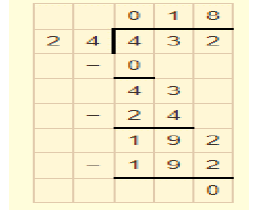
Therefore 18km can travel in 1litre of petrol.
Question. The total weight of some bags of wheat is 1743 kg. If each bag weighs 49.8 kg, how many bags are there?
Solution:
Given total weight of total bags = 1743 kg
Each bag weighs = 49.8 kg
Number of bags = 1743/49.8
Multiply both numerator and denominator by 10 then we get 17430/498
On dividing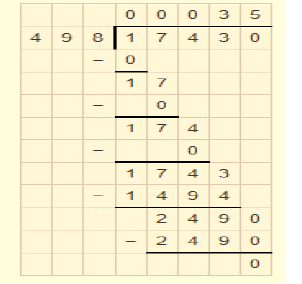
Therefore number of bags are 35
Question. Shikha cuts 50 m of cloth into pieces 0f 1.25 m each. How many pieces does she get?
Solution:
Given that total length of cloth = 50 m
Length of each piece = 1.25 m
Number of cloth piece = 50/1.25
Multiply both numerator and denominator by 100 then we get 5000/125
On dividing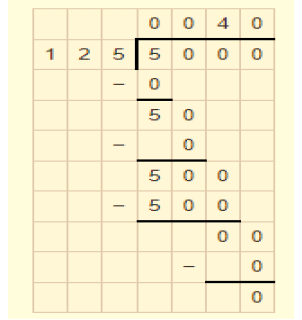
Number of cloth piece = 40
Question. Each side of a rectangular polygon is 2.5cm in length. The perimeter of the polygon is 12.5 cm. How many sides does the polygon have?
Solution:
Given that length of each side of polygon is = 2.5 cm
Perimeter of polygon = 12.5 cm
Number of sides = 12.5/2.5
Multiply both numerator and denominator by 10 then we get 125/25
On dividing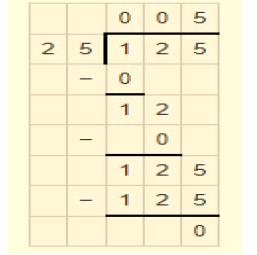
Number of sides of polygon is 5
Question. The product of two decimals is 42.987. If one of them is 12.46, find the other.
Solution:
Given that product of two decimals = 42.987
One of the number is = 12.46
Another number is = 42.987/12.46
Multiply both numerator and denominator by 1000 then we get 42987/12460
On dividing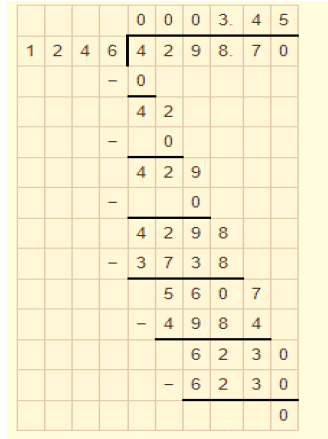
Another number is 3.45
Question. The weight of 34 bags of sugar is 3483.3 kg. If all bags weigh equally, find the weight of each bag.
Solution:
Given that weight of 34 bags of sugar is = 3483.3 kg
Weight of each bag = 3483.3/34
Multiply both numerator and denominator by 10 then we get 34833/34
On dividing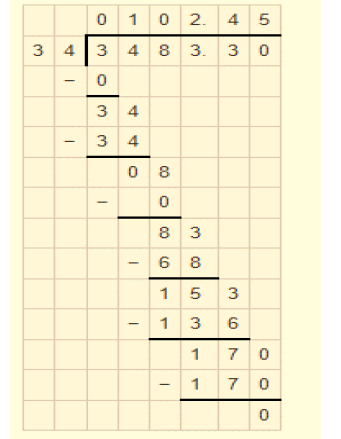
Weight of each bag = 1o2.45 kg
Question. How many buckets of equal capacity can be filled from 586.5 litres of water, if each has capacity of 8.5 litres?
Solution:
Given that capacity of each bucket = 8.5 litres
Total water available = 586.5 litres
Number of buckets = 586.5/8.5
Multiply both numerator and denominator by 10 then we get 5865/85
On dividing
Number of buckets = 69
Question 1. Choose the correct option (Multiple Choice Questions) :
(i) Which of the following is a proper fraction?
(a) \( \frac{5}{0} \)
(b) \( \frac{0}{0} \)
(c) \( \frac{3}{4} \)
(d) \( \frac{11}{4} \)
(ii) Which of the following is an improper fraction?
(a) \( \frac{2}{5} \)
(b) \( \frac{0}{0} \)
(c) \( \frac{3}{8} \)
(d) \( \frac{13}{5} \)
(iii) Which of the following is a mixed number/fraction?
(a) 1
(b) \( \frac{2}{3} \)
(c) \( 1\frac{2}{4} \)
(d) \( 1\frac{1}{3} \)
(iv) \( 5 \div \frac{1}{2} = ? \)
(a) \( \frac{5}{2} \)
(b) \( 2\frac{1}{2} \)
(c) \( 5\frac{1}{2} \)
(d) 10
(v) When \( \frac{-8}{15} \) is divided by \( \frac{2}{3} \), the result is
(a) \( \frac{-16}{24} \)
(b) \( \frac{3}{36} \)
(c) \( \frac{-4}{5} \)
(d) \( \frac{-5}{8} \)
(vi) Zero divided by any integer gives
(a) the same integer
(b) zero
(c) cannot be diveded
(d) depends on the integer
(vii) Reciprocal of \( \frac{5}{4} \times \frac{7}{3} \) is
(a) \( \frac{5}{4} \times \frac{7}{3} \)
(b) \( \frac{4}{5} \times \frac{3}{7} \)
(c) \( \frac{4}{5} \times \frac{7}{3} \)
(d) \( \frac{5}{4} \times \frac{3}{7} \)
(viii) \( \frac{3}{4} \div 6 = ? \)
(a) \( \frac{1}{8} \)
(b) \( \frac{3}{24} \)
(c) \( \frac{1}{3} \times \frac{1}{8} \)
(d) \( \frac{1}{8} \)
(ix) \( \frac{1}{3} \) of 3 is
(a) 3
(b) \( \frac{1}{3} \)
(c) \( \frac{1}{2} \)
(d) 1
(x) \( \frac{1}{3} \) of \( \frac{1}{3} \) is
(a) 3
(b) \( \frac{1}{3} \)
(c) \( \frac{1}{9} \)
(d) 1
(xi) In the expression \( 7.2 \times \_\_\_\_ = 0.432 \), the mission number is
(a) 0.06
(b) 0.1104
(c) 6
(d) 311.04
(xii) The product of 1.2 and 0.5 expressed as a fraction is
(a) \( \frac{3}{5} \)
(b) \( \frac{1}{2} \)
(c) \( \frac{5}{3} \)
(d) \( \frac{2}{5} \)
(xiii) To multiply a decimal number by 100, move the decimal point
(a) to the right by 2 places
(b) to the left by 4 places
(c) to the right by 4 places
(d) to the left by 3 places.
(xiv) 2.28 is the same as
(a) 20.28
(b) 2.208
(c) 2.280
(d) 2.028
(xv) \( 140.75 \times 0.01 = ? \)
(a) 140.7500
(b) 14000.75
(c) 1.0475
(d) 1.4075
(xvi) \( 123.45 \div 6.7 \) is the same as
(a) \( 123.45 \div 67 \)
(b) \( 1234.5 \div 67 \)
(c) \( 1234.5 \div 6.7 \)
(d) \( 12345 \div 67 \)
(xvii) \( 1000 \times 0.001 = ? \)
(a) 0.1
(b) 1
(c) 0.01
(d) 0.0001
(xviii) If \( 537 \times 2 = 1074 \), what is \( 537 \times 0.02 = ? \)
(a) 0.1074
(b) 1.074
(c) 10.74
(d) 107.4
(xix) To divide a decimal number by 1000, move the decimal point
(a) to the right by 3 places
(b) to the left by 4 places
(c) to the right by 4 places
(d) to the left by 3 places.
(xx) If \( 156 \div 3 = 52 \), what is \( 156 \div 0.03 = ? \)
(a) 0.52
(b) 520
(c) 5.2
(d) 5200
Answer:
(i) **(c) \( \frac{3}{4} \)** - Proper fractions have a smaller top number than the bottom number.
(ii) **(d) \( \frac{13}{5} \)** - Improper fractions have a top number larger than or equal to the bottom number.
(iii) **(d) \( 1\frac{1}{3} \)** - A mixed number has a whole number and a fraction side-by-side.
(iv) **(d) 10** - Division by a half is the same as multiplying by 2: \( 5 \times 2 = 10 \).
(v) **(c) \( \frac{-4}{5} \)** - Turn division into multiplication: \( \frac{-8}{15} \times \frac{3}{2} = \frac{-24}{30} = \frac{-4}{5} \).
(vi) **(b) zero** - Dividing zero by any non-zero number always yields zero.
(vii) **(b) \( \frac{4}{5} \times \frac{3}{7} \)** - Flip each fraction upside down to get the reciprocal.
(viii) **(a) \( \frac{1}{8} \)** - Change to multiplication: \( \frac{3}{4} \times \frac{1}{6} = \frac{3}{24} = \frac{1}{8} \).
(ix) **(d) 1** - "Of" means multiply: \( \frac{1}{3} \times 3 = 1 \).
(x) **(c) \( \frac{1}{9} \)** - Multiply the top and bottom numbers: \( \frac{1}{3} \times \frac{1}{3} = \frac{1}{9} \).
(xi) **(a) 0.06** - Divide the product by the known multiplier: \( 0.432 \div 7.2 = 0.06 \).
(xii) **(a) \( \frac{3}{5} \)** - Multiply the decimals: \( 1.2 \times 0.5 = 0.6 \), which is \( \frac{6}{10} = \frac{3}{5} \).
(xiii) **(a) to the right by 2 places** - Multiplying by 100 shifts the decimal point two places to the right.
(xiv) **(c) 2.280** - Putting extra zeros at the very end of a decimal does not alter its value.
(xv) **(d) 1.4075** - Multiplying by 0.01 shifts the decimal point two places to the left.
(xvi) **(b) \( 1234.5 \div 67 \)** - Multiply both sides by 10 to keep the division equivalent.
(xvii) **(b) 1** - Since \( 0.001 \) is one-thousandth, multiplying it by 1000 leaves you with exactly 1.
(xviii) **(c) 10.74** - Shift the decimal point two places to the left to match the change in the multiplier.
(xix) **(d) to the left by 3 places** - Dividing by 1000 moves the decimal point three places to the left.
(xx) **(d) 5200** - Turn division by \( 0.03 \) into multiplication by \( \frac{100}{3} \): \( 156 \times \frac{100}{3} = 52 \times 100 = 5200 \).
In simple words: This section checks your basic rules for working with fractions and decimals. Remember that "of" means multiply, and division by a fraction means multiplying by its reciprocal.
Exam Tip: Be careful with the position of decimal points. Write your steps slowly to avoid making tiny calculation errors.
Question 2. Arrange the following fractions in ascending order:
(i) \( \frac{2}{5}, \frac{5}{6}, \frac{6}{8}, \frac{3}{5}, \frac{1}{8} \)
(ii) \( \frac{4}{6}, \frac{3}{8}, \frac{6}{12}, \frac{5}{16} \)
Answer:
(i) Let us find the decimal values of these fractions to compare them:
- \( \frac{1}{8} = 0.125 \)
- \( \frac{2}{5} = 0.400 \)
- \( \frac{3}{5} = 0.600 \)
- \( \frac{6}{8} = 0.750 \)
- \( \frac{5}{6} \approx 0.833 \)
Now write them from smallest to largest:
\( \frac{1}{8} < \frac{2}{5} < \frac{3}{5} < \frac{6}{8} < \frac{5}{6} \).
(ii) Let us convert these fractions into decimal values:
- \( \frac{5}{16} = 0.3125 \)
- \( \frac{3}{8} = 0.3750 \)
- \( \frac{6}{12} = 0.5000 \)
- \( \frac{4}{6} \approx 0.6667 \)
Now write them from smallest to largest:
\( \frac{5}{16} < \frac{3}{8} < \frac{6}{12} < \frac{4}{6} \).
In simple words: Turn the fractions into decimals first. This makes it very easy to see which one is smaller and which one is larger.
Exam Tip: Converting fractions to decimals is a quick way to compare them, but you can also find a common denominator to be absolutely sure of your order.
Question 3. Simplify:
(i) \( \frac{2}{3} + \frac{5}{6} - \frac{1}{9} \)
(ii) \( 7\frac{5}{6} - 4\frac{3}{8} + 2\frac{7}{12} \)
Answer:
(i) Find the Least Common Multiple (LCM) of the denominators 3, 6, and 9, which is 18.
Convert each fraction:
- \( \frac{2}{3} = \frac{2 \times 6}{3 \times 6} = \frac{12}{18} \)
- \( \frac{5}{6} = \frac{5 \times 3}{6 \times 3} = \frac{15}{18} \)
- \( \frac{1}{9} = \frac{1 \times 2}{9 \times 2} = \frac{2}{18} \)
Now perform the calculation:
\( \frac{12 + 15 - 2}{18} = \frac{25}{18} = 1\frac{7}{18} \).
(ii) Convert the mixed fractions to improper fractions first:
- \( 7\frac{5}{6} = \frac{47}{6} \)
- \( 4\frac{3}{8} = \frac{35}{8} \)
- \( 2\frac{7}{12} = \frac{31}{12} \)
Find the LCM of 6, 8, and 12, which is 24.
Convert each fraction:
- \( \frac{47}{6} = \frac{47 \times 4}{24} = \frac{188}{24} \)
- \( \frac{35}{8} = \frac{35 \times 3}{24} = \frac{105}{24} \)
- \( \frac{31}{12} = \frac{31 \times 2}{24} = \frac{62}{24} \)
Now perform the calculation:
\( \frac{188 - 105 + 62}{24} = \frac{145}{24} = 6\frac{1}{24} \).
In simple words: Make the bottom numbers of all the fractions equal before you add or subtract the top numbers.
Exam Tip: Convert mixed numbers to improper fractions before starting any calculations to prevent mistakes with negative signs.
Question 4. Multiply:
(i) \( \frac{3}{11} \times \frac{2}{5} \)
(ii) \( \frac{3}{5} \times 25 \)
(iii) \( 3\frac{1}{15} \times 24 \)
(iv) \( 3\frac{1}{9} \times 4\frac{10}{11} \)
Answer:
(i) Multiply the top numbers together and the bottom numbers together:
\( \frac{3 \times 2}{11 \times 5} = \frac{6}{55} \).
(ii) Simplify before multiplying:
\( \frac{3}{5} \times 25 = 3 \times 5 = 15 \).
(iii) Turn the mixed number into an improper fraction first:
\( 3\frac{1}{15} = \frac{46}{15} \)
Now multiply and simplify:
\( \frac{46}{15} \times 24 = \frac{46 \times 8}{5} = \frac{368}{5} = 73\frac{3}{5} \).
(iv) Convert both mixed fractions to improper fractions:
- \( 3\frac{1}{9} = \frac{28}{9} \)
- \( 4\frac{10}{11} = \frac{54}{11} \)
Multiply and simplify:
\( \frac{28}{9} \times \frac{54}{11} = \frac{28 \times 6}{11} = \frac{168}{11} = 15\frac{3}{11} \).
In simple words: To multiply fractions, simplify any numbers you can first, then multiply across the top and bottom.
Exam Tip: Simplify diagonally to reduce the fractions before multiplying. This keeps the numbers small and easy to manage.
Question 5. Find:
(i) \( \frac{7}{11} \) of Rs 330
(ii) \( \frac{5}{9} \) of 108 metres
(iii) \( \frac{3}{7} \) of 42 litres
(iv) \( \frac{1}{12} \) of an hour
(v) \( \frac{5}{6} \) of a year
(vi) \( \frac{3}{20} \) of a kg
(vii) \( \frac{7}{20} \) of a litre
(viii) \( \frac{5}{6} \) of a day
(ix) \( \frac{2}{7} \) of a week
Answer:
(i) \( \frac{7}{11} \times 330 = 7 \times 30 = \text{Rs } 210 \).
(ii) \( \frac{5}{9} \times 108 = 5 \times 12 = 60 \text{ metres} \).
(iii) \( \frac{3}{7} \times 42 = 3 \times 6 = 18 \text{ litres} \).
(iv) Convert 1 hour to 60 minutes: \( \frac{1}{12} \times 60 = 5 \text{ minutes} \).
(v) Convert 1 year to 12 months: \( \frac{5}{6} \times 12 = 10 \text{ months} \).
(vi) Convert 1 kg to 1000 grams: \( \frac{3}{20} \times 1000 = 3 \times 50 = 150 \text{ grams} \).
(vii) Convert 1 litre to 1000 mL: \( \frac{7}{20} \times 1000 = 7 \times 50 = 350 \text{ mL} \).
(viii) Convert 1 day to 24 hours: \( \frac{5}{6} \times 24 = 5 \times 4 = 20 \text{ hours} \).
(ix) Convert 1 week to 7 days: \( \frac{2}{7} \times 7 = 2 \text{ days} \).
In simple words: Replace the word "of" with a multiplication sign and convert the units to find the correct answer.
Exam Tip: Always convert the units (like hours to minutes or kg to grams) first to make the division clean and easy.
Question 6. A sugar bag contains 30 kg of sugar. After consuming of it, how much sugar is left in the bag?
Answer: Let us find the remaining portion of sugar in the bag first:
If \( \frac{2}{3} \) of the sugar is consumed, then:
\( \text{Remaining portion} = 1 - \frac{2}{3} = \frac{1}{3} \)
Now calculate the weight of the remaining sugar:
\( \text{Remaining sugar} = \frac{1}{3} \times 30\text{ kg} = 10\text{ kg} \).
In simple words: Since two-thirds of the sugar was eaten, one-third is left. One-third of 30 kg is exactly 10 kg.
Exam Tip: You can also find the sugar eaten first (\( \frac{2}{3} \times 30 = 20\text{ kg} \)) and subtract it from the total (\( 30 - 20 = 10\text{ kg} \)) to get the same answer.
Question 7. If milk is available at Rs per litre, find the cost of litres of milk.
Answer: The price of 1 litre of milk is Rs \( 17\frac{3}{4} = \text{Rs } \frac{71}{4} \).
The total quantity of milk to buy is \( 7\frac{2}{5} = \frac{37}{5} \text{ litres} \).
Multiply the rate by the quantity to get the total cost:
\( \text{Total cost} = \frac{71}{4} \times \frac{37}{5} = \frac{2627}{20} = \text{Rs } 131.35 \).
In simple words: Multiply the price of one litre by the total litres. Change the mixed fractions into simple fractions first.
Exam Tip: When dealing with money, convert the final fraction into a decimal to write the exact amount in Rupees and paise.
Question 8. Find the area of a rectangular park which is m long and m broad.
Answer: Convert the mixed fractions to improper fractions:
- \( \text{Length} = 41\frac{2}{3}\text{ m} = \frac{125}{3}\text{ m} \)
- \( \text{Breadth} = 18\frac{3}{5}\text{ m} = \frac{93}{5}\text{ m} \)
Calculate the area using the formula \( \text{Area} = \text{Length} \times \text{Breadth} \):
\( \text{Area} = \frac{125}{3} \times \frac{93}{5} = \left(\frac{125}{5}\right) \times \left(\frac{93}{3}\right) = 25 \times 31 = 775 \text{ m}^2 \).
In simple words: Multiply the length of the park by its width. The final area is 775 square meters.
Exam Tip: Simplify the numbers across the multiplication sign first (like \( 125 \div 5 = 25 \) and \( 93 \div 3 = 31 \)) to avoid big multiplication steps.
Question 9. Divide:
(i) by 4
(ii) by 6
(iii) 9 by
(iv) 10 by
(v)
(vi)
(vii)
(viii)
Answer:
(i) \( \frac{3}{5} \div 4 = \frac{3}{5} \times \frac{1}{4} = \frac{3}{20} \).
(ii) \( \frac{9}{16} \div 6 = \frac{9}{16} \times \frac{1}{6} = \frac{3 \times 1}{16 \times 2} = \frac{3}{32} \).
(iii) \( 9 \div \frac{3}{16} = 9 \times \frac{16}{3} = 3 \times 16 = 48 \).
(iv) \( 10 \div \frac{100}{3} = 10 \times \frac{3}{100} = \frac{3}{10} \).
(v) \( \frac{3}{10} \div \frac{10}{3} = \frac{3}{10} \times \frac{3}{10} = \frac{9}{100} \).
(vi) Convert to improper: \( 4\frac{2}{5} = \frac{22}{5} \).
\( \frac{22}{5} \div \frac{4}{5} = \frac{22}{5} \times \frac{5}{4} = \frac{22}{4} = \frac{11}{2} = 5\frac{1}{2} \).
(vii) Convert to improper: \( 5\frac{1}{3} = \frac{16}{3} \) and \( 1\frac{7}{9} = \frac{16}{9} \).
\( \frac{16}{3} \div \frac{16}{9} = \frac{16}{3} \times \frac{9}{16} = 3 \).
(viii) Convert to improper: \( 4\frac{1}{2} = \frac{9}{2} \) and \( 2\frac{2}{5} = \frac{12}{5} \).
\( \frac{9}{2} \div \frac{12}{5} = \frac{9}{2} \times \frac{5}{12} = \frac{3 \times 5}{2 \times 4} = \frac{15}{8} = 1\frac{7}{8} \).
In simple words: To divide fractions, flip the second fraction upside down and multiply it by the first one instead.
Exam Tip: Never flip the first fraction. Only turn the second fraction (the divisor) upside down before you multiply.
Question 10. A wire of length m is cut into 10 pieces of equal length. Find the length of each piece.
Answer: Convert the mixed number to an improper fraction:
\( \text{Total length} = 12\frac{1}{2}\text{ m} = \frac{25}{2}\text{ m} \).
Divide the total length by the number of pieces:
\( \text{Length of each piece} = \frac{25}{2} \div 10 = \frac{25}{2} \times \frac{1}{10} = \frac{5}{4} = 1\frac{1}{4}\text{ m} = 1.25\text{ m} \).
In simple words: Divide the total length of the wire by 10. Each piece is exactly \( 1\frac{1}{4} \) meters long.
Exam Tip: You can write the final answer as a mixed fraction (\( 1\frac{1}{4} \)) or a decimal (1.25). Both are correct!
Question 11. In a charity show Rs 6496 were collected by selling some tickets. If the price of each ticket was Rs , how many tickets were sold?
Answer: Convert the ticket price to an improper fraction:
\( \text{Ticket price} = \text{Rs } 50\frac{3}{4} = \text{Rs } \frac{203}{4} \).
Divide the total money collected by the price of one ticket:
\( \text{Tickets sold} = 6496 \div \frac{203}{4} = 6496 \times \frac{4}{203} \).
Simplify the division:
\( 6496 \div 203 = 32 \)
\( \text{Tickets sold} = 32 \times 4 = 128\text{ tickets} \).
In simple words: Divide the total money by the cost of one ticket. This shows that 128 tickets were sold.
Exam Tip: For large division steps, check if the larger number is a direct multiple of the prime factors of the smaller one to simplify the math.
Question 12. Find the product:
(i) 2.506 1000
(ii) 100 0.005
(iii) 3.4 17
(iv) 0.745 12
(v) 1.07 0.02
(vi) 211.9 1.13
(vii) 10.05 1.05
(viii) 13.01 5.01
Answer:
(i) \( 2.506 \times 1000 = 2506 \).
(ii) \( 100 \times 0.005 = 0.5 \).
(iii) \( 3.4 \times 17 = 57.8 \).
(iv) \( 0.745 \times 12 = 8.94 \).
(v) \( 1.07 \times 0.02 = 0.0214 \).
(vi) \( 211.9 \times 1.13 = 239.447 \).
(vii) \( 10.05 \times 1.05 = 10.5525 \).
(viii) \( 13.01 \times 5.01 = 65.1801 \).
In simple words: Multiply decimal numbers like regular numbers first. Then, count the total decimal places from the question to place your decimal point.
Exam Tip: Be very careful when multiplying decimals by 100 or 1000; simply shift the decimal point to the right by counting the number of zeros.
Question 13. If the cost of a book is Rs 25.75, find the cost of 24 such books.
Answer: Multiply the cost of a single book by 24:
\( \text{Total cost} = 25.75 \times 24 = \text{Rs } 618 \).
In simple words: Multiply the price of one book by 24 to get the total cost of Rs 618.
Exam Tip: To avoid calculation errors, you can split \( 24 \) into \( 20 + 4 \) and perform the multiplication in two smaller parts.
Question 14. One metre of cloth costs Rs 152.50. What is the cost of 10.75 metres of cloth?
Answer: Multiply the cost per meter by the total length of cloth:
\( \text{Total cost} = 152.50 \times 10.75 = \text{Rs } 1639.375 \) (rounded to Rs 1639.38).
In simple words: Multiply the price of one meter of cloth by 10.75 meters to get Rs 1639.38.
Exam Tip: Always round money answers to two decimal places, as paise are expressed up to two digits after the decimal point.
Question 15. Divide:
(i) 142.45 by 10
(ii) 144 by 15
(iii) 217.44 by 18
(iv) 0.192 by 12
(v) 40.32 by 9.6
(vi) 0.768 by 1.6
(vii) 76 by 0.019
(viii) 7 by 0.014
Answer:
(i) \( 142.45 \div 10 = 14.245 \).
(ii) \( 144 \div 15 = 9.6 \).
(iii) \( 217.44 \div 18 = 12.08 \).
(iv) \( 0.192 \div 12 = 0.016 \).
(v) \( 40.32 \div 9.6 = 403.2 \div 96 = 4.2 \).
(vi) \( 0.768 \div 1.6 = 7.68 \div 16 = 0.48 \).
(vii) \( 76 \div 0.019 = 76000 \div 19 = 4000 \).
(viii) \( 7 \div 0.014 = 7000 \div 14 = 500 \).
In simple words: When dividing by decimals, shift the decimal point to make the divisor a whole number, then divide.
Exam Tip: If you divide by a very small decimal (like 0.019), the final answer will be much larger than the starting number.
Question 16. The total weight of some bags of wheat is 1743 kg. If each bag weighs 49.8 kg, how many bags are there?
Answer: Divide the total weight of wheat by the weight of a single bag:
\( \text{Number of bags} = 1743 \div 49.8 = 17430 \div 498 = 35 \text{ bags} \).
In simple words: Divide 1743 kg by 49.8 kg to find that there are 35 bags of wheat.
Exam Tip: Write the division as a fraction and multiply the numerator and denominator by 10 to clear the decimal point before dividing.
Question 17. Each side of a polygon is 2.5 cm in length. The perimeter of the polygon is 12.5 cm. How many sides does the polygon have?
Answer: Divide the total perimeter of the polygon by the length of one side:
\( \text{Number of sides} = 12.5 \div 2.5 = 125 \div 25 = 5 \text{ sides} \).
In simple words: Since the perimeter is the sum of all sides, divide 12.5 cm by 2.5 cm to find that the shape has 5 sides.
Exam Tip: A polygon with 5 equal sides is called a regular pentagon. Always include the word "sides" in your final answer.
Question 18. The product of two decimals is 42.987. If one of them is 12.46, find the other.
Answer: Divide the product by the given decimal number:
\( \text{Other decimal} = 42.987 \div 12.46 = 4298.7 \div 1246 = 3.45 \).
In simple words: Divide the total product 42.987 by 12.46 to find that the other number is 3.45.
Exam Tip: Check your division by multiplying \( 12.46 \) and your answer \( 3.45 \) to see if you get \( 42.987 \) back.
Question 19. In the repeating decimal 0.1276988………, which digit is in the 5267th place to right of the decimal point?
Answer: The repeating decimal is \( 0.\overline{1276988} \), where the block of 7 digits (\( 1, 2, 7, 6, 9, 8, 8 \)) repeats continuously.
To find the digit at the 5267th position, we divide 5267 by the block length 7:
\( 5267 \div 7 = 752 \) with a remainder of 3.
Since the remainder is 3, the digit in the 5267th place is the 3rd digit of the repeating block:
The 3rd digit of the block \( 1, 2, 7, 6, 9, 8, 8 \) is 7.
In simple words: Divide 5267 by the number of repeating digits (7). The remainder is 3, so the 3rd digit in the pattern, which is 7, is our answer.
Exam Tip: If the remainder of the division is 0, the answer is always the last digit of the repeating block.
Question 20. A sports team received Rs 9, 58, 394 as prize money. This money was split among 29 players and the coach. If the players got one share each and the coach got 0.875 shares, how much would one share be worth?
Answer: Find the total number of shares first:
- Each of the 29 players gets 1 share.
- The coach gets 0.875 shares.
- \( \text{Total shares} = 29 + 0.875 = 29.875 \text{ shares} \).
Divide the total money by the total number of shares to find the value of one share:
\( \text{Value of one share} = 958394 \div 29.875 = \text{Rs } 32080.13 \).
In simple words: Add the coach's share to the 29 players' shares to get 29.875 shares. Dividing the total money by this number gives Rs 32080.13.
Exam Tip: Convert \( 29.875 \) to the fraction \( \frac{239}{8} \) to make the long division step much easier to compute.
Free study material for Mathematics
CBSE Class 7 Mathematics Worksheets for Chapter 02 Fractions and Decimals
Practice Exercises for Class 7 Mathematics Chapter 02 Fractions and Decimals
Review targeted practice exercises for Class 7 Mathematics Chapter 02 Fractions and Decimals. Curated to match official CBSE guidelines, these printable problem sets support daily revision and improve overall test readiness.
Step-by-Step Solutions and Practice Guidelines
Built using official NCERT guidelines for Class 7 Mathematics, these practice sheets provide reliable academic support. Cross-reference your completed work with our detailed solutions to learn standard answer-writing formats for CBSE exams.
Enhance Speed with Online Practice
Wrap up your chapter revision by testing your knowledge against standard objective question formats. Explore our full library of free, up-to-date printable assignments to maximize your academic results in upcoming CBSE evaluations.
FAQs
You can download the latest chapter-wise printable worksheets for Class 7 Mathematics Chapter 02 Fractions and Decimals for free from StudiesToday.com. These have been made as per the latest CBSE curriculum for this academic year.
Yes, Class 7 Mathematics worksheets for Chapter 02 Fractions and Decimals focus on activity-based learning and also competency-style questions. This helps students to apply theoretical knowledge to practical scenarios.
Yes, we have provided solved worksheets for Class 7 Mathematics Chapter 02 Fractions and Decimals to help students verify their answers instantly.
Yes, our Class 7 Mathematics test sheets are mobile-friendly PDFs and can be printed by teachers for classroom.
For Chapter 02 Fractions and Decimals, regular practice with our worksheets will improve question-handling speed and help students understand all technical terms and diagrams.