

Class 7 Mathematics Practice Sheet: CBSE Class 7 Mathematics Lines And Angles Worksheet Set 05
Explore structured practice materials through the CBSE Class 7 Mathematics Lines And Angles Worksheet Set 05. Tailored for Class 7 learners, utilizing these Mathematics worksheets ensures thorough preparation and strengthens problem-solving accuracy before final school evaluations.
Download Chapter 05 Lines and Angles Worksheet PDF with Answers
Navigate directly to the solved Mathematics worksheets using the digital viewer below. Each practice set includes detailed step-by-step solutions, allowing students to instantly cross-check their work and identify areas requiring further revision.
Question 1. Find the complement of the angles : (a) \(56^\circ\) (b) \(47^\circ\) (c) \(12^\circ\) (d) \(81^\circ\)
Answer: Two angles are complementary if their sum is \(90^\circ\).
(a) Complement of \(56^\circ = 90^\circ - 56^\circ = 34^\circ\)
(b) Complement of \(47^\circ = 90^\circ - 47^\circ = 43^\circ\)
(c) Complement of \(12^\circ = 90^\circ - 12^\circ = 78^\circ\)
(d) Complement of \(81^\circ = 90^\circ - 81^\circ = 9^\circ\)
In simple words: Subtract the given angle from \(90^\circ\) to find its complement.
Exam Tip: Always remember that complementary angles add up to a right angle (\(90^\circ\)).
Question 2. Find the supplement of the angles : (a) \(135^\circ\) (b) \(87^\circ\) (c) \(39^\circ\) (d) \(112^\circ\)
Answer: Two angles are supplementary if their sum is \(180^\circ\).
(a) Supplement of \(135^\circ = 180^\circ - 135^\circ = 45^\circ\)
(b) Supplement of \(87^\circ = 180^\circ - 87^\circ = 93^\circ\)
(c) Supplement of \(39^\circ = 180^\circ - 39^\circ = 141^\circ\)
(d) Supplement of \(112^\circ = 180^\circ - 112^\circ = 68^\circ\)
In simple words: Subtract the given angle from \(180^\circ\) to find its supplement.
Exam Tip: Supplementary angles form a straight line and always add up to \(180^\circ\).
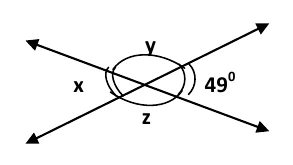
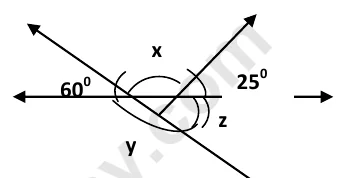
Question 3. Find the supplement of the angles : (a) (b)
Answer:
(a) From the intersecting lines diagram, the angle \(49^\circ\) and angle \(z\) are vertically opposite angles, so \(z = 49^\circ\).
The angles \(x\) and \(49^\circ\) form a linear pair on a straight line, so:
\(x + 49^\circ = 180^\circ\)
\(x = 180^\circ - 49^\circ = 131^\circ\)
Similarly, \(y\) and \(z\) form a linear pair, so:
\(y = 180^\circ - z = 180^\circ - 49^\circ = 131^\circ\)
(b) From the intersecting lines diagram, the angle \(25^\circ\) and angle \(z\) are vertically opposite angles, so \(z = 25^\circ\).
The angle \(x\) and \(60^\circ\) along with \(z\) form a straight line sum of \(180^\circ\), or using adjacent angles on a straight line:
\(x + 60^\circ + 25^\circ = 180^\circ\)
\(x + 85^\circ = 180^\circ\)
\(x = 180^\circ - 85^\circ = 95^\circ\)
The angle \(y\) is vertically opposite to the combined angle \((60^\circ + z)\) or can be found using linear pair with \(x\):
\(y = 180^\circ - x = 180^\circ - 95^\circ = 85^\circ\)
In simple words: Use vertically opposite angles to find equal angles, and linear pairs (sum equal to \(180^\circ\)) to find unknown angles on a straight line.
Exam Tip: Identify intersecting lines first to spot equal vertically opposite angles before applying linear pair rules.
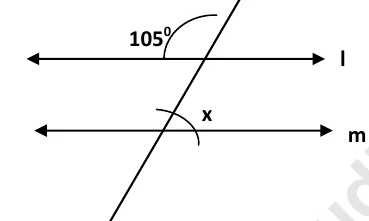
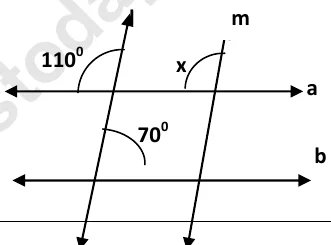
Question 4. Find x, if \(l \parallel m\) : (a) (b)
Answer:
(a) Given lines \(l \parallel m\) cut by a transversal:
The alternate exterior or corresponding angle properties show that the interior angle adjacent to \(105^\circ\) and \(x\) relates as follows:
The angle corresponding to \(105^\circ\) on line \(m\) is \(105^\circ\).
Since \(x\) and this corresponding angle form a linear pair:
\(x + 105^\circ = 180^\circ\)
\(x = 180^\circ - 105^\circ = 75^\circ\)
(b) Given parallel lines with transversal lines \(a\) and \(b\):
Using alternate interior angles and corresponding angles given by \(110^\circ\) and \(70^\circ\):
The two parallel transversals cut line \(a\), and the angle \(110^\circ\) and \(x\) lie on the same side of line \(a\) between the two transversals, so they are co-interior (consecutive interior) angles and add up to \(180^\circ\):
\(x + 110^\circ = 180^\circ\)
\(x = 180^\circ - 110^\circ = 70^\circ\)
In simple words: Use properties of parallel lines (alternate interior, corresponding, and consecutive interior angles) to equate or relate angles.
Exam Tip: Always extend the transversal lines mentally to clearly visualize alternate interior and corresponding angle pairs.
Revision Notes on Lines and Angles
Point: A point is a geometrical element which has no dimensions

Line: A line is a straight path which has no endpoints.


3. Adjacent Angles: It is the pair of two angles which are placed next to each other. Adjacent angles have-
• A common vertex.
• A common arm.
• A non-common arm could be on either side of the common arm.

4. Linear Pair: A pair of adjacent angles whose non-common arm makes a single line i.e. they are the opposite rays.
A linear pair is also a pair of supplementary angles as their sum is 180°.

The above pair of angles is –
• Adjacent, as they have one common arm.
• Supplementary, as the sum of two angles, is 180°.
• The linear pair, as the sum is 180° and the non – common arms are opposite rays.
5. Vertically Opposite Angles: When two lines intersect each other then they form four angles. So that
• ∠a and ∠b is pair of vertically opposite angles.
• ∠n and ∠m is pair of vertically opposite angles.

Vertically opposite angles are equal.
Pairs of Lines
1. Intersecting Lines If two lines touch each other in such a way that there is a point in common then these lines are called intersecting lines.
That common point is called a Point of Intersection.

Here, line l and m intersect each other at point C.
2. Transversal: If a line intersects two or more lines at different points then that line is called Transversal Line.

3. Angles made by a transversal: When a transversal intersects two lines then they make 8 angles.

Free study material for Mathematics
Download Class 7 Mathematics Chapter 05 Lines and Angles Practice Worksheets
Daily Practice Questions for Class 7 Mathematics
Explore reliable practice questions for Chapter 05 Lines and Angles tailored for Class 7 Mathematics learners. Use these structured worksheets to evaluate exam preparedness and strengthen problem-solving skills throughout the 2026 academic session.
Detailed Answers for Class 7 Mathematics Chapter 05 Lines and Angles
Built using official NCERT guidelines for Class 7 Mathematics, these practice sheets provide reliable academic support. Cross-reference your completed work with our detailed solutions to learn standard answer-writing formats for CBSE exams.
Complete Your Chapter Revision
Wrap up your chapter revision by testing your knowledge against standard objective question formats. Explore our full library of free, up-to-date printable assignments to maximize your academic results in upcoming CBSE evaluations.
FAQs
You can download the latest chapter-wise printable worksheets for Class 7 Mathematics Chapter 05 Lines and Angles for free from StudiesToday.com. These have been made as per the latest CBSE curriculum for this academic year.
Yes, Class 7 Mathematics worksheets for Chapter 05 Lines and Angles focus on activity-based learning and also competency-style questions. This helps students to apply theoretical knowledge to practical scenarios.
Yes, we have provided solved worksheets for Class 7 Mathematics Chapter 05 Lines and Angles to help students verify their answers instantly.
Yes, our Class 7 Mathematics test sheets are mobile-friendly PDFs and can be printed by teachers for classroom.
For Chapter 05 Lines and Angles, regular practice with our worksheets will improve question-handling speed and help students understand all technical terms and diagrams.