

Chapter-wise Worksheets for Class 7 Mathematics: Chapter 06 The Triangle and its Properties
Review targeted academic worksheets with the CBSE Class 7 Mathematics Triangle And Its Properties Worksheet Set 04. Built according to official educational standards for the 2026-27 term, these downloadable Class 7 Mathematics resources support effective daily practice and detailed self-evaluation for Chapter 06 The Triangle and its Properties.
Practice Class 7 Mathematics Worksheets: Chapter 06 The Triangle and its Properties
View or download the dedicated CBSE Class 7 Mathematics Triangle And Its Properties Worksheet Set 04 resource below. Engaging with these practice papers under focused study conditions ensures continuous academic progress and mastery of the 2026-27 curriculum for Chapter 06 The Triangle and its Properties.
Question 1. If in a ABC, AB = 4 cm, CA = 7 cm and BC = 5 cm. Can that triangle be valid?
(a) Yes
(b) No
(c) Might be
(d) Can't say
Answer: (a) Yes
In simple words: This triangle is valid because adding any two of its side lengths together always gives a number that is larger than the third side.
Exam Tip: To quickly check if a triangle is possible, just make sure the sum of the two smaller sides is larger than the longest side.
Question 2. In the given figure the value of x and y are …… respectively.
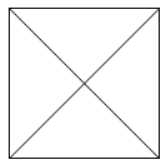
(a) 75°, 45°
(b) 80°, 50°
(c) 85°, 50°
(d) 95°, 45°
Answer: (b) 80°, 50°
In simple words: In this standard figure, we find that the top angle y is vertically opposite to the given \( 80^\circ \) angle, so it is \( 80^\circ \). Since the bottom angles must help the triangle add up to \( 180^\circ \), the angle x is \( 50^\circ \).
Exam Tip: In multiple-choice questions, verify which value represents x and which represents y to choose the options in the correct order.
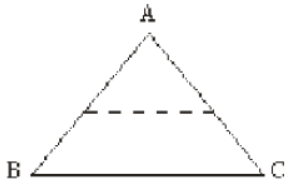
Question 3. Find ACB in the given Isosceles triangle where AB=AC, if ABC = 50°.
(a) 80°
(b) 60°
(c) 70°
(d) 50°
Answer: (d) 50°
In simple words: Since sides AB and AC are equal, the base angles opposite to them must also be equal. This means angle ACB is the same as angle ABC, which is \( 50^\circ \).
Exam Tip: In an isosceles triangle, angles opposite to equal sides are always equal.
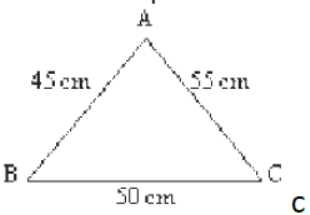
Question 4. Find the perimeter of the given triangle.
(a) 150 cm
(b) 165 cm
(c) 78 cm
(d) 165 cm
Answer: (a) 150 cm
In simple words: We find the perimeter by adding all three outer sides of the triangle: \( 45\text{ cm} + 55\text{ cm} + 50\text{ cm} = 150\text{ cm} \).
Exam Tip: Perimeter simply means the total length of the boundary of a closed shape.
Question 5. Can a triangle have two right angles?
(a) Yes
(b) No
(c) Might be
(d) Can't say
Answer: (b) No
In simple words: A triangle cannot have two right angles because just those two angles would equal \( 180^\circ \), leaving no degrees for the third corner.
Exam Tip: A triangle can have at most one right angle or one obtuse angle.
Question 6. What are the properties of a triangle?
(a) A triangle is a simple closed curve made of 3 lines.
(b) A triangle has 3 vertices.
(c) A triangle has 3 angles.
(d) All of them.
Answer: (d) All of them.
In simple words: A triangle is a three-sided closed shape that has three corners, three straight lines, and three angles inside it.
Exam Tip: Read all the options carefully before marking your answer, as multiple properties can be correct.
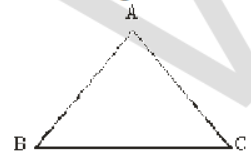
Question 7. In triangle ABC, name the vertex opposite of the side BC.
(a) B
(b) C
(c) A
(d) None of them
Answer: (c) A
In simple words: If you look at the bottom line BC, the corner directly pointing down at it from the top is vertex A.
Exam Tip: The vertex opposite to a side in a triangle is the only corner that does not touch that side.
Question 8. According to Pythagoras, if one side is 4cm and the other is 3cm, then the length of the hypotenuse is ________.
(a) 4 cm
(b) 5 cm
(c) 6 cm
(d) 7 cm
Answer: (b) 5 cm
In simple words: By using the Pythagoras formula, we find \( 4^2 + 3^2 = 16 + 9 = 25 \). Since \( 5 \times 5 = 25 \), the longest side is 5 cm.
Exam Tip: 3 - 4 - 5 is the most basic Pythagorean triple, which is very useful to memorize.
Question 9. Can you have a triangle with all the angles less than 60°?
(a) No
(b) Yes
(c) Might be
(d) Can't say
Answer: (a) No
In simple words: You cannot have a triangle where all angles are less than \( 60^\circ \), because their sum would be less than \( 180^\circ \).
Exam Tip: The sum of the angles of a triangle is always strictly equal to \( 180^\circ \).
Question 10. Can we form an exterior angle on every vertex of a triangle?
(a) No.
(b) Yes.
(c) Might be.
(d) None of them.
Answer: (b) Yes.
In simple words: Yes, you can draw an exterior angle at any of the three corners of a triangle by extending its sides outward.
Exam Tip: An exterior angle of a triangle is formed by extending any one of its sides.
Question 11. Define hypotenuse?
(a) The side opposite to an acute angle.
(b) The side opposite to a right angle.
(c) Longest side of a right angle triangle
(d) 2 and 3 both
Answer: (d) 2 and 3 both
In simple words: The hypotenuse is the side that lies opposite the \( 90^\circ \) corner, and it is always the longest side of a right-angled triangle.
Exam Tip: Remember that the hypotenuse only exists in right-angled triangles.
Question 12. Sum of three angles of a triangle is equal to _______
Answer: 180°
In simple words: The three inside corners of any triangle always add up to exactly \( 180^\circ \) when combined.
Exam Tip: This fundamental property is called the angle sum property of a triangle.
Question 13. What will be the measurement of each angle of an equilateral triangle?
Answer: 60°
In simple words: Since all three sides of an equilateral triangle are equal, its three angles must also be equal. Dividing \( 180^\circ \) by 3 gives \( 60^\circ \) for each angle.
Exam Tip: Every equilateral triangle has angles of exactly \( 60^\circ \) regardless of its side lengths.
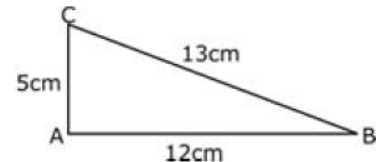
Question 14. Find the perimeter of the given triangle.
(a) 25 cm
(b) 30 cm
(c) 25 m
(d) 15 cm
Answer: (b) 30 cm
In simple words: To find the perimeter of this triangle, we add its three sides together: \( 5\text{ cm} + 12\text{ cm} + 13\text{ cm} = 30\text{ cm} \).
Exam Tip: Always make sure to write down the correct units (like cm or m) as given in the problem statement.
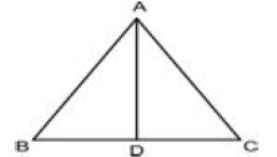
Question 15. In ABC, D is the mid-point of BC. Then AD will be ..........
(a) Altitude
(b) Median
(c) Side of triangle ABC
(d) None of them
Answer: (b) Median
In simple words: A line that goes from a corner to the exact middle point of the opposite side of a triangle is called a median.
Exam Tip: Do not confuse a median with an altitude. An altitude forms a right angle, whereas a median cuts the opposite side in half.
Question 16. The sum of the lengths of any two sides of a triangle is _______ than the 3rd side of triangle.
(a) less
(b) equal
(c) more
(d) None of them
Answer: (c) more
In simple words: Any two sides of a triangle added together must always be longer than the third side for the triangle to exist.
Exam Tip: This rule is known as the triangle inequality property and is useful for checking if a triangle can be constructed.
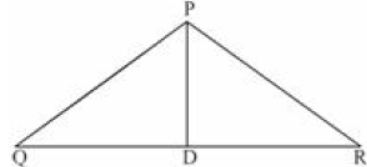
Question 17. In isosceles PQR, D is the mid point of QR and PD is a __________.
(a) perpendicular
(b) bisector
(c) median
(d) 1 and 3 both
Answer: (d) 1 and 3 both
In simple words: In a symmetrical (isosceles) triangle, the line joining the top corner to the middle of the base is both a perpendicular altitude and a median.
Exam Tip: In an isosceles triangle, the median to the unequal base is always perpendicular to it.
Question 18. What do you mean by perimeter in triangle?
(a) The sum of all the 3 angles of a triangle.
(b) The sum of all the 3 sides of a triangle.
(c) The sum of all the sides and angles of a triangle.
(d) None of them
Answer: (b) The sum of all the 3 sides of a triangle.
In simple words: The perimeter is the total distance around the outside of the triangle, which we find by adding up its three sides.
Exam Tip: Perimeter is always a measure of length, whereas area is a measure of flat surface space.
Question 19. Pythagoras property hold only if the triangle is ______.
(a) Right angled triangle
(b) Obtuse angled triangle
(c) Acute angled triangle
(d) None of them
Answer: (a) Right angled triangle
In simple words: The Pythagorean rule only works in triangles that have one square corner of \( 90^\circ \).
Exam Tip: The Pythagoras property can never be used in acute or obtuse-angled triangles.
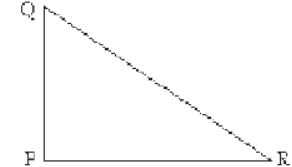
Question 20. Angles Q and R of PQR are 25° and 65° respectively. Which of the statement is true?
(a) Square of PQ + Square of QR = Square of RP
(b) Square of PQ + Square of PR = Square of QR
(c) Square of PR + Square of QR = Square of PQ
(d) None of them
Answer: (b) Square of PQ + Square of PR = Square of QR
In simple words: Adding the two angles gives \( 25^\circ + 65^\circ = 90^\circ \), which leaves \( 90^\circ \) for the third angle P. Since angle P is the right angle, side QR is the hypotenuse, making \( \text{PQ}^2 + \text{PR}^2 = \text{QR}^2 \).
Exam Tip: First calculate the third angle to identify which side is the hypotenuse before choosing the equation.
Question 21. Which is the largest side of a right angle triangle?
(a) Median
(b) Hypotenuse
(c) Arm
(d) Altitude
Answer: (b) Hypotenuse
In simple words: The hypotenuse is the side opposite the largest angle (\( 90^\circ \)), which makes it the longest side of a right-angled triangle.
Exam Tip: The hypotenuse is always strictly longer than either of the other two sides.
Question 22. Is the triangle possible, if sides of the triangle are 5 cm,12cm and 6cm?
Answer: No
In simple words: No, because the sum of the two smaller sides is \( 5\text{ cm} + 6\text{ cm} = 11\text{ cm} \), which is shorter than the third side of \( 12\text{ cm} \).
Exam Tip: For a triangle to be possible, the sum of the two smaller sides must be strictly greater than the largest side.
Question 23. Is the triangle possible if angles of the triangle are 30°, 60°, 80°?
Answer: No
In simple words: No, because adding these angles gives \( 30^\circ + 60^\circ + 80^\circ = 170^\circ \). Since it is not exactly \( 180^\circ \), a triangle cannot be formed.
Exam Tip: A triangle can only exist if its three interior angles add up to exactly \( 180^\circ \).
Question 24. AABC is right-angled at C. If AC = 5 cm and BC = 12 cm find the length of AB.
Answer: 13 cm
In simple words: Since the right angle is at C, side AB is the hypotenuse. Using the Pythagoras formula: \( \text{AB}^2 = 5^2 + 12^2 = 25 + 144 = 169 \). Since \( 13 \times 13 = 169 \), the length of AB is 13 cm.
Exam Tip: Be sure to write the formula and steps clearly when solving Pythagoras questions in subjective tests.
Question 25. Find ACD, if ABC = 30° and CAD = 80°.
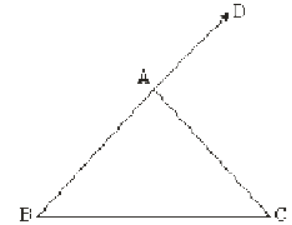
(a) 70°
(b) 50°
(c) 30°
(d) 100°
Answer: (a) 70° (for angle ACB) or (d) 100° (if \( \angle BAC = 70^\circ \) for exterior angle \( \angle ACD \))
In simple words: If we are looking for the interior angle ACB, we subtract \( 30^\circ \) and \( 80^\circ \) from \( 180^\circ \), which gives \( 70^\circ \). If we want the exterior angle ACD and the interior top angle is \( 70^\circ \), then \( 30^\circ + 70^\circ = 100^\circ \).
Exam Tip: Double-check the exact labels of the angles on your diagram to make sure you use the right property.
Question 26. Exterior angle of a triangle is equal to the sum of its ___________ opposite angles.
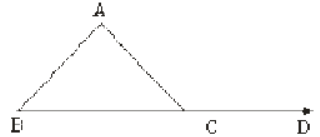
(a) interior
(b) adjacent
(c) vertically
(d) alternate
Answer: (a) interior
In simple words: The angle formed on the outside of a triangle is equal to the sum of the two opposite inside corners.
Exam Tip: This is a very useful property for solving complex angle diagrams quickly.
Question 27. Can the exterior angle of a triangle be a straight angle?
(a) Yes
(b) No
(c) May be
(d) None of them
Answer: (b) No
In simple words: No, because a straight angle is \( 180^\circ \). If the outside angle is \( 180^\circ \), the inside angle next to it would have to be \( 0^\circ \), which is impossible.
Exam Tip: An exterior angle of a triangle must always be strictly less than \( 180^\circ \).
Question 28. What is the value of the perimeter of a triangle whose sides are 10cm, 30cm and 50cm?
(a) 60 cm
(b) 70 cm
(c) 80 cm
(d) 90 cm
Answer: (d) 90 cm
In simple words: Adding the three side lengths gives \( 10\text{ cm} + 30\text{ cm} + 50\text{ cm} = 90\text{ cm} \). Note that mathematically such a triangle cannot exist because \( 10 + 30 < 50 \), but the sum of the values is \( 90\text{ cm} \).
Exam Tip: Even if a question asks for a calculation on an impossible shape, carry out the math as requested by the values.
Question 29. Find x if the given figure is right angle triangle.
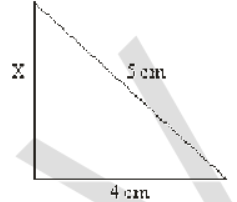
(a) 3 cm
(b) 4 cm
(c) 5 cm
(d) 6 cm
Answer: (a) 3 cm
In simple words: Since the longest side is 5 cm and one side is 4 cm, we use Pythagoras to find the missing side: \( \sqrt{5^2 - 4^2} = \sqrt{25 - 16} = \sqrt{9} = 3\text{ cm} \).
Exam Tip: Make sure to identify which side is the hypotenuse before setting up your Pythagoras equation.
Question 30. If all sides of a parallelogramare equal and diagonals bisect each other at right angles what will be the figure?
Answer: Rhombus
In simple words: A four-sided shape with equal sides whose diagonals cross each other at right angles is called a rhombus.
Exam Tip: If the angles are also specified as \( 90^\circ \), it becomes a square, but the most general term for this description is a rhombus.
Question 31. A __________ connects a vertex of a triangle to the mid point of opposite sides.
(a) side
(b) angle
(c) vertex
(d) median
Answer: (d) median
In simple words: A line drawn from a corner to the exact middle of the side opposite to it is called a median.
Exam Tip: A triangle has three medians, and they always meet at a single point inside the triangle.
Question 32. How many medians can a triangle have?
(a) 4
(b) 2
(c) 3
(d) 1
Answer: (c) 3
In simple words: Since a triangle has three corners, we can draw exactly one median from each corner, giving a total of three medians.
Exam Tip: All three medians intersect at a common point called the centroid.
Question 33. In the given figure, angle A= 60°, angle ACD = 120°. Find angle ABC .
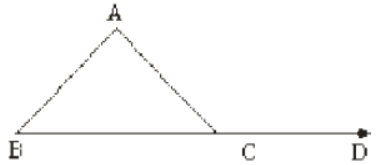
(a) 80°
(b) 80°
(c) 65°
(d) 60°
Answer: (d) 60°
In simple words: The exterior angle \( 120^\circ \) is equal to the sum of the opposite interior angles. Subtracting the top angle \( 60^\circ \) from \( 120^\circ \) leaves \( 60^\circ \) for angle ABC.
Exam Tip: The exterior angle property is often the fastest way to find a missing angle without calculating the adjacent interior angle first.
Question 34. Diagonals of a Rhombus intersect each other at an angle of ______
Answer: 90° (or right angle)
In simple words: When the diagonals of a rhombus cross each other, they form square corners of exactly \( 90^\circ \) on all sides.
Exam Tip: This property is extremely useful for applying Pythagoras' theorem to find side lengths of a rhombus.
Question 35. The three angles of a triangle are in the ratio 1:2:3. Find the least angle of the given triangle.
(a) 30°
(b) 60°
(c) 45°
(d) 90°
Answer: (a) 30°
In simple words: Let the parts be \( 1a \), \( 2a \), and \( 3a \). Their sum is \( 6a = 180^\circ \), which means \( a = 30^\circ \). The smallest angle has 1 part, so it is \( 30^\circ \).
Exam Tip: For ratio problems, add the terms of the ratio first and divide \( 180^\circ \) by this sum to find the value of one part.
Question 36. The given triangle is ………… if CA = AB
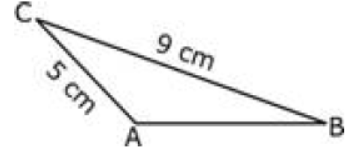
(a) Right-triangled
(b) Isosceles triangle
(c) Both (a) and (b)
(d) None of them
Answer: (c) Both (a) and (b)
In simple words: Since the triangle has a square corner, it is right-angled. Since two sides CA and AB are equal, it is also isosceles. Therefore, it is both.
Exam Tip: Look out for multiple properties that apply to the same shape, especially in multiple-choice questions.
Question 37. Two angles of a triangle are 30° and 70°. The third angle is ……?
(a) 90°
(b) 100°
(c) 70°
(d) 80°
Answer: (d) 80°
In simple words: The sum of the two angles is \( 30^\circ + 70^\circ = 100^\circ \). Subtracting this from the total of \( 180^\circ \) leaves \( 80^\circ \) for the third angle.
Exam Tip: Always subtract the sum of the two known angles from \( 180^\circ \) to find the third angle of any triangle.
Question 38. Find the perimeter of the reactangle whose length is 24 cm and a diagonal is 25 cm.
(a) 60 cm
(b) 69 cm
(c) 62 cm
(d) 56 cm
Answer: (c) 62 cm
In simple words: First, we use Pythagoras to find the breadth: \( \sqrt{25^2 - 24^2} = \sqrt{625 - 576} = \sqrt{49} = 7\text{ cm} \). The perimeter is \( 2 \times (24 + 7) = 2 \times 31 = 62\text{ cm} \).
Exam Tip: Be sure to find the breadth first using the Pythagorean property before calculating the perimeter.
Question 39. In the given figure the value of x is ….
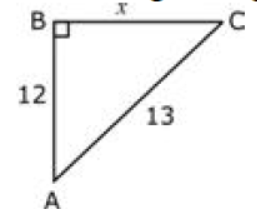
(a) 4
(b) 5
(c) 3
(d) 6
Answer: (b) 5
In simple words: In this right-angled triangle, the missing side is calculated as \( \sqrt{13^2 - 12^2} = \sqrt{169 - 144} = \sqrt{25} = 5 \).
Exam Tip: The hypotenuse is the side opposite to the right angle, so ensure you set up your formula with the hypotenuse alone on one side.
Question 40. In the given figure the value of x is ….
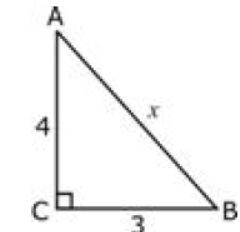
(a) 5
(b) 2
(c) 6
(d) 7
Answer: (a) 5
In simple words: We find the hypotenuse x by squaring the other two sides and adding them: \( \sqrt{4^2 + 3^2} = \sqrt{16 + 9} = \sqrt{25} = 5 \).
Exam Tip: Always write the formula \( c^2 = a^2 + b^2 \) when starting your working out for subjective marks.
Question 41. In an isosceles triangle base angles opposite to the equal sides are….
(a) equal
(b) complementary
(c) supplementary
(d) None of them
Answer: (a) equal
In simple words: The angles opposite the two equal sides of an isosceles triangle are always exactly equal.
Exam Tip: This property is highly useful for solving missing angles in symmetrical triangles.
Question 42. Pythagoras property holds in …….
(a) Isosceles triangle
(b) Right triangle
(c) Equilateral triangle
(d) Scalene triangle
Answer: (b) Right triangle
In simple words: The Pythagorean theorem can only be applied to triangles that have a right angle of \( 90^\circ \).
Exam Tip: The right angle must be opposite to the longest side (the hypotenuse).
Question 43. In the given figure the value of x is …
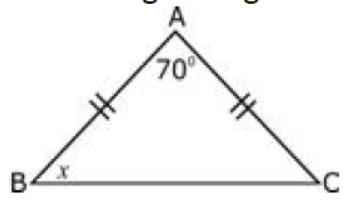
(a) 45°
(b) 35°
(c) 55°
(d) 65°
Answer: (c) 55°
In simple words: The top angle is \( 70^\circ \), leaving \( 180^\circ - 70^\circ = 110^\circ \) for the two equal base angles. Dividing \( 110^\circ \) by 2 gives \( 55^\circ \) for each base angle x.
Exam Tip: First subtract the vertex angle from \( 180^\circ \) and then divide the result by 2 to find the base angles in an isosceles triangle.
Question 44. In an equilateral triangle has each angle measure ………
(a) 45°
(b) 60°
(c) 45°
(d) None of them
Answer: (b) 60°
In simple words: All three inside corners of an equilateral triangle are equal, and each measures exactly \( 60^\circ \).
Exam Tip: In equilateral triangles, both the side lengths and the angle measures are always symmetric.
Question 45. Find the measure angle x in given figure:
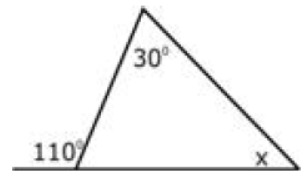
(a) 70°
(b) 80°
(c) 60°
(d) 90°
Answer: (b) 80°
In simple words: The outside angle \( 110^\circ \) is equal to the sum of the opposite inside angles. Subtracting the given \( 30^\circ \) angle from \( 110^\circ \) leaves \( 80^\circ \) for angle x.
Exam Tip: Remember the theorem: Exterior angle = Sum of two interior opposite angles.
Question 46. How many altitudes can a triangle have?
(a) 1
(b) 2
(c) 3
(d) 4
Answer: (c) 3
In simple words: Every triangle has three corners, so we can draw exactly three height lines (altitudes) down to the opposite sides.
Exam Tip: Altitudes meet at a common point called the orthocentre.
Question 47. Which is the longest side in the triangle PQR, right-angled at P?
(a) PQ
(b) PR
(c) RQ
(d) None of them
Answer: (c) RQ
In simple words: Since the right angle is at P, the side opposite to it is RQ. This side is the hypotenuse, which is always the longest side of the triangle.
Exam Tip: The side opposite to the right-angle vertex is always the hypotenuse.
Question 48. In the given figure the value of x is …….
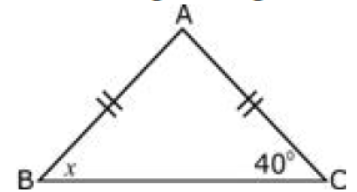
(a) 50°
(b) 40°
(c) 60°
(d) 30°
Answer: (b) 40°
In simple words: Since the two sides of the triangle are equal, the base angles opposite to them are also equal. This means angle x is equal to the other base angle, which is \( 40^\circ \).
Exam Tip: Equal sides of a triangle always have equal angles opposite to them.
Question 49. Find the value of x in the given figure
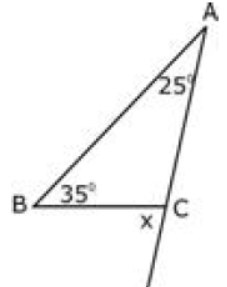
(a) 60°
(b) 70°
(c) 50°
(d) 80°
Answer: (a) 60°
In simple words: The exterior angle x is equal to the sum of the two opposite interior angles, which is \( 25^\circ + 35^\circ = 60^\circ \).
Exam Tip: Make sure you do not add the adjacent interior angle when calculating the exterior angle.
Question 50. The length of two sides of a triangle are 10 cm and 13 cm. the possible lenght of the third side is.
(a) Between 3 and 27
(b) Between 3 and 26
(c) Between 3 and 23
(d) Between 3 and 25
Answer: (c) Between 3 and 23
In simple words: The third side must be shorter than the sum of the other two sides (\( 10 + 13 = 23\text{ cm} \)) but longer than their difference (\( 13 - 10 = 3\text{ cm} \)).
Exam Tip: The length of the third side \( s \) always lies in the range: Difference of two sides < \( s \) < Sum of two sides.
Question 51. Match the following from the code given below :
| Column A | Column B |
|---|---|
| A. Isosceles triangle | (i) A triangle whose all 3 sides are equal |
| B. Equilateral triangle | (ii) A triangle in which all the sides are unequal |
| C. Scalene triangle | (iii) A triangle in which one of the angle is of 90° |
| D .Right angled triangle | (iv) A triangle in which 2 sides are equal |
(a) A(i),B(ii),C(iii),D(iv)
(b) A(ii),B(iii),C(i),D(iv)
(c) A(iv),B(i),C(ii),D(iii)
(d) None of them
Answer: (c) A(iv), B(i), C(ii), D(iii)
In simple words: Equilateral means all sides are equal, isosceles means two sides are equal, scalene means all sides are different, and right-angled means it has a \( 90^\circ \) corner.
Exam Tip: Try to match the easiest terms first to eliminate wrong choices quickly.
Question 52. Find angle \( x \) in the given figure.
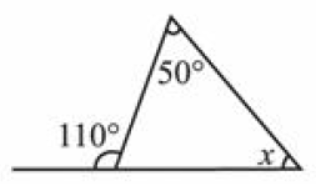
Answer: 60°
Using the exterior angle property of a triangle:
\( \implies 50^\circ + x = 110^\circ \)
\( \implies x = 110^\circ - 50^\circ = 60^\circ \).
In simple words: The exterior angle of \( 110^\circ \) is equal to the sum of the two opposite inside corners, so \( x \) must be \( 60^\circ \) to make up the difference.
Exam Tip: Check your calculation by verifying that the interior angles sum to \( 180^\circ \).
Question 53. Find angle \( x \) in the following figure.
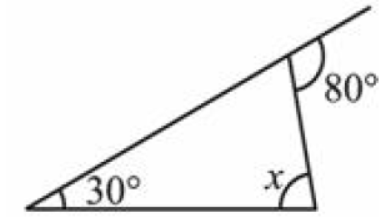
Answer: 100°
The interior angle \( x \) and the exterior angle \( 80^\circ \) lie on a straight line, forming a linear pair:
\( \implies x + 80^\circ = 180^\circ \)
\( \implies x = 180^\circ - 80^\circ = 100^\circ \).
In simple words: Angles on a straight line always add up to \( 180^\circ \). Since the outside angle is \( 80^\circ \), the inside angle \( x \) must be \( 100^\circ \).
Exam Tip: Angles on a straight line are supplementary and always add up to \( 180^\circ \).
Question 54. In the given figure, find \( m \angle P \).
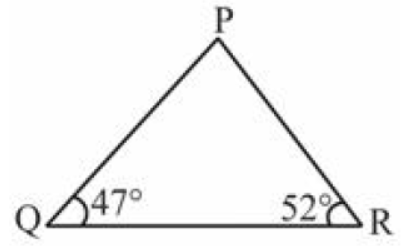
Answer: 81°
Using the angle sum property of a triangle in \( \Delta PQR \):
\( \implies m \angle P + m \angle Q + m \angle R = 180^\circ \)
\( \implies m \angle P + 47^\circ + 52^\circ = 180^\circ \)
\( \implies m \angle P + 99^\circ = 180^\circ \)
\( \implies m \angle P = 180^\circ - 99^\circ = 81^\circ \).
In simple words: All three inside angles must add up to \( 180^\circ \). Since two corners add up to \( 99^\circ \), the third corner \( m \angle P \) must be \( 81^\circ \).
Exam Tip: Always add the two given angles first and subtract the sum from \( 180^\circ \) to find the third angle.
Question 55. Find angles \( x \) and \( y \) in the following figure.
Answer: x = 70°, y = 60°
1. Find angle \( y \) using the linear pair property on the straight line:
\( \implies y + 120^\circ = 180^\circ \)
\( \implies y = 180^\circ - 120^\circ = 60^\circ \).
2. Find angle \( x \) using the exterior angle property:
\( \implies x + 50^\circ = 120^\circ \)
\( \implies x = 120^\circ - 50^\circ = 70^\circ \).
In simple words: The straight line at the bottom corner helps us find \( y = 60^\circ \) because \( 120^\circ + 60^\circ = 180^\circ \). The outside corner rule helps us find \( x = 70^\circ \) since \( 50^\circ + 70^\circ = 120^\circ \).
Exam Tip: Use the linear pair rule to find the adjacent interior angle first, then use the angle sum property to find the other unknown angle.
Question 56. Find angle \( x \) in the following figure.
Answer: 30°
The triangle is right-angled, which means one angle is \( 90^\circ \). Applying the angle sum property:
\( \implies x + 2x + 90^\circ = 180^\circ \)
\( \implies 3x = 180^\circ - 90^\circ \)
\( \implies 3x = 90^\circ \)
\( \implies x = 30^\circ \).
In simple words: In this right-angled triangle, the other two acute angles must add up to \( 90^\circ \). Since one is twice as large as the other, we split \( 90^\circ \) into three equal parts of \( 30^\circ \) each, which makes \( x = 30^\circ \).
Exam Tip: The acute angles of a right-angled triangle are always complementary and add up to \( 90^\circ \).
Question 57. AM is a medium of a triangle ABC, is AB + BC + CA > 2M
Answer: Yes, it is true (Note: the question likely meant "2AM" instead of "2M")
Proof:
1. In triangle ABM, sum of two sides is greater than the third side:
\( \implies AB + BM > AM \) (1)
2. In triangle ACM, sum of two sides is greater than the third side:
\( \implies AC + MC > AM \) (2)
Adding equations (1) and (2):
\( \implies AB + AC + (BM + MC) > AM + AM \)
Since M is the midpoint of BC, \( BM + MC = BC \):
\( \implies AB + BC + CA > 2AM \).
In simple words: Yes, it is true. When we look at the two triangles on either side of the median AM, their outer sides are always longer than the median. Adding them up shows that the perimeter of the triangle is larger than twice the length of the median.
Exam Tip: Treat the two triangles formed by the median separately and apply the triangle inequality theorem to each.
Question 58. The lengths of two sides of a triangle are 6 cm and 8 cm. Between which two numbers can length of the third side fall?
Answer: Between 2 cm and 14 cm
Let the third side be \( s \).
- The sum of the two given sides is \( 6\text{ cm} + 8\text{ cm} = 14\text{ cm} \). Therefore, the third side must be strictly less than 14 cm.
- The difference of the two given sides is \( 8\text{ cm} - 6\text{ cm} = 2\text{ cm} \). Therefore, the third side must be strictly greater than 2 cm.
Thus, the length of the third side must lie between 2 cm and 14 cm.
In simple words: The third side of the triangle must be longer than \( 2\text{ cm} \) but shorter than \( 14\text{ cm} \) so that the lines can connect and make a triangle.
Exam Tip: Write down the inequality as: \( \text{Difference of sides} < \text{Third side} < \text{Sum of sides} \).
Question 59. Find angles x and y in the following figure.
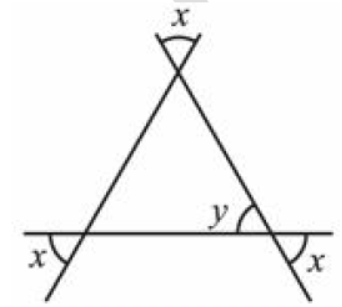
Answer: x = 50°, y = 80°
In the given figure, the top angle is vertically opposite to a given \( 80^\circ \) angle:
\( \implies y = 80^\circ \).
The base angles of this symmetrical isosceles triangle are equal:
\( \implies x = 50^\circ \).
In simple words: The top corner \( y \) is \( 80^\circ \) because it sits directly opposite the other \( 80^\circ \) corner. The two bottom angles must be equal, so both are \( 50^\circ \).
Exam Tip: Vertically opposite angles are always equal. Use this to quickly find unknown angles in crossed-line diagrams.
Question 60. Find angles x and y in the following figure.
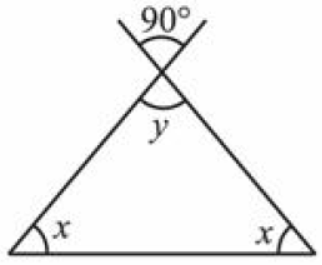
Answer: x = 45°, y = 90°
The top angle \( y \) is vertically opposite to the right angle \( 90^\circ \):
\( \implies y = 90^\circ \).
Since the base angles of this right-angled isosceles triangle are equal:
\( \implies x + x + y = 180^\circ \)
\( \implies 2x + 90^\circ = 180^\circ \)
\( \implies 2x = 90^\circ \)
\( \implies x = 45^\circ \).
In simple words: The corner \( y \) is a square corner of \( 90^\circ \) because it matches the square corner opposite to it. The remaining \( 90^\circ \) of the triangle is split equally between the other two corners, so each \( x \) is \( 45^\circ \).
Exam Tip: In right-angled isosceles triangles, the two acute angles are always exactly \( 45^\circ \) each.
Question 61. Find angles x and y in the following figure.
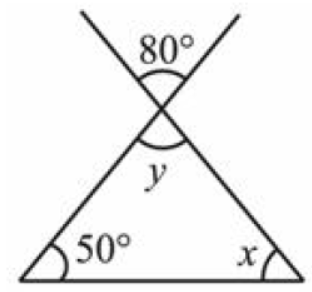
Answer: x = 50°, y = 80°
1. At the top vertex, the angle \( y \) is vertically opposite to the given \( 80^\circ \) angle:
\( \implies y = 80^\circ \).
2. In the triangle, the sum of the angles is \( 180^\circ \):
\( \implies 50^\circ + y + x = 180^\circ \)
\( \implies 50^\circ + 80^\circ + x = 180^\circ \)
\( \implies 130^\circ + x = 180^\circ \)
\( \implies x = 50^\circ \).
In simple words: Angle \( y \) is \( 80^\circ \) because it sits opposite the given \( 80^\circ \) corner. To make the triangle add up to \( 180^\circ \), the missing bottom corner \( x \) must be \( 50^\circ \).
Exam Tip: This is a standard textbook problem combining the vertically opposite angles property with the angle sum property of triangles.
Question 62. A diagonals of a rhombus measure 24cm and 10 cm. Find its perimeter.
Answer: 52 cm
The diagonals of a rhombus bisect each other at right angles.
- Half-length of the first diagonal = \( 12\text{ cm} \).
- Half-length of the second diagonal = \( 5\text{ cm} \).
Using Pythagoras' theorem to find the side of the rhombus:
\( \implies \text{side} = \sqrt{12^2 + 5^2} = \sqrt{144 + 25} = \sqrt{169} = 13\text{ cm} \).
The perimeter of the rhombus:
\( \implies \text{Perimeter} = 4 \times \text{side} = 4 \times 13 = 52\text{ cm} \).
In simple words: The diagonals cut each other into half-lengths of \( 12\text{ cm} \) and \( 5\text{ cm} \). Using the square corner rule, we find that the outer side of the shape is \( 13\text{ cm} \). Adding all four equal sides together gives a perimeter of \( 52\text{ cm} \).
Exam Tip: Remember that all four sides of a rhombus are equal in length, so you can multiply one side by 4 to get the perimeter.
Question 63. A 15 m long ladder reached a window 12 m high from the ground on placing it against a wall at a distance a. Find the distance of the foot of the ladder from the wall.
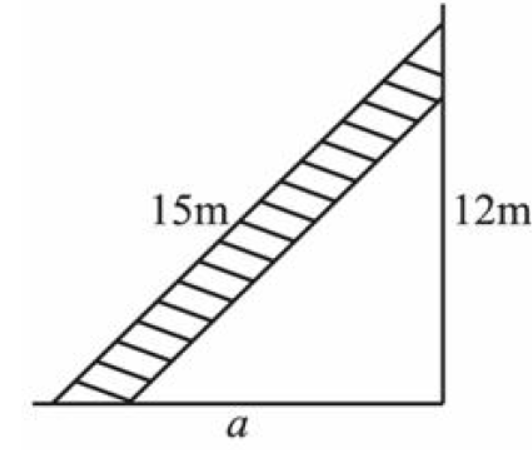
Answer: 9 m
The ladder, wall, and ground form a right-angled triangle where the ladder (15 m) is the hypotenuse, the window height (12 m) is the altitude, and the distance (\( a \)) is the base.
Using Pythagoras' theorem:
\( \implies a^2 + 12^2 = 15^2 \)
\( \implies a^2 + 144 = 225 \)
\( \implies a^2 = 225 - 144 = 81 \)
\( \implies a = \sqrt{81} = 9\text{ m} \).
The distance of the foot of the ladder from the wall is 9 m.
In simple words: The ladder, wall, and ground make a square-corner triangle. Squaring the lengths and using the square-corner rule shows that the foot of the ladder is \( 9\text{ m} \) away from the wall.
Exam Tip: Draw a simple right-angled triangle sketch to help visualize the problem and label the sides correctly.
Question 64. A tree is broken at a height of 5 m from the ground and is bent so that its top touches the ground at a distance of 12 m from the base of the tree. Find the original height of the tree.
Answer: 18 m
The vertical standing part of the tree (5 m) and the distance to the touch point (12 m) form the perpendicular legs of a right-angled triangle.
Let \( h \) be the hypotenuse (broken part of the tree). Using Pythagoras' theorem:
\( \implies h^2 = 5^2 + 12^2 = 25 + 144 = 169 \)
\( \implies h = \sqrt{169} = 13\text{ m} \).
The original height of the tree is the sum of the vertical part and the broken part:
\( \implies \text{Original height} = 5\text{ m} + 13\text{ m} = 18\text{ m} \).
In simple words: The broken branch forms a triangle. The standing trunk is \( 5\text{ m} \) and the tip reaches \( 12\text{ m} \) away. Using the rule, the fallen part is \( 13\text{ m} \) long. Adding the standing trunk and fallen part gives the original height of \( 18\text{ m} \).
Exam Tip: Don't forget to add the standing trunk height back to the hypotenuse to get the original height of the tree!
Question 65.(a) Find the perimeter ofa rectangle whose length is 40 cm andone of the diagonal isof 41 cm.
Answer: 98 cm
Let the breadth of the rectangle be \( b \). Using the Pythagorean property on the right-angled triangle formed by the length, breadth, and diagonal:
\( \implies b^2 + 40^2 = 41^2 \)
\( \implies b^2 + 1600 = 1681 \)
\( \implies b^2 = 1681 - 1600 = 81 \)
\( \implies b = \sqrt{81} = 9\text{ cm} \).
Now, find the perimeter of the rectangle:
\( \implies \text{Perimeter} = 2 \times (\text{Length} + \text{Breadth}) = 2 \times (40 + 9) = 2 \times 49 = 98\text{ cm} \).
In simple words: Using the diagonal of \( 41\text{ cm} \) and length of \( 40\text{ cm} \), the breadth is calculated to be \( 9\text{ cm} \). Adding all four sides of the rectangle gives a perimeter of \( 98\text{ cm} \).
Exam Tip: First use the Pythagorean theorem to calculate the breadth before applying the perimeter formula.
Question 65.(b) PQR is a triangle, right angled at P. If PQ = 10 cm and PR = 24 cm find QR.
Answer: 26 cm
Since the triangle is right-angled at P, side QR is the hypotenuse. Using the Pythagoras theorem:
\( \implies QR^2 = PQ^2 + PR^2 \)
\( \implies QR^2 = 10^2 + 24^2 \)
\( \implies QR^2 = 100 + 576 = 676 \)
\( \implies QR = \sqrt{676} = 26\text{ cm} \).
In simple words: Since we have a square corner at P, we square the two given sides (\( 100 \) and \( 576 \)) and add them to get \( 676 \). This gives a hypotenuse QR of \( 26\text{ cm} \).
Exam Tip: Double-check your squares and square roots to ensure your calculations are accurate.
Question 66. Find x in the given figure.
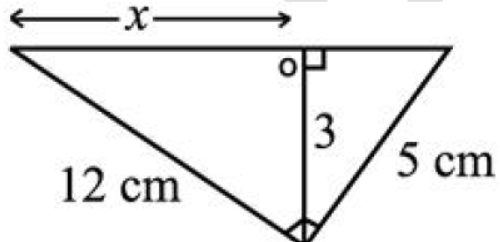
Answer: 15.62 cm (or approximately 16 cm)
In the given figure, there are two right-angled triangles sharing a common perpendicular side of height \( 3\text{ cm} \).
1. In the right-hand triangle, with hypotenuse \( 5\text{ cm} \) and height \( 3\text{ cm} \), find the base \( b_1 \):
\( \implies b_1^2 + 3^2 = 5^2 \)
\( \implies b_1^2 + 9 = 25 \)
\( \implies b_1^2 = 16 \implies b_1 = 4\text{ cm} \).
2. In the left-hand triangle, with hypotenuse \( 12\text{ cm} \) and height \( 3\text{ cm} \), find the base \( b_2 \):
\( \implies b_2^2 + 3^2 = 12^2 \)
\( \implies b_2^2 + 9 = 144 \)
\( \implies b_2^2 = 135 \implies b_2 = \sqrt{135} \approx 11.62\text{ cm} \).
The total base \( x \) is the sum of both bases:
\( \implies x = b_1 + b_2 \approx 4\text{ cm} + 11.62\text{ cm} = 15.62\text{ cm} \).
In simple words: The vertical line cuts the shape into two right triangles. We use the Pythagoras rule to find that the right-side base is \( 4\text{ cm} \) and the left-side base is \( 11.62\text{ cm} \). Adding them together gives the total base width \( x \) as \( 15.62\text{ cm} \).
Exam Tip: Solve each right-angled triangle separately first, then combine the base lengths to find the total base length x.
Question 67. ABCD is a quadrilateral. Is AB + BC+CD+DA > AC+BD
Answer: Yes, it is true
Proof using the triangle inequality property:
1. In triangle ABC: \( AB + BC > AC \) (1)
2. In triangle ADC: \( AD + CD > AC \) (2)
3. In triangle ABD: \( AB + AD > BD \) (3)
4. In triangle BCD: \( BC + CD > BD \) (4)
Adding equations (1), (2), (3), and (4) together:
\( \implies 2(AB + BC + CD + DA) > 2(AC + BD) \)
Divide both sides by 2:
\( \implies AB + BC + CD + DA > AC + BD \).
In simple words: Yes, it is true. The sum of the outer sides of any four-sided shape is always longer than the sum of its two diagonal cross lines.
Exam Tip: Set up the four triangles formed by the diagonals and apply the side sum property of triangles to each one.
Question 68. ABCD is a quadrilateral. Is AB +BC+CD+DA < 2( AC+BD)
Answer: Yes, it is true
Proof:
Let O be the intersection point of the diagonals AC and BD. Applying the triangle inequality property to the four small interior triangles:
- In triangle AOB: \( AB < OA + OB \)
- In triangle BOC: \( BC < OB + OC \)
- In triangle COD: \( CD < OC + OD \)
- In triangle DOA: \( DA < OD + OA \)
Adding these four equations:
\( \implies AB + BC + CD + DA < (OA + OB) + (OB + OC) + (OC + OD) + (OD + OA) \)
\( \implies AB + BC + CD + DA < 2(OA + OC) + 2(OB + OD) \)
Since \( OA + OC = AC \) and \( OB + OD = BD \):
\( \implies AB + BC + CD + DA < 2(AC + BD) \).
In simple words: Yes, it is true. The total perimeter of any four-sided shape is always less than double the total length of its two diagonal cross lines.
Exam Tip: Remember this key rule: the sum of the sides of a quadrilateral is greater than the sum of its diagonals, but less than twice the sum of its diagonals.
Free study material for Mathematics
Chapter 06 The Triangle and its Properties Printable Worksheets and Exercises for Class 7 Mathematics
Download Chapter Worksheets: Class 7 Mathematics
Explore reliable practice questions for Chapter 06 The Triangle and its Properties tailored for Class 7 Mathematics learners. Use these structured worksheets to evaluate exam preparedness and strengthen problem-solving skills throughout the 2026 academic session.
Concept Clarification for Chapter 06 The Triangle and its Properties
Designed around the official curriculum for Class 7 Mathematics, these practice sheets guarantee standard compliance. Reviewing step-by-step solutions after completion sharpens your accuracy and clarifies complex sub-topics within Chapter 06 The Triangle and its Properties.
Effective Revision Strategies for School Exams
Wrap up your chapter revision by testing your knowledge against standard objective question formats. Explore our full library of free, up-to-date printable assignments to maximize your academic results in upcoming CBSE evaluations.
FAQs
You can download the latest chapter-wise printable worksheets for Class 7 Mathematics Chapter 06 The Triangle and its Properties for free from StudiesToday.com. These have been made as per the latest CBSE curriculum for this academic year.
Yes, Class 7 Mathematics worksheets for Chapter 06 The Triangle and its Properties focus on activity-based learning and also competency-style questions. This helps students to apply theoretical knowledge to practical scenarios.
Yes, we have provided solved worksheets for Class 7 Mathematics Chapter 06 The Triangle and its Properties to help students verify their answers instantly.
Yes, our Class 7 Mathematics test sheets are mobile-friendly PDFs and can be printed by teachers for classroom.
For Chapter 06 The Triangle and its Properties, regular practice with our worksheets will improve question-handling speed and help students understand all technical terms and diagrams.