

Class 7 Mathematics Practice Sheet: CBSE Class 7 Mathematics Symmetry Worksheet Set 02
Review targeted academic worksheets with the CBSE Class 7 Mathematics Symmetry Worksheet Set 02. Built according to official educational standards for the 2026-27 term, these downloadable Class 7 Mathematics resources support effective daily practice and detailed self-evaluation for Chapter 14 Symmetry.
Download Chapter 14 Symmetry Worksheet PDF with Answers
Navigate directly to the solved Mathematics worksheets using the digital viewer below. Each practice set includes detailed step-by-step solutions, allowing students to instantly cross-check their work and identify areas requiring further revision.
Question 1. Find the next figure
(A)
(B)
(C)
(D) None of these
Answer: (c)
The shape rotates by 90 degrees clockwise at each step. Following this pattern:
- Step 1: Points up (A is at the top)
- Step 2: Points right (A is on the right)
- Step 3: Points down (A is at the bottom)
- Step 4: Points left (A must be on the left)
This matches option (C).
In simple words: The triangle rotates like the hands of a clock. Since it pointed up, then right, then down, it must point left in the next step.
Exam Tip: Track a single marked feature, like the letter A, to easily follow rotation patterns.
Question 2. Find the next figure
(A)
(B)
(C)
(D)
Answer: (b)
The ellipse and its diagonal line rotate by 45 degrees clockwise in each step:
- Step 1: Vertical (90 degrees)
- Step 2: Tilted right (45 degrees)
- Step 3: Horizontal (0 degrees)
- Step 4: Tilted left (135 degrees)
This matches the design in option (B).
In simple words: The oval turns a little bit in each step. After lying completely flat, it will tilt to the left side next.
Exam Tip: Identify the angle of rotation (here, 45 degrees) to find the exact next position of the shape.
Question 3. Regular pentagon has ………line of symmetry.
Answer: 5
A regular pentagon has five equal sides and five equal angles. It has 5 lines of symmetry, each passing through a vertex and the midpoint of the opposite side.
In simple words: A regular five-sided shape has exactly 5 lines of symmetry because you can fold it in half in 5 different ways.
Exam Tip: For any regular polygon, the number of lines of symmetry is always equal to its number of sides.
Question 4. Equlilateral triangle has …….. lines of symmetry.
Answer: 3
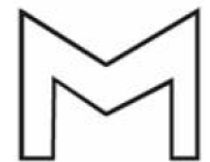
An equilateral triangle has three equal sides and three equal angles, giving it 3 lines of symmetry.
In simple words: An equilateral triangle can be folded down the middle from any of its three corners, so it has 3 lines of symmetry.
Exam Tip: Remember that a scalene triangle has 0 lines of symmetry, and an isosceles triangle has only 1.
Question 5. Regular hexagon has …….. lines of symmetry.
Answer: 6
A regular hexagon has six equal sides, so it contains 6 lines of symmetry.
In simple words: A six-sided regular shape has exactly 6 lines of symmetry.
Exam Tip: In regular polygons, half of the lines of symmetry join opposite corners, and the other half join midpoints of opposite sides.
Question 6. In a complete turn (of \( 360^\circ \)), the number of times an object looks exactly the same is called ……..
Answer: order of rotational symmetry
The number of positions in which a figure looks identical to its original state during a full rotation is called the order of rotational symmetry.
In simple words: When you spin a shape all the way around, the number of times it looks exactly like it did at the start is called its order of rotational symmetry.
Exam Tip: Every object has rotational symmetry of at least order 1, representing a full 360-degree spin.
Question 7. Rotation turns an object about a fixed point. This fixed point is the ………..
Answer: centre of rotation
The stationary point around which any shape is rotated is known as the centre of rotation.
In simple words: The exact middle point around which an object spins is called the centre of rotation.
Exam Tip: For regular shapes, the centre of rotation is always located at the exact geometric center of the shape.
Question 8. If, after a rotation, an object looks exactly the same, we say that it has a rotational symmetry. (True/False)
Answer: True
When a figure matches its original orientation after being rotated by an angle less than 360 degrees, it has rotational symmetry.
In simple words: This statement is true. If a shape looks unchanged after being turned, it has rotational symmetry.
Exam Tip: Rotational symmetry can be tested by turning tracing paper over the original drawing.
Question 9. If a figure has two or more lines of symmetry, should it have rotational symmetry of order more than 1?
Answer: Yes
Yes, if a shape possesses two or more lines of symmetry, its order of rotational symmetry will always be greater than 1.
In simple words: Yes. If you can fold a shape in two or more different ways to make it match, it will also look identical at least once before you finish spinning it all the way around.
Exam Tip: This is a key mathematical relationship between reflectional and rotational symmetry properties.
Question 10. A square has a rotational symmetry of order 4.
Answer: True
A square looks identical at rotations of 90 degrees, 180 degrees, 270 degrees, and 360 degrees, so it has rotational symmetry of order 4.
In simple words: This is true. You can spin a square four times during a full circle, and it will look exactly the same each time.
Exam Tip: The order of rotational symmetry of a regular polygon is always equal to its number of sides.
Question 11. When an object rotates, its shape and size change. (True/False)
Answer: False
Rotation is a rigid transformation. The orientation of the shape changes, but its size and shape remain identical.
In simple words: This is false. When you spin an object, it does not shrink, grow, or change its shape.
Exam Tip: Transformations like translation, rotation, and reflection never alter the actual shape or size of an object.
Question 12. How many symmetrical lines are possible in the given figure?
(A) 2
(B) 3
(C) 4
(D) 5
Answer: (b) 3
The three-pointed leaf-like figure has 3-fold symmetry, which allows for exactly 3 lines of symmetry.
In simple words: Since the drawing has 3 identical points spaced out evenly, you can fold it in half in exactly 3 different ways.
Exam Tip: Count the number of repeated identical elements in a radial design to estimate its lines of symmetry.
Question 13. Find the next figure.
(A)
(B)
(C)
(D) None of these
Answer: (a)
The small triangle rotates 90 degrees clockwise at each step:
- Step 1: At the top of the vertical line (pointing up)
- Step 2: At the right of the horizontal line (pointing right)
- Step 3: At the bottom of the vertical line (pointing down)
This matches option (A).
In simple words: The little pointer moves clockwise around the cross. Since it was at the top, and then on the right, it will now be at the bottom.
Exam Tip: Pay close attention to both the position and the direction of the rotating element.
Question 14. Find the line of symmetry in the following figure.
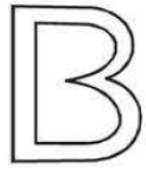
(A) 0
(B) 1
(C) 2
(D) 3
Answer: (b) 1
The letter 'B' has exactly 1 horizontal line of symmetry that cuts it into two equal halves.
In simple words: You can draw one horizontal line straight through the middle of the letter B to split it into matching top and bottom halves.
Exam Tip: Try folded-paper visualization to determine if a line creates two matching halves.
Question 15. Identify the number of lines of symmetry in a square.
(A) 1
(B) 2
(C) 3
(D) 4
Answer: (d) 4
A square contains 4 lines of symmetry: 1 vertical, 1 horizontal, and 2 diagonal lines.
In simple words: A square has four fold lines - up-and-down, side-to-side, and from corner to corner.
Exam Tip: Remember that rectangles only have 2 lines of symmetry because their diagonals are not lines of symmetry.
Question 16. Identify the number of lines of symmetry in circle.
(A) 1
(B) 2
(C) 3
(D) infinite
Answer: (d) infinite
Every diameter line passing through the center of a circle acts as a line of symmetry, meaning there are infinitely many lines of symmetry.
In simple words: Any straight line drawn right through the center of a circle splits it perfectly in half, so a circle has infinite lines of symmetry.
Exam Tip: The circle is the most symmetrical 2D shape because it has infinite reflectional and rotational symmetry.
Question 17. Identify the number of lines of symmetry in cone.
(A) 4
(B) 3
(C) 2
(D) 1
Answer: (d) 1
A standard 2D front view of a cone is an isosceles triangle, which has exactly 1 line of symmetry.
In simple words: If you look at a cone from the front, it looks like a triangle that can be split down the middle in only 1 way.
Exam Tip: For 3D objects, line of symmetry questions usually refer to their 2D orthographic projections (like the front view).
Question 18. Find next figure
(A)
(B)
(C)
(D) none of these
Answer: (b)
The small circle rotates 90 degrees clockwise at each step around the cross:
- Step 1: At the top of the vertical line
- Step 2: At the right of the horizontal line
- Step 3: At the bottom of the vertical line
- Step 4: At the left of the horizontal line
This matches the design in option (B).
In simple words: The small dot travels clockwise around the cross. After visiting the top, right, and bottom ends, it will land on the left end next.
Exam Tip: Verify the pattern sequence to make sure the direction of rotation (clockwise vs counterclockwise) is constant.
Question 19. Find the mirror image of
(A)
(B)
(C)
(D)
Answer: (a)
The original figure is a rectangle with a diagonal line going from bottom-left to top-right. When reflected across a vertical mirror, the diagonal line is reversed, going from bottom-right to top-right. This corresponds to option (A).
In simple words: In a mirror, left and right swap. The line going up and to the right will reflect to go up and to the left.
Exam Tip: In vertical mirror reflection, vertical properties remain the same while horizontal properties are reversed.
Question 20. Identify the number of lines of symmetry in right angle isosceles triangle.

(A) 0
(B) 1
(C) 2
(D) 3
Answer: (b) 1
A right-angled isosceles triangle has two equal sides, meaning it has exactly 1 line of symmetry passing through the right-angled vertex.
In simple words: An isosceles triangle has only 1 line of symmetry down the middle that splits it into two equal halves.
Exam Tip: Make sure to read the full description of the triangle - isosceles triangles always have exactly one line of symmetry, even if they contain a right angle.
Question 21. Find the mirror image.
(A)
(B)
(C)
(D)
Answer: (a)
The original is a right-angled triangle with the vertical side on the left. In the mirror, this vertical side reflects to the right side, which matches option (A).
In simple words: The tall side of the triangle was on the left, so in the mirror image, the tall side must appear on the right.
Exam Tip: Features closest to the mirror line must remain closest in the reflected image.
Question 22. Find the mirror image.
(A) 9
(B) 6
(C) \(\mathbf{\partial}\) (backwards 9)
(D) \(\mathbf{\rho}\)
Answer: (c)
The mirror reflection of the number '9' across a vertical axis results in a backwards '9' shape, which corresponds to option (C).
In simple words: When you hold a number 9 up to a mirror, the circular loop on the top-left flips to the top-right, creating a backwards 9.
Exam Tip: Draw the digit on paper and look at the reverse side of the page against the light to see its exact mirror image.
Question 23. Identify the number of lines of symmetry in cylinder.
(A) 4
(B) 3
(C) 2
(D) 1
Answer: (c) 2
In 2D view, a cylinder's front projection is a rectangle, which contains exactly 2 lines of symmetry.
In simple words: If we look at a cylinder from the front, it looks like a flat rectangle. A flat rectangle can be cut in half in exactly 2 ways.
Exam Tip: For standard syllabus worksheets, 3D shapes like cylinders are evaluated based on their 2D rectangular profile views.
Question 24. Find the next figure.
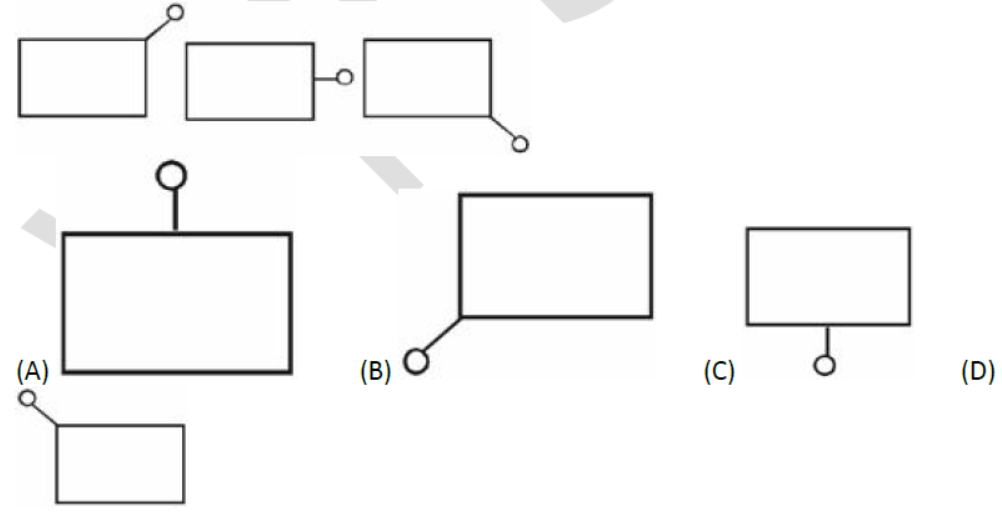
(A) Circle on top
(B) Circle at bottom-left
(C) Circle at bottom
(D) None of these
Answer: (b)
The small circle attached to the corner of the rectangle rotates clockwise:
- Step 1: Top-left corner
- Step 2: Top-right corner (via side extension)
- Step 3: Bottom-right corner
- Step 4: Bottom-left corner
This matches option (B).
In simple words: The little circle walks around the corners of the rectangle. It moves from top-left, to top-right, to bottom-right, and will land at the bottom-left next.
Exam Tip: Follow the corners of the rectangle in a clockwise path to find the next position.
Question 25. The angle of turning rotation is called the ……….
Answer: angle of rotation
The angle of turning rotation is called the angle of rotation.
In simple words: The exact angle by which you spin an object around its center point is called its angle of rotation.
Exam Tip: For a full rotation, the angle is \( 360^\circ \), and for a half turn, the angle is \( 180^\circ \).
Question 26. The next figure completing the sequence is
(A)
(B)
(C)
(D) None of these
Answer: (c)
The letter 'A' rotates 90 degrees clockwise along the cross lines:
- Step 1: At the top position
- Step 2: At the right position
- Step 3: At the bottom position
- Step 4: At the left position
This corresponds to option (C).
In simple words: The letter A moves clockwise to each end of the lines. After top, right, and bottom, the next spot is the left side.
Exam Tip: Treat the four directional endpoints of a cross as a clock (12, 3, 6, and 9 o'clock) to track movement.
Question 27. Name of the given figure is
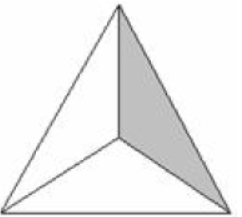
(A) cube
(B) cuboid
(C) pyramid
(D) circle
Answer: (c) pyramid
The three-dimensional figure shown is a triangular pyramid (tetrahedron).
In simple words: A solid shape with a flat bottom and triangular sides that meet at a point at the top is called a pyramid.
Exam Tip: Be sure to differentiate between a prism (which has matching ends) and a pyramid (which tapers to a single point at the top).
Question 28. Find next figure.
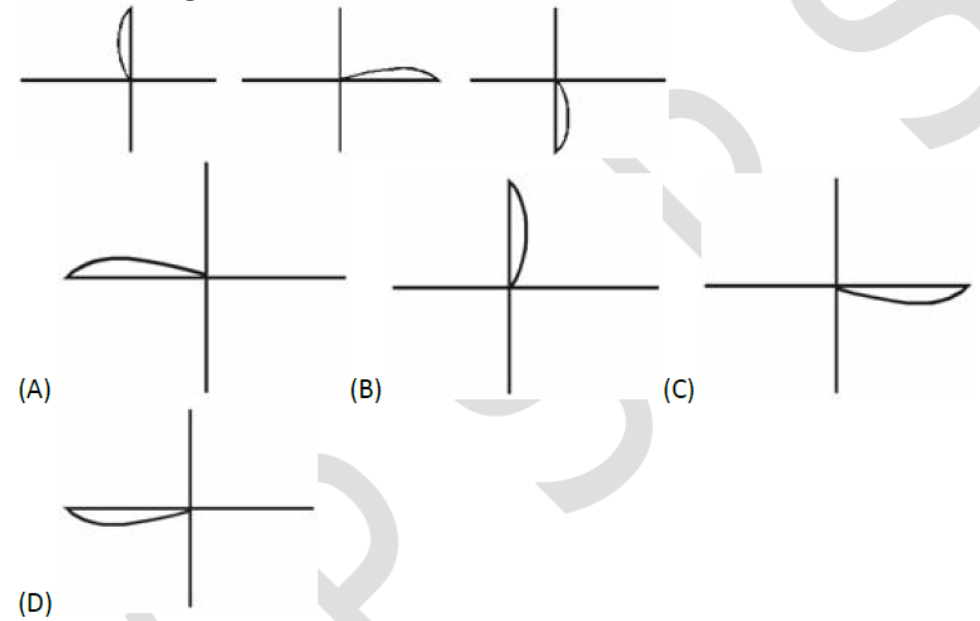
(A) Wave at left
(B) Wave at top
(C) Wave at right
(D) Wave at bottom
Answer: (d)
The small wave curve rotates 90 degrees clockwise:
- Step 1: On the right side of the line
- Step 2: On the top side of the line
- Step 3: On the left side of the line
- Step 4: On the bottom side of the line
This corresponds to option (D).
In simple words: The little wave spins clockwise. After pointing right, up, and left, it will point down next.
Exam Tip: Look at both where the wave is attached and which way it curves to identify the correct rotation step.
Question 29. Find the mirror image of
(A) | | 0
(B) | 0 |
(C) 0 | |
(D) none of these
Answer: (c) 0 | |
When reflecting the sequence `| | 0` across a vertical mirror on its right, the elements closest to the mirror appear closest in the reflection. Since `0` is on the right, it appears on the left of the reflected image, yielding `0 | |`.
In simple words: Swapping left and right means the circle at the end of the line will now appear at the very start of the line.
Exam Tip: Reflection reverses the order of a sequence of objects from left to right.
Question 30. Find the mirror image.
(A)
(B)
(C)
(D)
Answer: (a)
The original rectangle has a circle in the top-left and a circle in the bottom-right. When reflected vertically, these circles swap sides: the top-left circle moves to the top-right, and the bottom-right circle moves to the bottom-left. This matches option (A).
In simple words: The dot in the top-left moves to the top-right in the reflection, and the dot in the bottom-right moves to the bottom-left.
Exam Tip: Mark the coordinate positions of points to help map their reflections accurately across a vertical mirror line.
Question 31. Identify the number of lines of symmetry in the given figure.
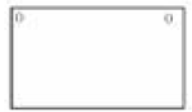
(A) 1
(B) 2
(C) 3
(D) 4
Answer: (a) 1
The given rectangle has two punched holes on its left side. This leaves only 1 horizontal line of symmetry that cuts both the rectangle and the hole positions in half.
In simple words: Because the two holes are on the left side, you can only fold this card flat along a middle horizontal line to make both halves match.
Exam Tip: Holes on a sheet of paper restrict the overall lines of symmetry of the shape.
Question 32. Identify the number of lines of symmetry in following figure
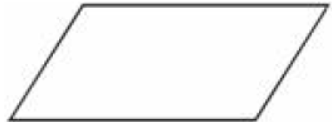
(A) 0
(B) 2
(C) 3
(D) 4
Answer: (a) 0
A standard oblique parallelogram has no lines of symmetry.
In simple words: You cannot fold a standard slanted parallelogram in half along any line to make its corners match up perfectly, so it has 0 lines of symmetry.
Exam Tip: A parallelogram has rotational symmetry of order 2, but it has no lines of reflectional symmetry.
Question 33. Identify the number of lines of symmetry in rectangle.
(A) 1
(B) 2
(C) 3
(D) 4
Answer: (b) 2
A rectangle has exactly 2 lines of symmetry: one vertical line and one horizontal line.
In simple words: A rectangle can be folded in half in only two ways - vertically and horizontally.
Exam Tip: Keep in mind that a rectangle's diagonals are not lines of symmetry, unlike a square's diagonals.
Question 34. Find the axes of symmetry of the given figure?
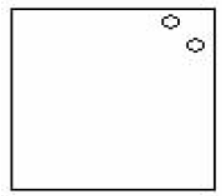
(A) vertical
(B) horizontal
(C) diagonal
(D) none of these
Answer: (a) vertical
The figure is a square card with two holes in the top corners (top-left and top-right). It has exactly 1 vertical line of symmetry down the middle.
In simple words: Because the holes are placed in the top corners, you can only fold this card in half along a vertical line.
Exam Tip: Verify if folding along the vertical line places one hole directly on top of the other.
Question 35. Find the mirror image
(A) N
(B) И (backwards N)
(C) Z
(D) None of these
Answer: (b) И
The mirror image of the letter 'N' across a vertical axis is 'И', which matches option (B).
In simple words: The slanted middle line of the letter N reverses direction in a mirror, making it look like a backwards N.
Exam Tip: Letters like A, H, I, M, O, T, U, V, W, X, and Y look identical in a vertical mirror, while others like N and S are reversed.
Question 36. Find the mirror image.
(A)
(B)
(C)
(D)
Answer: (a)
The original figure is a circle with a diagonal ellipse that tilts from bottom-left to top-right. When reflected across a vertical axis, the diagonal tilts from bottom-right to top-left, matching option (A).
In simple words: The diagonal oval in the circle reverses its tilt direction in the mirror image.
Exam Tip: A line that goes up and right always reflects to go up and left in a vertical mirror.
Question 37. Find the mirror image.
(A) \(\mathbf{\sqsupset}\) (backwards L)
(B) \(\mathbf{\Gamma}\)
(C) \(\mathbf{T}\)
(D) \(\mathbf{\Pi}\)
Answer: (a)
The mirror reflection of 'L' across a vertical mirror results in a backwards 'L' shape, matching option (A).
In simple words: The horizontal foot of the letter L points to the right. In a mirror, it will point to the left.
Exam Tip: Horizontal extensions are reversed in direction when reflected across vertical mirrors.
Question 38. How many symmetrical lines are possible in the given figure
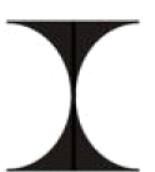
(A) 1
(B) 2
(C) 3
(D) 4
Answer: (b) 2
The hourglass-like figure shown on the top of Page 6 has 2 lines of symmetry: one vertical line and one horizontal line.
In simple words: You can cut this hourglass shape in half either vertically or horizontally to get two matching pieces.
Exam Tip: Symmetrical details on both the top and bottom, as well as the left and right, indicate at least two lines of symmetry.
Question 39. Identify the numbers of lines of symmetry in following figure.
(A) 0
(B) 2
(C) 3
(D) 1
Answer: (d) 1
The letter 'M' has exactly 1 vertical line of symmetry down its middle.
In simple words: You can draw one vertical line down the exact middle of the letter M to divide it into two matching halves.
Exam Tip: Letters with vertical symmetry like A, M, T, Y, and W have only 1 line of symmetry.
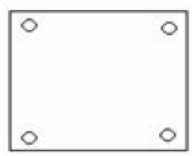
Question 40. Copy the following figure with punched holes and find the axes of symmetry for the following:
Answer:
The given figure is a square card with four punched holes, one in each of its four corners.
This figure has exactly 4 axes of symmetry:
1. One vertical line of symmetry down the middle.
2. One horizontal line of symmetry across the middle.
3. Two diagonal lines of symmetry passing through opposite corners.
In simple words: Since the card is a square and has a hole in each of its four corners, you can fold it in half vertically, horizontally, or diagonally. This gives it 4 lines of symmetry.
Exam Tip: If the outer shape is a square and the hole pattern is symmetric, the lines of symmetry of the square are preserved.
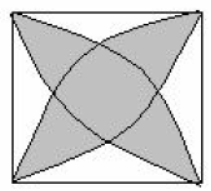
Question 41. For the following figure identify multiple lines of symmetry.
Answer:
The given figure consists of a square with a symmetric curved design inside.
This figure has exactly 4 lines of symmetry:
1. One vertical line of symmetry.
2. One horizontal line of symmetry.
3. Two diagonal lines of symmetry.
In simple words: This symmetrical square design has 4 different fold lines that can divide it into matching halves: up-and-down, side-to-side, and both diagonal ways.
Exam Tip: Always check if diagonal folds align the internal curves of the pattern exactly.
Question 42. Given the lines of symmetry, find the other holes.
Answer:
The figure shows a circle with a diagonal line of symmetry and a punched hole in the top-left section.
To make the figure symmetric about the diagonal line, the other hole must be placed in the bottom-right section of the circle, at an equal distance from the diagonal line.
In simple words: Since the fold line goes diagonally, folding the circle will place the top-left hole onto the bottom-right side. We must punch a hole there to make it symmetric.
Exam Tip: Imagine folding the shape along the dotted line to find where the reflected hole must be punched.
Question 43. Name the quadrilaterals which have both line and rotational symmetry of order more than 1.
Answer: Square and Rectangle
The quadrilaterals that have both line symmetry and rotational symmetry of order greater than 1 are:
- Square: 4 lines of symmetry, rotational symmetry of order 4.
- Rectangle: 2 lines of symmetry, rotational symmetry of order 2.
- Rhombus: 2 lines of symmetry, rotational symmetry of order 2.
In simple words: Squares, rectangles, and rhombuses are flat four-sided shapes that have fold lines and can also be spun to look exactly the same before making a full turn.
Exam Tip: Parallelograms have rotational symmetry of order 2 but have 0 lines of symmetry, so they do not satisfy both conditions.
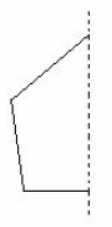
Question 44. In the following figure, the mirror line is given as a dotted line. Complete each figure performing reflection in the dotted line. Are you able to recall the name of the figure you complete?
Answer:
By reflecting the given half-shape across the vertical dotted line, the shape is completed on the right side.
The completed figure has 5 equal straight sides.
The name of this completed figure is a regular pentagon.
In simple words: When we copy the left half onto the right side of the dotted line, it completes a regular five-sided shape called a pentagon.
Exam Tip: Count the total number of sides of the completed shape to identify its name (e.g., 5 sides is a pentagon, 6 is a hexagon).
Question 45. What letters of the English alphabet have reflectional symmetry about
(a) a vertical mirror
(b) a horizontal mirror
(c) both horizontal and vertical mirrors.
Answer:
(a) Letters with reflectional symmetry about a vertical mirror:
A, H, I, M, O, T, U, V, W, X, Y
(b) Letters with reflectional symmetry about a horizontal mirror:
B, C, D, E, H, I, K, O, X
(c) Letters with reflectional symmetry about both horizontal and vertical mirrors:
H, I, O, X
In simple words: Some capital letters look the same when cut vertically (like A), some when cut horizontally (like E), and some can be cut both ways and still match (like H, I, O, X).
Exam Tip: Practice drawing a horizontal and a vertical line through capital letters to quickly identify their reflectional properties.
Question 46. State the number of lines of symmetry for the following figures:
(a) An equilateral triangle
(b) A rectangle
Answer:
(a) An equilateral triangle has 3 lines of symmetry.
(b) A rectangle has 2 lines of symmetry.
In simple words: You can fold an equilateral triangle in 3 ways, and a rectangle in only 2 ways to get matching halves.
Exam Tip: Remember that a rectangle's diagonals are not lines of symmetry, so its lines of symmetry are only horizontal and vertical.
Question 47. What other name can you give to the line of symmetry of
(a) an isosceles triangle
(b) a circle
Answer:
(a) The line of symmetry of an isosceles triangle is also called its median (or altitude) to the unequal base.
(b) The line of symmetry of a circle is also called its diameter.
In simple words: For an isosceles triangle, the fold line is the altitude from the top corner. For a circle, any fold line across the middle is a diameter.
Exam Tip: Connecting geometric definitions with symmetry properties is highly valued by examiners.
Question 48. Give the order of rotational symmetry for each figure:
(a)
(b)
(c)
Answer:
(a) The cross/plus sign has an order of rotational symmetry of 4.
(b) The two intersecting lines have an order of rotational symmetry of 2.
(c) The line with two opposite-facing triangles has an order of rotational symmetry of 2.
In simple words: The cross looks identical 4 times in a full turn. The intersecting lines and the double-triangle line look identical 2 times during a full spin.
Exam Tip: For intersecting lines with different angles, they only look identical after a half turn (180 degrees), so their order is 2.
Question 49. Give three examples of shapes with no line of symmetry.
Answer:
Three examples of shapes that have 0 lines of symmetry are:
1. Scalene triangle (all three sides are of different lengths).
2. Oblique Parallelogram (slanted four-sided shape with opposite sides equal).
3. Scalene Trapezium (four-sided shape with only one pair of parallel sides and all sides unequal).
In simple words: A scalene triangle, a slanted parallelogram, and an irregular quadrilateral cannot be folded in half anywhere to make matching sides.
Exam Tip: Try to use common geometric terms like scalene triangle or parallelogram rather than simply saying "an irregular shape".
Question 50. For the given alphabets given in the table complete the following table:
| Alphabet Letters | Line Symmetry (Yes / No) | Number of Lines of Symmetry | Rotational Symmetry (Yes / No) | Order of Rotational Symmetry |
|---|---|---|---|---|
| Z | No | 0 | Yes | 2 |
| S | No | 0 | Yes | 2 |
| H | Yes | 2 | Yes | 2 |
| O | Yes | Infinite | Yes | Infinite |
| E | Yes | 1 | No | 1 |
| N | No | 0 | Yes | 2 |
| C | Yes | 1 | No | 1 |
Answer:
The completed table above shows the line symmetry and rotational symmetry characteristics for each letter.
- Letters like Z, S, and N have no lines of symmetry but have rotational symmetry of order 2.
- Letters like E and C have 1 line of symmetry but no rotational symmetry (order 1).
- Letters like H and O have both types of symmetry.
In simple words: This table explains how different letters fold or spin. Some letters can only be folded, some can only be spun, and some can do both.
Exam Tip: Be careful with the letter O. In standard fonts, it is treated as a perfect circle, giving it infinite lines of symmetry and infinite order of rotational symmetry.
Free study material for Mathematics
Free CBSE Practice Worksheets: Class 7 Mathematics Chapter 14 Symmetry
Download Chapter Worksheets: Class 7 Mathematics
Access structured practice worksheets for Chapter 14 Symmetry aligned with the 2026 CBSE curriculum. These downloadable exercises for Class 7 Mathematics help students build accuracy and reinforce core concepts for upcoming school tests.
Concept Clarification for Chapter 14 Symmetry
Each worksheet draws directly from authorized standard textbooks to maintain academic accuracy. Evaluating your finished exercises against expert-verified solutions helps master the formal presentation standards expected in school evaluations.
Effective Revision Strategies for School Exams
Consistent engagement with these exercises builds familiarity with recurring exam themes. If specific areas within Chapter 14 Symmetry cause trouble, utilize our dedicated NCERT solutions for Class 7 Mathematics to clear up doubts immediately.
FAQs
You can download the latest chapter-wise printable worksheets for Class 7 Mathematics Chapter 14 Symmetry for free from StudiesToday.com. These have been made as per the latest CBSE curriculum for this academic year.
Yes, Class 7 Mathematics worksheets for Chapter 14 Symmetry focus on activity-based learning and also competency-style questions. This helps students to apply theoretical knowledge to practical scenarios.
Yes, we have provided solved worksheets for Class 7 Mathematics Chapter 14 Symmetry to help students verify their answers instantly.
Yes, our Class 7 Mathematics test sheets are mobile-friendly PDFs and can be printed by teachers for classroom.
For Chapter 14 Symmetry, regular practice with our worksheets will improve question-handling speed and help students understand all technical terms and diagrams.