

Chapter-wise Worksheets for Class 7 Mathematics: Chapter 14 Symmetry
Review targeted academic worksheets with the CBSE Class 7 Mathematics Symmetry Worksheet Set 01. Built according to official educational standards for the 2026-27 term, these downloadable Class 7 Mathematics resources support effective daily practice and detailed self-evaluation for Chapter 14 Symmetry.
Practice Class 7 Mathematics Worksheets: Chapter 14 Symmetry
Navigate directly to the solved Mathematics worksheets using the digital viewer below. Each practice set includes detailed step-by-step solutions, allowing students to instantly cross-check their work and identify areas requiring further revision.
Question 1. Which of the following has a horizontal line of symmetry:
(a) P
(b) 3
(c) M
(d) W
Answer: (b) 3
The digit 3 can be divided into identical top and bottom halves along a horizontal line passing through its middle. Letters P and M have vertical lines of symmetry, while W has a vertical line of symmetry and its upside-down version has a horizontal one, but among the given standard capital letters and digits, 3 possesses a clear horizontal line of symmetry.
In simple words: The number 3 looks the same on the top and bottom if you fold it horizontally.
Exam Tip: Always visualize folding the shape along a horizontal axis (left-to-right line) to check for a horizontal line of symmetry.
Question 2. What is the number of lines of symmetry of a regular pentagon?
(a) 5
(b) 4
(c) 3
(d) 2
Answer: (a) 5
A regular pentagon has 5 sides and 5 vertices. Every regular polygon has a number of lines of symmetry equal to the number of its sides. Therefore, a regular pentagon has 5 lines of symmetry passing through each vertex and the midpoint of the opposite side.
In simple words: A regular pentagon has 5 equal sides, so it has 5 lines of symmetry.
Exam Tip: For any regular polygon with \(n\) sides, the number of lines of symmetry is always \(n\).
Question 3. A rhombus is symmetrical about its:
(a) Diagonals
(b) sides
(c) angles
(d) none of the options.
Answer: (a) Diagonals
A rhombus is symmetrical about its two diagonals, which act as its lines of symmetry. Folding a rhombus along either of its diagonals results in the two parts coinciding perfectly.
In simple words: A rhombus folds neatly along its corner-to-corner diagonal lines.
Exam Tip: Remember that the diagonals of a rhombus are perpendicular bisectors of each other and serve as lines of symmetry, whereas lines joining the midpoints of opposite sides are not lines of symmetry.
Question 4. The figure has has a rotational symmetry of order:
(a) 2
(b) 3
(c) 5
(d) 6
Answer: (b) 3
Observing the flower-like figure with 3 distinct petals, it maps onto itself 3 times during a complete 360-degree rotation. Thus, the order of rotational symmetry is 3.
In simple words: The figure fits onto itself 3 times in one full turn.
Exam Tip: Count the number of identical repeating petals or arms radiating from the center to quickly find the order of rotational symmetry for symmetric shapes.
Question 5. In the word 'MATHS' which letter shows rotational symmetry:
(a) M
(b) A
(c) H
(d) S
Answer: (c) H
The letter H looks identical after a 180-degree rotation (rotational symmetry of order 2). Letters M, A, and S do not look the same after a 180-degree rotation.
In simple words: If you turn the letter H upside down (180 degrees), it still looks like an H.
Exam Tip: Letters with rotational symmetry of order 2 include H, I, N, O, S, X, and Z.
Question 6. List any five symmetrical objects from your practical life. Draw their pictures also.
Answer:
1. Ceiling fan (with 3 or 4 blades)
2. Glass tumbler
3. Notebook / Book
4. Blackboard / Whiteboard
5. Cricket bat (front view)
In simple words: Common everyday items that can be divided into identical halves are symmetrical.
Exam Tip: Choose objects that have a clear line of symmetry down the middle or radial symmetry.
Question 7. List all the letters of English alphabets and show how many of them have : 1) vertical lines of symmetry 2) horizontal lines of symmetry 3) both lines of symmetry. 4) unlimited lines of symmetry. 5) 4 lines of symmetry 6) no lines of symmetry.
Answer:
1) Vertical lines of symmetry: A, H, I, M, O, T, U, V, W, X, Y (11 letters)
2) Horizontal lines of symmetry: B, C, D, E, H, I, O, X (8 letters)
3) Both vertical and horizontal lines of symmetry: H, I, O, X (4 letters)
4) Unlimited lines of symmetry: None of the letters of the English alphabet have unlimited lines of symmetry (circles have unlimited lines of symmetry, not letters).
5) 4 lines of symmetry: None (squares have 4 lines of symmetry, not letters).
6) No lines of symmetry: F, G, J, L, N, P, Q, R, S, Z (10 letters)
In simple words: Capital letters can be categorized based on how they can be folded symmetrically.
Question 8. Draw a rough figure of the following shapes and show how many lines of symmetry they possess : 1) scalene triangle 2) isosceles triangle 3) equilateral triangle 8) kite 9) line 10) line segment 11) angle 12) semi circle 13) circle 14) arrow head
Answer:
1) Scalene triangle: 0 lines of symmetry.
2) Isosceles triangle: 1 line of symmetry.
3) Equilateral triangle: 3 lines of symmetry.
8) Kite: 1 line of symmetry (along its main diagonal).
9) Line: Infinite (unlimited) lines of symmetry (every perpendicular line and the line itself).
10) Line segment: 2 lines of symmetry (the perpendicular bisector and the line segment itself).
11) Angle: 1 line of symmetry (the angle bisector).
12) Semicircle: 1 line of symmetry (perpendicular bisector of the diameter).
13) Circle: Infinite (unlimited) lines of symmetry (every line passing through the center).
14) Arrow head: 1 line of symmetry.
In simple words: Different geometric shapes have a specific number of ways they can be folded into identical halves.
Exam Tip: Memorize standard symmetry counts: circle = infinite, regular polygons = number of sides, scalene = 0, isosceles = 1.
Question 9. Fill in the blanks:
1) A rectangle has --------- lines of symmetry.
2) A regular hexagon has --------- lines of symmetry.
3) --------------- has 3 lines of symmetry.
4) A ------------ triangle has no lines of symmetry.
5) A rhombus has -------------- lines of symmetry where as a square has ----------- lines of symmetry.
6) A kite has ----------- lines of symmetry.
Answer:
1) A rectangle has 2 lines of symmetry.
2) A regular hexagon has 6 lines of symmetry.
3) An equilateral triangle has 3 lines of symmetry.
4) A scalene triangle has no lines of symmetry.
5) A rhombus has 2 lines of symmetry where as a square has 4 lines of symmetry.
6) A kite has 1 line of symmetry.
In simple words: Fill in each blank with the correct geometric count or shape name.
Exam Tip: Double-check properties of quadrilaterals and regular polygons before filling in symmetry blanks.
Question 10. List the numbers from 0 to 9 and show how many of them are symmetrical . Also draw there axis of symmetry.
Answer:
The symmetrical numbers from 0 to 9 are 0, 1, 3, 8 (total 4 numbers).
- 0: Has 2 lines of symmetry (vertical and horizontal).
- 1: Has 1 vertical line of symmetry.
- 3: Has 1 horizontal line of symmetry.
- 8: Has 2 lines of symmetry (vertical and horizontal).
The digits 2, 4, 5, 6, 7, 9 are not symmetrical.
In simple words: The digits 0, 1, 3, and 8 can be folded symmetrically.
Exam Tip: Write digits in standard digital/block font to correctly determine their symmetry axes.
Question 11. State the order of rotation and the angle of rotation of the following :
a) Square b) equilateral triangle c) rhombus d) alphabet: N, H, I, X, W, M e) rectangle
Answer:
a) Square: Order of rotation = 4, Angle of rotation = \(\frac{360^\circ}{4} = 90^\circ\)
b) Equilateral triangle: Order of rotation = 3, Angle of rotation = \(\frac{360^\circ}{3} = 120^\circ\)
c) Rhombus: Order of rotation = 2, Angle of rotation = \(\frac{360^\circ}{2} = 180^\circ\)
d) Alphabets:
- N: Order of rotation = 2, Angle of rotation = \(180^\circ\)
- H: Order of rotation = 2, Angle of rotation = \(180^\circ\)
- I: Order of rotation = 2, Angle of rotation = \(180^\circ\)
- X: Order of rotation = 2, Angle of rotation = \(180^\circ\)
- W: Order of rotation = 1, Angle of rotation = \(360^\circ\)
- M: Order of rotation = 1, Angle of rotation = \(360^\circ\)
e) Rectangle: Order of rotation = 2, Angle of rotation = \(180^\circ\)
In simple words: Angle of rotation is calculated by dividing \(360^\circ\) by the order of rotational symmetry.
Exam Tip: Formula for angle of rotation = \(\frac{360^\circ}{\text{Order of rotation}}\).
Question 12. What is the order of rotation and the angle of rotation of a ceiling fan with :
(i) 3 blades (ii) 4 blades 4) square 5) rectangle 6) parallel lines 7) rhombus
Answer:
(i) Ceiling fan with 3 blades:
- Order of rotation = 3
- Angle of rotation = \(\frac{360^\circ}{3} = 120^\circ\)
(ii) Ceiling fan with 4 blades:
- Order of rotation = 4
- Angle of rotation = \(\frac{360^\circ}{4} = 90^\circ\)
4) Square:
- Order of rotation = 4
- Angle of rotation = \(\frac{360^\circ}{4} = 90^\circ\)
5) Rectangle:
- Order of rotation = 2
- Angle of rotation = \(\frac{360^\circ}{2} = 180^\circ\)
6) Parallel lines:
- Order of rotation = 2
- Angle of rotation = \(\frac{360^\circ}{2} = 180^\circ\)
7) Rhombus:
- Order of rotation = 2
- Angle of rotation = \(\frac{360^\circ}{2} = 180^\circ\)
In simple words: Match each shape or object to its number of symmetrical turns in a full circle.
Exam Tip: A 2-fold rotational symmetry always corresponds to a \(180^\circ\) turn.
1 Which of the following alphabets has a vertical line of symmetry?
(A) M
(B) B
(C) Q
(D) E
Answer : S
2 Which of the following alphabets has a horizontal line of symmetry?
(A) C
(B) K
(C) D
(D) All the above
Answer : D
3 Which of the following alphabets has no line of symmetry?
(A) A
(B) B
(C) p
(D) 0
Answer : C
4 Which of the following alphabets has many lines of symmetry?
(A) I
(B) 0
(C) P
(D) F
Answer : B
5 Which of the following triangles has no line of symmetry?
(A) An equilateral triangle
(B) An isosceles triangle
(C) A scalene triangle
(D) All of the above
Answer : C
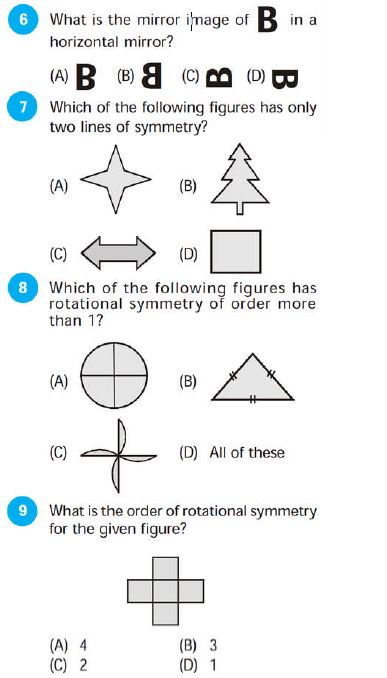
Answer 6: A
Answer 7: C
Answer 8: D
Answer 9: A
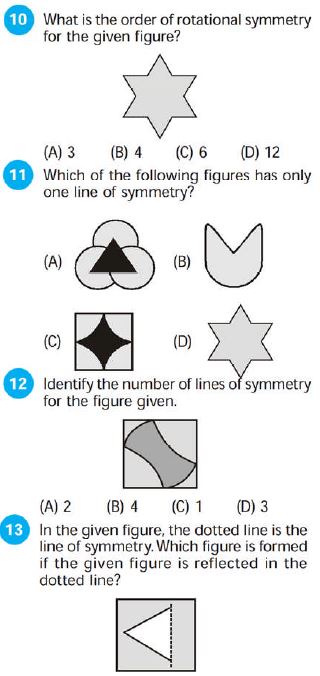 :
(A) A square
(B) A rhombus
(C) A triangle
(D) A pentagon
Answer 10: C
Answer 11: B
Answer 12: A
Answer 13: B
14 What is the other name for a line of symmetry of a circle?
(A) An arc
(B) A sector
(C) A diameter
(D) A radius
Answer : C
15 In ΔXVZ , XV = XZ and XM ⊥ VZ and ZP ⊥ XV . About which of the following is the triangle symmetrical?
(A) XM
(B) VN
(C) ZP
(D) XZ
Answer : A
16 What is the order of rotational symmetry of the English alphabet Z?
(A) 0
(B) 1
(C) 2
(D) 3
Answer : C
17 Which of these quadrilaterals have both line and rotational symmetries of order more than 3?
(A) A triangle
(B) A square
(C) A kite
(D) A rectangle
Answer : B
18 Which of these letters has only rotational symmetry?
(A) S
(B) E
(C) B
(D) P
Answer : A
19 A square has a rotational symmetry of order 4 about its centre. What is the angle of rotation?
(A) 45°
(B) 90°
(C) 180°
(D) 270°
Answer : C
20 What is the order of rotational symmetry of the figure given?
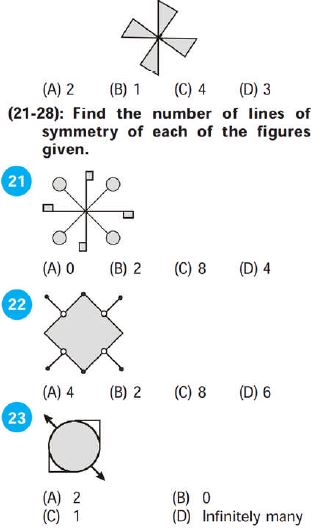
Answer 20: C
Answer 21: A
Answer 22: A
Answer 23: A
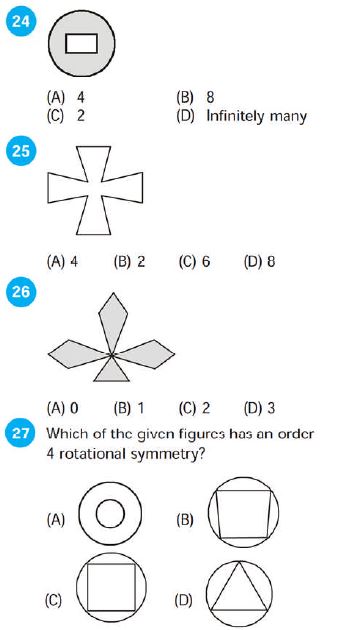
Answer 24: C
Answer 25: A
Answer 26: B
Answer 27: C
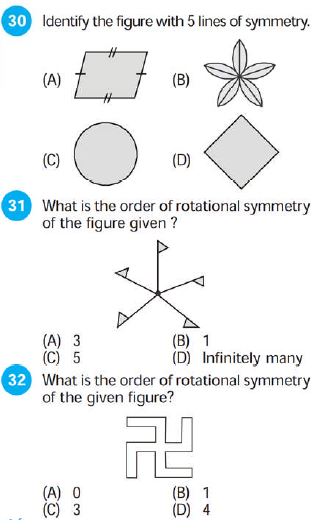

Answer 30: B
Answer 31: C
Answer 32: D
Answer 33: B
34 What is the order of rotational symmetry of given figure?
(A) 3
(C) 0
(B) 6
(D) Many
Answer : A
35 Which of the following figures has both linear symmetry and rotational symmetry?
(A) An isosceles triangle
(B) A scalene triangle
(C) A parallelogram
(D) A square
Answer : D
36 Which of the following is the odd one out?
(A) A pentagon
(B) A scalene triangle
(C) A semicircle
(D) An isosceles triangle
Answer : A
37 Which of the following statements is correct?
(A) An equilateral triangle has three lines of symmetry.
(B) A rectangle has four lines of symmetry.
(C) A circle has only one line of symmetry.
(D) A parallelogram has two lines of symmetry.
Answer : A
Students must free download and practice these worksheets to gain more marks in exams. CBSE Class 7 Maths Worksheet - Symmetry (1)
Free study material for Mathematics
Free CBSE Practice Worksheets: Class 7 Mathematics Chapter 14 Symmetry
Download Chapter Worksheets: Class 7 Mathematics
Explore reliable practice questions for Chapter 14 Symmetry tailored for Class 7 Mathematics learners. Use these structured worksheets to evaluate exam preparedness and strengthen problem-solving skills throughout the 2026 academic session.
Concept Clarification for Chapter 14 Symmetry
Built using official NCERT guidelines for Class 7 Mathematics, these practice sheets provide reliable academic support. Cross-reference your completed work with our detailed solutions to learn standard answer-writing formats for CBSE exams.
Effective Revision Strategies for School Exams
Follow up your worksheet practice by attempting the interactive online MCQ tests for Chapter 14 Symmetry to evaluate your execution speed. All printable assignments and revision sheets on our platform are updated for the 2026 session and available free of charge.
FAQs
You can download the latest chapter-wise printable worksheets for Class 7 Mathematics Chapter 14 Symmetry for free from StudiesToday.com. These have been made as per the latest CBSE curriculum for this academic year.
Yes, Class 7 Mathematics worksheets for Chapter 14 Symmetry focus on activity-based learning and also competency-style questions. This helps students to apply theoretical knowledge to practical scenarios.
Yes, we have provided solved worksheets for Class 7 Mathematics Chapter 14 Symmetry to help students verify their answers instantly.
Yes, our Class 7 Mathematics test sheets are mobile-friendly PDFs and can be printed by teachers for classroom.
For Chapter 14 Symmetry, regular practice with our worksheets will improve question-handling speed and help students understand all technical terms and diagrams.