

Chapter-wise Worksheets for Class 7 Mathematics: Chapter 05 Lines and Angles
Access comprehensive chapter-wise worksheets for Chapter 05 Lines and Angles using the CBSE Class 7 Mathematics Lines And Angles Worksheet Set 01. Designed to align with the 2026-27 academic syllabus for Class 7 Mathematics, these printable practice sets help students reinforce key concepts and improve their overall exam readiness.
Practice Class 7 Mathematics Worksheets: Chapter 05 Lines and Angles
Access the complete worksheet PDF for Class 7 Mathematics below. Regular practice with these targeted academic tasks builds familiarity with standard question patterns and helps secure higher marks in final school examinations.
Question. In the given Fig. i.e., ∠1 50 then find ∠2, ∠3, ∠4.
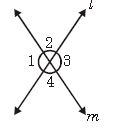
Answer : ∠2 = 130°, ∠3 = 50°, ∠4 = 130°
Question. Two angles of a linear pair are in the ratio 2 : 7, find the angles.
Answer : 40°, 140°
Question. Find the angle which is (1/5)th of its complementry angle.
Answer : 15°
Question. The difference in the measure of two supplementry angles is 80°, find the measures of the angles.
Answer : 50°, 130°
Question. Find complement of the following angles : m
(a) 20°
(b) 66°
(c) 40°
(d) 35°
Answer : (a) 70° (b) = 24° (c) 50° (d) = 55°
Question. Find the angle which is equal to its complement.
Answer : 45°
Question. An angle is greater than 80° than its supplement. What is its supplementary angle
Answer : 130°
Question. Two complementary angle are in the ratio 2 : 3, find the angles.
Answer : 36°, 54°
Question. Two supplementry angles are in the ratio 2 : 3, find the smallest angle.
Answer : 72°
Question. An angle is equal to 5 times its complement. Determine its measure.
Answer : 15°, 75°
Question. Find the angle which is equal to its supplement.
Answer : 90°
Question. An angle is 20° greater than its complementry angle. What is the complementry angle.
Answer : 35°
Question. An angle is equal to 8 times its supplement. Determine its measure.
Answer : 20°, 160°
Question. Find the angle which is one third of its supplementry angle.
Answer : 45°
Question. An angle is equal to double of its complement. Determine its measure
Answer : 60°
Question. Find supplement of the following angles.
(a) 105°
(b) 87°
(c) 154°
Answer : a = 75°; b = 93°; c = 26°
Question. An angle is greater than 30° than its complement. What the measurement of complementary angles?
Answer : 60°, 30°
Question. Two complementry angles are in the ratio 4 : 5, find the greater angle.
Answer : 50°
Question. An angle is greater than 60° than its supplementary angle. What is the supplementary angle?
Answer : 60°
Question. The difference of the measures of two complementry angles is 40°. Find the measures of the angles
Answer : 25°, 65°.
Question. Find the angle which is 9 times of its supplementry angle.
Answer : 162°
Question. Two supplementary angles are in the ratio 3 : 7, find the angles.
Answer : 54°, 126°
Question. Two angles of a linear pairs are in the ratio 1 : 5 find angles.
Answer : 30°, 150°
Question. Find the angle which is half of its complementary angle.
Answer : 30°
Question. Identify which of the following pair of angles are complementary and which are supplementary :
(a) 63°, 117°
(b) 23°, 67°
(c) 105°, 75°
(d) 120°, 60°.
Answer : Complementry = b, Supplementry = a, c, d
Question. An angle is greater then 25° than its complement. What is its complementary angle?
Answer : 57.5°
Question. An angle is equal to 3 times of its supplement. Determine its measure.
Answer : 135°
Question 1. In the adjoining figure:
(i) Is ∠1 adjacent to ∠2?
(ii) Is ∠AOC adjacent to ∠AOE?
(iii) Do ∠COE and ∠EOD form a linear pair?
(iv) Are ∠BOD and ∠DOA supplementary?
(v) Is ∠1 vertically opposite to ∠4?
(vi) What is the vertically opposite angle of ∠5?
Answer:
(i) **Yes.** They sit right next to each other. They share the center point \(O\) and the middle line \(OC\).
(ii) **No.** Even though they share the center point \(O\) and the line \(OA\), they overlap. One angle is inside the other.
(iii) **Yes.** These two angles lie on the straight line \(CD\). Together, they form a flat straight angle.
(iv) **Yes.** They lie on the straight line \(AB\). Their measures add up to \(180^\circ\).
(v) **Yes.** They are directly across from each other where the two lines cross.
(vi) The vertically opposite angle of \(\angle 5\) is \(\angle COB\) (which can also be written as \(\angle 2 + \angle 3\)).
In simple words: Angles are adjacent when they sit side-by-side without overlapping. Angles that make a straight line are supplementary and form a linear pair.
Exam Tip: To find if angles are adjacent, check if they share a corner, a middle line, and do not share any inside space.
Question 2. Indicate which pairs of angles in question 1 are:
(i) Vertically opposite angles.
(ii) Linear pairs.
Answer:
(i) Vertically opposite angles:
- \(\angle 1\) and \(\angle 4\) (which are \(\angle AOC\) and \(\angle BOD\))
- \(\angle 5\) and \(\angle BOC\) (where \(\angle BOC\) is the combined angle \(\angle 2 + \angle 3\))
(ii) Linear pairs:
- \(\angle 1\) and \(\angle 5\) (they form the straight line \(CD\))
- \(\angle 5\) and \(\angle 4\) (they form the straight line \(AB\))
- \(\angle 4\) and \(\angle BOC\) (where \(\angle BOC\) is \(\angle 2 + \angle 3\); they form the straight line \(CD\))
- \(\angle 1\) and \(\angle BOC\) (where \(\angle BOC\) is \(\angle 2 + \angle 3\); they form the straight line \(AB\))
In simple words: Vertically opposite angles are directly across from each other. Linear pairs are side-by-side angles that make a flat straight line.
Exam Tip: Remember that the non-shared sides of a linear pair must always point in opposite directions to form a straight line.
Question 3. Fill in the blanks:
(i) If two angles are complementary, then the sum of their measures is _______.
(ii) If two angles are supplementary, then the sum of their measures is ______.
(iii) Two angles forming a linear pair are _______________.
(iv) If two adjacent angles are supplementary, they form a ___________.
(v) If two lines intersect at a point, then the vertically opposite angles are always_____________.
(vi) If two lines intersect at a point, and if one pair of vertically opposite angles are acute angles, then the other pair of vertically opposite angles are __________.
Answer:
(i) **\( 90^\circ \)** - Complementary angles always add up to a right angle.
(ii) **\( 180^\circ \)** - Supplementary angles always add up to a straight line.
(iii) **supplementary** - A linear pair of angles lies on a straight line, so their sum is \( 180^\circ \).
(iv) **linear pair** - Adjacent angles that add up to \( 180^\circ \) form a straight line together.
(v) **equal** - When two lines cross, the opposite angles are always identical in size.
(vi) **obtuse angles** - If one set of opposite angles is small (less than \( 90^\circ \)), the other set must be large (more than \( 90^\circ \)) to complete the circle.
In simple words: Complementary angles make a corner right-angle. Supplementary angles and linear pairs make a flat straight line.
Exam Tip: Memorize these basic terms as they are very common in matching and fill-in-the-blank exam questions.
Free study material for Mathematics
Chapter 05 Lines and Angles Printable Worksheets and Exercises for Class 7 Mathematics
Practice Exercises for Class 7 Mathematics Chapter 05 Lines and Angles
Review targeted practice exercises for Class 7 Mathematics Chapter 05 Lines and Angles. Curated to match official CBSE guidelines, these printable problem sets support daily revision and improve overall test readiness.
Step-by-Step Solutions and Practice Guidelines
Each worksheet draws directly from authorized standard textbooks to maintain academic accuracy. Evaluating your finished exercises against expert-verified solutions helps master the formal presentation standards expected in school evaluations.
Enhance Speed with Online Practice
Wrap up your chapter revision by testing your knowledge against standard objective question formats. Explore our full library of free, up-to-date printable assignments to maximize your academic results in upcoming CBSE evaluations.
FAQs
You can download the latest chapter-wise printable worksheets for Class 7 Mathematics Chapter 05 Lines and Angles for free from StudiesToday.com. These have been made as per the latest CBSE curriculum for this academic year.
Yes, Class 7 Mathematics worksheets for Chapter 05 Lines and Angles focus on activity-based learning and also competency-style questions. This helps students to apply theoretical knowledge to practical scenarios.
Yes, we have provided solved worksheets for Class 7 Mathematics Chapter 05 Lines and Angles to help students verify their answers instantly.
Yes, our Class 7 Mathematics test sheets are mobile-friendly PDFs and can be printed by teachers for classroom.
For Chapter 05 Lines and Angles, regular practice with our worksheets will improve question-handling speed and help students understand all technical terms and diagrams.