

Class 7 Mathematics Practice Sheet: CBSE Class 7 Mathematics Triangle And Its Properties Worksheet Set 06
Review targeted academic worksheets with the CBSE Class 7 Mathematics Triangle And Its Properties Worksheet Set 06. Built according to official educational standards for the 2026-27 term, these downloadable Class 7 Mathematics resources support effective daily practice and detailed self-evaluation for Chapter 06 The Triangle and its Properties.
Download Chapter 06 The Triangle and its Properties Worksheet PDF with Answers
Access the complete worksheet PDF for Class 7 Mathematics below. Regular practice with these targeted academic tasks builds familiarity with standard question patterns and helps secure higher marks in final school examinations.
Page 1
Question 1. Solve the following equations:
a) \( -2(3x - 6) = 4 \)
b) \( -4(2x + 7) = -12 \)
c) \( -3(2x - 1) = 15 \)
d) \( 10 = 5(2p - 2) \)
e) \( -15 = -5(2 - 2p) \)
f) \( 0 = 20 + 4(4x - 3) \)
Answer:
a) \( -2(3x - 6) = 4 \)
Divide both sides by \( -2 \):
\( 3x - 6 = -2 \)
Add \( 6 \) to both sides:
\( 3x = 4 \)
Divide both sides by \( 3 \):
\( x = \frac{4}{3} \)
b) \( -4(2x + 7) = -12 \)
Divide both sides by \( -4 \):
\( 2x + 7 = 3 \)
Subtract \( 7 \) from both sides:
\( 2x = -4 \)
Divide both sides by \( 2 \):
\( x = -2 \)
c) \( -3(2x - 1) = 15 \)
Divide both sides by \( -3 \):
\( 2x - 1 = -5 \)
Add \( 1 \) to both sides:
\( 2x = -4 \)
Divide both sides by \( 2 \):
\( x = -2 \)
d) \( 10 = 5(2p - 2) \)
Divide both sides by \( 5 \):
\( 2 = 2p - 2 \)
Add \( 2 \) to both sides:
\( 4 = 2p \)
Divide both sides by \( 2 \):
\( p = 2 \)
e) \( -15 = -5(2 - 2p) \)
Divide both sides by \( -5 \):
\( 3 = 2 - 2p \)
Subtract \( 2 \) from both sides:
\( 1 = -2p \)
Divide both sides by \( -2 \):
\( p = -\frac{1}{2} \)
f) \( 0 = 20 + 4(4x - 3) \)
Subtract \( 20 \) from both sides:
\( -20 = 4(4x - 3) \)
Divide both sides by \( 4 \):
\( -5 = 4x - 3 \)
Add \( 3 \) to both sides:
\( -2 = 4x \)
Divide both sides by \( 4 \):
\( x = -\frac{2}{4} = -\frac{1}{2} \)
In simple words: To find the unknown letter, open the brackets, move the numbers to one side, and keep the letter on the other side.
Exam Tip: Always substitute your final answer back into the original equation to check if both sides become equal.
Question 2. Write the following statements in the form of equations:
a) The sum of two times a number and seven is twenty one.
b) The sum of five times a number and four is thirteen.
c) The sum of half times a number and one is ten.
d) One-third of a number gives fifteen.
e) One-fifth of a number gives twenty.
f) One-tenth of a number gives hundred.
g) One-fourth of a number added to two is 15.
h) My father is 30 years older than me. In 12 years time my father will be three times as old as me. My age is _____________.
i) I am the length of a rectangular field. I am twice my breadth. If the perimeter of the field is 120 m my length is __________. Also the breadth of the rectangular field is __________.
Answer: Let the unknown number be \( x \).
a) \( 2x + 7 = 21 \)
b) \( 5x + 4 = 13 \)
c) \( \frac{1}{2}x + 1 = 10 \)
d) \( \frac{1}{3}x = 15 \)
e) \( \frac{1}{5}x = 20 \)
f) \( \frac{1}{10}x = 100 \)
g) \( \frac{1}{4}x + 2 = 15 \)
h) Let my current age be \( m \). My father's age is \( m + 30 \).
In 12 years, my age will be \( m + 12 \) and my father's age will be \( (m + 30) + 12 = m + 42 \).
According to the problem:
\( m + 42 = 3(m + 12) \)
\( \implies m + 42 = 3m + 36 \)
\( \implies 2m = 6 \)
\( \implies m = 3 \)
My age is 3 years.
i) Let the breadth of the field be \( b \). The length is \( l = 2b \).
Perimeter of the field is \( 2(l + b) = 120 \text{ m} \).
Substitute \( l = 2b \):
\( 2(2b + b) = 120 \)
\( \implies 2(3b) = 120 \)
\( \implies 6b = 120 \)
\( \implies b = 20 \text{ m} \)
Length \( l = 2(20) = 40 \text{ m} \).
So, my length is 40 m, and the breadth of the rectangular field is 20 m.
In simple words: Translate the word problems into simple mathematical lines using a letter like x, and then solve them.
Exam Tip: Define your variable clearly at the start (such as "Let the number be x") to help the examiner follow your steps.
Page 2
Question 1. Match the following.
a) The sum of the angles of a triangle is equal to | i) hypotenuse.
b) If a triangle has a right angle, it is called | ii) 180o.
c) If all the sides of a triangle are equal. | iii) it is called as an obtuse
d) If a triangle has one angle > 90o | iv) two acute angles.
e) The largest side of a right triangle is known as | v) an isosceles triangle.
f) An isosceles right triangle has | vi) does not include a right angle.
g) An obtuse triangle | vii) it must be equiangular.
h) If two angles are equal, it must be | viii) a right angled triangle.
Answer:
a) The sum of the angles of a triangle is equal to - ii) 180°
b) If a triangle has a right angle, it is called - viii) a right angled triangle.
c) If all the sides of a triangle are equal - vii) it must be equiangular.
d) If a triangle has one angle > 90° - iii) it is called as an obtuse
e) The largest side of a right triangle is known as - i) hypotenuse.
f) An isosceles right triangle has - iv) two acute angles.
g) An obtuse triangle - vi) does not include a right angle.
h) If two angles are equal, it must be - v) an isosceles triangle.
In simple words: This section matches important properties of triangles with their correct geometrical terms.
Exam Tip: Read through all the options on both sides before marking your matches to avoid simple errors.
Question 2. ABC is an isosceles right triangle which has a right angle at C. Therefore,
a) AB2 = AC2
b) AB2 = 4AC2
c) AB2 = 2AC2
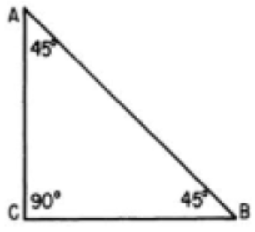
Answer: (c) AB2 = 2AC2
In right-angled triangle \( ABC \), using Pythagoras' theorem:
\( AB^2 = AC^2 + BC^2 \)
Since \( ABC \) is also an isosceles triangle with the right angle at \( C \), the sides forming the right angle must be equal:
\( AC = BC \)
Substitute \( BC = AC \) in the equation:
\( AB^2 = AC^2 + AC^2 \)
\( \implies AB^2 = 2AC^2 \)
In simple words: Since two sides are equal, we can write BC as AC. Using the square rule for right triangles gives us \( AB^2 = 2AC^2 \).
Exam Tip: In right-angled triangles, the hypotenuse is always the side opposite the 90-degree angle.
Question 3. The length of a rectangle is 5 cm more than twice its breadth. If the Perimeter of the rectangle is 166 cm. Find its dimensions.
Answer: Let the breadth of the rectangle be \( b \) cm.
According to the problem, the length \( l \) is:
\( l = 2b + 5 \) cm
The perimeter of a rectangle is given by the formula:
\( \text{Perimeter} = 2(l + b) \)
Substitute the values into the formula:
\( 166 = 2((2b + 5) + b) \)
Divide both sides by \( 2 \):
\( 83 = 3b + 5 \)
Subtract \( 5 \) from both sides:
\( 78 = 3b \)
Divide by \( 3 \):
\( b = 26 \text{ cm} \)
Now, find the length \( l \):
\( l = 2(26) + 5 = 52 + 5 = 57 \text{ cm} \)
So, the length is 57 cm and the breadth is 26 cm.
In simple words: The width is 26 cm, and the length is 57 cm.
Exam Tip: Don't forget to write the units (like cm or m) alongside your final values.
Page 3
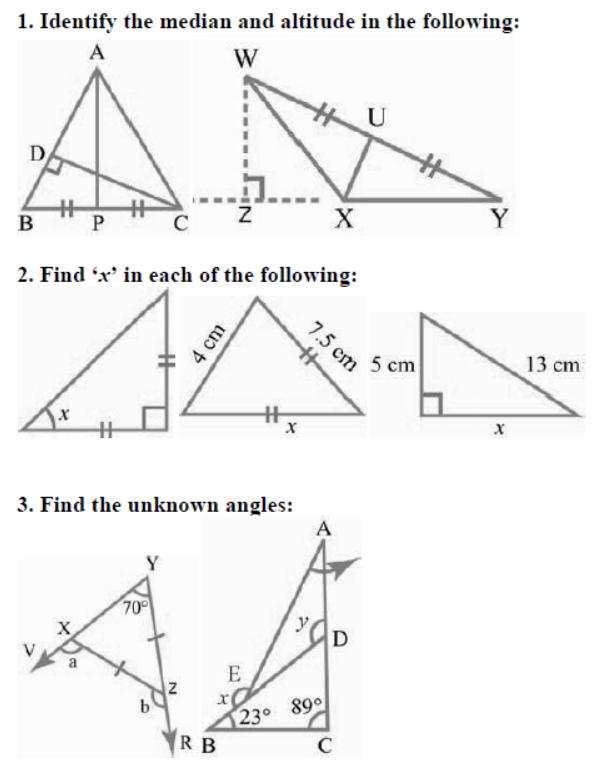
Question 1. Identify the median and altitude in the following:
Answer:
- In the first figure (Triangle ABC):
AP is the altitude because it is perpendicular to the base BC (indicated by the right-angle symbol at P).
CD is the median because it joins the vertex C to the midpoint D of the opposite side AB (shown by the equal tick marks on AD and DB).
- In the second figure (Triangle WXY):
WZ is the altitude because it is the perpendicular line segment dropped from vertex W to the line containing the opposite side XY.
XU is the median because it connects the vertex X to the midpoint U of the opposite side WY (shown by the equal tick marks on WU and UY).
In simple words: An altitude is a straight line making a 90-degree angle, while a median is a line that cuts the opposite side into two equal halves.
Exam Tip: Always look for the square perpendicular box for altitudes and the matching tick marks on a side for medians.
Question 2. Find ‘x’ in each of the following:
Answer:
- In the first figure (left):
This is a right-angled triangle. The base and height have identical single tick marks, which means they are equal in length. This is an isosceles right triangle.
The angles opposite to equal sides must be equal, so:
\( x + x + 90^{\circ} = 180^{\circ} \)
\( \implies 2x = 90^{\circ} \)
\( \implies x = 45^{\circ} \)
- In the second figure (middle):
The base and the right side have identical double tick marks, indicating they are equal in length.
Since the right side is \( 7.5 \text{ cm} \), the base \( x \) must also be equal to it:
\( x = 7.5 \text{ cm} \)
- In the third figure (right):
This is a right-angled triangle. Using Pythagoras' theorem:
\( x^2 + 5^2 = 13^2 \)
\( \implies x^2 + 25 = 169 \)
\( \implies x^2 = 144 \)
\( \implies x = 12 \text{ cm} \)
In simple words: The first value is \( 45^{\circ} \), the second is \( 7.5 \text{ cm} \), and the third is \( 12 \text{ cm} \).
Exam Tip: Remember the basic Pythagorean triplets like (5, 12, 13) to quickly verify your answers in exams.
Question 3. Find the unknown angles:
Answer:
- In the first figure (left):
The triangle \( XYZ \) has equal sides \( YX \) and \( YZ \) (shown by single tick marks). This means the angles opposite to these sides are equal:
\( \angle YXZ = \angle YZX \)
Let these angles be \( \theta \). Using the angle sum property of triangles:
\( 70^{\circ} + \theta + \theta = 180^{\circ} \)
\( \implies 2\theta = 110^{\circ} \)
\( \implies \theta = 55^{\circ} \)
Angle \( a \) and \( \angle YXZ \) form a linear pair:
\( a + 55^{\circ} = 180^{\circ} \implies a = 125^{\circ} \)
Similarly, angle \( b \) and \( \angle YZX \) form a linear pair:
\( b + 55^{\circ} = 180^{\circ} \implies b = 125^{\circ} \)
- In the second figure (right):
We are given that line segment \( ED \) is parallel to \( BC \) (indicated by the arrowheads on the lines). Therefore, the corresponding angles are equal:
\( x = \angle B = 23^{\circ} \) (Corresponding angles)
\( y = \angle C = 89^{\circ} \) (Corresponding angles)
In simple words: In the first diagram, \( a = 125^{\circ} \) and \( b = 125^{\circ} \). In the second diagram, \( x = 23^{\circ} \) and \( y = 89^{\circ} \).
Exam Tip: When lines are parallel, identify the transversal line clearly to find matching alternate or corresponding angles.
Page 4
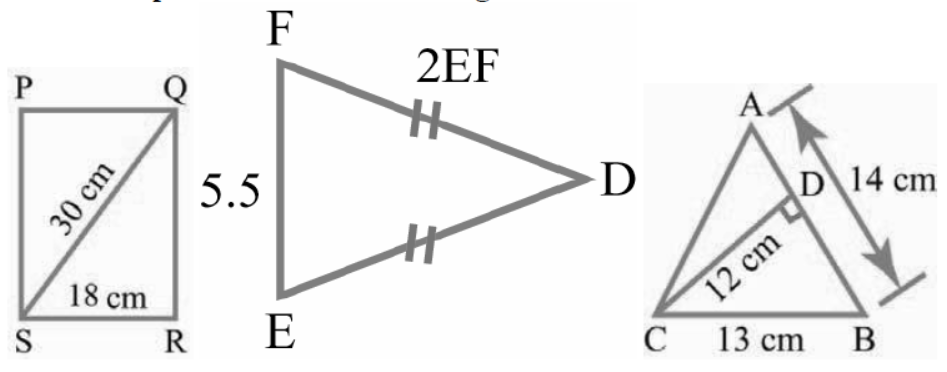
Question 4. Find the perimeter of the following:
Answer:
- In the first figure (left):
In the right-angled triangle \( SRQ \):
\( QR^2 + SR^2 = SQ^2 \)
\( QR^2 + 18^2 = 30^2 \)
\( \implies QR^2 + 324 = 900 \)
\( \implies QR^2 = 576 \)
\( \implies QR = 24 \text{ cm} \)
Since \( PQRS \) is a rectangle with length \( 24 \text{ cm} \) and breadth \( 18 \text{ cm} \):
\( \text{Perimeter} = 2(\text{Length} + \text{Breadth}) \)
\( \text{Perimeter} = 2(24 + 18) = 2(42) = 84 \text{ cm} \)
- In the second figure (middle):
The triangle \( FED \) has side \( FE = 5.5 \) units.
The other two sides are equal (shown by double tick marks) and are labeled as \( 2EF \):
\( FD = ED = 2 \times EF = 2 \times 5.5 = 11 \text{ units} \)
\( \text{Perimeter} = FE + ED + DF = 5.5 + 11 + 11 = 27.5 \text{ units} \)
- In the third figure (right):
The triangle \( ABC \) has three sides of lengths \( AB = 14 \text{ cm} \), \( BC = 13 \text{ cm} \), and \( AC = 12 \text{ cm} \).
\( \text{Perimeter} = AB + BC + AC = 14 + 13 + 12 = 39 \text{ cm} \)
In simple words: The perimeter of the first shape is 84 cm, the second is 27.5 units, and the third is 39 cm.
Exam Tip: Perimeter is simply the total distance around the outside of a shape. Always sum up all outer boundary sides.
Question 5. The angles of a triangle are in the ratio 2 : 3 : 4. The measure of the smallest angle is _______.
Answer: 40°
Let the three angles of the triangle be \( 2x \), \( 3x \), and \( 4x \).
The sum of the angles in a triangle is \( 180^{\circ} \):
\( 2x + 3x + 4x = 180^{\circ} \)
\( \implies 9x = 180^{\circ} \)
\( \implies x = 20^{\circ} \)
The smallest angle is:
\( 2x = 2 \times 20^{\circ} = 40^{\circ} \)
In simple words: The smallest angle is 40 degrees.
Exam Tip: To find any angle from a ratio, divide 180 by the sum of the ratio terms, then multiply by the specific ratio number.
Question 6. In a right-angled triangle, the ___________ is the longest side.
Answer: hypotenuse
The hypotenuse is the side opposite to the right angle (90°) and is always the longest side of a right-angled triangle.
In simple words: The longest side of a right-angled triangle is called the hypotenuse.
Exam Tip: Examiners look for the correct spelling of "hypotenuse" in fill-in-the-blank questions.
Question 7. In a triangle right angled at B, AB = 7 cm, AC = 25 cm, then BC = ?
Answer: 24 cm
Using Pythagoras' theorem in triangle \( ABC \) (right-angled at B):
\( AB^2 + BC^2 = AC^2 \)
\( 7^2 + BC^2 = 25^2 \)
\( \implies 49 + BC^2 = 625 \)
\( \implies BC^2 = 576 \)
\( \implies BC = 24 \text{ cm} \)
In simple words: The side BC is 24 cm long.
Exam Tip: Double check your calculations by verifying that \( 7^2 + 24^2 \) indeed equals \( 25^2 \).
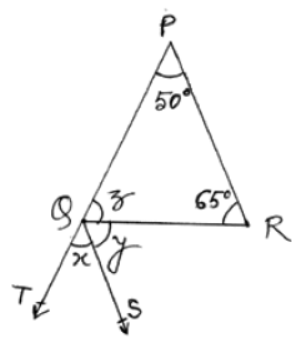
Question 8. If PR || QS, find the measures of x, y and z.
Answer:
Given that line \( PR \) is parallel to line \( QS \):
- For the transversal line \( PQ \):
\( z = \angle QPR = 50^{\circ} \) (Alternate interior angles)
- For the transversal line \( TR \):
\( x = \angle PRQ = 65^{\circ} \) (Corresponding angles)
- Since \( TQR \) is a straight line, the sum of the angles on it is \( 180^{\circ} \):
\( x + y + z = 180^{\circ} \)
Substitute the values of \( x \) and \( z \):
\( 65^{\circ} + y + 50^{\circ} = 180^{\circ} \)
\( \implies y + 115^{\circ} = 180^{\circ} \)
\( \implies y = 65^{\circ} \)
So, \( x = 65^{\circ} \), \( y = 65^{\circ} \), and \( z = 50^{\circ} \).
In simple words: The values are \( x = 65^{\circ} \), \( y = 65^{\circ} \), and \( z = 50^{\circ} \).
Exam Tip: Alternate interior angles are equal when two parallel lines are cut by a transversal.
Question 9. Can a triangle have two right angles?
a) yes b) no c) maybe d) none of these
Answer: b) no
The sum of all three angles of a triangle is always 180°. If a triangle had two right angles (90° each), their sum alone would be 180°, leaving 0° for the third angle, which is impossible.
In simple words: No, because a triangle's angles cannot add up to more than 180 degrees.
Exam Tip: Use the angle sum property of triangles to justify why a triangle cannot have more than one right angle or obtuse angle.
Question 10. A line segment that joins the vertex to the midpoint of the opposite side in a triangle is called the
a) altitude b) bisector c) median d) ray
Answer: c) median
A median is the line segment connecting a vertex to the middle point of the opposite side of a triangle.
In simple words: The line segment joining a corner to the middle of the opposite side is called the median.
Exam Tip: Be clear on the difference between altitude (perpendicular) and median (joins to midpoint).
Question 11. In a right triangle c2 = a2 + b2, the hypotenuse will be
a) a b) b c) c d) a + b
Answer: c) c
According to the Pythagorean theorem, the square of the hypotenuse is equal to the sum of the squares of the other two sides. In \( c^2 = a^2 + b^2 \), \( c \) is the hypotenuse.
In simple words: The letter c represents the hypotenuse of the triangle.
Exam Tip: The hypotenuse is always represented by the single term on one side of the Pythagoras equation.
Free study material for Mathematics
Download Class 7 Mathematics Chapter 06 The Triangle and its Properties Practice Worksheets
Download Chapter Worksheets: Class 7 Mathematics
Access structured practice worksheets for Chapter 06 The Triangle and its Properties aligned with the 2026 CBSE curriculum. These downloadable exercises for Class 7 Mathematics help students build accuracy and reinforce core concepts for upcoming school tests.
Concept Clarification for Chapter 06 The Triangle and its Properties
Designed around the official curriculum for Class 7 Mathematics, these practice sheets guarantee standard compliance. Reviewing step-by-step solutions after completion sharpens your accuracy and clarifies complex sub-topics within Chapter 06 The Triangle and its Properties.
Effective Revision Strategies for School Exams
Wrap up your chapter revision by testing your knowledge against standard objective question formats. Explore our full library of free, up-to-date printable assignments to maximize your academic results in upcoming CBSE evaluations.
FAQs
You can download the latest chapter-wise printable worksheets for Class 7 Mathematics Chapter 06 The Triangle and its Properties for free from StudiesToday.com. These have been made as per the latest CBSE curriculum for this academic year.
Yes, Class 7 Mathematics worksheets for Chapter 06 The Triangle and its Properties focus on activity-based learning and also competency-style questions. This helps students to apply theoretical knowledge to practical scenarios.
Yes, we have provided solved worksheets for Class 7 Mathematics Chapter 06 The Triangle and its Properties to help students verify their answers instantly.
Yes, our Class 7 Mathematics test sheets are mobile-friendly PDFs and can be printed by teachers for classroom.
For Chapter 06 The Triangle and its Properties, regular practice with our worksheets will improve question-handling speed and help students understand all technical terms and diagrams.