

Class 12 Mathematics Practice Sheet: CBSE Class 12 Mathematics Linear Differential Equations Worksheet Set 05
Explore structured practice materials through the CBSE Class 12 Mathematics Linear Differential Equations Worksheet Set 05. Tailored for Class 12 learners, utilizing these Mathematics worksheets ensures thorough preparation and strengthens problem-solving accuracy before final school evaluations.
Download Chapter 09 Differential Equations Worksheet PDF with Answers
Navigate directly to the solved Mathematics worksheets using the digital viewer below. Each practice set includes detailed step-by-step solutions, allowing students to instantly cross-check their work and identify areas requiring further revision.
CBSE Class 12 Mathematics Linear Differential Equations (5). The Relations And Functions questions in the worksheets have been specifically designed by best mathematics teachers so that the students can practice them to clear their Relations And Functions concepts and get better marks in class 12 mathematics tests and examinations. Students can free download these Relations And Functions worksheets in pdf and practice them. This will help them to get better marks in examinations. Also refer to other worksheets for the Relations And Functions chapter and other subjects too. Use them for better understanding of the subjects.
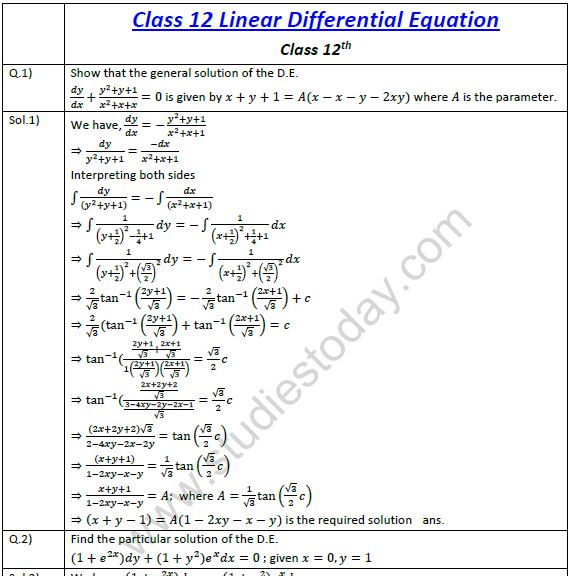
Question. Show that the general solution of the D.E. \( \frac{dy}{dx} + \frac{y^2+y+1}{x^2+x+1} = 0 \) is given by \( x + y + 1 = A(1 - x - y - 2xy) \) where \( A \) is the parameter.
Answer: We have, \( \frac{dy}{dx} = -\frac{y^2+y+1}{x^2+x+1} \)
\( \implies \frac{dy}{y^2+y+1} = \frac{-dx}{x^2+x+1} \)
Interpreting both sides:
\( \int \frac{dy}{y^2+y+1} = -\int \frac{dx}{x^2+x+1} \)
\( \implies \int \frac{1}{\left(y+\frac{1}{2}\right)^2 - \frac{1}{4} + 1} dy = -\int \frac{1}{\left(x+\frac{1}{2}\right)^2 - \frac{1}{4} + 1} dx \)
\( \implies \int \frac{1}{\left(y+\frac{1}{2}\right)^2 + \left(\frac{\sqrt{3}}{2}\right)^2} dy = -\int \frac{1}{\left(x+\frac{1}{2}\right)^2 + \left(\frac{\sqrt{3}}{2}\right)^2} dx \)
\( \implies \frac{2}{\sqrt{3}} \tan^{-1}\left(\frac{2y+1}{\sqrt{3}}\right) = -\frac{2}{\sqrt{3}} \tan^{-1}\left(\frac{2x+1}{\sqrt{3}}\right) + c \)
\( \implies \frac{2}{\sqrt{3}}\left(\tan^{-1}\left(\frac{2y+1}{\sqrt{3}}\right) + \tan^{-1}\left(\frac{2x+1}{\sqrt{3}}\right)\right) = c \)
\( \implies \tan^{-1}\left( \frac{\frac{2y+1}{\sqrt{3}} + \frac{2x+1}{\sqrt{3}}}{1 - \left(\frac{2y+1}{\sqrt{3}}\right)\left(\frac{2x+1}{\sqrt{3}}\right)} \right) = \frac{\sqrt{3}}{2}c \)
\( \implies \tan^{-1}\left( \frac{\frac{2x+2y+2}{\sqrt{3}}}{\frac{3-4xy-2y-2x-1}{3}} \right) = \frac{\sqrt{3}}{2}c \)
\( \implies \frac{(2x+2y+2)\sqrt{3}}{2-4xy-2x-2y} = \tan \left( \frac{\sqrt{3}}{2}c \right) \)
\( \implies \frac{(x+y+1)\sqrt{3}}{1-2xy-x-y} = \tan \left( \frac{\sqrt{3}}{2}c \right) \)
\( \implies \frac{x+y+1}{1-2xy-x-y} = \frac{1}{\sqrt{3}}\tan\left(\frac{\sqrt{3}}{2}c\right) \)
\( \implies \frac{x+y+1}{1-2xy-x-y} = A \); where \( A = \frac{1}{\sqrt{3}}\tan\left(\frac{\sqrt{3}}{2}c\right) \)
\( \implies (x + y + 1) = A(1 - 2xy - x - y) \) is the required solution.
Question. Find the particular solution of the D.E. \( (1 + e^{2x})dy + (1 + y^2)e^xdx = 0 \); given \( x = 0, y = 1 \)
Answer: We have, \( (1 + e^{2x})dy = -(1 + y^2)e^xdx \)
\( \implies \frac{dy}{dx} = -\frac{(1+y^2)e^x}{1+e^{2x}} \)
Separating the variables & interpreting both sides:
\( \implies \int \frac{dy}{1+y^2} = -\int \frac{e^x}{1+e^{2x}} dx \)
Put \( e^x = t \implies e^x dx = dt \)
\( \implies \tan^{-1} y = -\int \frac{dt}{1+t^2} \)
\( \implies \tan^{-1} y = -\tan^{-1} t + c \)
\( \implies \tan^{-1}(y) + \tan^{-1}(e^x) = c \)
Put \( x = 0 \) & \( y = 1 \):
\( \implies \tan^{-1}(1) + \tan^{-1}(1) = c \implies c = \frac{\pi}{4} + \frac{\pi}{4} = \frac{\pi}{2} \)
\( \therefore \tan^{-1}(y) + \tan^{-1}(e^x) = \frac{\pi}{2} \)
\( \implies \tan^{-1}\left(\frac{y+e^x}{1-ye^x}\right) = \frac{\pi}{2} \)
\( \implies \frac{y+e^x}{1-ye^x} = \tan\left(\frac{\pi}{2}\right) \)
\( \implies \frac{y+e^x}{1-ye^x} = \frac{1}{0} \quad \dots \left\{\tan\left(\frac{\pi}{2}\right) = \infty\right\} \)
\( \implies 0 = 1 - ye^x \)
\( \implies y = \frac{1}{e^x} \) is the required solution.
Question. At any point \( (x, y) \) of a curve, the slope of the tangent is twice the slope of the line segment joining the point of contact to the point \( (-4, -3) \). Find the equation of the curve given that it passes through \( (-2,1) \).
Answer: It is given that \( (x, y) \) is the point of contact of the curve and its tangent.
Hence the slope of the line segment joining \( (x, y) \) and \( (-4, -3) \) is \( m_1 = \frac{y+3}{x+4} \).
Let this be \( m_1 \)
But we know that the slope of the tangent to the curve is \( \frac{dy}{dx} \).
Let this be \( m_2 \)
According to the given information, \( m_2 = 2m_1 \)
\( \frac{dy}{dx} = \frac{2(y+3)}{x+4} \)
Separating the variables, we get:
\( \frac{dy}{y+3} = \frac{2dx}{x+4} \)
Integrating on both sides, we get:
\( \int \frac{dy}{y+3} = 2\int \frac{dx}{x+4} \)
\( \implies \log(y + 3) = 2 \log(x + 4) + \log c \)
\( \implies \log(y + 3) = \log [c(x + 4)^2] \)
\( \implies y + 3 = c(x + 4)^2 \)
It is given that the curve passes through the point \( (-2, 1) \).
Substituting for \( x \) and \( y \) in the general equation to evaluate for \( c \), we get:
\( 1 + 3 = c(-2 + 4)^2 \)
\( \implies 4 = 4c \)
\( \implies c = 1 \)
Substituting this for \( c \), we get:
\( y + 3 = (x + 4)^2 \) is the required equation of the curve.
Question. Solve the D.E. \( \sqrt{1 + x^2 + y^2 + x^2y^2} + xy\frac{dy}{dx} = 0 \)
Answer: We have, \( xy\frac{dy}{dx} = -\sqrt{1 + x^2 + y^2 + x^2y^2} \)
\( \implies \frac{dy}{dx} = -\frac{\sqrt{(1+x^2)(1+y^2)}}{xy} \)
\( \implies \frac{dy}{dx} = -\frac{\sqrt{1+x^2}\sqrt{1+y^2}}{xy} \)
Separating the variables & interpreting both sides:
\( \implies \int \frac{y}{\sqrt{1+y^2}} dy = -\int \frac{\sqrt{1+x^2}}{x} dx \)
Put \( 1+y^2 = t \implies ydy = \frac{dt}{2} \)
Put \( 1+x^2 = z^2 \implies 2xdx = 2zdz \implies dx = \frac{zdz}{x} \)
\( \therefore \frac{1}{2}\int \frac{dt}{\sqrt{t}} = -\int \frac{z}{x} \cdot \frac{zdx}{x} \)
\( \implies \frac{1}{2} \times 2\sqrt{t} = -\int \frac{z^2}{z^2-1} dz \)
\( \implies \sqrt{t} = -\int \frac{z^2-1+1}{z^2-1} dz \)
\( \implies \sqrt{t} = -\int \left( 1 + \frac{1}{z^2-1} \right) dz \)
\( \implies \sqrt{1+y^2} = -\left[ z + \frac{1}{2} \log \left| \frac{z-1}{z+1} \right| \right] + c \)
\( \implies \sqrt{1+y^2} = -\left[ \sqrt{1+x^2} + \frac{1}{2} \log \left| \frac{\sqrt{1+x^2}-1}{\sqrt{1+x^2}+1} \right| \right] + c \)
\( \implies \sqrt{1+x^2} + \sqrt{1+y^2} + \frac{1}{2} \log \left| \frac{\sqrt{1+x^2}-1}{\sqrt{1+x^2}+1} \right| = c \)
Question. Find the equation of the curve passing through the point \( (1,0) \) given that slope of the tangent to the curve at any point \( (x, y) \) is \( \frac{2x(\log x+1)}{\sin y+y \cos y} \).
Answer: Slope of tangent at any point \( (x, y) \) is given by \( \frac{dy}{dx} \).
We have, \( \frac{dy}{dx} = \frac{2x(\log x+1)}{\sin y+y \cos y} \)
\( \implies (\sin y + y \cos y)dy = 2x(\log x + 1)dx \)
Interpreting both sides:
\( \int(\sin y + y \cos y)dy = 2 \int x(\log x + 1)dx \)
\( \implies \int \sin y dy + \int y \cos y dy = 2 \int x dx + 2 \int x \log x dx \)
\( \implies -\cos y + y \sin y - \int \sin y dy = \frac{2x^2}{2} + 2 \left[ \log x \cdot \frac{x^2}{2} - \int \frac{1}{x} \cdot \frac{x^2}{2} dx \right] \)
\( \implies -\cos y + y \sin y + \cos y = x^2 + 2 \left( \frac{x^2}{2} \log x - \frac{x^2}{4} \right) + c \)
\( \implies y \sin y = x^2 + x^2 \log x - \frac{x^2}{2} + c \)
This equation passes through the point \( (1,0) \).
Put \( x = 1 \) and \( y = 0 \):
\( \implies 0 = 1 + 0 - \frac{1}{2} + c \)
\( \implies c = -\frac{1}{2} \)
\( \therefore y \sin y = x^2 + x^2 \log x - \frac{x^2}{2} - \frac{1}{2} \)
\( \implies y \sin y = \frac{x^2}{2} + x^2 \log x - \frac{1}{2} \)
\( \implies 2y \sin y = x^2 + 2x^2 \log x - 1 \) is the required equation of curve.
Question. Solve the D.E. \( 3e^x \tan y dx + (1 - e^x) \sec^2 y dy = 0 \)
Answer: We have, \( (1 - e^x) \sec^2 y dy = -3e^x \tan y dx \)
\( \implies \frac{dy}{dx} = \frac{-3e^x \tan y}{(1-e^x) \sec^2 y} \)
Separating variables & interpreting both sides:
\( \implies \int \frac{\sec^2 y}{\tan y} dy = -3 \int \frac{e^x}{1-e^x} dx \)
Put \( \tan y = t \implies \sec^2 y dy = dt \)
Put \( 1 - e^x = z \implies -e^x dx = dz \)
\( \implies \log|t| = 3 \log z + \log c \)
\( \implies \log\left| \frac{t}{z^3} \right| = \log c \)
Replacing \( t \) & \( z \):
\( \implies \left| \frac{\tan y}{(e^x-1)^3} \right| = c \)
\( \implies \frac{\tan y}{(e^x-1)^3} = \pm c \)
\( \implies \tan y = c_1(e^x - 1)^3 \) where \( c_1 = \pm c \) is the required solution.
Question. For the D.E. \( xy\frac{dy}{dx} = (x + 2)(y + 2) \). Find the solution curve passes through \( (1,-1) \).
Answer: We have, \( \frac{dy}{dx} = \frac{(x+2)(y+2)}{xy} \)
\( \implies \frac{y}{y+2} dy = \frac{x+2}{x} dx \)
Interpreting both sides:
\( \implies \int \frac{y+2-2}{y+2} dy = \int \left( \frac{x}{x} + \frac{2}{x} \right) dx \)
\( \implies \int \left( 1 - \frac{2}{y+2} \right) dy = \int \left( 1 + \frac{2}{x} \right) dx \)
\( \implies y - 2 \log|y + 2| = x + 2 \log|x| + c \)
It passes through the point \( (1,-1) \).
Put \( x = 1 \) & \( y = -1 \):
\( \therefore -1 - 2 \log|-1+2| = 1 + 2 \log|1| + c \)
\( \implies -1 - 0 = 1 + 0 + c \implies c = -2 \)
\( \therefore y - 2 \log|y + 2| = x + 2 \log|x| - 2 \)
\( \implies y - x + 2 = 2 \log|x| + 2 \log|y+2| \)
\( \implies y - x + 2 = \log|x^2(y + 2)^2| \)
\( \implies y - x + 2 = \log\left(x^2(y + 2)^2\right) \)
Question. In a bank principal increases at the rate of 5% per year. In how many years Rs.1000 double itself.
Answer: Let \( P \) be the principal at any time \( t \).
Then, according to the question:
\( \frac{dp}{dt} = 5 \frac{p}{100} \)
\( \implies \frac{dp}{dt} = \frac{p}{20} \)
\( \implies \frac{1}{p} dp = \frac{1}{20} dt \)
Interpreting both sides:
\( \int \frac{1}{p} dp = \frac{1}{20} \int dt \)
\( \implies \log p = \frac{1}{20}t + c \)
\( \implies p = e^{\frac{1}{20}t+c} \)
\( \implies p = e^{\frac{t}{20}} \cdot e^c \)
\( \implies p = e^{\frac{t}{20}} \cdot c_1 \) where \( c_1 = e^c \)
Given at \( t = 0 \); \( p = 1000 \):
\( \therefore 1000 = e^0 \cdot c_1 \)
\( \implies c_1 = 1000 \)
\( \therefore p = e^{\frac{t}{20}} \cdot 1000 \)
Let at \( t = t_1 \); \( p = 2000 \):
\( \implies 2000 = e^{\frac{t_1}{20}} \cdot 1000 \)
\( \implies e^{\frac{t_1}{20}} = 2 \)
Taking log on both sides:
\( \frac{t_1}{20} = \log_e 2 \)
\( t_1 = 20 \log_e 2 \) years
\( \therefore \) principal doubles in \( 20 \log_e 2 \) years.
Question. The volume of a spherical balloon being inflated changes at a constant rate. If initially its radius is 3 units & after 3 seconds it is 6 units. Find the radius of the balloon after \( t \) seconds.
Answer: Let the rate of change of the volume of balloon be \( k \).
Hence, \( \frac{dv}{dt} = k \)
\( \implies \frac{d}{dt}\left(\frac{4}{3}\pi r^3\right) = k \)
\( \implies \frac{4}{3}\pi(3r^2) \left(\frac{dr}{dt}\right) = k \)
Now separating the variables, we get:
\( 4\pi r^2 dr = k dt \)
Integrating on both sides we get:
\( 4\pi \int r^2 dr = k \int dt \)
\( \implies 4\pi \left(\frac{r^3}{3}\right) = kt + C \)
\( \implies 4\pi r^3 = 3(kt + C) \)
Given \( t = 0, r = 3 \):
\( 4\pi (3^3) = 3(k \cdot 0 + C) \)
\( \implies 108\pi = 3C \)
\( \implies C = 36\pi \)
When \( t = 3, r = 6 \):
\( 4\pi \cdot 6^3 = 3(3k + C) \)
\( \implies 864\pi = 3(3k + 36\pi) \)
Dividing throughout by 3 we get:
\( 3k = 288\pi - 36\pi \)
\( \implies 3k = 252\pi \)
Hence, \( k = 84\pi \).
Now substituting the values of \( k \) and \( C \):
\( 4\pi r^3 = 3(84\pi t + 36\pi) \)
Taking \( 12\pi \) as a common factor:
\( 4\pi r^3 = 4\pi (63t + 27) \)
Dividing throughout by \( 4\pi \):
\( r^3 = 63t + 27 \)
\( r = (63t + 27)^{\frac{1}{3}} \)
Thus the radius of the balloon after \( t \) seconds is \( (63t + 27)^{\frac{1}{3}} \).
Question. In a culture the bacteria count is 1,00,000. The number is increases by 10% in 2 hours. In how many hours will the count reach 2,00,000, if the rate of growth of bacteria is proportional to the number present?
Answer: From the given information we know that \( \frac{dy}{dt} \) is proportional to \( y \).
\( \frac{dy}{dt} = ky \)
On separating the variables, we get:
\( \frac{dy}{y} = k \cdot dt \)
Integrating on both sides, we get:
\( \int \frac{dy}{y} = k \int dt \)
\( \log y = kt + c \quad \dots (1) \)
Let \( y_0 \) be the number of bacteria when \( t = 0 \).
Hence, \( \log y_0 = c \)
Substituting this value in equation (1), we get:
\( \log y = kt + \log y_0 \)
\( \implies \log y - \log y_0 = kt \)
\( \implies \log \left(\frac{y}{y_0}\right) = kt \quad \dots (2) \)
It is also given that the number of bacteria increases 10% in 2 hours.
Hence, \( y = \frac{110}{100} y_0 = \frac{11}{10} y_0 \) at \( t = 2 \).
Substituting this in (2):
we get \( 2k = \log\left(\frac{11}{10}\right) \)
or \( k = \frac{1}{2} \log\left(\frac{11}{10}\right) \)
Therefore, \( \frac{1}{2} \log\left(\frac{11}{10}\right) t = \log\left(\frac{y}{y_0}\right) \)
\( \implies t = \frac{2 \log\left(\frac{y}{y_0}\right)}{\log\left(\frac{11}{10}\right)} \)
Let the time when the number of bacteria increases from 1,00,000 to 2,00,000 be \( t_1 \).
\( y = 2y_0 \) at \( t = t_1 \)
Hence, \( t_1 = \frac{2 \log\left(\frac{2y_0}{y_0}\right)}{\log\left(\frac{11}{10}\right)} = \frac{2 \log 2}{\log\left(\frac{11}{10}\right)} \)
Hence, in \( \frac{2 \log 2}{\log\left(\frac{11}{10}\right)} \) hours, the number of bacteria increases from 1,00,000 to 2,00,000.
Please click the link below to download CBSE Class 12 Mathematics Linear Differential Equations (5).
Free study material for Mathematics
Free CBSE Practice Worksheets: Class 12 Mathematics Chapter 09 Differential Equations
Download Chapter Worksheets: Class 12 Mathematics
Explore reliable practice questions for Chapter 09 Differential Equations tailored for Class 12 Mathematics learners. Use these structured worksheets to evaluate exam preparedness and strengthen problem-solving skills throughout the 2026 academic session.
Concept Clarification for Chapter 09 Differential Equations
Designed around the official curriculum for Class 12 Mathematics, these practice sheets guarantee standard compliance. Reviewing step-by-step solutions after completion sharpens your accuracy and clarifies complex sub-topics within Chapter 09 Differential Equations.
Effective Revision Strategies for School Exams
Follow up your worksheet practice by attempting the interactive online MCQ tests for Chapter 09 Differential Equations to evaluate your execution speed. All printable assignments and revision sheets on our platform are updated for the 2026 session and available free of charge.
FAQs
You can download the latest chapter-wise printable worksheets for Class 12 Mathematics Chapter 09 Differential Equations for free from StudiesToday.com. These have been made as per the latest CBSE curriculum for this academic year.
Yes, Class 12 Mathematics worksheets for Chapter 09 Differential Equations focus on activity-based learning and also competency-style questions. This helps students to apply theoretical knowledge to practical scenarios.
Yes, we have provided solved worksheets for Class 12 Mathematics Chapter 09 Differential Equations to help students verify their answers instantly.
Yes, our Class 12 Mathematics test sheets are mobile-friendly PDFs and can be printed by teachers for classroom.
For Chapter 09 Differential Equations, regular practice with our worksheets will improve question-handling speed and help students understand all technical terms and diagrams.