

Here is the CBSE Class 12 Mathematics Integration Worksheet Set 08 for your practice. Download printable Class 12 Mathematics worksheets covering Chapter 7 Integrals for the 2026-27 academic session. Created by experienced educators, these sheets follow official testing patterns from NCERT, CBSE, and KVS to help students succeed.
Download Class 12 Mathematics Chapter 7 Integrals Printable Sheet
Every student in Class 12 can use this Mathematics practice paper to review Chapter 7 Integrals. Complete with important questions and solutions, regular self-testing will boost your confidence and improve your grades in school assessments and final tests.
Chapter 7 Integrals Questions & Answers for Class 12 Mathematics
CBSE Class 12 Mathematics Integration Worksheet (6). CBSE issues sample papers every year for students for class 12 board exams. Students should solve the CBSE issued sample papers to understand the pattern of the question paper which will come in class 12 board exams this year. The sample papers have been provided with marking scheme. It’s always recommended to practice as many CBSE sample papers as possible before the board examinations. Sample papers should be always practiced in examination condition at home or school and the student should show the answers to teachers for checking or compare with the answers provided. Students can download the sample papers in pdf format free and score better marks in examinations. Refer to other links too for latest sample papers.
Integration (Indefinite Integrals)
Type: \( \int e^{ax} \sin(bx + c) \, dx \), \( \int e^{ax} \cos(bx + c) \, dx \)
I repeats of the two types by Parts
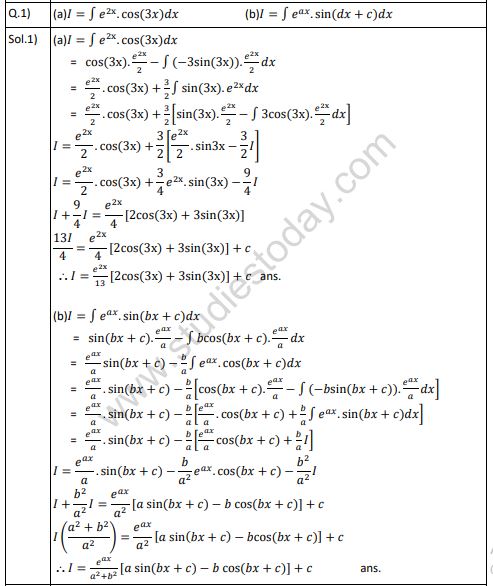
Question. (a) \( I = \int e^{2x} \cdot \cos(3x) \, dx \) (b) \( I = \int e^{ax} \cdot \sin(dx + c) \, dx \)
Answer:
(a) \( I = \int e^{2x} \cdot \cos(3x) \, dx \)
\( = \cos(3x) \cdot \frac{e^{2x}}{2} - \int (-3\sin(3x)) \cdot \frac{e^{2x}}{2} \, dx \)
\( = \frac{e^{2x}}{2} \cdot \cos(3x) + \frac{3}{2}\int \sin(3x) \cdot e^{2x} \, dx \)
\( = \frac{e^{2x}}{2} \cdot \cos(3x) + \frac{3}{2} \left[ \sin(3x) \cdot \frac{e^{2x}}{2} - \int 3\cos(3x) \cdot \frac{e^{2x}}{2} \, dx \right] \)
\( I = \frac{e^{2x}}{2} \cdot \cos(3x) + \frac{3}{2} \left[ \frac{e^{2x}}{2} \cdot \sin(3x) - \frac{3}{2} I \right] \)
\( I = \frac{e^{2x}}{2} \cdot \cos(3x) + \frac{3}{4} e^{2x} \cdot \sin(3x) - \frac{9}{4} I \)
\( I + \frac{9}{4} I = \frac{e^{2x}}{4} [2\cos(3x) + 3\sin(3x)] \)
\( \frac{13I}{4} = \frac{e^{2x}}{4} [2\cos(3x) + 3\sin(3x)] + c \)
\( \therefore I = \frac{e^{2x}}{13} [2\cos(3x) + 3\sin(3x)] + c \) ans.
(b) \( I = \int e^{ax} \cdot \sin(bx + c) \, dx \)
\( = \sin(bx + c) \cdot \frac{e^{ax}}{a} - \int b\cos(bx + c) \cdot \frac{e^{ax}}{a} \, dx \)
\( = \frac{e^{ax}}{a} \sin(bx + c) - \frac{b}{a}\int e^{ax} \cdot \cos(bx + c) \, dx \)
\( = \frac{e^{ax}}{a} \cdot \sin(bx + c) - \frac{b}{a} \left[ \cos(bx + c) \cdot \frac{e^{ax}}{a} - \int (-b\sin(bx + c)) \cdot \frac{e^{ax}}{a} \, dx \right] \)
\( = \frac{e^{ax}}{a} \cdot \sin(bx + c) - \frac{b}{a} \left[ \frac{e^{ax}}{a} \cdot \cos(bx + c) + \frac{b}{a}\int e^{ax} \cdot \sin(bx + c) \, dx \right] \)
\( = \frac{e^{ax}}{a} \cdot \sin(bx + c) - \frac{b}{a} \left[ \frac{e^{ax}}{a} \cos(bx + c) + \frac{b}{a} I \right] \)
\( I = \frac{e^{ax}}{a} \cdot \sin(bx + c) - \frac{b^2}{a^2} e^{ax} \cdot \cos(bx + c) - \frac{b^2}{a^2} I \)
\( I + \frac{b^2}{a^2} I = \frac{e^{ax}}{a^2} [a \sin(bx + c) - b \cos(bx + c)] + c \)
\( I \left( \frac{a^2 + b^2}{a^2} \right) = \frac{e^{ax}}{a^2} [a \sin(bx + c) - b\cos(bx + c)] + c \)
\( \therefore I = \frac{e^{ax}}{a^2 + b^2} [a \sin(bx + c) - b \cos(bx + c)] + c \) ans.
Question. \( I = \int e^x \cdot \cos^2 x \, dx \)
Answer:
\( I = \int e^x \cdot \cos^2 x \, dx \)
\( = \int e^x \cdot \left\{ \frac{1+\cos(2x)}{2} \right\} \, dx \)
\( = \frac{1}{2}\int e^x + e^x \cdot \cos(2x) \, dx \)
\( I = \frac{1}{2}\int e^x \, dx + \frac{1}{2}\int e^x \cdot \cos(2x) \, dx \)
\( I = \frac{1}{2}\int e^x \, dx + \frac{1}{2} I_1 \)
where \( I_1 = \int e^x \cdot \cos(2x) \, dx \)
\( = \cos(2x) \cdot e^x - \int -2\sin(2x) \cdot e^x \, dx \)
\( = e^x \cdot \cos(2x) + 2\int e^x \cdot \sin(2x) \, dx \)
\( = e^x \cdot \cos(2x) + 2 [ e^x \cdot \sin(2x) - 2\int \cos(2x) \cdot e^x \, dx ] \)
\( I_1 = e^x \cos(2x) + 2 e^x \sin(2x) - 4 I_1 \)
\( 5 I_1 = e^x [\cos(2x) + 2\sin(2x)] \)
\( I_1 = \frac{e^x}{5} [\cos(2x) + 2\sin(2x)] + c \)
\( \therefore I = \frac{1}{2} e^x + \frac{1}{2} \left[ \frac{e^x}{5} \cdot (\cos(2x) + 2\sin(2x)) \right] + c \) ans.
Type: \( I = \int e^x ( f(x) + f'(x) ) \, dx \)
\( I = \int e^x \cdot f(x) \, dx + \int e^x \cdot f'(x) \, dx \)
\( = f(x) \cdot e^x - \int f'(x) \cdot e^x \, dx + \int e^x \cdot f'(x) \, dx \)
\( I = e^x \cdot f(x) + c \)
Question. (a) \( I = \int e^x \left( \frac{2+\sin(2x)}{1+\cos(2x)} \right) \, dx \) (b) \( I = \int e^x \left( \frac{1-\sin x}{1-\cos x} \right) \, dx \) (c) \( I = \int e^{2x} \left( \frac{1+\sin(2x)}{1+\cos(2x)} \right) \, dx \)
Answer:
(a) \( I = \int e^x \left( \frac{2+\sin(2x)}{1+\cos(2x)} \right) \, dx \)
\( = \int e^x \left[ \frac{2+2\sin x \cdot \cos x}{2\cos^2 x} \right] \, dx \)
\( = \int e^x \left[ \frac{2}{2\cos^2 x} + \frac{2\sin x \cdot \cos x}{2\cos^2 x} \right] \, dx \)
\( = \int e^x (\sec^2 x + \tan x) \, dx \qquad \dots\dots \{f'(x) = \sec^2 x, f(x) = \tan x\} \)
\( = \int e^x \cdot \tan x \, dx + \int e^x \sec^2 x \, dx \)
\( = \tan x \cdot e^x - \int \sec^2 x \cdot e^x \, dx + \int e^x \sec^2 x \, dx \)
\( = e^x \cdot \tan x + c \) ans.
(b) \( I = \int e^x \left( \frac{1-\sin x}{1-\cos x} \right) \, dx \)
\( = \int e^x \left[ \frac{1 - 2\sin\frac{x}{2} \cdot \cos\frac{x}{2}}{2\sin^2\frac{x}{2}} \right] \, dx \)
\( = \int e^x \left[ \frac{1}{2\sin^2\frac{x}{2}} - \frac{2\sin\frac{x}{2} \cdot \cos\frac{x}{2}}{2\sin^2\frac{x}{2}} \right] \, dx \)
\( = \int e^x \left[ \frac{1}{2}\csc^2\left(\frac{x}{2}\right) - \cot\left(\frac{x}{2}\right) \right] \, dx \qquad \dots\dots \{f'(x) = \frac{1}{2}\csc^2\left(\frac{x}{2}\right), f(x) = -\cot\left(\frac{x}{2}\right)\} \)
\( = -\int e^x \cdot \cot\left(\frac{x}{2}\right) \, dx + \frac{1}{2}\int e^x \cdot \csc^2\left(\frac{x}{2}\right) \, dx \)
\( = -\left[ \cot\left(\frac{x}{2}\right) \cdot e^x - \int -\frac{1}{2}\csc^2\left(\frac{x}{2}\right) \cdot e^x \, dx \right] + \frac{1}{2}\int e^x \cdot \csc^2\left(\frac{x}{2}\right) \, dx \)
\( = -e^x \cot\left(\frac{x}{2}\right) - \frac{1}{2}\int e^x \cdot \csc^2\left(\frac{x}{2}\right) \, dx + \frac{1}{2}\int e^x \cdot \csc^2\left(\frac{x}{2}\right) \, dx \)
\( = I = -e^x \cdot \cot\left(\frac{x}{2}\right) + c \) ans.
(c) \( I = \int e^{2x} \left( \frac{1+\sin(2x)}{1+\cos(2x)} \right) \, dx \)
\( = \int e^{2x} \left( \frac{1+2\sin x \cos x}{2\cos^2 x} \right) \, dx \)
\( = \int e^{2x} \cdot \left( \frac{1}{2}\sec^2 x + \tan x \right) \, dx \)
\( = \int e^{2x} \cdot \tan x \, dx + \frac{1}{2}\int e^{2x} \cdot \sec^2 x \, dx \)
\( = \tan x \cdot \frac{e^{2x}}{2} - \int \sec^2 x \cdot \frac{e^{2x}}{2} \, dx + \frac{1}{2}\int e^{2x} \cdot \sec^2 x \, dx \)
\( I = \frac{1}{2} e^{2x} \cdot \tan x + c \) ans.
Question. (a) \( I = \int e^x - \frac{x}{(x+1)^2} \, dx \) (b) \( I = \int e^x \left( \frac{x-4}{(x-2)^3} \right) \, dx \)
Answer:
(a) \( I = \int e^x \cdot \frac{x}{(x+1)^2} \, dx \)
\( = \int e^x \left[ \frac{x+1-1}{(x+1)^2} \right] \, dx \)
\( = \int e^x \left[ \frac{1}{x+1} - \frac{1}{(x+1)^2} \right] \, dx \qquad \dots\dots \{f(x) = \frac{1}{x+1}, f'(x) = -\frac{1}{(x+1)^2}\} \)
\( = \int e^x \cdot \frac{1}{x+1} \, dx - \int e^x \cdot \frac{1}{(x+1)^2} \, dx \)
\( = \frac{1}{x+1} \cdot e^x + \int \frac{1}{(x+1)^2} \cdot e^x \, dx - \int \frac{1}{(x+1)^2} \cdot e^x \, dx \)
\( I = e^x \cdot \frac{1}{x+1} + c \) ans.
(b) \( I = \int e^x \left( \frac{x-4}{(x-2)^3} \right) \, dx \)
\( = \int e^x \left( \frac{x-4}{(x-2)^3} \right) \, dx \)
\( = \int e^x \left[ \frac{1}{(x-2)^2} - \frac{2}{(x-2)^3} \right] \, dx \qquad \dots\dots \{f(x) = \frac{1}{(x-2)^2}, f'(x) = -\frac{2}{(x-2)^3}\} \)
Proceed Yourself
\( e^x \cdot \frac{1}{(x-2)^2} + c \) ans.
Question. \( I = \int e^x \cdot \frac{(x^2 + 1)}{(x + 1)^2} \, dx \)
Answer:
\( I = \int e^x \cdot \frac{(x^2 + 1)}{(x + 1)^2} \, dx \)
\( = \int e^x \cdot \left[ \frac{x^2+1+2x-2x}{(x+1)^2} \right] \, dx \)
\( = \int e^x \left( \frac{x^2+1+2x}{(x+1)^2} - \frac{2x}{(x+1)^2} \right) \, dx \)
\( = \int e^x \left( 1 - \frac{2x}{(x+1)^2} \right) \, dx \)
\( = \int e^x \, dx - 2\int e^x \cdot \frac{x}{(x+1)^2} \, dx \)
\( = e^x - 2\int e^x \cdot \left[ \frac{x+1-1}{(x+1)^2} \right] \, dx \)
\( = e^x - 2\int e^x \left( \frac{1}{x+1} - \frac{1}{(x+1)^2} \right) \, dx \)
\( = e^x - 2 \left[ \int e^x \cdot \frac{1}{x+1} \, dx - \int e^x \cdot \frac{1}{(x+1)^2} \, dx \right] \)
\( = e^x - 2 \left[ \frac{1}{(x+1)} \cdot e^x + \int \frac{1}{(x+1)^2} \cdot e^x \, dx - \int e^x \cdot \frac{1}{(x+1)^2} \, dx \right] \)
\( = e^x - 2 \cdot \frac{e^x}{x+1} + c \)
\( = e^x \left( 1 - \frac{2}{(x+1)} \right) + c \)
\( = e^x \left( \frac{x-1}{x+1} \right) + c \) ans.
Question. (a) \( I = \int \frac{\log x}{(\log x+1)^2} \, dx \) (b) \( I = \int \left[ \log(\log x) + \frac{1}{(\log x)^2} \right] \, dx \)
Answer:
(a) \( I = \int \frac{\log x}{(\log x+1)^2} \, dx \)
put \( \log x = t \)
\( x = e^t \)
\( dx = e^t \, dt \)
\( \therefore I = \int \frac{t}{(t+1)^2} \cdot e^t \, dt \)
\( = \int e^t \left[ \frac{t+1-1}{(t+1)^2} \right] \, dt \)
\( = \int e^t \left[ \frac{1}{t+1} - \frac{1}{(t+1)^2} \right] \, dt \)
\( = e^t \cdot \frac{1}{t+1} + c \)
replacing \( t \):
\( = x \cdot \frac{1}{\log x+1} + c \) ans.
(b) \( I = \int \left[ \log(\log x) + \frac{1}{(\log x)^2} \right] \, dx \)
put \( \log x = t \)
\( x = e^t \)
\( dx = e^t \, dt \)
\( \therefore I = \int \left( \log t + \frac{1}{t^2} \right) \cdot e^t \, dt \)
adjustment:
\( = \int e^t \left[ \log t + \frac{1}{t} - \frac{1}{t} + \frac{1}{t^2} \right] \, dt \)
\( = \int e^t \left( \log t + \frac{1}{t} \right) \, dt - \int e^t \left( \frac{1}{t} - \frac{1}{t^2} \right) \, dt \)
\( = \left[ \int e^t \log t \, dt + \int e^t \cdot \frac{1}{t} \, dt \right] - \left[ \int e^t \cdot \frac{1}{t} \, dt - \int e^t \cdot \frac{1}{t^2} \, dt \right] \)
\( = \left[ \log t \cdot e^t - \int \frac{1}{t} \cdot e^t \, dt + \int e^t \cdot \frac{1}{t} \, dt \right] - \left[ \frac{1}{t} \cdot e^t + \int \frac{1}{t^2} \cdot e^t \, dt - \int e^t \cdot \frac{1}{t^2} \, dt \right] \)
\( = \log t \cdot e^t - \frac{1}{t} \cdot e^t + c \)
\( = e^t \left( \log t - \frac{1}{t} \right) + c \)
\( I = x \left( \log(\log x) - \frac{1}{\log x} \right) + c \) ans.
Question. (a) \( I = \int e^{-x/2} \frac{\sqrt{1-\sin x}}{1+\cos x} \, dx \) (b) \( I = \int e^{2x} (-\sin x + 2\cos x) \, dx \)
Answer:
(a) \( I = \int e^{-x/2} \frac{\sqrt{1-\sin x}}{1+\cos x} \, dx \)
\( = \int e^{-x/2} \frac{\sqrt{\sin^2\frac{x}{2}+\cos^2\frac{x}{2}-2\sin\frac{x}{2}\cos\frac{x}{2}}}{2\cos^2\left(\frac{x}{2}\right)} \, dx \)
\( = \int e^{-x/2} \frac{\sqrt{\left(\sin\frac{x}{2}-\cos\frac{x}{2}\right)^2}}{2\cos^2\frac{x}{2}} \, dx \)
\( = \int e^{-x/2} \frac{\left(\sin\frac{x}{2}-\cos\frac{x}{2}\right)}{2\cos^2\left(\frac{x}{2}\right)} \, dx \)
\( = \int e^{-x/2} \left[ \frac{1}{2}\tan\frac{x}{2} \cdot \sec\frac{x}{2} - \frac{1}{2}\sec\left(\frac{x}{2}\right) \right] \, dx \)
\( = -\frac{1}{2}\int e^{-x/2} \sec\left(\frac{x}{2}\right) \, dx + \frac{1}{2}\int e^{-x/2} \sec\frac{x}{2} \cdot \tan\frac{x}{2} \, dx \)
\( = -\frac{1}{2} \left[ \sec\left(\frac{x}{2}\right) \cdot e^{-x/2}(-2) - \int \sec\left(\frac{x}{2}\right) \cdot \tan\frac{x}{2} \cdot \left(\frac{1}{2}\right) \cdot e^{-x/2}(-2) \, dx \right] + \frac{1}{2}\int e^{-x/2} \cdot \sec\frac{x}{2}\tan\frac{x}{2} \, dx \)
\( = e^{-x/2} \cdot \sec\frac{x}{2} - \frac{1}{2}\int e^{-x/2} \cdot \sec\frac{x}{2}\tan\frac{x}{2} \, dx + \frac{1}{2}\int e^{-x/2} \sec\frac{x}{2}\tan\frac{x}{2} \, dx \)
\( = e^{-x/2}\sec\left(\frac{x}{2}\right) + c \) ans.
Type: \( \int \sqrt{\text{Quadratic}} \, dx \) and \( \int \text{Linear}\sqrt{\text{Quadratic}} \, dx \)
Perfect Square. Use Long Formula
Question. (a) \( I = \int \sqrt{(x - 3)(5 - x)} \, dx \) (b) \( I = \int \sqrt{2x^2 + 3x + 4} \, dx \) (c) \( I = \int \sqrt{3 - 2x - 2x^2} \, dx \)
Answer:
(a) \( I = \int \sqrt{(x - 3)(5 - x)} \, dx \)
\( = \int \sqrt{5x - x^2 - 15 + 3x} \, dx \)
\( = \int \sqrt{-x^2 + 8x - 15} \, dx \)
\( = \int \sqrt{-[x^2 - 8x + 15]} \, dx \)
\( = \int \sqrt{-[(x - 4)^2 - 1]} \, dx \)
\( = \int \sqrt{1^2 - (x - 4)^2} \, dx \)
\( = \frac{(x-4)}{2}\sqrt{1 - (x - 4)^2} + \frac{1}{2}\sin^{-1}\left(\frac{x-4}{1}\right) + c \)
\( = \frac{(x-4)}{2}\sqrt{(x - 3)(5 - x)} + \frac{1}{2}\sin^{-1}(x - 4) + c \) ans.
Question. \( I = \int \cos x\sqrt{4 - \sin^2 x} \, dx \)
Answer:
\( I = \int \cos x\sqrt{4 - \sin^2 x} \, dx \)
put \( \sin x = t \)
\( \therefore \cos x \, dx = dt \)
\( I = \int \sqrt{4 - t^2} \, dt \)
\( = \frac{t}{2}\sqrt{4 - t^2} + 2\sin^{-1}\left(\frac{t}{2}\right) + c \)
\( = \frac{\sin x}{2}\sqrt{4 - \sin^2 x} + 2\sin^{-1}\left(\frac{\sin x}{2}\right) + c \) ans.
Question. (a) \( I = \int (3x - 2)\sqrt{x^2 + x + 1} \, dx \) (b) \( I = \int (4x + 1)\sqrt{x^2 - x - 2} \, dx \)
Answer:
(a) \( I = \int (3x - 2)\sqrt{x^2 + x + 1} \, dx \)
(take \( 2x + 1 \))
\( = 3\int \left(x - \frac{2}{3}\right)\sqrt{x^2 + x + 1} \, dx \)
\( = \frac{3}{2}\int \left(2x - \frac{4}{3}\right)\sqrt{x^2 + x + 1} \, dx \)
\( = \frac{3}{2}\int \left(2x - \frac{4}{3} + 1 - 1\right)\sqrt{x^2 + x + 1} \, dx \)
\( = \frac{3}{2}\int (2x + 1)\sqrt{x^2 + x + 1} \, dx - \frac{7}{2}\int \sqrt{x^2 + x + 1} \, dx \)
put \( x^2 + x + 1 = t \) in I
\( (2x + 1)dx = dt \)
\( = \frac{3}{2}\int \sqrt{t} \, dt - \frac{7}{2}\int \sqrt{\left(x + \frac{1}{2}\right)^2 - \frac{1}{4} + 1} \, dx \)
\( = \frac{3}{2} \times \frac{2}{3}(t)^{3/2} - \frac{7}{2}\int \sqrt{\left(x + \frac{1}{2}\right)^2 + \left(\frac{\sqrt{3}}{2}\right)^2} \, dx \)
\( = (t)^{3/2} - \frac{7}{2} \left[ \frac{\left(x+\frac{1}{2}\right)}{2}\sqrt{\left(x + \frac{1}{2}\right)^2 + \left(\frac{\sqrt{3}}{2}\right)^2} + \frac{3}{8}\log\left| \left(x + \frac{1}{2}\right) + \sqrt{\left(x + \frac{1}{2}\right)^2 + \left(\frac{\sqrt{3}}{2}\right)^2} \right| \right] \)
\( = (x^2 + x + 1)^{3/2} - \frac{7}{2}\left[ \frac{(2x+1)}{4}\sqrt{x^2 + x + 1} + \frac{3}{8}\log\left| \frac{2x+1}{2} + \sqrt{x^2 + x + 1} \right| \right] \)
(b) \( I = \int (4x + 1)\sqrt{x^2 - x - 2} \, dx \)
\( = 2\int \left(2x + \frac{1}{2}\right)\sqrt{x^2 - x - 2} \, dx \)
\( = 2\int \left(2x + \frac{1}{2} - 1 + 1\right)\sqrt{x^2 - x - 2} \, dx \)
\( = 2\int \left(2x - 1 + \frac{3}{2}\right)\sqrt{x^2 - x - 2} \, dx \)
\( = 2\int (2x - 1)\sqrt{x^2 - x - 2} \, dx + 3\int \sqrt{x^2 - x - 2} \, dx \)
put \( x^2 - x - 2 = t \)
\( (2x - 1)dx = dt \)
\( \dots I = 2\int \sqrt{t} \, dt + 3\int \sqrt{\left(x - \frac{1}{2}\right)^2 - \frac{1}{4} - 2} \, dx \)
\( = 2 \times \frac{2}{3}(t)^{3/2} + 3\int \sqrt{\left(x - \frac{1}{2}\right)^2 - \left(\frac{3}{2}\right)^2} \, dx \)
\( = \frac{4}{3}(t)^{3/2} + 3\left[ \frac{2x-1}{4}\sqrt{x^2 - x - 2} - \frac{9}{8}\log\left| \frac{2x-1}{2} + \sqrt{x^2 - x - 2} \right| \right] \) ans.
Please click the link below to download full pdf file for CBSE Class 12 Mathematics Integration Worksheet (6).
Free study material for Mathematics
Practice Questions & Worksheets for Class 12 Mathematics Chapter 7 Integrals
Practice Exercises for Class 12 Mathematics
Prepare effectively for your upcoming evaluations by utilizing the curated practice tasks for Chapter 7 Integrals featured above. Built by expert educators to reflect the current 2026 CBSE guidelines for Class 12, these tools support steady academic growth. Regular practice is strongly recommended for Class 12 students seeking lasting proficiency in Mathematics.
Detailed Answers & NCERT Integration
Built using specifications from the active NCERT book for Class 12 Mathematics, these worksheets mirror authentic academic structures. Comparing your completed work with our expert-verified solutions ensures you learn standard formatting for CBSE exams. Supplement your study routine with the provided MCQ questions for Mathematics to touch upon every essential learning objective.
Boosting Grades with Free Mathematics Resources
Consistent engagement with this Class 12 Mathematics material builds familiarity with recurring exam themes and high-yield questions. Whenever you encounter challenging concepts in Chapter 7 Integrals, turn to our comprehensive NCERT solutions for Class 12 Mathematics for immediate clarity. All printable assignments and revision sheets hosted on our platform remain completely free to support Class 12 students in raising their examination scores.
FAQs
You can download the latest chapter-wise printable worksheets for Class 12 Mathematics Chapter 7 Integrals for free from StudiesToday.com. These have been made as per the latest CBSE curriculum for this academic year.
Yes, Class 12 Mathematics worksheets for Chapter 7 Integrals focus on activity-based learning and also competency-style questions. This helps students to apply theoretical knowledge to practical scenarios.
Yes, we have provided solved worksheets for Class 12 Mathematics Chapter 7 Integrals to help students verify their answers instantly.
Yes, our Class 12 Mathematics test sheets are mobile-friendly PDFs and can be printed by teachers for classroom.
For Chapter 7 Integrals, regular practice with our worksheets will improve question-handling speed and help students understand all technical terms and diagrams.