

Class 12 Mathematics Practice Sheet: CBSE Class 12 Mathematics Determinants Worksheet Set 03
Access comprehensive chapter-wise worksheets for Chapter 04 Determinants using the CBSE Class 12 Mathematics Determinants Worksheet Set 03. Designed to align with the 2026-27 academic syllabus for Class 12 Mathematics, these printable practice sets help students reinforce key concepts and improve their overall exam readiness.
Download Chapter 04 Determinants Worksheet PDF with Answers
Access the complete worksheet PDF for Class 12 Mathematics below. Regular practice with these targeted academic tasks builds familiarity with standard question patterns and helps secure higher marks in final school examinations.
CBSE Class 12 Mathematics Determinants Worksheet (3). The Determinants questions in the worksheets have been specifically designed by best mathematics teachers so that the students can practise them to clear their Determinants concepts and get better marks in class 12 mathematics tests and examinations. Students can free download these Determinants worksheets in pdf and practice them. This will help them to get better marks in examinations. Also refer to other worksheets for the Determinants chapter and other subjects too. Use them for better understanding of the subjects.
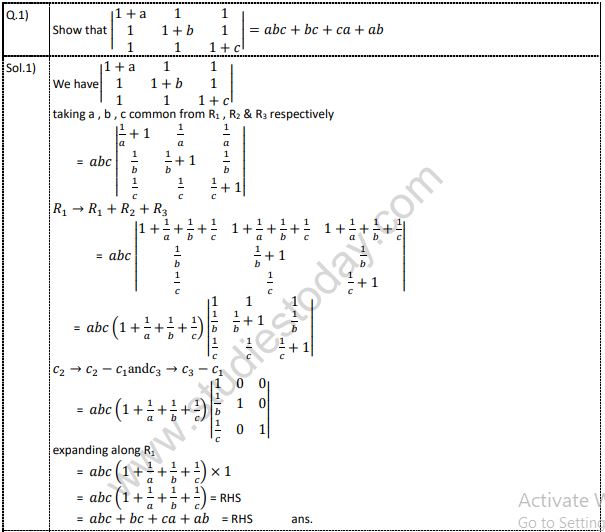
Question 1. Show that \( \begin{vmatrix} 1 + a & 1 & 1 \\ 1 & 1 + b & 1 \\ 1 & 1 & 1 + c \end{vmatrix} = abc + bc + ca + ab \).
Answer: Let us denote the given determinant by \( \Delta \):
\( \Delta = \begin{vmatrix} 1 + a & 1 & 1 \\ 1 & 1 + b & 1 \\ 1 & 1 & 1 + c \end{vmatrix} \)
By factoring out \( a \), \( b \), and \( c \) from the first, second, and third rows respectively, we get:
\( \Delta = abc \begin{vmatrix} \frac{1}{a} + 1 & \frac{1}{a} & \frac{1}{a} \\ \frac{1}{b} & \frac{1}{b} + 1 & \frac{1}{b} \\ \frac{1}{c} & \frac{1}{c} & \frac{1}{c} + 1 \end{vmatrix} \)
Applying the row operation \( R_1 \to R_1 + R_2 + R_3 \):
\( \Delta = abc \begin{vmatrix} 1 + \frac{1}{a} + \frac{1}{b} + \frac{1}{c} & 1 + \frac{1}{a} + \frac{1}{b} + \frac{1}{c} & 1 + \frac{1}{a} + \frac{1}{b} + \frac{1}{c} \\ \frac{1}{b} & \frac{1}{b} + 1 & \frac{1}{b} \\ \frac{1}{c} & \frac{1}{c} & \frac{1}{c} + 1 \end{vmatrix} \)
Factoring out the term \( \left(1 + \frac{1}{a} + \frac{1}{b} + \frac{1}{c}\right) \) from the first row \( R_1 \):
\( \Delta = abc \left(1 + \frac{1}{a} + \frac{1}{b} + \frac{1}{c}\right) \begin{vmatrix} 1 & 1 & 1 \\ \frac{1}{b} & \frac{1}{b} + 1 & \frac{1}{b} \\ \frac{1}{c} & \frac{1}{c} & \frac{1}{c} + 1 \end{vmatrix} \)
Now, performing the column transformations \( C_2 \to C_2 - C_1 \) and \( C_3 \to C_3 - C_1 \):
\( \Delta = abc \left(1 + \frac{1}{a} + \frac{1}{b} + \frac{1}{c}\right) \begin{vmatrix} 1 & 0 & 0 \\ \frac{1}{b} & 1 & 0 \\ \frac{1}{c} & 0 & 1 \end{vmatrix} \)
Expanding the simplified determinant along the first row \( R_1 \):
\( \Delta = abc \left(1 + \frac{1}{a} + \frac{1}{b} + \frac{1}{c}\right) \times [1 \cdot (1 - 0)] \)
\( \implies \Delta = abc \left(1 + \frac{1}{a} + \frac{1}{b} + \frac{1}{c}\right) \)
\( \implies \Delta = abc + bc + ca + ab = \text{R.H.S.} \)
Hence, verified.
In simple words: Factor out a, b, and c from the rows to simplify the variables. Then add the second and third rows to the first row, factor out the common bracket, and use column subtractions to easily compute the final value.
Exam Tip: Always look for a way to create identical row or column elements that can be factored out. This is a very common trick in Board exams.
Question 2. Show that \( \begin{vmatrix} a & a + b & a + b + c \\ 2a & 3a + 2b & 4a + 3b + 2c \\ 3a & 6a + 3b & 10a + 6b + 3c \end{vmatrix} = a^3 \).
Answer: Let us write the given determinant as:
\( \Delta = \begin{vmatrix} a & a + b & a + b + c \\ 2a & 3a + 2b & 4a + 3b + 2c \\ 3a & 6a + 3b & 10a + 6b + 3c \end{vmatrix} \)
Factoring out the term \( a \) from the first column \( C_1 \):
\( \Delta = a \begin{vmatrix} 1 & a + b & a + b + c \\ 2 & 3a + 2b & 4a + 3b + 2c \\ 3 & 6a + 3b & 10a + 6b + 3c \end{vmatrix} \)
Applying the row operations \( R_2 \to R_2 - 2R_1 \) and \( R_3 \to R_3 - 3R_1 \) to create zeros in the first column:
\( \Delta = a \begin{vmatrix} 1 & a + b & a + b + c \\ 0 & a & 2a + b \\ 0 & 3a & 7a + 3b \end{vmatrix} \)
To simplify the third row, we apply \( R_3 \to R_3 - 3R_2 \):
\( \Delta = a \begin{vmatrix} 1 & a + b & a + b + c \\ 0 & a & 2a + b \\ 0 & 0 & a \end{vmatrix} \)
Now, expanding the determinant along the first column \( C_1 \):
\( \Delta = a [1 \cdot (a \cdot a - 0)] \)
\( \implies \Delta = a \cdot a^2 = a^3 = \text{R.H.S.} \)
Hence, verified.
In simple words: Factor out the term 'a' from the first column, then subtract multiples of the first row from the others to create zeros. Finally, expand the triangular matrix to prove the result.
Exam Tip: Creating zeros in a single column or row using row operations is the most efficient way to simplify and expand determinants.
Question 3. If x, y, z are different and \( \begin{vmatrix} x & x^2 & 1 + x^3 \\ y & y^2 & 1 + y^3 \\ z & z^2 & 1 + z^3 \end{vmatrix} = 0 \), then show \( xyz = -1 \).
Answer: We start with the equation:
\( \begin{vmatrix} x & x^2 & 1 + x^3 \\ y & y^2 & 1 + y^3 \\ z & z^2 & 1 + z^3 \end{vmatrix} = 0 \)
Splitting the determinant into two by applying the addition property on the third column \( C_3 \):
\( \begin{vmatrix} x & x^2 & 1 \\ y & y^2 & 1 \\ z & z^2 & 1 \end{vmatrix} + \begin{vmatrix} x & x^2 & x^3 \\ y & y^2 & y^3 \\ z & z^2 & z^3 \end{vmatrix} = 0 \)
Factoring out \( x \) from the first row, \( y \) from the second row, and \( z \) from the third row of the second determinant:
\( \begin{vmatrix} x & x^2 & 1 \\ y & y^2 & 1 \\ z & z^2 & 1 \end{vmatrix} + xyz \begin{vmatrix} 1 & x & x^2 \\ 1 & y & y^2 \\ 1 & z & z^2 \end{vmatrix} = 0 \)
We interchange the second and third columns \( C_2 \leftrightarrow C_3 \) in the first determinant, introducing a negative sign:
\( - \begin{vmatrix} x & 1 & x^2 \\ y & 1 & y^2 \\ z & 1 & z^2 \end{vmatrix} + xyz \begin{vmatrix} 1 & x & x^2 \\ 1 & y & y^2 \\ 1 & z & z^2 \end{vmatrix} = 0 \)
Next, interchanging the first and second columns \( C_1 \leftrightarrow C_2 \) yields another sign change, making it positive:
\( \begin{vmatrix} 1 & x & x^2 \\ 1 & y & y^2 \\ 1 & z & z^2 \end{vmatrix} + xyz \begin{vmatrix} 1 & x & x^2 \\ 1 & y & y^2 \\ 1 & z & z^2 \end{vmatrix} = 0 \)
Now, factoring out the common determinant from both terms:
\( \begin{vmatrix} 1 & x & x^2 \\ 1 & y & y^2 \\ 1 & z & z^2 \end{vmatrix} (1 + xyz) = 0 \)
To evaluate the determinant, we apply row operations \( R_2 \to R_2 - R_1 \) and \( R_3 \to R_3 - R_1 \):
\( \begin{vmatrix} 1 & x & x^2 \\ 0 & y - x & y^2 - x^2 \\ 0 & z - x & z^2 - x^2 \end{vmatrix} (1 + xyz) = 0 \)
We can factor out \( (y - x) \) from \( R_2 \) and \( (z - x) \) from \( R_3 \):
\( (y - x)(z - x) \begin{vmatrix} 1 & x & x^2 \\ 0 & 1 & y + x \\ 0 & 1 & z + x \end{vmatrix} (1 + xyz) = 0 \)
Expanding the remaining determinant along the first column \( C_1 \):
\( (y - x)(z - x) [1 \cdot ((z + x) - (y + x))] (1 + xyz) = 0 \)
\( \implies (y - x)(z - x)(z - y)(1 + xyz) = 0 \)
Given that \( x, y, z \) are all distinct, none of the differences can be zero:
\( y - x \neq 0 \)
\( z - x \neq 0 \)
\( z - y \neq 0 \)
Consequently, the only remaining term must be zero, which gives:
\( 1 + xyz = 0 \)
\( \implies xyz = -1 \)
Hence, verified.
In simple words: Use the column addition rule to break the determinant into two parts. Rearrange the columns to make both determinants identical, factor it out, and use the fact that the variables are distinct to show that the remaining term is zero.
Exam Tip: Be very careful with signs when interchanging columns. Each single swap of adjacent rows or columns multiplies the determinant by -1.
Question 4. Show that \( \begin{vmatrix} -bc & b^2 + bc & c^2 + bc \\ a^2 + ac & -ac & c^2 + ac \\ a^2 + ab & b^2 + ab & -ab \end{vmatrix} = (ab + bc + ca)^3 \).
Answer: Let us define the determinant as \( \Delta \):
\( \Delta = \begin{vmatrix} -bc & b^2 + bc & c^2 + bc \\ a^2 + ac & -ac & c^2 + ac \\ a^2 + ab & b^2 + ab & -ab \end{vmatrix} \)
We multiply the rows \( R_1 \), \( R_2 \), and \( R_3 \) by \( a \), \( b \), and \( c \) respectively, and divide the determinant by \( abc \) to keep it equal:
\( \Delta = \frac{1}{abc} \begin{vmatrix} -abc & ab^2 + abc & ac^2 + abc \\ a^2b + abc & -abc & bc^2 + abc \\ a^2c + abc & b^2c + abc & -abc \end{vmatrix} \)
Next, factoring out \( a \), \( b \), and \( c \) from columns \( C_1 \), \( C_2 \), and \( C_3 \) respectively:
\( \Delta = \frac{abc}{abc} \begin{vmatrix} -bc & ab + ac & ac + ab \\ ab + bc & -ac & bc + ab \\ ac + bc & bc + ac & -ab \end{vmatrix} = \begin{vmatrix} -bc & ab + ac & ac + ab \\ ab + bc & -ac & bc + ab \\ ac + bc & bc + ac & -ab \end{vmatrix} \)
We perform the row addition \( R_1 \to R_1 + R_2 + R_3 \):
\( \Delta = \begin{vmatrix} ab + bc + ac & ab + bc + ac & ab + bc + ac \\ ab + bc & -ac & bc + ab \\ ac + bc & bc + ac & -ab \end{vmatrix} \)
Factoring out the common algebraic expression \( (ab + bc + ca) \) from the first row:
\( \Delta = (ab + bc + ca) \begin{vmatrix} 1 & 1 & 1 \\ ab + bc & -ac & bc + ab \\ ac + bc & bc + ac & -ab \end{vmatrix} \)
Applying column transformations \( C_2 \to C_2 - C_1 \) and \( C_3 \to C_3 - C_1 \) to simplify the determinant:
\( \Delta = (ab + bc + ca) \begin{vmatrix} 1 & 0 & 0 \\ ab + bc & -(ab + bc + ca) & 0 \\ ac + bc & 0 & -(ab + bc + ca) \end{vmatrix} \)
Now, factoring out \( (ab + bc + ca) \) from both the second and third columns:
\( \Delta = (ab + bc + ca)(ab + bc + ca)^2 \begin{vmatrix} 1 & 0 & 0 \\ ab + bc & -1 & 0 \\ ac + bc & 0 & -1 \end{vmatrix} \)
Expanding the remaining matrix along the first row \( R_1 \):
\( \Delta = (ab + bc + ca)^3 [1 \cdot ((-1)(-1) - 0)] \)
\( \implies \Delta = (ab + bc + ca)^3 = \text{R.H.S.} \)
Hence, verified.
In simple words: Multiply the rows by variables, factor those same variables out of the columns, and sum the rows to find a common term. Use column operations to create zeros and expand.
Exam Tip: When multiplying a determinant row by a variable, always write the compensating division factor on the outside of the determinant.
Question 5. Show that \( \begin{vmatrix} b^2 + c^2 & ab & ac \\ ba & c^2 + a^2 & bc \\ ca & cb & a^2 + b^2 \end{vmatrix} = 4a^2b^2c^2 \).
Answer: We begin by multiplying rows \( R_1 \), \( R_2 \), and \( R_3 \) by \( a \), \( b \), and \( c \) respectively, and divide by \( abc \):
\( \Delta = \frac{1}{abc} \begin{vmatrix} a(b^2 + c^2) & a^2b & a^2c \\ ab^2 & b(c^2 + a^2) & b^2c \\ c^2a & c^2b & c(a^2 + b^2) \end{vmatrix} \)
Next, we factor out \( a \), \( b \), and \( c \) from columns \( C_1 \), \( C_2 \), and \( C_3 \) respectively:
\( \Delta = \frac{abc}{abc} \begin{vmatrix} b^2 + c^2 & a^2 & a^2 \\ b^2 & c^2 + a^2 & b^2 \\ c^2 & c^2 & a^2 + b^2 \end{vmatrix} = \begin{vmatrix} b^2 + c^2 & a^2 & a^2 \\ b^2 & c^2 + a^2 & b^2 \\ c^2 & c^2 & a^2 + b^2 \end{vmatrix} \)
We add the second and third rows to the first row \( R_1 \to R_1 + R_2 + R_3 \):
\( \Delta = \begin{vmatrix} 2(b^2 + c^2) & 2(c^2 + a^2) & 2(a^2 + b^2) \\ b^2 & c^2 + a^2 & b^2 \\ c^2 & c^2 & a^2 + b^2 \end{vmatrix} \)
Factoring out \( 2 \) from the first row:
\( \Delta = 2 \begin{vmatrix} b^2 + c^2 & c^2 + a^2 & a^2 + b^2 \\ b^2 & c^2 + a^2 & b^2 \\ c^2 & c^2 & a^2 + b^2 \end{vmatrix} \)
Applying row subtractions \( R_2 \to R_2 - R_1 \) and \( R_3 \to R_3 - R_1 \):
\( \Delta = 2 \begin{vmatrix} b^2 + c^2 & c^2 + a^2 & a^2 + b^2 \\ -c^2 & 0 & -a^2 \\ -b^2 & -a^2 & 0 \end{vmatrix} \)
Again, we perform \( R_1 \to R_1 + R_2 + R_3 \) to make the first term zero:
\( \Delta = 2 \begin{vmatrix} 0 & c^2 & b^2 \\ -c^2 & 0 & -a^2 \\ -b^2 & -a^2 & 0 \end{vmatrix} \)
Expanding the simplified determinant along the first row:
\( \Delta = 2 [ -c^2((-c^2)(0) - (-a^2)(-b^2)) + b^2((-c^2)(-a^2) - 0) ] \)
\( \implies \Delta = 2 [ -c^2(-a^2b^2) + b^2(a^2c^2) ] \)
\( \implies \Delta = 2 [ a^2b^2c^2 + a^2b^2c^2 ] \)
\( \implies \Delta = 4a^2b^2c^2 = \text{R.H.S.} \)
Hence, verified.
In simple words: Multiply rows by variables, pull them out from the columns, and use row additions. Subtract the first row from the others and simplify to get the product.
Exam Tip: Practice the algebraic expansion of simple 3x3 matrices as it helps avoid basic arithmetic mistakes under exam pressure.
Question 6. Show that \( \begin{vmatrix} b + c & c + a & a + b \\ q + r & r + p & p + q \\ y + z & z + x & x + y \end{vmatrix} = 2 \begin{vmatrix} a & b & c \\ p & q & r \\ x & y & z \end{vmatrix} \).
Answer: Let us write the left-hand side determinant as:
\( \Delta = \begin{vmatrix} b + c & c + a & a + b \\ q + r & r + p & p + q \\ y + z & z + x & x + y \end{vmatrix} \)
We apply the column transformation \( C_1 \to C_1 + C_2 + C_3 \) to gather all terms in the first column:
\( \Delta = \begin{vmatrix} 2(a + b + c) & c + a & a + b \\ 2(p + q + r) & r + p & p + q \\ 2(x + y + z) & z + x & x + y \end{vmatrix} \)
Factoring out \( 2 \) from the first column:
\( \Delta = 2 \begin{vmatrix} a + b + c & c + a & a + b \\ p + q + r & r + p & p + q \\ x + y + z & z + x & x + y \end{vmatrix} \)
Next, we apply column transformations \( C_2 \to C_2 - C_1 \) and \( C_3 \to C_3 - C_1 \):
\( \Delta = 2 \begin{vmatrix} a + b + c & -b & -c \\ p + q + r & -q & -r \\ x + y + z & -y & -z \end{vmatrix} \)
We then add the second and third columns back to the first column \( C_1 \to C_1 + C_2 + C_3 \):
\( \Delta = 2 \begin{vmatrix} a & -b & -c \\ p & -q & -r \\ x & -y & -z \end{vmatrix} \)
Finally, factoring out a negative sign \( (-1) \) from both the second and third columns:
\( \Delta = 2(-1)(-1) \begin{vmatrix} a & b & c \\ p & q & r \\ x & y & z \end{vmatrix} = 2 \begin{vmatrix} a & b & c \\ p & q & r \\ x & y & z \end{vmatrix} = \text{R.H.S.} \)
Hence, verified.
In simple words: Sum all three columns to find a common term, pull it out, and subtract columns from each other to simplify. Swapping the negative signs out from the columns gives the final matrix.
Exam Tip: Column operations that involve adding or subtracting other columns do not change the value of the determinant.
Question 7. Show that \( \begin{vmatrix} a + bx & c + dx & p + qx \\ ax + b & cx + d & px + q \\ u & v & w \end{vmatrix} = (1 - x^2) \begin{vmatrix} a & c & p \\ b & d & q \\ u & v & w \end{vmatrix} \).
Answer: Let us denote the given determinant as:
\( \Delta = \begin{vmatrix} a + bx & c + dx & p + qx \\ ax + b & cx + d & px + q \\ u & v & w \end{vmatrix} \)
Applying the row transformation \( R_1 \to R_1 - xR_2 \):
\( \Delta = \begin{vmatrix} a + bx - x(ax + b) & c + dx - x(cx + d) & p + qx - x(px + q) \\ ax + b & cx + d & px + q \\ u & v & w \end{vmatrix} \)
Simplifying the terms in the first row:
\( \Delta = \begin{vmatrix} a(1 - x^2) & c(1 - x^2) & p(1 - x^2) \\ ax + b & cx + d & px + q \\ u & v & w \end{vmatrix} \)
Factoring out \( (1 - x^2) \) from the first row \( R_1 \):
\( \Delta = (1 - x^2) \begin{vmatrix} a & c & p \\ ax + b & cx + d & px + q \\ u & v & w \end{vmatrix} \)
Next, to eliminate the \( x \) term from the second row, we perform \( R_2 \to R_2 - xR_1 \):
\( \Delta = (1 - x^2) \begin{vmatrix} a & c & p \\ b & d & q \\ u & v & w \end{vmatrix} = \text{R.H.S.} \)
Hence, verified.
In simple words: Subtract the second row scaled by x from the first row, pull out the common factor, and then perform a similar operation on the second row to get the final form.
Exam Tip: Look for terms like (1 - x^2) which suggest that scaling one row or column and subtracting it from another is the right approach.
Question 8. Show that the value of the determinants \( \begin{vmatrix} a & b & c \\ b & c & a \\ c & a & b \end{vmatrix} \) is negative.
Answer: Let us define the determinant as \( \Delta \):
\( \Delta = \begin{vmatrix} a & b & c \\ b & c & a \\ c & a & b \end{vmatrix} \)
We apply the column transformation \( C_1 \to C_1 + C_2 + C_3 \):
\( \Delta = \begin{vmatrix} a + b + c & b & c \\ a + b + c & c & a \\ a + b + c & a & b \end{vmatrix} \)
Factoring out \( (a + b + c) \) from the first column \( C_1 \):
\( \Delta = (a + b + c) \begin{vmatrix} 1 & b & c \\ 1 & c & a \\ 1 & a & b \end{vmatrix} \)
Now, we perform row operations \( R_2 \to R_2 - R_1 \) and \( R_3 \to R_3 - R_1 \):
\( \Delta = (a + b + c) \begin{vmatrix} 1 & b & c \\ 0 & c - b & a - c \\ 0 & a - b & b - c \end{vmatrix} \)
Expanding the determinant along the first column \( C_1 \):
\( \Delta = (a + b + c) [1 \cdot ((c - b)(b - c) - (a - c)(a - b))] \)
\( \implies \Delta = (a + b + c) [ -(b - c)^2 - (a^2 - ab - ac + bc) ] \)
\( \implies \Delta = -(a + b + c) (a^2 + b^2 + c^2 - ab - bc - ca) \)
To simplify the algebraic expression, we multiply and divide the entire term by 2:
\( \Delta = -\frac{1}{2} (a + b + c) (2a^2 + 2b^2 + 2c^2 - 2ab - 2bc - 2ca) \)
\( \implies \Delta = -\frac{1}{2} (a + b + c) [(a - b)^2 + (b - c)^2 + (c - a)^2] \)
Since the sum of squares is positive and \( a, b, c \) are positive, the negative sign on the outside ensures the final value is negative.
In simple words: Sum the columns to factor out (a + b + c), then simplify the matrix to expand. Rewriting the expanded polynomial as a sum of squared differences shows that the result is negative.
Exam Tip: Remember the algebraic identity \( a^3 + b^3 + c^3 - 3abc = (a + b + c)(a^2 + b^2 + c^2 - ab - bc - ca) \), which is closely related to this determinant.
Question 9. If a, b, c are real number such that \( \begin{vmatrix} b + c & c + a & a + b \\ c + a & a + b & b + c \\ a + b & b + c & c + a \end{vmatrix} = 0 \) then show that either a + b + c = 0 (or) a = b = c.
Answer: We begin with the equation:
\( \begin{vmatrix} b + c & c + a & a + b \\ c + a & a + b & b + c \\ a + b & b + c & c + a \end{vmatrix} = 0 \)
Applying column transformation \( C_1 \to C_1 + C_2 + C_3 \):
\( \begin{vmatrix} 2(a + b + c) & c + a & a + b \\ 2(a + b + c) & a + b & b + c \\ 2(a + b + c) & b + c & c + a \end{vmatrix} = 0 \)
Factoring out the term \( 2(a + b + c) \) from the first column:
\( 2(a + b + c) \begin{vmatrix} 1 & c + a & a + b \\ 1 & a + b & b + c \\ 1 & b + c & c + a \end{vmatrix} = 0 \)
Applying row operations \( R_2 \to R_2 - R_1 \) and \( R_3 \to R_3 - R_1 \) to simplify the first column:
\( 2(a + b + c) \begin{vmatrix} 1 & c + a & a + b \\ 0 & b - c & c - a \\ 0 & b - a & c - b \end{vmatrix} = 0 \)
Expanding the determinant along the first column:
\( 2(a + b + c) [1 \cdot ((b - c)(c - b) - (c - a)(b - a))] = 0 \)
\( \implies -2(a + b + c) (a^2 + b^2 + c^2 - ab - bc - ca) = 0 \)
To factor the quadratic terms, we multiply and divide by 2:
\( -\frac{2}{2} (a + b + c) (2a^2 + 2b^2 + 2c^2 - 2ab - 2bc - 2ca) = 0 \)
\( \implies -(a + b + c) [(a - b)^2 + (b - c)^2 + (c - a)^2] = 0 \)
This product can only equal zero if:
Either \( a + b + c = 0 \)
Or \( (a - b)^2 + (b - c)^2 + (c - a)^2 = 0 \)
This sum of squares can only equal zero when each term is individually zero:
\( a - b = 0 \implies a = b \)
\( b - c = 0 \implies b = c \)
\( c - a = 0 \implies c = a \)
Which gives \( a = b = c \).
Therefore, either \( a + b + c = 0 \) or \( a = b = c \).
In simple words: Add all columns together to pull out a common factor, simplify the rows, and expand. Factorizing the final expression as a sum of squares shows that either the sum of terms is zero or all terms are equal.
Exam Tip: Whenever a sum of squares of real numbers equals zero, each individual term must be zero. This is a very useful property to solve algebraic equations.
Question 10. Show that \( \begin{vmatrix} 0 & a & -b \\ -a & 0 & -c \\ b & c & 0 \end{vmatrix} = 0 \).
Answer: Let the given determinant be represented as \( \Delta \):
\( \Delta = \begin{vmatrix} 0 & a & -b \\ -a & 0 & -c \\ b & c & 0 \end{vmatrix} \)
We multiply the rows \( R_1 \), \( R_2 \), and \( R_3 \) by the scalars \( c \), \( b \), and \( a \) respectively, dividing by \( abc \) to maintain equality:
\( \Delta = \frac{1}{abc} \begin{vmatrix} 0 & ac & -bc \\ -ab & 0 & -bc \\ ab & ac & 0 \end{vmatrix} \)
Now, we can factor out \( ab \) from the first column, \( ac \) from the second column, and \( bc \) from the third column:
\( \Delta = \frac{(ab)(ac)(bc)}{abc} \begin{vmatrix} 0 & 1 & -1 \\ -1 & 0 & -1 \\ 1 & 1 & 0 \end{vmatrix} \)
\( \implies \Delta = abc \begin{vmatrix} 0 & 1 & -1 \\ -1 & 0 & -1 \\ 1 & 1 & 0 \end{vmatrix} \)
Expanding this simplified determinant:
\( \Delta = abc [ -1(0 - (-1)) - 1(-1 - 0) ] \)
\( \implies \Delta = abc [ -1 + 1 ] = abc(0) = 0 = \text{R.H.S.} \)
Hence, verified.
In simple words: Multiply the rows by scaling factors, factor them out of the columns, and expand the simplified determinant to show that it is equal to zero.
Exam Tip: A skew-symmetric determinant of odd order is always equal to zero. Recognizing this property can help you quickly verify your final answer.
Please click the link below to download CBSE Class 12 Mathematics Determinants Worksheet (3)
Free study material for Mathematics
Download Class 12 Mathematics Chapter 04 Determinants Practice Worksheets
Download Chapter Worksheets: Class 12 Mathematics
Explore reliable practice questions for Chapter 04 Determinants tailored for Class 12 Mathematics learners. Use these structured worksheets to evaluate exam preparedness and strengthen problem-solving skills throughout the 2026 academic session.
Concept Clarification for Chapter 04 Determinants
Designed around the official curriculum for Class 12 Mathematics, these practice sheets guarantee standard compliance. Reviewing step-by-step solutions after completion sharpens your accuracy and clarifies complex sub-topics within Chapter 04 Determinants.
Effective Revision Strategies for School Exams
Follow up your worksheet practice by attempting the interactive online MCQ tests for Chapter 04 Determinants to evaluate your execution speed. All printable assignments and revision sheets on our platform are updated for the 2026 session and available free of charge.
FAQs
You can download the latest chapter-wise printable worksheets for Class 12 Mathematics Chapter 04 Determinants for free from StudiesToday.com. These have been made as per the latest CBSE curriculum for this academic year.
Yes, Class 12 Mathematics worksheets for Chapter 04 Determinants focus on activity-based learning and also competency-style questions. This helps students to apply theoretical knowledge to practical scenarios.
Yes, we have provided solved worksheets for Class 12 Mathematics Chapter 04 Determinants to help students verify their answers instantly.
Yes, our Class 12 Mathematics test sheets are mobile-friendly PDFs and can be printed by teachers for classroom.
For Chapter 04 Determinants, regular practice with our worksheets will improve question-handling speed and help students understand all technical terms and diagrams.