

Download Class 12 Mathematics Practice Worksheets
Review targeted academic worksheets with the CBSE Class 12 Mathematics Differential Equations Worksheet Set 01. Built according to official educational standards for the 2026-27 term, these downloadable Class 12 Mathematics resources support effective daily practice and detailed self-evaluation for Chapter 09 Differential Equations.
Access Chapter 09 Differential Equations Practice Papers and Solutions
Access the complete worksheet PDF for Class 12 Mathematics below. Regular practice with these targeted academic tasks builds familiarity with standard question patterns and helps secure higher marks in final school examinations.
CBSE Class 12 Mathematics Differentials Equation (1). Students can download these worksheets and practice them. This will help them to get better marks in examinations. Also refer to other worksheets for the same chapter and other subjects too. Use them for better understanding of the subjects.
1 MARK QUESTIONS
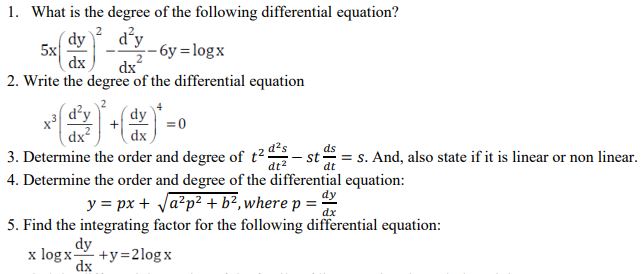
Question. What is the degree of the following differential equation?
\( 5x\left(\frac{dy}{dx}\right)^2 - \frac{d^2y}{dx^2} - 6y = \log x \)
Answer: The highest order derivative in the given differential equation is \( \frac{d^2y}{dx^2} \), which has an order of 2. The exponent of this highest order derivative is 1. Since the differential equation is a polynomial in its derivatives, the degree of the differential equation is 1.
Question. Write the degree of the differential equation
\( x^3 \left(\frac{d^2y}{dx^2}\right)^2 + \left(\frac{dy}{dx}\right)^4 = 0 \)
Answer: The highest order derivative in the given differential equation is \( \frac{d^2y}{dx^2} \), and its power is 2. Therefore, the degree of the differential equation is 2.
Question. Determine the order and degree of \( t^2 \frac{d^2s}{dt^2} - st \frac{ds}{dt} = s \). And, also state if it is linear or non linear.
Answer: For the given differential equation \( t^2 \frac{d^2s}{dt^2} - st \frac{ds}{dt} = s \):
- Order: The highest derivative present is \( \frac{d^2s}{dt^2} \), so the order is 2.
- Degree: The power of the highest order derivative \( \frac{d^2s}{dt^2} \) is 1, so the degree is 1.
- Linearity: The equation is non-linear because it contains the product of the dependent variable \( s \) and its derivative \( \frac{ds}{dt} \) in the term \( st \frac{ds}{dt} \).
Question. Determine the order and degree of the differential equation:
\( y = px + \sqrt{a^2p^2 + b^2} \), where \( p = \frac{dy}{dx} \)
Answer: First, we write the differential equation in a polynomial form with respect to its derivatives:
\( y - px = \sqrt{a^2p^2 + b^2} \)
Squaring both sides:
\( (y - px)^2 = a^2p^2 + b^2 \)
\( \Rightarrow y^2 - 2xyp + x^2p^2 = a^2p^2 + b^2 \)
Substituting \( p = \frac{dy}{dx} \):
\( y^2 - 2xy \left(\frac{dy}{dx}\right) + (x^2 - a^2)\left(\frac{dy}{dx}\right)^2 - b^2 = 0 \)
- Order: The highest order derivative present is \( \frac{dy}{dx} \), so the order is 1.
- Degree: The power of \( \frac{dy}{dx} \) in this polynomial form is 2, so the degree is 2.
Question. Find the integrating factor for the following differential equation:
\( x \log x \frac{dy}{dx} + y = 2\log x \)
Answer: Dividing the entire equation by \( x \log x \) to express it in standard linear form \( \frac{dy}{dx} + Py = Q \):
\( \frac{dy}{dx} + \frac{1}{x \log x} y = \frac{2}{x} \)
Here, \( P = \frac{1}{x \log x} \).
The Integrating Factor (I.F.) is:
\( \text{I.F.} = e^{\int P \, dx} = e^{\int \frac{1}{x \log x} \, dx} \)
To evaluate \( \int \frac{1}{x \log x} \, dx \), let \( \log x = u \implies \frac{1}{x} \, dx = du \):
\( \int \frac{1}{u} \, du = \log|u| = \log|\log x| \)
Thus, \( \text{I.F.} = e^{\log(\log x)} = \log x \).
Question. Find the differential equation of the family of lines passing through the origin
Answer: The equation of the family of lines passing through the origin is:
\( y = mx \) --- (1)
where \( m \) is an arbitrary constant. Differentiating both sides with respect to \( x \):
\( \frac{dy}{dx} = m \)
Substituting the value of \( m \) from (1) into this derivative equation:
\( \frac{dy}{dx} = \frac{y}{x} \)
\( \Rightarrow x \frac{dy}{dx} - y = 0 \)
Question. Find the differential equation of all circles, which pass through the origin and whose centres lie on the Y-axis.
Answer: Let the center of the circle on the Y-axis be \( (0, b) \). Since the circle passes through the origin \( (0,0) \), its radius is \( |b| \).
The equation of such a circle is:
\( (x - 0)^2 + (y - b)^2 = b^2 \)
\( \Rightarrow x^2 + y^2 - 2by + b^2 = b^2 \)
\( \Rightarrow x^2 + y^2 = 2by \)
\( \Rightarrow 2b = \frac{x^2 + y^2}{y} \) --- (1)
Differentiating \( x^2 + y^2 = 2by \) with respect to \( x \):
\( 2x + 2y \frac{dy}{dx} = 2b \frac{dy}{dx} \)
Substitute \( 2b \) from (1):
\( 2x + 2y \frac{dy}{dx} = \left(\frac{x^2 + y^2}{y}\right) \frac{dy}{dx} \)
\( \Rightarrow 2xy + 2y^2 \frac{dy}{dx} = (x^2 + y^2) \frac{dy}{dx} \)
\( \Rightarrow (x^2 - y^2) \frac{dy}{dx} - 2xy = 0 \)
Question. Show that the differential equation of which \( y = 2(x^2 - 1) + ce^{-x^2} \) is a solution to \( \frac{dy}{dx} + 2xy = 4x^3 \).
Answer: Given function:
\( y = 2(x^2 - 1) + ce^{-x^2} = 2x^2 - 2 + ce^{-x^2} \)
Differentiating both sides with respect to \( x \):
\( \frac{dy}{dx} = 4x + ce^{-x^2}(-2x) \)
\( \Rightarrow \frac{dy}{dx} = 4x - 2x(ce^{-x^2}) \)
From the given equation, \( ce^{-x^2} = y - 2x^2 + 2 \). Substituting this:
\( \frac{dy}{dx} = 4x - 2x(y - 2x^2 + 2) \)
\( \Rightarrow \frac{dy}{dx} = 4x - 2xy + 4x^3 - 4x \)
\( \Rightarrow \frac{dy}{dx} + 2xy = 4x^3 \)
Since LHS = RHS, the given function is a solution to the differential equation.
Question. If \( y\sqrt{x^2 + 1} = \log\left[\sqrt{x^2 + 1} - x\right] \), Show that \( (x^2 + 1)\frac{dy}{dx} + xy + 1 = 0 \)
Answer: Given:
\( y\sqrt{x^2 + 1} = \log\left[\sqrt{x^2 + 1} - x\right] \)
Differentiating both sides with respect to \( x \):
\( \frac{dy}{dx}\sqrt{x^2 + 1} + y \left( \frac{2x}{2\sqrt{x^2 + 1}} \right) = \frac{1}{\sqrt{x^2 + 1} - x} \cdot \left( \frac{2x}{2\sqrt{x^2 + 1}} - 1 \right) \)
\( \Rightarrow \frac{dy}{dx}\sqrt{x^2 + 1} + \frac{xy}{\sqrt{x^2 + 1}} = \frac{1}{\sqrt{x^2 + 1} - x} \cdot \left( \frac{x - \sqrt{x^2 + 1}}{\sqrt{x^2 + 1}} \right) \)
\( \Rightarrow \frac{dy}{dx}\sqrt{x^2 + 1} + \frac{xy}{\sqrt{x^2 + 1}} = \frac{1}{\sqrt{x^2 + 1} - x} \cdot \frac{-(\sqrt{x^2 + 1} - x)}{\sqrt{x^2 + 1}} \)
\( \Rightarrow \frac{dy}{dx}\sqrt{x^2 + 1} + \frac{xy}{\sqrt{x^2 + 1}} = -\frac{1}{\sqrt{x^2 + 1}} \)
Multiplying the entire equation by \( \sqrt{x^2 + 1} \):
\( (x^2 + 1)\frac{dy}{dx} + xy = -1 \)
\( \Rightarrow (x^2 + 1)\frac{dy}{dx} + xy + 1 = 0 \)
Hence proved.
Question. Form the differential equation of the family of curves represented by the equation:
\( (2x + a)^2 + y^2 = a^2 \).
Answer: Given equation:
\( (2x + a)^2 + y^2 = a^2 \)
\( \Rightarrow 4x^2 + 4ax + a^2 + y^2 = a^2 \)
\( \Rightarrow 4x^2 + 4ax + y^2 = 0 \)
\( \Rightarrow 4a = -\frac{4x^2 + y^2}{x} \) --- (1)
Differentiating \( 4x^2 + 4ax + y^2 = 0 \) with respect to \( x \):
\( 8x + 4a + 2y\frac{dy}{dx} = 0 \)
Substituting \( 4a \) from (1):
\( 8x - \left(\frac{4x^2 + y^2}{x}\right) + 2y\frac{dy}{dx} = 0 \)
\( \Rightarrow \frac{8x^2 - 4x^2 - y^2 + 2xy\frac{dy}{dx}}{x} = 0 \)
\( \Rightarrow 4x^2 - y^2 + 2xy\frac{dy}{dx} = 0 \)
\( \Rightarrow (y^2 - 4x^2) - 2xy\frac{dy}{dx} = 0 \)
Question. Write the degree of the differential equation
\( x^3\left(\frac{d^2y}{dx^2}\right)^2 + \left(\frac{dy}{dx}\right)^4 = 0 \)
Answer: The highest order derivative in this differential equation is \( \frac{d^2y}{dx^2} \). The power raised to this highest derivative is 2. Therefore, the degree of this differential equation is 2.
Question. Solve the following differential equation:
\( \cos^2 x \frac{dy}{dx} + y = \tan x \)
Answer: Dividing the entire equation by \( \cos^2 x \):
\( \frac{dy}{dx} + (\sec^2 x) y = \tan x \sec^2 x \)
This is a linear differential of the form \( \frac{dy}{dx} + Py = Q \), where \( P = \sec^2 x \) and \( Q = \tan x \sec^2 x \).
Integrating Factor (I.F.) is:
\( \text{I.F.} = e^{\int P \, dx} = e^{\int \sec^2 x \, dx} = e^{\tan x} \)
The general solution is given by:
\( y \cdot \text{I.F.} = \int (Q \cdot \text{I.F.}) \, dx + C \)
\( \Rightarrow y \cdot e^{\tan x} = \int e^{\tan x} \tan x \sec^2 x \, dx + C \)
To solve the integral, let \( \tan x = t \implies \sec^2 x \, dx = dt \):
\( \int e^t \cdot t \, dt = t e^t - \int e^t \, dt = t e^t - e^t = e^t(t - 1) = e^{\tan x}(\tan x - 1) \)
Thus:
\( y e^{\tan x} = e^{\tan x}(\tan x - 1) + C \)
\( \Rightarrow y = \tan x - 1 + C e^{-\tan x} \)
4 MARKS OR 6 MARKS QUESTIONS
Question. Solve the following differential equation:
\( (x^2 - y^2) \, dx + 2xy \, dy = 0 \) given that \( y = 1 \) when \( x = 1 \)
Answer: Rearranging the given equation:
\( 2xy \, dy = -(x^2 - y^2) \, dx \)
\( \Rightarrow \frac{dy}{dx} = \frac{y^2 - x^2}{2xy} \) --- (1)
This is a homogeneous differential equation. Let \( y = vx \implies \frac{dy}{dx} = v + x\frac{dv}{dx} \). Substituting into (1):
\( v + x\frac{dv}{dx} = \frac{(vx)^2 - x^2}{2x(vx)} = \frac{v^2x^2 - x^2}{2vx^2} = \frac{v^2 - 1}{2v} \)
\( \Rightarrow x\frac{dv}{dx} = \frac{v^2 - 1}{2v} - v = \frac{v^2 - 1 - 2v^2}{2v} = -\left(\frac{v^2 + 1}{2v}\right) \)
Separating the variables:
\( \frac{2v}{v^2 + 1} \, dv = -\frac{1}{x} \, dx \)
Integrating both sides:
\( \int \frac{2v}{v^2 + 1} \, dv = -\int \frac{1}{x} \, dx \)
\( \Rightarrow \log(v^2 + 1) = -\log|x| + \log C \)
\( \Rightarrow \log(v^2 + 1) = \log\left(\frac{C}{x}\right) \)
\( \Rightarrow v^2 + 1 = \frac{C}{x} \)
Substitute \( v = \frac{y}{x} \):
\( \frac{y^2}{x^2} + 1 = \frac{C}{x} \)
\( \Rightarrow \frac{y^2 + x^2}{x^2} = \frac{C}{x} \)
\( \Rightarrow x^2 + y^2 = Cx \) --- (2)
Using the initial condition \( y = 1 \) when \( x = 1 \):
\( 1^2 + 1^2 = C(1) \implies C = 2 \)
Substituting \( C = 2 \) into (2) gives the particular solution:
\( x^2 + y^2 = 2x \)
Question. Find the particular solution, satisfying the given condition, for the following differential equation:
\( \frac{dy}{dx} - \frac{y}{x} + \csc\left(\frac{y}{x}\right) = 0 \); \( y = 0 \) when \( x = 1 \)
Answer: Let \( y = vx \implies \frac{dy}{dx} = v + x\frac{dv}{dx} \). Substituting into the differential equation:
\( v + x\frac{dv}{dx} - v + \csc v = 0 \)
\( \Rightarrow x\frac{dv}{dx} + \csc v = 0 \)
\( \Rightarrow x\frac{dv}{dx} = -\csc v = -\frac{1}{\sin v} \)
Separating variables:
\( \sin v \, dv = -\frac{1}{x} \, dx \)
Integrating both sides:
\( \int \sin v \, dv = -\int \frac{1}{x} \, dx \)
\( \Rightarrow -\cos v = -\log|x| + C \)
\( \Rightarrow \cos\left(\frac{y}{x}\right) = \log|x| - C \)
Let \( C' = -C \):
\( \cos\left(\frac{y}{x}\right) = \log|x| + C' \) --- (1)
Using the given condition \( y = 0 \) when \( x = 1 \):
\( \cos(0) = \log(1) + C' \)
\( \Rightarrow 1 = 0 + C' \implies C' = 1 \)
Substituting \( C' = 1 \) into (1), we get the particular solution:
\( \cos\left(\frac{y}{x}\right) = \log|x| + 1 \)
Question. Find the particular solution of the differential equation satisfying the given conditions:
\( x^2 \, dy + (xy + y^2) \, dx = 0 \); \( y = 1 \) when \( x = 1 \).
Answer: Rearranging the given equation:
\( x^2 \, dy = -(xy + y^2) \, dx \)
\( \Rightarrow \frac{dy}{dx} = -\left(\frac{xy + y^2}{x^2}\right) \) --- (1)
This is a homogeneous differential equation. Let \( y = vx \implies \frac{dy}{dx} = v + x\frac{dv}{dx} \). Substituting into (1):
\( v + x\frac{dv}{dx} = -\left(\frac{v x^2 + v^2 x^2}{x^2}\right) = -(v + v^2) \)
\( \Rightarrow x\frac{dv}{dx} = -v - v^2 - v = -(v^2 + 2v) \)
Separating variables:
\( \frac{dv}{v(v+2)} = -\frac{1}{x} \, dx \)
Integrating both sides:
\( \int \frac{dv}{v(v+2)} = -\int \frac{1}{x} \, dx \)
Using partial fractions, \( \frac{1}{v(v+2)} = \frac{1}{2}\left[\frac{1}{v} - \frac{1}{v+2}\right] \):
\( \frac{1}{2}\int \left(\frac{1}{v} - \frac{1}{v+2}\right) \, dv = -\int \frac{1}{x} \, dx \)
\( \Rightarrow \frac{1}{2}\left(\log|v| - \log|v+2|\right) = -\log|x| + \log C \)
\( \Rightarrow \log\sqrt{\frac{v}{v+2}} = \log\left(\frac{C}{x}\right) \)
\( \Rightarrow \sqrt{\frac{v}{v+2}} = \frac{C}{x} \)
Squaring both sides:
\( \frac{v}{v+2} = \frac{C^2}{x^2} \)
Let \( C' = C^2 \). Substituting \( v = \frac{y}{x} \):
\( \frac{\frac{y}{x}}{\frac{y}{x} + 2} = \frac{C'}{x^2} \)
\( \Rightarrow \frac{y}{y + 2x} = \frac{C'}{x^2} \)
\( \Rightarrow x^2 y = C'(y + 2x) \) --- (2)
Using the condition \( y = 1 \) when \( x = 1 \):
\( 1^2(1) = C'(1 + 2(1)) \implies 1 = 3C' \implies C' = \frac{1}{3} \)
Substituting \( C' = \frac{1}{3} \) into (2):
\( x^2 y = \frac{1}{3}(y + 2x) \)
\( \Rightarrow 3x^2 y = y + 2x \)
Question. Find the general solution of the differential equation,
\( x \log x \frac{dy}{dx} + y = \frac{2}{x} \log x \)
Answer: Dividing by \( x\log x \) to write the equation in the standard linear form \( \frac{dy}{dx} + Py = Q \):
\( \frac{dy}{dx} + \frac{1}{x\log x} y = \frac{2}{x^2} \)
Here, \( P = \frac{1}{x\log x} \) and \( Q = \frac{2}{x^2} \).
The Integrating Factor (I.F.) is:
\( \text{I.F.} = e^{\int \frac{1}{x\log x} \, dx} = e^{\log(\log x)} = \log x \)
The general solution is:
\( y \cdot \text{I.F.} = \int (Q \cdot \text{I.F.}) \, dx + C \)
\( \Rightarrow y \log x = \int \frac{2}{x^2} \log x \, dx + C \)
To find \( \int \frac{\log x}{x^2} \, dx \), we use integration by parts:
Let \( u = \log x \implies du = \frac{1}{x} \, dx \)
Let \( dv = x^{-2} \, dx \implies v = -\frac{1}{x} \)
\( \int \frac{\log x}{x^2} \, dx = -\frac{\log x}{x} - \int \left(-\frac{1}{x}\right)\left(\frac{1}{x}\right) \, dx = -\frac{\log x}{x} + \int x^{-2} \, dx = -\frac{\log x}{x} - \frac{1}{x} = -\frac{\log x + 1}{x} \)
Substituting this back:
\( y \log x = 2\left(-\frac{\log x + 1}{x}\right) + C \)
\( \Rightarrow y \log x = -\frac{2(\log x + 1)}{x} + C \)
Question. Solve the following differential equation:
\( e^x \tan y \, dx + (1 - e^x)\sec^2 y \, dy = 0 \)
Answer: Rearranging the given equation to separate variables:
\( (1 - e^x)\sec^2 y \, dy = -e^x \tan y \, dx \)
\( \Rightarrow \frac{\sec^2 y}{\tan y} \, dy = -\frac{e^x}{1 - e^x} \, dx \)
\( \Rightarrow \frac{\sec^2 y}{\tan y} \, dy = \frac{e^x}{e^x - 1} \, dx \)
Integrating both sides:
\( \int \frac{\sec^2 y}{\tan y} \, dy = \int \frac{e^x}{e^x - 1} \, dx \)
\( \Rightarrow \log|\tan y| = \log|e^x - 1| + \log C \)
\( \Rightarrow \log|\tan y| = \log|C(e^x - 1)| \)
\( \Rightarrow \tan y = C(e^x - 1) \)
Question. Find the particular solution of the following differential equation:
\( (x+1)\frac{dy}{dx} = 2e^{-y} - 1 \); \( y = 0 \) when \( x = 0 \)
Answer: Separating the variables:
\( \frac{dy}{2e^{-y} - 1} = \frac{dx}{x+1} \)
\( \Rightarrow \frac{dy}{\frac{2}{e^y} - 1} = \frac{dx}{x+1} \)
\( \Rightarrow \frac{e^y \, dy}{2 - e^y} = \frac{dx}{x+1} \)
Integrating both sides:
\( \int \frac{e^y}{2 - e^y} \, dy = \int \frac{1}{x+1} \, dx \)
Let \( 2 - e^y = u \implies -e^y \, dy = du \):
\( -\int \frac{1}{u} \, du = \int \frac{1}{x+1} \, dx \)
\( \Rightarrow -\log|2 - e^y| = \log|x+1| + \log C \)
\( \Rightarrow \log|x+1| + \log|2 - e^y| = \log C' \) (where \( \log C' = -\log C \))
\( \Rightarrow (x+1)(2 - e^y) = C' \) --- (1)
Applying the initial condition \( y = 0 \) when \( x = 0 \):
\( (0+1)(2 - e^0) = C' \)
\( \Rightarrow 1(2-1) = C' \implies C' = 1 \)
Substituting \( C' = 1 \) into (1):
\( (x+1)(2 - e^y) = 1 \)
\( \Rightarrow 2 - e^y = \frac{1}{x+1} \)
\( \Rightarrow e^y = 2 - \frac{1}{x+1} = \frac{2x+1}{x+1} \)
\( \Rightarrow y = \log\left(\frac{2x+1}{x+1}\right) \)
Question. Find the particular solution of the differential equation
\( \log\left(\frac{dy}{dx}\right) = 3x + 4y \), given that \( y = 0 \) when \( x = 0 \).
Answer: Rewriting the equation by taking exponentials:
\( \frac{dy}{dx} = e^{3x+4y} = e^{3x} \cdot e^{4y} \)
Separating variables:
\( e^{-4y} \, dy = e^{3x} \, dx \)
Integrating both sides:
\( \int e^{-4y} \, dy = \int e^{3x} \, dx \)
\( \Rightarrow \frac{e^{-4y}}{-4} = \frac{e^{3x}}{3} + C_1 \)
Multiplying the entire equation by \( -12 \):
\( 3e^{-4y} = -4e^{3x} + C \)
\( \Rightarrow 4e^{3x} + 3e^{-4y} = C \) --- (1)
Applying the condition \( y = 0 \) when \( x = 0 \):
\( 4e^0 + 3e^0 = C \implies 4(1) + 3(1) = C \implies C = 7 \)
Substituting \( C = 7 \) into (1) gives the particular solution:
\( 4e^{3x} + 3e^{-4y} = 7 \)
Question. Find the particular solution of the differential equation \( x^2 \, dy = (2xy + y^2) \, dx \), given that \( y = 1 \), when \( x = 1 \).
Answer: Rewriting the equation:
\( \frac{dy}{dx} = \frac{2xy + y^2}{x^2} \) --- (1)
Let \( y = vx \implies \frac{dy}{dx} = v + x\frac{dv}{dx} \). Substituting into (1):
\( v + x\frac{dv}{dx} = \frac{2x(vx) + (vx)^2}{x^2} = \frac{2vx^2 + v^2x^2}{x^2} = 2v + v^2 \)
\( \Rightarrow x\frac{dv}{dx} = 2v + v^2 - v = v^2 + v \)
Separating variables:
\( \frac{dv}{v(v+1)} = \frac{dx}{x} \)
Integrating both sides:
\( \int \frac{dv}{v(v+1)} = \int \frac{dx}{x} \)
Using partial fractions, \( \frac{1}{v(v+1)} = \frac{1}{v} - \frac{1}{v+1} \):
\( \int \left(\frac{1}{v} - \frac{1}{v+1}\right) \, dv = \int \frac{1}{x} \, dx \)
\( \Rightarrow \log|v| - \log|v+1| = \log|x| + \log C \)
\( \Rightarrow \log\left|\frac{v}{v+1}\right| = \log|Cx| \)
\( \Rightarrow \frac{v}{v+1} = Cx \)
Substituting \( v = \frac{y}{x} \):
\( \frac{\frac{y}{x}}{\frac{y}{x} + 1} = Cx \)
\( \Rightarrow \frac{y}{y+x} = Cx \)
\( \Rightarrow y = Cx(y+x) \) --- (2)
Applying the initial condition \( y = 1 \) when \( x = 1 \):
\( 1 = C(1)(1+1) \implies 1 = 2C \implies C = \frac{1}{2} \)
Substituting \( C = \frac{1}{2} \) into (2) gives the particular solution:
\( y = \frac{x(y+x)}{2} \)
\( \Rightarrow 2y = xy + x^2 \)
Question. Find the particular solution of the differential equation \( (1+x^2)\frac{dy}{dx} = \left(e^{m \tan^{-1} x} - y\right) \), given that \( y = 1 \) when \( x = 0 \).
Answer: Rearranging into standard linear form \( \frac{dy}{dx} + Py = Q \):
\( (1+x^2)\frac{dy}{dx} + y = e^{m\tan^{-1} x} \)
\( \Rightarrow \frac{dy}{dx} + \frac{1}{1+x^2} y = \frac{e^{m\tan^{-1} x}}{1+x^2} \)
Here, \( P = \frac{1}{1+x^2} \) and \( Q = \frac{e^{m\tan^{-1} x}}{1+x^2} \).
The Integrating Factor (I.F.) is:
\( \text{I.F.} = e^{\int \frac{1}{1+x^2} \, dx} = e^{\tan^{-1} x} \)
The general solution is:
\( y \cdot e^{\tan^{-1} x} = \int \frac{e^{m\tan^{-1} x}}{1+x^2} \cdot e^{\tan^{-1} x} \, dx + C \)
\( \Rightarrow y e^{\tan^{-1} x} = \int \frac{e^{(m+1)\tan^{-1} x}}{1+x^2} \, dx + C \)
Let \( \tan^{-1} x = \theta \implies \frac{1}{1+x^2} \, dx = d\theta \):
\( \int e^{(m+1)\theta} \, d\theta = \frac{e^{(m+1)\theta}}{m+1} = \frac{e^{(m+1)\tan^{-1} x}}{m+1} \)
So the solution is:
\( y e^{\tan^{-1} x} = \frac{e^{(m+1)\tan^{-1} x}}{m+1} + C \)
\( \Rightarrow y = \frac{e^{m\tan^{-1} x}}{m+1} + C e^{-\tan^{-1} x} \) --- (1)
Applying the given condition \( y = 1 \) when \( x = 0 \):
\( 1 = \frac{e^0}{m+1} + C e^0 \)
\( \Rightarrow 1 = \frac{1}{m+1} + C \implies C = 1 - \frac{1}{m+1} = \frac{m}{m+1} \)
Substituting the value of \( C \) back into (1) gives the particular solution:
\( y = \frac{e^{m\tan^{-1} x}}{m+1} + \left(\frac{m}{m+1}\right) e^{-\tan^{-1} x} \)
\( \Rightarrow y = \frac{e^{m\tan^{-1} x} + m e^{-\tan^{-1} x}}{m+1} \)
Free study material for Mathematics
Chapter 09 Differential Equations Printable Worksheets and Exercises for Class 12 Mathematics
Download Chapter Worksheets: Class 12 Mathematics
Review targeted practice exercises for Class 12 Mathematics Chapter 09 Differential Equations. Curated to match official CBSE guidelines, these printable problem sets support daily revision and improve overall test readiness.
Concept Clarification for Chapter 09 Differential Equations
Each worksheet draws directly from authorized standard textbooks to maintain academic accuracy. Evaluating your finished exercises against expert-verified solutions helps master the formal presentation standards expected in school evaluations.
Effective Revision Strategies for School Exams
Consistent engagement with these exercises builds familiarity with recurring exam themes. If specific areas within Chapter 09 Differential Equations cause trouble, utilize our dedicated NCERT solutions for Class 12 Mathematics to clear up doubts immediately.
FAQs
You can download the latest chapter-wise printable worksheets for Class 12 Mathematics Chapter 09 Differential Equations for free from StudiesToday.com. These have been made as per the latest CBSE curriculum for this academic year.
Yes, Class 12 Mathematics worksheets for Chapter 09 Differential Equations focus on activity-based learning and also competency-style questions. This helps students to apply theoretical knowledge to practical scenarios.
Yes, we have provided solved worksheets for Class 12 Mathematics Chapter 09 Differential Equations to help students verify their answers instantly.
Yes, our Class 12 Mathematics test sheets are mobile-friendly PDFs and can be printed by teachers for classroom.
For Chapter 09 Differential Equations, regular practice with our worksheets will improve question-handling speed and help students understand all technical terms and diagrams.