

Download Class 12 Mathematics Practice Worksheets
Explore structured practice materials through the CBSE Class 12 Mathematics Application Of Integrals Worksheet Set 05. Tailored for Class 12 learners, utilizing these Mathematics worksheets ensures thorough preparation and strengthens problem-solving accuracy before final school evaluations.
Access Chapter 08 Application Of Integrals Practice Papers and Solutions
Access the complete worksheet PDF for Class 12 Mathematics below. Regular practice with these targeted academic tasks builds familiarity with standard question patterns and helps secure higher marks in final school examinations.
CBSE Class 12 Mathematics Application Of Integrals (4). Students can download these worksheets and practice them. This will help them to get better marks in examinations. Also refer to other worksheets for the same chapter and other subjects too. Use them for better understanding of the subjects.
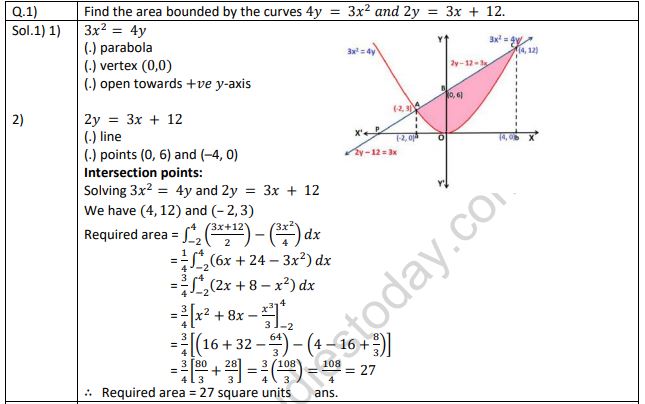
Question. Find the area bounded by the curves \(4y = 3x^2\) and \(2y = 3x + 12\).
Answer:
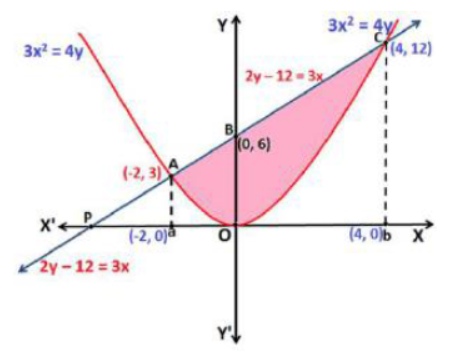
1) \(3x^2 = 4y\)
(.) parabola
(.) vertex \((0,0)\)
(.) open towards \(+\)ve \(y\)-axis
2) \(2y = 3x + 12\)
(.) line
(.) points \((0, 6)\) and \((-4, 0)\)
Intersection points:
Solving \(3x^2 = 4y\) and \(2y = 3x + 12\)
We have \((4, 12)\) and \((-2, 3)\)
Required area = \(\int_{-2}^{4} \left( \frac{3x+12}{2} \right) - \left( \frac{3x^2}{4} \right) \, dx\)
\[ = \frac{1}{4} \int_{-2}^{4} (6x + 24 - 3x^2) \, dx \]
\[ = \frac{3}{4} \int_{-2}^{4} (2x + 8 - x^2) \, dx \]
\[ = \frac{3}{4} \left[ x^2 + 8x - \frac{x^3}{3} \right]_{-2}^{4} \]
\[ = \frac{3}{4} \left[ \left(16 + 32 - \frac{64}{3}\right) - \left(4 - 16 + \frac{8}{3}\right) \right] \]
\[ = \frac{3}{4} \left[ \frac{80}{3} + \frac{28}{3} \right] = \frac{3}{4} \left( \frac{108}{3} \right) = \frac{108}{4} = 27 \]
\( \therefore \) Required area = \(27\) square units ans.
Question. Find the area bounded by \(y^2 = 4ax\) and \(y = mx\).
Answer:
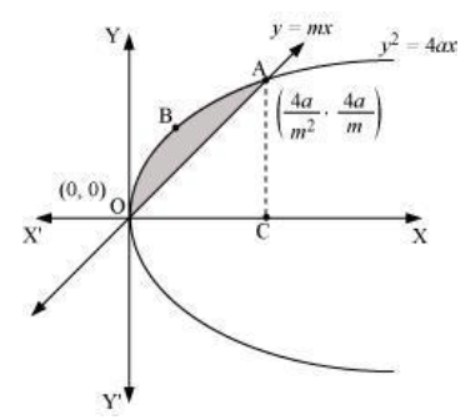
1) \(y^2 = 4ax\)
(.) parabola
(.) vertex \((0,0)\)
(.) open towards \(+\)ve \(x\)-axis
2) \(y = mx\)
(.) line
(.) passing through \((0,0)\)
Intersection Points:
Solving \(y^2 = 4ax\) and \(y = mx\)
we have, \((0,0)\) and \(\left(\frac{4a}{m^2}, \frac{4a}{m}\right)\)
Required area = \(\int_{0}^{\frac{4a}{m^2}} (2\sqrt{a}\sqrt{x} - mx) \, dx\)
\[ = \left[ 2\sqrt{a} \cdot \frac{2}{3}x^{\frac{3}{2}} - \frac{mx^2}{2} \right]_{0}^{\frac{4a}{m^2}} \]
\[ = \left[ \frac{4\sqrt{a}}{3} \left(\frac{4a}{m^2}\right)^{\frac{3}{2}} - \frac{m}{2} \left(\frac{4a}{m^2}\right)^2 \right] - [0] \]
\[ = \frac{4\sqrt{a}}{3} \cdot \left(\frac{8a\sqrt{a}}{m^3}\right) - \frac{m}{2} \left(\frac{16a^2}{m^4}\right) \]
\[ = \frac{32a^2}{3m^3} - \frac{8a^2}{m^3} \]
\[ = \frac{8a^2}{3m^3} \]
\( \dots \) Required area \(\frac{8a^2}{3m^3}\) square units. ans.
Question. Find the area bounded by curve \(y^2 = 4a^2(x - 1)\) and lines \(x = 1\) and \(y = 4a\).
Answer:
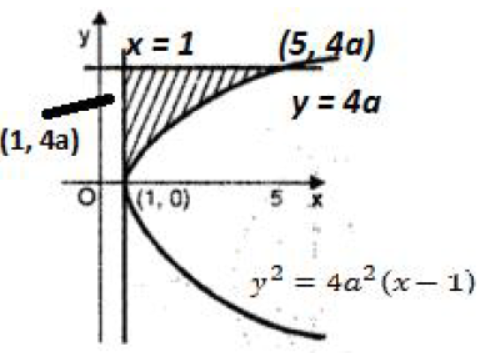
1) \(x = 1\)
(.) line parallel to \(y\)-axis at \((1, 0)\)
2) \(y = 4a\)
(.) line parallel to \(x\)-axis at \((0, 4a)\)
3) \(y^2 = 4a^2(x - 1)\)
(.) shifting parabola
(.) vertex \((1,0)\)
(.) open towards \(+\)ve \(x\)-axis
Intersection Points:
Solving \(y^2 = 4a^2(x - 1)\) and \(y = 4a\)
We have \(16a^2 = 4a^2(x - 1)\)
\( 4 = x - 1 \Rightarrow x = 5 \therefore \) point \((5, 4a)\)
Required area = \(\int_{1}^{5} (4a - 2a\sqrt{x - 1}) \, dx\)
\[ = \left[ 4ax - 2a \cdot \frac{2}{3}(x - 1)^{\frac{3}{2}} \right]_{1}^{5} \]
\[ = \left[ 20a - \frac{4a}{3}(4)^{\frac{3}{2}} \right] - [4a - 0] \]
\[ = 20a - \frac{32a}{3} - 4a \]
\[ = 16a - \frac{32a}{3} \]
\[ = \frac{16a}{3} \]
\( \therefore \) Required area = \(\frac{16a}{3}\) sq. units. ans.
Question. Find the area of the region bounded by \(x^2 = 4y\), \(y = 2\), \(y = 4\) and \(y\)-axis.
Answer:
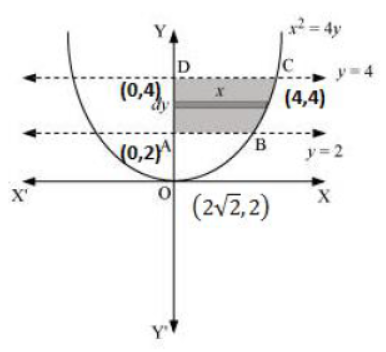
1) \(x^2 = 4y\)
(.) parabola
(.) vertex \((0,0)\)
(.) open towards \(+\)ve \(y\)-axis
2) \(y = 2\)
(.) line parallel to \(x\)-axis at \((0,2)\)
3) \(y = 4\)
(.) line parallel to \(x\)-axis at \((0,4)\)
4) \(y\)-axis
Intersection points:
Solving \(x^2 = 4y\) and \(y = 4\) we have \((4,4)\)
Solving \(x^2 = 4y\) and \(y = 2\) we have \((2\sqrt{2} , 2)\)
Required area = \(\int_{0}^{2\sqrt{2}} (4 - 2) \, dx + \int_{2\sqrt{2}}^{4} \left(4 - \frac{x^2}{4}\right) \, dx\)
\[ = (2x)_{0}^{2\sqrt{2}} + \left[ 4x - \frac{x^3}{12} \right]_{2\sqrt{2}}^{4} \]
\[ = 4\sqrt{2} + \left[ 16 - \frac{64}{12} \right] - \left[ 8\sqrt{2} - \frac{16\sqrt{2}}{12} \right] \]
\[ = 4\sqrt{2} + \frac{128}{12} - \frac{80\sqrt{2}}{12} \]
\[ = \frac{128-32\sqrt{2}}{12} \]
\[ = \frac{32-8\sqrt{2}}{3} \]
\( \therefore \) Required area = \(\frac{32-8\sqrt{2}}{3}\) sq. units
Question. Find the area of the region bounded by curves \(y = x^2 + 2\), \(y = x\), \(x = 0\) and \(x = 3\).
Answer:
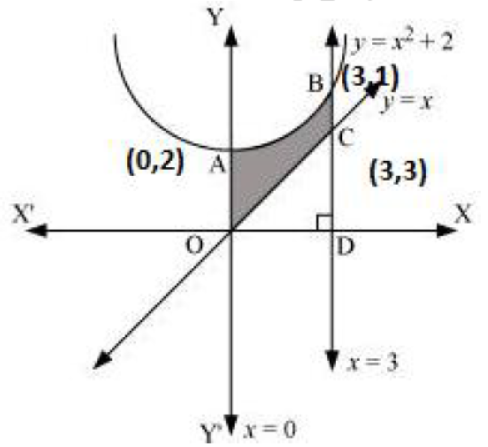
1) \(y = x^2 + 2 \Rightarrow x^2 = y - 2\)
(.) shifting
(.) vertex \((0,2)\)
(.) open towards \(+\)ve \(y\)-axis
2) \(y = x\)
(.) line passing through \((0,0)\)
3) \(x = 0\)
(.) \(y\)-axis
4) \(x = 3\)
(.) line parallel to \(y\)-axis at \((3,0)\)
Intersection point:
Solving \(y = x^2 + 2\) and \(x = 3\)
We have \(x = 3\) & \(y = 11\)
\( \therefore (3,11) \)
Required area = \(\int_{0}^{3} (x^2 + 2 - x) \, dx\)
\[ = \left[ \frac{x^3}{3} + 2x - \frac{x^2}{2} \right]_{0}^{3} \]
\[ = \left(9 + 6 - \frac{9}{2}\right) - 0 \]
\[ = \frac{21}{2} \ ]
\( \therefore \) Required area = \(\frac{21}{2}\) square unit. ans.
Question. Find the area of the region \(0 \leq y \leq x^2 + 1\); \(0 \leq y \leq x + 1\); \(0 \leq x \leq 2\).
Answer:
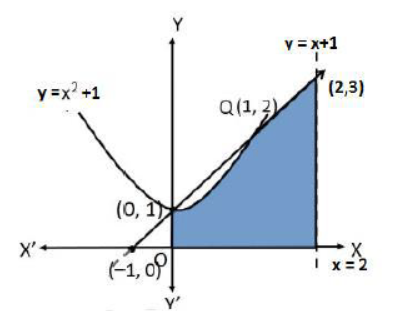
1) \(y \geq 0\)
2) \(y \leq x^2 + 1 \Rightarrow x^2 \geq y - 1\)
(.) shifting parabola
(.) vertex \((0,1)\)
(.) open towards \(+\)ve \(y\)-axis
(.) solution outside the parabola
3) \(y \leq x + 1\)
(.) line passing through \((0,1)\) & \((-1,0)\)
(.) solution towards the origin
4) \(x \geq 0\)
5) \(x \leq 2\)
(.) line parallel to \(y\)-axis at \((2,0)\)
(.) solution towards the origin
\(x \geq 0\) & \(y \geq 0\) means solution in 1st quadrant.
Intersection points:
Solving \(y = x^2 + 1\) and \(y = x + 1\)
We have \((0,1)\) and \((1,2)\)
Required area = \(\int_{0}^{1} (x^2 + 1) \, dx + \int_{1}^{2} (x + 1) \, dx\)
\[ = \left[ \frac{x^3}{3} + x \right]_{0}^{1} + \left[ \frac{x^2}{2} + x \right]_{1}^{2} \]
\[ = \left[\frac{1}{3} + 1\right] + \left[(2 + 2) - \left(\frac{1}{2} + 1\right)\right] \]
\[ = \frac{4}{3} + 4 - \frac{3}{2} \]
\[ = \frac{8+24-9}{6} = \frac{23}{6} \]
\( \therefore \) Required area = \(\frac{23}{6}\) square units ans.
Question. Find the area bounded by the curves \(y = x|x|\), \(x\)-axis, \(x = -1\) and \(x = 1\).
Answer:
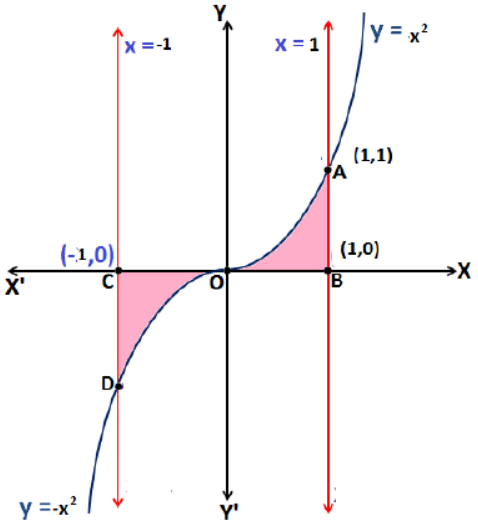
1) \(y = x|x| \Rightarrow\) two parabolas
(.) \(y = x^2\) ; \(x \geq 0\)
vertex \((0,0)\) open towards \(+\)ve \(y\)-axis
(.) \(y = -x^2\) ; \(x < 0\)
Vertex \((0,0)\) open towards \(-\)ve \(y\)-axis
2) \(x\)-axis
3) \(x = 1 \Rightarrow\) line parallel to \(y\)-axis at \((1,0)\)
4) \(x = -1 \Rightarrow\) line parallel to \(y\)-axis at \((-1,0)\)
Required area = \(\int_{-1}^{0} -(-x^2) \, dx + \int_{0}^{1} x^2 \, dx\)
\[ = \left[ \frac{x^3}{3} \right]_{-1}^{0} + \left[ \frac{x^3}{3} \right]_{0}^{1} \]
\[ = \left(0 - \left(-\frac{1}{3}\right)\right) + \left(\frac{1}{3} - 0\right) \]
\[ = \frac{1}{3} + \frac{1}{3} = \frac{2}{3} \]
\( \therefore \) Required area = \(\frac{2}{3}\) sq. units ans.
Question. The area between \(x = y^2\) and \(x = 4\) is divided in to two equal parts by line \(x = a\). Find value of \(a\).
Answer:
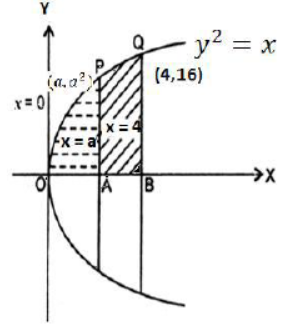
1) \(y^2 = x\)
(.) parabola, vertex \((0,0)\)
open towards \(+\)ve \(x\)-axis
2) \(x = 4\)
(.) line parallel to \(y\)-axis at \((4,0)\)
3) \(x = a\)
(.) line parallel to \(y\)-axis at \((a, 0)\)
Area of region A:
\[ = 2 \int_{0}^{a} (\sqrt{x} - 0) \, dx \quad \dots\{\text{due to symmetry}\} \]
\[ = 2 \cdot \frac{2}{3} \left[x^{\frac{3}{2}}\right]_{0}^{a} \]
\[ = \frac{4}{3} a\sqrt{a} \text{ sq. units} \]
Area of region B:
\[ = 2 \int_{a}^{4} (\sqrt{x} - 0) \, dx \quad \dots\{\text{due to symmetry}\} \]
\[ = 2 \cdot \frac{2}{3} \left[x^{\frac{3}{2}}\right]_{a}^{4} \]
\[ = \frac{4}{3} [8 - a^{\frac{3}{2}}] \text{ sq. units} \]
We are given that, area of region A = area of region B
\( \Rightarrow \frac{4}{3} a\sqrt{a} = \frac{4}{3} (8 - a^{\frac{3}{2}}) \)
\( \Rightarrow a^{\frac{3}{2}} = 8 - a^{\frac{3}{2}} \)
\( \Rightarrow 2a^{\frac{3}{2}} = 8 \)
\( \Rightarrow a^{\frac{3}{2}} = 4 \)
\( \Rightarrow a = 4^{\frac{2}{3}} \) ans.
Question. Prove that the curves \(y^2 = 4x\) and \(x^2 = 4y\) divide the area of the square bounded by lines \(x = 0\), \(y = 4\), \(y = 0\) and \(x = 4\) in to three equal parts.
Answer:
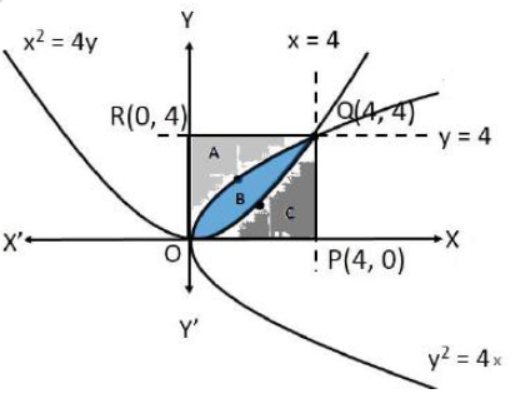
1) \(y^2 = 4x\)
(.) parabola, vertex \((0,0)\), open towards \(+\)ve \(x\)-axis
2) \(x^2 = 4y\)
(.) parabola, vertex \((0,0)\), open towards \(+\)ve \(y\)-axis
3) \(x = 0\)
(.) y-axis
4) \(x = 4\)
(.) line parallel to \(y\)-axis at \((4,0)\)
5) \(y = 0\)
(.) equation of \(x\)-axis
6) \(y = 4\)
(.) line parallel to \(x\)-axis at \((0,4)\)
Area of region A:
\[ = \int_{0}^{4} (4 - 2\sqrt{x}) \, dx \]
\[ = \left(4x - \frac{4}{3}x^{\frac{3}{2}}\right)_{0}^{4} \]
\[ = \left(16 - \frac{4}{3}(8)\right) - (0) \]
\[ = \frac{16}{3} \text{ sq. units} \]
Area of region B:
\[ = \int_{0}^{4} \left(2\sqrt{x} - \frac{x^2}{4}\right) \, dx \]
\[ = \left(\frac{4}{3}x^{\frac{3}{2}} - \frac{x^3}{12}\right)_{0}^{4} \]
\[ = \left(\frac{4}{3}(8) - \frac{64}{12}\right) - 0 \]
\[ = \frac{32}{3} - \frac{16}{3} = \frac{16}{3} \text{ sq. units} \]
Area of region C:
\[ = \int_{0}^{4} \left(\frac{x^2}{4} - 0\right) \, dx \]
\[ = \left(\frac{x^3}{12}\right)_{0}^{4} \]
\[ = \frac{64}{12} = \frac{16}{3} \text{ sq. units} \]
Clearly, the parabolas divide the area of the square in to three equal parts.
Question. Find the area of the region \(\{(x, y): x^2 \leq y \leq |x|\}\)
Answer:
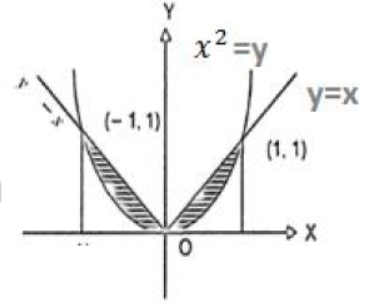
1) \(x^2 \leq y\)
(.) parabola
(.) vertex \((0,0)\)
(.) open towards \(+\)ve \(y\)-axis
(.) solution inside the parabola
2) \(y \leq |x|\)
(.) \(y \leq x\); \(x \geq 0\) [line passes through \((0,0)\)]
(.) \(y \leq -x\); \(x < 0\) [line passes through \((0,0)\)]
Required area = \(2 \int_{0}^{1} (x - x^2) \, dx \quad \dots\{\text{due to symmetry}\}\)
\[ = 2 \left( \frac{x^2}{2} - \frac{x^3}{3} \right)_{0}^{1} \]
\[ = 2 \left( \frac{1}{2} - \frac{1}{3} \right) \]
\[ = 2 \left( \frac{1}{6} \right) = \frac{1}{3} \text{ sq. units ans.} \]
Free study material for Mathematics
CBSE Class 12 Mathematics Worksheets for Chapter 08 Application Of Integrals
Practice Exercises for Class 12 Mathematics Chapter 08 Application Of Integrals
Access structured practice worksheets for Chapter 08 Application Of Integrals aligned with the 2026 CBSE curriculum. These downloadable exercises for Class 12 Mathematics help students build accuracy and reinforce core concepts for upcoming school tests.
Step-by-Step Solutions and Practice Guidelines
Built using official NCERT guidelines for Class 12 Mathematics, these practice sheets provide reliable academic support. Cross-reference your completed work with our detailed solutions to learn standard answer-writing formats for CBSE exams.
Enhance Speed with Online Practice
Follow up your worksheet practice by attempting the interactive online MCQ tests for Chapter 08 Application Of Integrals to evaluate your execution speed. All printable assignments and revision sheets on our platform are updated for the 2026 session and available free of charge.
FAQs
You can download the latest chapter-wise printable worksheets for Class 12 Mathematics Chapter 08 Application Of Integrals for free from StudiesToday.com. These have been made as per the latest CBSE curriculum for this academic year.
Yes, Class 12 Mathematics worksheets for Chapter 08 Application Of Integrals focus on activity-based learning and also competency-style questions. This helps students to apply theoretical knowledge to practical scenarios.
Yes, we have provided solved worksheets for Class 12 Mathematics Chapter 08 Application Of Integrals to help students verify their answers instantly.
Yes, our Class 12 Mathematics test sheets are mobile-friendly PDFs and can be printed by teachers for classroom.
For Chapter 08 Application Of Integrals, regular practice with our worksheets will improve question-handling speed and help students understand all technical terms and diagrams.