

Class 12 Mathematics Practice Sheet: CBSE Class 12 Mathematics Continuity And Differentiability Worksheet Set 10
Access comprehensive chapter-wise worksheets for Chapter 05 Continuity and Differentiability using the CBSE Class 12 Mathematics Continuity And Differentiability Worksheet Set 10. Designed to align with the 2026-27 academic syllabus for Class 12 Mathematics, these printable practice sets help students reinforce key concepts and improve their overall exam readiness.
Download Chapter 05 Continuity and Differentiability Worksheet PDF with Answers
Access the complete worksheet PDF for Class 12 Mathematics below. Regular practice with these targeted academic tasks builds familiarity with standard question patterns and helps secure higher marks in final school examinations.
CBSE Class 12 Mathematics Continuity And Differentiability (1). Students can download these worksheets and practice them. This will help them to get better marks in examinations. Also refer to other worksheets for the same chapter and other subjects too. Use them for better understanding of the subjects.
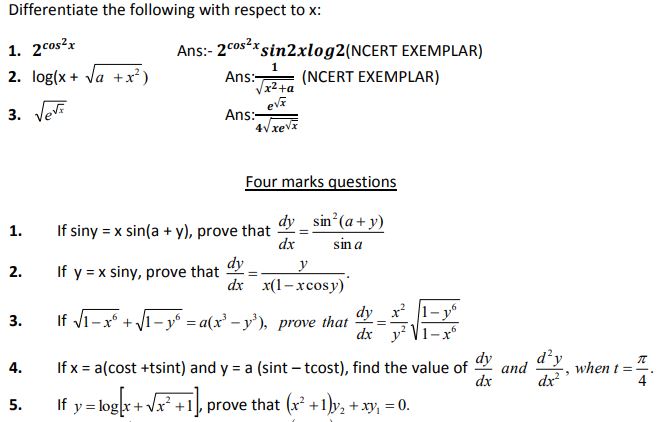
One marks questions
Question. Differentiate the following with respect to x: \( 2^{\cos^2 x} \)
Answer: \( -2^{\cos^2 x}\sin 2x \log 2 \) (NCERT EXEMPLAR)
Question. Differentiate the following with respect to x: \( \log(x + \sqrt{x^2 + a}) \)
Answer: \( \frac{1}{\sqrt{x^2+a}} \) (NCERT EXEMPLAR)
Question. Differentiate the following with respect to x: \( \sqrt{e^{\sqrt{x}}} \)
Answer: \( \frac{e^{\sqrt{x}}}{4\sqrt{x e^{\sqrt{x}}}} \)
Four marks questions
Question. If \( \sin y = x \sin(a + y) \), prove that \( \frac{dy}{dx} = \frac{\sin^2(a + y)}{\sin a} \)
Answer: Given, \( \sin y = x \sin(a+y) \)
\( \Rightarrow x = \frac{\sin y}{\sin(a+y)} \)
Differentiating both sides with respect to \( y \):
\( \frac{dx}{dy} = \frac{\cos y \sin(a+y) - \sin y \cos(a+y)}{\sin^2(a+y)} \)
Using \( \sin(A-B) = \sin A \cos B - \cos A \sin B \):
\( \frac{dx}{dy} = \frac{\sin(a+y-y)}{\sin^2(a+y)} = \frac{\sin a}{\sin^2(a+y)} \)
Taking the reciprocal on both sides:
\( \frac{dy}{dx} = \frac{\sin^2(a+y)}{\sin a} \)
Question. If \( y = x \sin y \), prove that \( \frac{dy}{dx} = \frac{y}{x(1 - x\cos y)} \)
Answer: Given, \( y = x \sin y \)
Differentiating with respect to \( x \):
\( \frac{dy}{dx} = \sin y + x \cos y \frac{dy}{dx} \)
\( \Rightarrow \frac{dy}{dx}(1 - x\cos y) = \sin y \)
Substituting \( \sin y = \frac{y}{x} \) from the given equation:
\( \frac{dy}{dx}(1 - x\cos y) = \frac{y}{x} \)
\( \Rightarrow \frac{dy}{dx} = \frac{y}{x(1 - x\cos y)} \)
Question. If \( \sqrt{1-x^6} + \sqrt{1-y^6} = a(x^3 - y^3) \), prove that \( \frac{dy}{dx} = \frac{x^2}{y^2}\sqrt{\frac{1-y^6}{1-x^6}} \)
Answer: Let \( x^3 = \sin A \) and \( y^3 = \sin B \). Then, the given equation becomes:
\( \sqrt{1-\sin^2 A} + \sqrt{1-\sin^2 B} = a(\sin A - \sin B) \)
\( \Rightarrow \cos A + \cos B = a(\sin A - \sin B) \)
\( \Rightarrow 2\cos\left(\frac{A+B}{2}\right)\cos\left(\frac{A-B}{2}\right) = a \cdot 2\cos\left(\frac{A+B}{2}\right)\sin\left(\frac{A-B}{2}\right) \)
\( \Rightarrow \cos\left(\frac{A-B}{2}\right) = a \sin\left(\frac{A-B}{2}\right) \)
\( \Rightarrow \cot\left(\frac{A-B}{2}\right) = a \)
\( \Rightarrow A - B = 2\cot^{-1}a \)
Substituting back the values of \( A \) and \( B \):
\( \sin^{-1}(x^3) - \sin^{-1}(y^3) = 2\cot^{-1}a \)
Differentiating both sides with respect to \( x \):
\( \frac{1}{\sqrt{1-(x^3)^2}} \cdot (3x^2) - \frac{1}{\sqrt{1-(y^3)^2}} \cdot (3y^2) \frac{dy}{dx} = 0 \br />` \( \Rightarrow \frac{3x^2}{\sqrt{1-x^6}} = \frac{3y^2}{\sqrt{1-y^6}} \frac{dy}{dx} \)
\( \Rightarrow \frac{dy}{dx} = \frac{x^2}{y^2}\sqrt{\frac{1-y^6}{1-x^6}} \)
Question. If \( x = a(\cos t + t\sin t) \) and \( y = a(\sin t - t\cos t) \), find the value of \( \frac{dy}{dx} \) and \( \frac{d^2y}{dx^2} \), when \( t = \frac{\pi}{4} \).
Answer: Given, \( x = a(\cos t + t\sin t) \)
Differentiating with respect to \( t \):
\( \frac{dx}{dt} = a(-\sin t + \sin t + t\cos t) = at\cos t \)
Given, \( y = a(\sin t - t\cos t) \)
Differentiating with respect to \( t \):
\( \frac{dy}{dt} = a(\cos t - (\cos t - t\sin t)) = at\sin t \)
Therefore, \( \frac{dy}{dx} = \frac{dy/dt}{dx/dt} = \frac{at\sin t}{at\cos t} = \tan t \).
At \( t = \frac{\pi}{4} \), \( \frac{dy}{dx} = \tan\frac{\pi}{4} = 1 \).
Now, to find \( \frac{d^2y}{dx^2} \):
\( \frac{d^2y}{dx^2} = \frac{d}{dx}(\tan t) = \sec^2 t \cdot \frac{dt}{dx} = \frac{\sec^2 t}{at\cos t} = \frac{\sec^3 t}{at} \).
At \( t = \frac{\pi}{4} \):
\( \frac{d^2y}{dx^2} = \frac{\sec^3(\pi/4)}{a(\pi/4)} = \frac{(\sqrt{2})^3}{\frac{a\pi}{4}} = \frac{8\sqrt{2}}{a\pi} \).
Question. If \( y = \log\left[x + \sqrt{x^2+1}\right] \), prove that \( (x^2+1)y_2 + xy_1 = 0 \).
Answer: Given, \( y = \log\left[x + \sqrt{x^2+1}\right] \)
Differentiating with respect to \( x \):
\( y_1 = \frac{1}{x + \sqrt{x^2+1}} \cdot \left(1 + \frac{2x}{2\sqrt{x^2+1}}\right) = \frac{1}{\sqrt{x^2+1}} \)
\( \Rightarrow y_1 \sqrt{x^2+1} = 1 \)
Squaring both sides:
\( y_1^2 (x^2 + 1) = 1 \)
Differentiating again with respect to \( x \):
\( 2 y_1 y_2 (x^2 + 1) + y_1^2 (2x) = 0 \)
Dividing by \( 2y_1 \) (since \( y_1 \neq 0 \)):
\( (x^2 + 1)y_2 + xy_1 = 0 \).
Hence proved.
Question. If \( y = e^{a\cos^{-1} x} \), \( -1 \le x \le 1 \), show that \( (1-x^2)y_2 - xy_1 - a^2 y = 0 \).
Answer: Given, \( y = e^{a\cos^{-1} x} \)
Differentiating with respect to \( x \):
\( y_1 = e^{a\cos^{-1} x} \cdot \left( -\frac{a}{\sqrt{1-x^2}} \right) = -\frac{ay}{\sqrt{1-x^2}} \)
\( \Rightarrow y_1 \sqrt{1-x^2} = -ay \)
Squaring both sides:
\( y_1^2 (1 - x^2) = a^2 y^2 \)
Differentiating both sides with respect to \( x \):
\( 2 y_1 y_2 (1 - x^2) + y_1^2 (-2x) = a^2 (2y y_1) \)
Dividing both sides by \( 2 y_1 \):
\( (1 - x^2) y_2 - x y_1 = a^2 y \)
\( \Rightarrow (1 - x^2) y_2 - x y_1 - a^2 y = 0 \).
Hence proved.
Question. Differentiate with respect to x: \( \tan^{-1}\left( \frac{\sqrt{1+\sin x} + \sqrt{1-\sin x}}{\sqrt{1+\sin x} - \sqrt{1-\sin x}} \right) \)
Answer: Let \( y = \tan^{-1}\left( \frac{\sqrt{1+\sin x} + \sqrt{1-\sin x}}{\sqrt{1+\sin x} - \sqrt{1-\sin x}} \right) \).
We know that:
\( 1 + \sin x = \cos^2\frac{x}{2} + \sin^2\frac{x}{2} + 2\sin\frac{x}{2}\cos\frac{x}{2} = \left(\cos\frac{x}{2} + \sin\frac{x}{2}\right)^2 \)
\( \Rightarrow \sqrt{1+\sin x} = \cos\frac{x}{2} + \sin\frac{x}{2} \)
Similarly, \( \sqrt{1-\sin x} = \cos\frac{x}{2} - \sin\frac{x}{2} \).
Substituting these into the expression:
\( y = \tan^{-1}\left( \frac{\left(\cos\frac{x}{2} + \sin\frac{x}{2}\right) + \left(\cos\frac{x}{2} - \sin\frac{x}{2}\right)}{\left(\cos\frac{x}{2} + \sin\frac{x}{2}\right) - \left(\cos\frac{x}{2} - \sin\frac{x}{2}\right)} \right) \)
\( \Rightarrow y = \tan^{-1}\left( \frac{2\cos\frac{x}{2}}{2\sin\frac{x}{2}} \right) = \tan^{-1}\left(\cot\frac{x}{2}\right) \)
\( \Rightarrow y = \tan^{-1}\left(\tan\left(\frac{\pi}{2} - \frac{x}{2}\right)\right) = \frac{\pi}{2} - \frac{x}{2} \).
Differentiating with respect to \( x \):
\( \frac{dy}{dx} = -\frac{1}{2} \).
Question. If \( y = \sin^{-1}\left( \frac{2x}{1+x^2} \right) + \sec^{-1}\left( \frac{1+x^2}{1-x^2} \right) \), prove that \( \frac{dy}{dx} = \frac{4}{1+x^2} \).
Answer: We know that:
\( \sin^{-1}\left( \frac{2x}{1+x^2} \right) = 2\tan^{-1}x \)
Also, \( \sec^{-1}\left( \frac{1+x^2}{1-x^2} \right) = \cos^{-1}\left( \frac{1-x^2}{1+x^2} \right) = 2\tan^{-1}x \).
Therefore, we have:
\( y = 2\tan^{-1}x + 2\tan^{-1}x = 4\tan^{-1}x \).
Differentiating with respect to \( x \):
\( \frac{dy}{dx} = \frac{4}{1+x^2} \).
Hence proved.
Question. Verify Rolle’s theorem for the function \( f(x) = \sin x - \sin 2x \) on \( [0, \pi] \).
Answer: Rolle's theorem states that if a function \( f \) is continuous on \( [a, b] \), differentiable on \( (a, b) \), and \( f(a) = f(b) \), then there exists at least one \( c \in (a, b) \) such that \( f'(c) = 0 \).
For \( f(x) = \sin x - \sin 2x \) on \( [0, \pi] \):
1. \( f(x) \) is a combination of sine functions, which are continuous everywhere. Thus, \( f(x) \) is continuous on \( [0, \pi] \).
2. \( f(x) \) is differentiable on \( (0, \pi) \) with \( f'(x) = \cos x - 2\cos 2x \).
3. \( f(0) = \sin(0) - \sin(0) = 0 \) and \( f(\pi) = \sin(\pi) - \sin(2\pi) = 0 \). Here, \( f(0) = f(\pi) \).
Now, let's solve for \( f'(c) = 0 \):
\( \cos c - 2\cos 2c = 0 \)
\( \Rightarrow \cos c - 2(2\cos^2 c - 1) = 0 \)
\( \Rightarrow 4\cos^2 c - \cos c - 2 = 0 \)
Using the quadratic formula for \( \cos c \):
\( \cos c = \frac{1 \pm \sqrt{1 - 4(4)(-2)}}{8} = \frac{1 \pm \sqrt{33}}{8} \).
This yields valid values of \( c \) in \( (0, \pi) \). Thus, Rolle's theorem is verified.
Question. Verify Mean Value theorem for the function \( f(x) = x^2 - 2x + 4 \) on \( [1, 5] \).
Answer: Mean Value Theorem states that if a function \( f \) is continuous on \( [a, b] \) and differentiable on \( (a, b) \), then there exists at least one \( c \in (a, b) \) such that:
\( f'(c) = \frac{f(b) - f(a)}{b - a} \).
For \( f(x) = x^2 - 2x + 4 \) on \( [1, 5] \):
1. Since \( f(x) \) is a polynomial function, it is continuous on \( [1, 5] \) and differentiable on \( (1, 5) \).
2. Calculate the values:
\( f(1) = 1^2 - 2(1) + 4 = 3 \)
\( f(5) = 5^2 - 2(5) + 4 = 19 \)
3. Thus, \( f'(c) = \frac{19 - 3}{5 - 1} = \frac{16}{4} = 4 \).
Since \( f'(x) = 2x - 2 \), we set \( f'(c) = 4 \):
\( 2c - 2 = 4 \implies 2c = 6 \implies c = 3 \in (1, 5) \).
Hence, Mean Value Theorem is verified.
Question. Find the values of ‘a’ and ‘b’ when \( f(x) = \begin{cases} 3ax + b, & x > 1 \\ 11, & x = 1 \\ 5ax - 2b, & x < 1 \end{cases} \) is continuous at \( x = 1 \).
Answer: For \( f(x) \) to be continuous at \( x = 1 \), the Left-Hand Limit (LHL), Right-Hand Limit (RHL), and value of function at \( x=1 \) must be equal:
\( \text{LHL} = \lim_{x \to 1^-} f(x) = \lim_{x \to 1^-} (5ax - 2b) = 5a - 2b \)
\( \text{RHL} = \lim_{x \to 1^+} f(x) = \lim_{x \to 1^+} (3ax + b) = 3a + b \)
\( f(1) = 11 \)
Thus:
\( 5a - 2b = 11 \) --- (1)
\( 3a + b = 11 \implies b = 11 - 3a \) --- (2)
Substituting equation (2) into (1):
\( 5a - 2(11 - 3a) = 11 \)
\( \Rightarrow 5a - 22 + 6a = 11 \)
\( \Rightarrow 11a = 33 \implies a = 3 \).
Now, substitute \( a = 3 \) back into (2):
\( b = 11 - 3(3) = 2 \).
Thus, the values are \( a = 3, b = 2 \).
Question. If \( x^{13} \cdot y^7 = (x + y)^{20} \), prove that \( \frac{dy}{dx} = \frac{y}{x} \).
Answer: Taking log on both sides of \( x^{13} \cdot y^7 = (x + y)^{20} \):
\( 13\log x + 7\log y = 20\log(x+y) \)
Differentiating both sides with respect to \( x \):
\( \frac{13}{x} + \frac{7}{y} \frac{dy}{dx} = \frac{20}{x+y} \left( 1 + \frac{dy}{dx} \right) \)
\( \Rightarrow \frac{13}{x} + \frac{7}{y} \frac{dy}{dx} = \frac{20}{x+y} + \frac{20}{x+y} \frac{dy}{dx} \)
\( \Rightarrow \left(\frac{7}{y} - \frac{20}{x+y}\right) \frac{dy}{dx} = \frac{20}{x+y} - \frac{13}{x} \)
\( \Rightarrow \left(\frac{7x + 7y - 20y}{y(x+y)}\right) \frac{dy}{dx} = \frac{20x - 13x - 13y}{x(x+y)} \)
\( \Rightarrow \left(\frac{7x - 13y}{y(x+y)}\right) \frac{dy}{dx} = \frac{7x - 13y}{x(x+y)} \)
Canceling \( \frac{7x - 13y}{x+y} \) from both sides:
\( \frac{1}{y} \frac{dy}{dx} = \frac{1}{x} \implies \frac{dy}{dx} = \frac{y}{x} \).
Hence proved.
Question. If \( y = \sqrt{\sin x + \sqrt{\sin x + \sqrt{\sin x + \dots \text{ to } \infty}}} \), prove that \( \frac{dy}{dx} = \frac{\cos x}{2y-1} \).
Answer: We can rewrite the given expression as:
\( y = \sqrt{\sin x + y} \)
Squaring both sides:
\( y^2 = \sin x + y \)
Differentiating both sides with respect to \( x \):
\( 2y \frac{dy}{dx} = \cos x + \frac{dy}{dx} \)
\( \Rightarrow (2y - 1) \frac{dy}{dx} = \cos x \)
\( \Rightarrow \frac{dy}{dx} = \frac{\cos x}{2y-1} \).
Hence proved.
Question. Check, the function \( f(x) = \begin{cases} |x-a|\sin\frac{1}{x-a}, & \text{if } x \neq a \\ 0, & \text{if } x = a \end{cases} \) is continuous or discontinuous at \( x = a \). (NCERT EXEMPLAR).
Answer: Let us find the limit of the function as \( x \to a \):
\( \lim_{x \to a} f(x) = \lim_{x \to a} |x-a|\sin\left(\frac{1}{x-a}\right) \)
As \( x \to a \), \( |x-a| \to 0 \).
Also, since \( \sin\left(\frac{1}{x-a}\right) \) lies between \( -1 \) and \( 1 \) for all \( x \neq a \), it is a bounded quantity.
Therefore, \( \lim_{x \to a} f(x) = 0 \times (\text{a bounded quantity}) = 0 \).
Since \( \lim_{x \to a} f(x) = f(a) = 0 \), the function \( f(x) \) is continuous at \( x = a \).
Question. Examine the differentiability of f, where f is defined by \( f(x) = \begin{cases} x[x], & \text{if } 0 \le x < 2 \\ (x-1)x, & \text{if } 2 \le x < 3 \end{cases} \) at \( x = 2 \), (NCERT EXEMPLAR).
Answer: A function is differentiable at \( x = 2 \) if the Left-Hand Derivative (LHD) is equal to the Right-Hand Derivative (RHD) at \( x = 2 \).
Here, \( f(2) = (2-1)\cdot 2 = 2 \).
Left-Hand Derivative (LHD) at \( x = 2 \):
\( \text{LHD} = \lim_{h \to 0^-} \frac{f(2+h) - f(2)}{h} = \lim_{h \to 0^-} \frac{(2+h)[2+h] - 2}{h} \)
Since \( h \to 0^- \), \( 2+h < 2 \implies [2+h] = 1 \).
\( \text{LHD} = \lim_{h \to 0^-} \frac{(2+h)\cdot 1 - 2}{h} = \lim_{h \to 0^-} \frac{h}{h} = 1 \).
Right-Hand Derivative (RHD) at \( x = 2 \):
\( \text{RHD} = \lim_{h \to 0^+} \frac{f(2+h) - f(2)}{h} = \lim_{h \to 0^+} \frac{(2+h-1)(2+h) - 2}{h} \)
\( = \lim_{h \to 0^+} \frac{(1+h)(2+h) - 2}{h} = \lim_{h \to 0^+} \frac{2 + 3h + h^2 - 2}{h} = \lim_{h \to 0^+} (3 + h) = 3 \).
Since LHD \( (1) \neq \) RHD \( (3) \), the function \( f(x) \) is not differentiable at \( x = 2 \).
Question. Find \( \frac{dy}{dx} \) of the function expressed in parametric form given by \( x = \frac{1 + \log t}{t^2} \), \( y = \frac{3 + 2\log t}{t} \). (NCERT EXEMPLAR).
Answer: Differentiating \( x \) with respect to \( t \) using the quotient rule:
\( \frac{dx}{dt} = \frac{t^2 \left(\frac{1}{t}\right) - (1+\log t)(2t)}{t^4} = \frac{t - 2t - 2t\log t}{t^4} = -\frac{t(1+2\log t)}{t^4} = -\frac{1+2\log t}{t^3} \)
Differentiating \( y \) with respect to \( t \) using the quotient rule:
\( \frac{dy}{dt} = \frac{t \left(\frac{2}{t}\right) - (3+2\log t)(1)}{t^2} = \frac{2 - 3 - 2\log t}{t^2} = -\frac{1+2\log t}{t^2} \)
Now, find \( \frac{dy}{dx} \):
\( \frac{dy}{dx} = \frac{\frac{dy}{dt}}{\frac{dx}{dt}} = \frac{-\frac{1+2\log t}{t^2}}{-\frac{1+2\log t}{t^3}} = t \).
Question. Find \( \frac{dy}{dx} \) when x and y are connected by the relation given by \( \sin(xy) + \frac{x}{y} = x^2 - y \) (NCERT EXEMPLAR).
Answer: Differentiating the given implicit relation with respect to \( x \):
\( \cos(xy) \left( y + x \frac{dy}{dx} \right) + \frac{y\cdot 1 - x\frac{dy}{dx}}{y^2} = 2x - \frac{dy}{dx} \)
Multiplying the entire equation by \( y^2 \) to clear the fraction:
\( y^2 \cos(xy) \left( y + x \frac{dy}{dx} \right) + y - x\frac{dy}{dx} = 2xy^2 - y^2 \frac{dy}{dx} \)
\( \Rightarrow y^3 \cos(xy) + xy^2\cos(xy) \frac{dy}{dx} + y - x\frac{dy}{dx} = 2xy^2 - y^2 \frac{dy}{dx} \)
Grouping the terms containing \( \frac{dy}{dx} \) on the Left Hand Side:
\( \frac{dy}{dx} \left[ xy^2\cos(xy) - x + y^2 \right] = 2xy^2 - y^3 \cos(xy) - y \)
\( \Rightarrow \frac{dy}{dx} = \frac{2xy^2 - y^3 \cos(xy) - y}{xy^2 \cos(xy) - x + y^2} \).
Question. Discuss the applicability of Rolle’s Theorem on the function given by \( f(x) = \begin{cases} x^2 + 1, & \text{if } 0 \le x \le 1 \\ 3 - x, & \text{if } 1 \le x \le 2 \end{cases} \). (NCERT EXEMPLAR)
Answer: Rolle's theorem is applicable if a function is continuous on \( [a, b] \) and differentiable on \( (a, b) \). Let us check these properties for \( f(x) \) on \( [0, 2] \):
1. Continuity at \( x = 1 \):
\( \text{LHL} = \lim_{x \to 1^-} f(x) = \lim_{x \to 1^-} (x^2 + 1) = 2 \)
\( \text{RHL} = \lim_{x \to 1^+} f(x) = \lim_{x \to 1^+} (3 - x) = 2 \)
Since \( \text{LHL} = \text{RHL} = f(1) = 2 \), the function is continuous at \( x = 1 \), hence continuous on \( [0, 2] \).
2. Differentiability at \( x = 1 \):
\( \text{LHD} = \lim_{h \to 0^-} \frac{f(1+h) - f(1)}{h} = \lim_{h \to 0^-} \frac{(1+h)^2 + 1 - 2}{h} = \lim_{h \to 0^-} \frac{h^2 + 2h}{h} = 2 \).
\( \text{RHD} = \lim_{h \to 0^+} \frac{f(1+h) - f(1)}{h} = \lim_{h \to 0^+} \frac{3 - (1+h) - 2}{h} = \lim_{h \to 0^+} \frac{-h}{h} = -1 \).
Since LHD \( (2) \neq \) RHD \( (-1) \), \( f(x) \) is not differentiable at \( x = 1 \in (0, 2) \).
Therefore, Rolle's Theorem is not applicable to the given function on \( [0, 2] \).
Free study material for Mathematics
CBSE Class 12 Mathematics Worksheets for Chapter 05 Continuity and Differentiability
Download Chapter Worksheets: Class 12 Mathematics
Review targeted practice exercises for Class 12 Mathematics Chapter 05 Continuity and Differentiability. Curated to match official CBSE guidelines, these printable problem sets support daily revision and improve overall test readiness.
Concept Clarification for Chapter 05 Continuity and Differentiability
Designed around the official curriculum for Class 12 Mathematics, these practice sheets guarantee standard compliance. Reviewing step-by-step solutions after completion sharpens your accuracy and clarifies complex sub-topics within Chapter 05 Continuity and Differentiability.
Effective Revision Strategies for School Exams
Follow up your worksheet practice by attempting the interactive online MCQ tests for Chapter 05 Continuity and Differentiability to evaluate your execution speed. All printable assignments and revision sheets on our platform are updated for the 2026 session and available free of charge.
FAQs
You can download the latest chapter-wise printable worksheets for Class 12 Mathematics Chapter 05 Continuity and Differentiability for free from StudiesToday.com. These have been made as per the latest CBSE curriculum for this academic year.
Yes, Class 12 Mathematics worksheets for Chapter 05 Continuity and Differentiability focus on activity-based learning and also competency-style questions. This helps students to apply theoretical knowledge to practical scenarios.
Yes, we have provided solved worksheets for Class 12 Mathematics Chapter 05 Continuity and Differentiability to help students verify their answers instantly.
Yes, our Class 12 Mathematics test sheets are mobile-friendly PDFs and can be printed by teachers for classroom.
For Chapter 05 Continuity and Differentiability, regular practice with our worksheets will improve question-handling speed and help students understand all technical terms and diagrams.