

Chapter-wise Worksheets for Class 12 Mathematics: Chapter 08 Application Of Integrals
Access comprehensive chapter-wise worksheets for Chapter 08 Application Of Integrals using the CBSE Class 12 Mathematics Application Of Integrals Worksheet Set 01. Designed to align with the 2026-27 academic syllabus for Class 12 Mathematics, these printable practice sets help students reinforce key concepts and improve their overall exam readiness.
Practice Class 12 Mathematics Worksheets: Chapter 08 Application Of Integrals
View or download the dedicated CBSE Class 12 Mathematics Application Of Integrals Worksheet Set 01 resource below. Engaging with these practice papers under focused study conditions ensures continuous academic progress and mastery of the 2026-27 curriculum for Chapter 08 Application Of Integrals.
Question. The area (in sq. units) of the region {(x, y) : 0 ≤ y ≤ x2 + 1, 0 ≤ y ≤ x + 1, 1/2 ≤ x ≤ 2) is :
(a) 23/16
(b) 79/24
(c) 79/16
(d) 23/6
Answer : B
Question. The area (in sq. units) of the region A = {(x, y) ∈ R × R|0 d” x d”3, 0 d” y d” 4, y d” x2 + 3x} is :
(a) 53/6
(b) 8
(c) 59/6
(d) 26/3
Answer : C
Question. The area (in sq. units) of the region {(x, y) ∈R2|4x2 ≤ y ≤ 8x + 12} is:
(a) 125/3
(b) 128/3
(c) 124/3
(d) 127/3
Answer : B
Question. If y = f(x) makes +ve intercept of 2 and 0 unit on x and y axes and encloses an area of 3/4 square unit with the axes then 0∫2 xf'(x)dx is
(a) 3/2
(b) 1
(c) 5/4
(d) –3/4
Answer : D
Question. The area (in sq. units) of the region A = {(x, y) : |x| + |y| ≤ 1, 2y2 ≥ |x|} is :
(a) 1/3
(b) 7/6
(c) 1/6
(d) 5/6
Answer : D
Question. For a > 0, let the curves C1: y2 = ax and C2: x2 = ay intersect at origin O and a point P. Let the line x = b (0 < b < a) intersect the chord OP and the x-axis at points Q and R, respectively. If the line x = b bisects the area bounded by the curves, C1 and C2, and the area of ΔOQR = 1/2, then ‘a’ satisfies the equation:
(a) x6 – 6x3 + 4 = 0
(b) x6 – 12x3 + 4 = 0
(c) x6 + 6x3 – 4 = 0
(d) x6 – 12x3 – 4 = 0
Answer : B
Question. The area (in sq. units) of the region A = {(x, y) : x2 ≤ y ≤ x + 2} is:
(a) 10/3
(b) 9/2
(c) 31/6
(d) 13/6
Answer : B
Question. The area (in sq. units) of the region enclosed by the curves y = x2 – 1 and y = 1 – x2 is equal to:
(a) 4/3
(b) 8/3
(c) 7/2
(d) 16/3
Answer : B
Question. The area of the region A = {(x, y): 0 ≤ y ≤ x |x| + 1 and – 1 ≤ x ≤ 1} in sq. units is:
(a) 2/3
(b) 2
(c) 4/3
(d) 1/3
Answer : B
Question. If the area (in sq. units) of the region {(x, y) : y2 ≤ 4x, x + y ≤ 1, x ≥ 0, y ≥ 0} is a √2 + b, then a – b is equal to :
(a) 10/3
(b) 6
(c) 8/3
(d) 2/3-
Answer : B
Question. The area enclosed between the curve y = loge (x + e) and the coordinate axes is
(a) 1
(b) 2
(c) 3
(d) 4
Answer : A
Question. The area of the region, enclosed by the circle x2 + y2 = 2 which is not common to the region bounded by the parabola y2 = x and the straight line y = x, is:
(a) (24π – 1)
(b) (6π – 1)
(c) (12π – 1)
(d) (12π – 1)/6
Answer : D
Question. The region represented by |x - y| ≤ 2 and |x + y| ≤ 2 is bounded by a :
(a) square of side length 2√2 units
(b) rhombus of side length 2 units
(c) square of area 16 sq. units
(d) rhombus of area 8√2sq. units
Answer : A
Question. Let 2 g(x) = cosx2 , f (x) = √x , and a, β (a < β) be the roots of the quadratic equation 18x2 - 9πx + π2 = 0 . Then the area (in sq. units) bounded by the curve y = (gof)(x) and the lines x = a,x = β and y = 0 , is :
(a) 1/2 (√3 + 1)
(b) 1/2 (√3 - √2)
(c) 1/2 (√2 - 1)
(d) 1/2 (√3 - 1)
Answer : D
Question. Consider a region R ={(x, y)∈R : x2 ≤ y ≤ 2x}. If a line y = a divides the area of region R into two equal parts, then which of the following is true?
(a) 3 2 a - 6a +16 = 0
(b) 2 3/ 2 3a -8a + 8 = 0
(c) 23a -8a + 8 = 0
(d) 3 3/ 2 a - 6a -16 = 0
Answer : B
Question. The area (in sq. units) of the region A = {(x , y): y2/2 ≤ x ≤ y + 4} is:
(a) 53/3
(b) 30
(c) 16
(d) 18
Answer : D
Question. If the area (in sq. units) bounded by the parabola y2 = 4λx and the line y = λx, λ > 0, is 1/9 , then λ is equal to :
(a) 2√6
(b) 48
(c) 24
(d) 4√3
Answer : C
Question. The area (in sq. units) of the region {(x, y) ∈ R2: x2 ≤ y ≤ |3 – 2x|, is:
(a) 32/3
(b) 34/3
(c) 29/3
(d) 31/3
Answer : A
Question. The area (in sq. units) of the region bounded by the curves y = 2x and y = |x + 1|, in the first quadrant is :
(a) log, 2 +3/2
(b) 3/2
(c) 1/2
(d) 3/2 - 1/log, 2
Answer : D
Question. Let S(a) = {(x, y) : y2 ≤ x, 0 ≤ x ≤ a} and A(a) is area of the region S(a). If for a λ, 0 < λ < 4, A(λ) : A(a) = 2 : 5, then λ equals :
(a) 2(4/25)1/3
(b) 2(2/5)1/3
(c) 4(2/5)1/3
(d) 4(4/25)1/3
Answer : D
1) Find the area enclosed by the parabola 𝑦 = 3𝑥2/4 𝑎𝑛𝑑 𝑡ℎ𝑒 𝑙𝑖𝑛𝑒 3𝑥 − 2𝑦 + 12 = 0.
2) Find the area of the smaller region between the ellipse 9𝑥2 + 𝑦2 = 36 and the line 𝑥2 + 𝑦6 =1
3) Using integration find the area of region bounded by the triangle whose vertices are (1,0), (2,2) and (3,1).
4) Using the method of integration find the area region bounded by the lines x + 2y = 2,y-x = 1 and 2x + y = 7.
5) Find the area of the region enclosed between the two circles 𝑥2 + 𝑦2 =4 𝑎𝑛𝑑 (𝑥−2)2+𝑦2 = 4
6) Find the area of the region bounded by {(𝑥,𝑦):𝑥2 ≤ 𝑦 ≤ |𝑥|}
7) Find the area of the region bounded the curve y = √1−𝑥2, line y = x and the positive x- axis.
8) Using integration ,find the area of the following region:
{(x,y):|𝑥−1|≤𝑦≤√5−𝑥2}
9) Find the area of the region bounded the curve y =4x - x2 and the x -axis.
10) Find the area of the region {(𝑥,𝑦):0≤𝑦≤𝑥2 +1,0≤𝑦 ≤ 𝑥+1,0 ≤ 𝑥 ≤ 2}
11) Find the area of the region {(𝑥,𝑦):𝑥2+𝑦2 ≤8𝑥,𝑦2 ≥ 4𝑥;𝑥 ≥ 0;𝑦≥0}
12) Find the area bounded by the curve y = 2x-x2 and the line y = -x .
13) Find the area bounded by the curves y = 6x – x2 and y = x2 – 2x.
14) Find the area bounded by the line x = 0, x = 2 and the curves y = 2x , y = 2x – x2.
1. Find the area bounded by the curve; y = √4-x , x-axis and y-axis.
2. Find the area bounded by the curves; y = x2 and x2 + y2 = 2 above x-axis.
3. Find the area bounded by; y = x2 – 4 and x + y = 2.
4. Find the area bounded by the circle; x2 + y2 = a2.
5. Find the area bounded by the curves; x2 + y2 = 4a2 & y2 = 3ax.
6. Find the area bounded by hyperbola x2 - y2 = a2 and the line x = 2a.
7. Find the area bounded by parabola y = x2, x-axis and the tangent to the parabola at (1,1).
8. Find the area of the portion of the circle x2 + y2 = 64 which is exterior to the parabola y2 = 12x.
Q9. Draw the rough sketch of the curve y = I x + 1 I and evaluate the area bounded by the curve and the x – axis between x = -4 and x = 2.
Q10. Using integration find the area of the triangular region with vertices (1, 0), (2, 2) and (3,1).
Q11. Calculate the area of the region enclosed between the circles x2 + y2 = 16 and (2 + 4)2 + y2 =16
Q12. Find the area of the region bounded by the curve y = x2 + 2 and the lines y = x, x = 0, and x=3.
Q13. Find the area of the region {(x, y): x + y < 1 < x + y}
Q14. Using integration, find the area of the region :- {(x, y) : y2 < 4x, 4x2 + 4y2 < 9 }
Q15. Using integration, find the area of the region enclosed between the circles x2 + y2 = 4 and (x – 2)2 + y2 = 4
Q1. Find the area bounded by the curve y = √4–x , x – axis and y – axis
Q2. Find the area bounded by the curves y = x2 and x2 + y2 = 2 above x – axis.
Q3. Find the area bounded by y = x2 – 4 and x = y = 2.
Q4. Find the area bounded by the circle x2 + y2 = a2
Q5. Find the area bounded by the curves :- x2 + y2 = 4a2 and y2 = 3ax
Q6. Find the area bounded by hyperbola x2 – y2 = a2 and the line x = 2a.
Q7. Find the area bounded by the parabola y = x2, x – axis and the tangent to the parabola at (1, 1).
Q8. Find the area of the protein of the circle x2 + y2 = 64 which is exterior to the parabola y2 = 12x.
Q9. Draw the rough sketch of the curve y = I x + 1 I and evaluate the area bounded by the curve and the x – axis between x = -4 and x = 2.
Q10. Using integration find the area of the triangular region with vertices (1, 0), (2, 2) and (3,1).
Q11. Calculate the area of the region enclosed between the circles x2 + y2 = 16 and (2 + 4)2 + y2 = 16
Q12. Find the area of the region bounded by the curve y = x2 + 2 and the lines y = x, x = 0, and x=3.
Q13. Find the area of the region {(x, y): x + y < 1 < x + y}
Q14. Using integration, find the area of the region :- {(x, y) : y2 < 4x, 4x2 + 4y2 < 9 }
Q15. Using integration, find the area of the region enclosed between the circles x2 + y2 = 4 and (x – 2)2 + y2 = 4
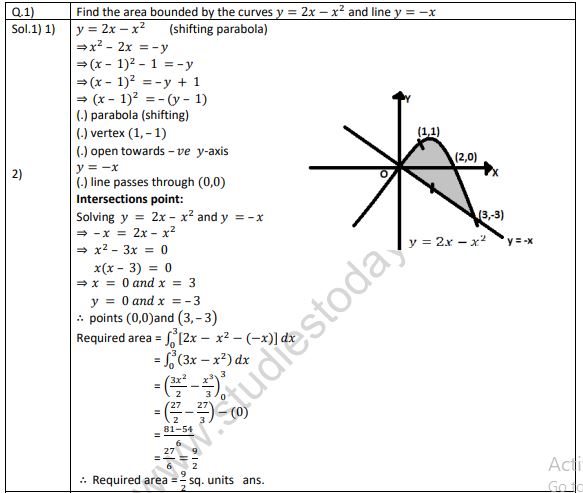
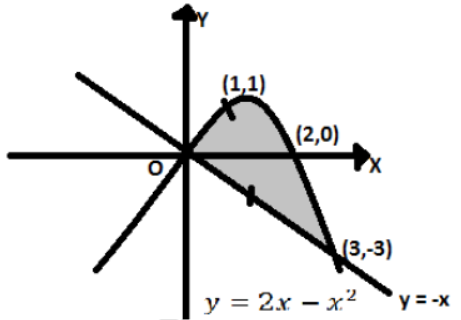
Question. Find the area bounded by the curves \( y = 2x - x^2 \) and line \( y = -x \).
Answer:
1) \( y = 2x - x^2 \) (shifting parabola)
\( \Rightarrow x^2 - 2x = -y \)
\( \Rightarrow (x - 1)^2 - 1 = -y \)
\( \Rightarrow (x - 1)^2 = -y + 1 \)
\( \Rightarrow (x - 1)^2 = -(y - 1) \)
(.) parabola (shifting)
(.) vertex \( (1, 1) \)
(.) open towards \( -\text{ve } y \)-axis
2) \( y = -x \)
(.) line passes through \( (0,0) \)
Intersections point:
Solving \( y = 2x - x^2 \) and \( y = -x \)
\( \Rightarrow -x = 2x - x^2 \)
\( \Rightarrow x^2 - 3x = 0 \)
\( x(x - 3) = 0 \)
\( \Rightarrow x = 0 \) and \( x = 3 \)
\( y = 0 \) and \( x = -3 \)
\( \therefore \) points \( (0,0) \) and \( (3, -3) \)
Required area = \( \int_{0}^{3} [2x - x^2 - (-x)] \, dx \)
\[ = \int_{0}^{3} (3x - x^2) \, dx \]
\[ = \left( \frac{3x^2}{2} - \frac{x^3}{3} \right)_{0}^{3} \]
\[ = \left( \frac{27}{2} - \frac{27}{3} \right) - (0) \]
\[ = \frac{81 - 54}{6} \]
\[ = \frac{27}{6} = \frac{9}{2} \]
\( \therefore \) Required area = \( \frac{9}{2} \) sq. units ans.
Question. Find the area bounded by curves \( y = 6x - x^2 \) and \( y = x^2 - 2x \).
Answer:
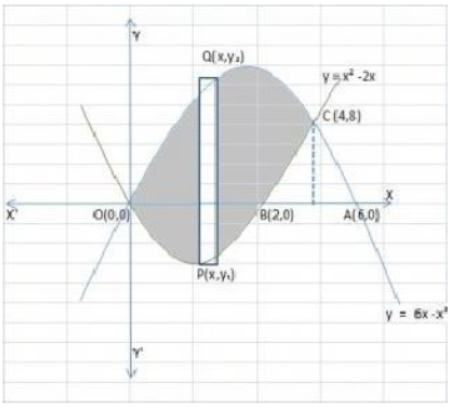
1) \( y = 6x - x^2 \)
\( \Rightarrow x^2 - 6x = -y \)
\( \Rightarrow (x - 3)^2 - 9 = -y \)
\( \Rightarrow (x - 3)^2 = -y + 9 \)
\( \Rightarrow (x - 3)^2 = -(y - 9) \)
(.) vertex \( (3,9) \)
(.) shifting parabola
(.) open towards \( -\text{ve } y \)-axis
(Imp.) Intersection point of this parabola with \( x \)-axis (\( y = 0 \)).
Put \( y = 0 \) in \( y = 6x - x^2 \)
\( \Rightarrow x^2 - 6x = 0 \)
\( \Rightarrow x(x - 6) = 0 \)
\( x = 0 \) and \( x = 6 \)
2) \( y = x^2 - 2x \)
\( \Rightarrow x^2 - 2x = y \)
\( \Rightarrow (x - 1)^2 - 1 = y \)
\( \Rightarrow (x - 1)^2 = (y + 1) \)
(.) shifting parabola
(.) vertex \( (1, -1) \)
(.) open towards \( +\text{ve } y \)-axis
Intersection point of this parabola with \( x - \text{axis} \) (\( y = 0 \))
Put \( y = 0 \) in \( y = x^2 - 2x \)
\( \Rightarrow x^2 - 2x = 0 \)
\( \Rightarrow x(x - 2) = 0 \)
\( x = 0 \) and \( x = 2 \)
Required area = \( \int_{0}^{4} [(6x - x^2) - (x^2 - 2x)] \, dx \)
\[ = \int_{0}^{4} (8x - 2x^2) \, dx \]
\[ = \left[ 4x^2 - \frac{2x^3}{3} \right]_{0}^{4} \]
\[ = \left[ 64 - \frac{128}{3} \right] - [0] \]
Required = \( \frac{64}{3} \) sq. units. ans.
Question. Find the area bounded by the triangle whose vertices are \( A(2,0) \), \( B(4,5) \), & \( C(6,3) \).
Answer:
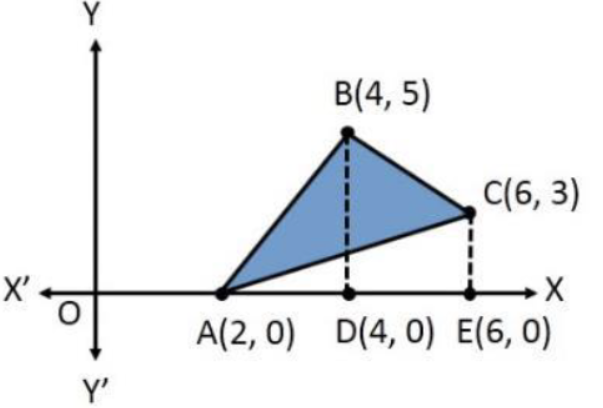
Vertices are \( A(2,0) \) & \( B(4,5) \), \( C(6,3) \)
Equation of side AB (two point form)
\( y - 0 = \frac{5 - 0}{4 - 2}(x - 2) \)
\( y = \frac{5x - 10}{2} \)
equation of side BC:
\( y - 5 = \frac{3 - 5}{6 - 4}(x - 4) \)
\( y - 5 = -1(x - 4) \)
\( \Rightarrow y - 5 = -x + 4 \)
\( \Rightarrow y = -x + 9 \)
Equation of side AC
\( y - 0 = \frac{3 - 0}{6 - 2}(x - 2) \)
\( y = \frac{3}{4}(x - 2) \)
Required area = \( \int_{2}^{4} \left( \frac{5x - 10}{2} \right) - \left( \frac{3x - 6}{4} \right) \, dx + \int_{4}^{6} (-x + 9) - \left( \frac{3x - 6}{4} \right) \, dx \)
\[ = \frac{1}{4} \int_{2}^{4} (10x - 20 - 3x + 6) \, dx + \frac{1}{4} \int_{4}^{6} (-4x + 36 - 3x + 6) \, dx \]
\[ = \frac{1}{4} \int_{2}^{4} (7x - 14) \, dx + \frac{1}{4} \int_{4}^{6} (-7x + 42) \, dx \]
\[ = \frac{7}{4} \int_{2}^{4} (x - 2) \, dx + \frac{7}{4} \int_{4}^{6} (-x + 6) \, dx \]
\[ = \frac{7}{4} \left[ \frac{x^2}{2} - 2x \right]_{2}^{4} + \frac{7}{4} \left[ -\frac{x^2}{2} + 6x \right]_{4}^{6} \]
\[ = \frac{7}{4} [(8 - 8) - (2 - 4)] + \frac{7}{4} [(-18 + 36) - (-8 + 24)] \]
\[ = \frac{7}{4}(2) + \frac{7}{4}(2) \]
\[ = \frac{7}{2} + \frac{7}{2} = 7 \]
\( \therefore \) Required area = 7 sq. units ans.
Question. Find the area bounded by the lines \( 2x + y = 4 \), \( 3x - 2y = 6 \) and \( x - 3y + 5 = 0 \).
Answer:
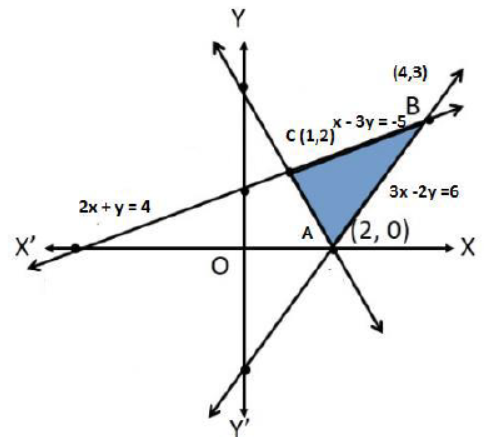
Given,
\( 2x + y = 4 \quad \dots (1) \)
\( 3x - 2y = 6 \quad \dots (2) \)
\( x - 3y = -5 \quad \dots (3) \)
Solving (1) & (2):
\( 6x + 3y = 12 \)
\( 6x - 4y = 12 \)
\( 7y = 0 \Rightarrow y = 0 \)
\( \therefore x = 2 \)
\( A(2, 0) \)
Solving (2) & (3):
\( 3x - 2y = 6 \)
\( 3x - 9y = -15 \)
\( 7y = 21 \Rightarrow y = 3 \)
\( \therefore x = 4 \)
\( B(4, 3) \)
Solving (1) & (3):
\( 2x + y = 4 \)
\( 2x - 6y = -10 \)
\( 7y = 14 \Rightarrow y = 2 \)
\( \therefore x = 1 \)
\( C(1, 2) \)
Now equation of \( AB = \) eq. (2) i.e. \( 3x - 2y = 6 \)
Equation of \( BC = \) eq. (3) i.e. \( x - 3y = -5 \)
& equation of \( AC = \) eq. (1) i.e. \( 2x + y = 4 \)
Required area = \( \int_{1}^{2} \left( \frac{x+5}{3} \right) - (4 - 2x) \, dx + \int_{2}^{4} \left( \frac{x+5}{3} \right) - \left( \frac{3x-6}{2} \right) \, dx \)
\[ = \frac{1}{3} \int_{1}^{2} (x + 5 - 12 + 6x) \, dx + \frac{1}{6} \int_{2}^{4} (2x + 10 - 9x + 18) \, dx \]
\[ = \frac{1}{3} \int_{1}^{2} (7x - 7) \, dx + \frac{1}{6} \int_{2}^{4} (28 - 7x) \, dx \]
\[ = \frac{7}{3} \int_{1}^{2} (x - 1) \, dx + \frac{7}{6} \int_{2}^{4} (4 - x) \, dx \]
\[ = \frac{7}{3} \left[ \frac{x^2}{2} - x \right]_{1}^{2} + \frac{7}{6} \left[ 4x - \frac{x^2}{2} \right]_{2}^{4} \]
\[ = \frac{7}{3} \left[ (2 - 2) - \left( \frac{1}{2} - 1 \right) \right] + \frac{7}{6} \left[ (16 - 8) - (8 - 2) \right] \]
\[ = \frac{7}{3} \left( \frac{1}{2} \right) + \frac{7}{6} (2) \]
\[ = \frac{7}{6} + \frac{14}{6} = \frac{21}{6} = \frac{7}{2} \]
\( \therefore \) Required area = \( \frac{7}{2} \) sq. units ans.
Question. Find the area of region bounded by the line \( y = 3x + 2 \), \( x \)-axis, \( x = -1 \) and \( x = 1 \).
Answer:
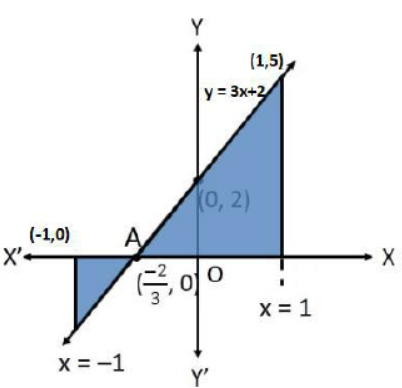
1) \( y = 3x + 2 \)
(.) line passing through points \( (0,2) \) and \( \left( \frac{-2}{3}, 0 \right) \)
2) \( x \)-axis
3) \( x = -1 \)
(.) line parallel to \( y \)-axis at \( (-1, 0) \)
4) \( x = 1 \)
(.) line parallel to \( y \)-axis at \( (1,0) \)
Required area = \( \int_{-1}^{-\frac{2}{3}} 0 - (3x + 2) \, dx + \int_{-\frac{2}{3}}^{1} (3x + 2) - 0 \, dx \)
\[ = -\left[ \frac{3x^2}{2} + 2x \right]_{-1}^{-\frac{2}{3}} + \left[ \frac{3x^2}{2} + 2x \right]_{-\frac{2}{3}}^{1} \]
\[ = \left[ \left( \frac{3}{2} \cdot \frac{4}{9} - \frac{4}{3} \right) - \left( \frac{3}{2} - 2 \right) \right] + \left[ \left( \frac{3}{2} + 2 \right) - \left( \frac{2}{3} - \frac{4}{3} \right) \right] \]
\[ = \left[ -\frac{2}{3} + \frac{1}{2} \right] + \left[ \frac{7}{2} + \frac{2}{3} \right] \]
\[ = -\left[ \frac{-4 + 3}{6} \right] + \left[ \frac{21 + 4}{6} \right] \]
\[ = \frac{1}{6} + \frac{25}{6} = \frac{26}{6} = \frac{13}{3} \]
\( \therefore \) Required area = \( \frac{13}{3} \) sq. units ans.
Question. Sketch the graph \( y = |x + 3| \). Evaluate \( \int_{-6}^{0} |x + 3| \, dx \). What does this value represent on the graph?
Answer:
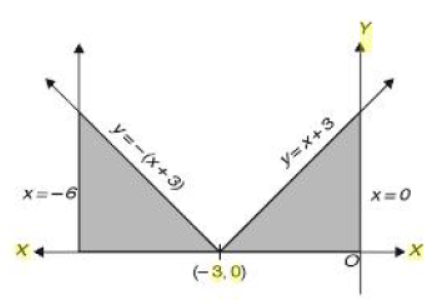
We have, \( y = |x + 3| \)
\[ y = \begin{cases} x + 3 & ; \quad x + 3 \ge -3 \implies x \ge -3 \\ -(x + 3) & ; \quad x + 3 < 0 \implies x < -3 \end{cases} \]
(.) \( y = x + 3 \;; \; x \ge -3 \)
Point \( (0,3) \) and \( (-3,0) \)
(.) \( y = -x - 3 \;; \; x < -3 \)
Point \( (0, -3) \) and \( (-3,0) \)
Now \( \int_{-6}^{0} |x + 3| \, dx = -\int_{-6}^{-3} (x + 3) \, dx + \int_{-3}^{0} (x + 3) \, dx \)
\[ = -\left[ \frac{x^2}{2} + 3x \right]_{-6}^{-3} + \left[ \frac{x^2}{2} + 3x \right]_{-3}^{0} \]
\[ = -\left[ \left( \frac{9}{2} - 9 \right) - \left( \frac{36}{2} - 18 \right) \right] + \left[ (0) - \left( \frac{9}{2} - 9 \right) \right] \]
\[ = -\left[ -\frac{9}{2} - 0 \right] + \left[ \frac{9}{2} \right] \]
\[ = \frac{9}{2} + \frac{9}{2} = 9 \]
\( \therefore \int_{-6}^{0} |x + 3| \, dx = 9 \) ans.
This value represents the area of the shaded region in the graph.
Question. Find the area bounded by the curve \( |x| + |y| = 1 \).
Answer:
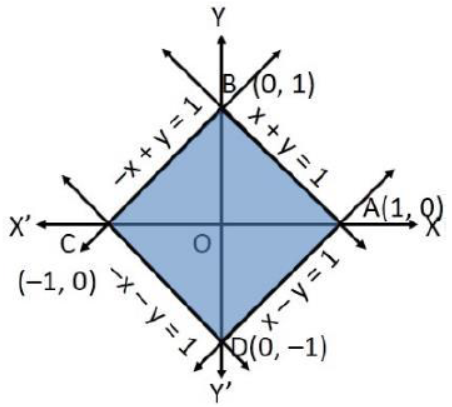
We have \( |x| + |y| = 1 \)
This curve has four lines:
1) \( x + y = 1 \;; \; x \ge 0 \) and \( y \ge 0 \)
Point \( (0,1) \) and \( (1,0) \)
2) \( -x + y = 1 \;; \; x < 0 \) and \( y \ge 0 \)
Points \( (0,1) \) and \( (-1,0) \)
3) \( x - y = 1 \;; \; x \ge 0 \) and \( y < 0 \)
Point \( (0, -1) \) & \( (1,0) \)
4) \( -x - y = 1 \;; \; x < 0 \) and \( y < 0 \)
Point \( (0, -1) \) & \( (-1,0) \)
Required area = \( \int_{-1}^{0} (1 + x) - 0 \, dx + \int_{0}^{1} (1 - x) - 0 \, dx + \int_{0}^{1} 0 - (x - 1) \, dx + \int_{-1}^{0} 0 - (-x - 1) \, dx \)
\[ = \left[ x + \frac{x^2}{2} \right]_{-1}^{0} + \left[ x - \frac{x^2}{2} \right]_{0}^{1} + \left[ \frac{-x^2}{2} + x \right]_{0}^{1} + \left[ \frac{x^2}{2} + x \right]_{-1}^{0} \]
\[ = \left[ (0) - \left( -1 + \frac{1}{2} \right) \right] + \left[ \left( 1 - \frac{1}{2} \right) - (0) \right] + \left[ \left( \frac{-1}{2} + 1 \right) - 0 \right] + \left[ (0) - \left( \frac{1}{2} - 1 \right) \right] \]
\[ = \frac{1}{2} + \frac{1}{2} + \frac{1}{2} + \frac{1}{2} = 2 \]
\( \therefore \) Req. Area = 2 sq. units.
Question. Find the area bounded by the curves \( y = 2 + |x + 2| \); \( x = -4 \) and \( x = 4 \) and \( y = 0 \).
Answer:
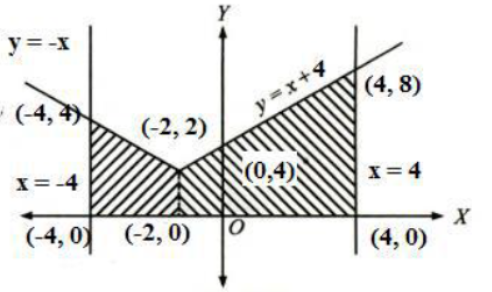
1) \( y = 2 + |x + 2| \)
(.) \( y = 2 + (x + 2) \;; \; x + 2 \ge 0 \)
\( \Rightarrow x \ge -2 \;; \; y = x + 4 \)
Points \( (0,4) \) and \( (-4,0) \)
(.) \( y = 2 - (x + 2) \;; \; x + 2 < 0 \)
\( \Rightarrow x < -2 \;; \; y = -x \)
line passing through \( (0,0) \) and \( 45^\circ \) with \( x \)-axis
2) \( x = -4 \)
(.) line parallel to \( y \)-axis at \( (-4,0) \)
3) \( x = 4 \)
(.) line parallel to \( y \)-axis at \( (4,0) \)
4) \( y = 0 \)
(.) equation of \( x \)-axis
Required area = \( \int_{-4}^{-2} (-x) \, dx + \int_{-2}^{4} (x + 4) \, dx \)
\[ = -\left( \frac{x^2}{2} \right)_{-4}^{-2} + \left( \frac{x^2}{2} + 4x \right)_{-2}^{4} \]
\[ = -[2 - 8] + [(8 + 16) - (2 - 8)] \]
\[ = 6 + 24 + 6 = 32 \]
\( \therefore \) Required area = 32 sq. units ans.
Question. Find the area bounded by the curves \( x^2 + y^2 = 1 \) and \( (x - 1)^2 + y^2 = 1 \).
Answer:
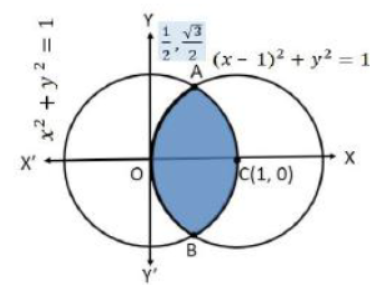
1) \( x^2 + y^2 = 1 \)
(.) circle : center \( (0,0) \) and radius = 1
2) \( (x - 1)^2 + y^2 = 1 \)
(.) circle : center \( (1,0) \) and radius = 1
Required Area:
\[ = 2 \int_{0}^{\frac{1}{2}} \sqrt{1 - (x - 1)^2} \, dx + 2 \int_{\frac{1}{2}}^{1} \sqrt{1 - x^2} \, dx \]
\[ = 2 \left[ \frac{(x-1)}{2} \sqrt{1 - (x - 1)^2} + \frac{1}{2} \sin^{-1}(x - 1) \right]_{0}^{\frac{1}{2}} + 2 \left[ \frac{x}{2}\sqrt{1 - x^2} + \frac{1}{2}\sin^{-1}(x) \right]_{\frac{1}{2}}^{1} \]
\[ = 2 \left[ \left( -\frac{1}{4} \cdot \frac{\sqrt{3}}{2} + \frac{1}{2}\sin^{-1}\left(-\frac{1}{2}\right) \right) - \left( 0 + \frac{1}{2}\sin^{-1}(-1) \right) \right] + 2 \left[ \left( 0 + \frac{1}{2}\sin^{-1}(1) \right) - \left( \frac{1}{4} \cdot \frac{\sqrt{3}}{2} + \frac{1}{2}\sin^{-1}\frac{1}{2} \right) \right] \]
\[ = 2 \left[ -\frac{\sqrt{3}}{8} - \frac{1}{2} \cdot \frac{\pi}{6} - \left( -\frac{1}{2} \cdot \frac{\pi}{2} \right) \right] + 2 \left[ \left( \frac{1}{2} \cdot \frac{\pi}{2} \right) - \frac{\sqrt{3}}{8} - \frac{1}{2} \cdot \frac{\pi}{6} \right] \]
\[ = 2 \left[ -\frac{\sqrt{3}}{8} - \frac{\pi}{12} + \frac{\pi}{4} \right] + 2 \left[ \frac{\pi}{4} - \frac{\sqrt{3}}{8} - \frac{\pi}{12} \right] \]
\[ = -\frac{\sqrt{3}}{4} - \frac{\pi}{6} + \frac{\pi}{2} + \frac{\pi}{2} - \frac{\sqrt{3}}{4} - \frac{\pi}{6} \]
\[ = \pi - \frac{\pi}{3} - \frac{\sqrt{3}}{2} = \frac{2\pi}{3} - \frac{\sqrt{3}}{2} \]
\( \therefore \) Required area = \( \left( \frac{2\pi}{3} - \frac{\sqrt{3}}{2} \right) \) sq. units ans.
Question. Find the area bounded by the curves \( (x - 3)^2 + y^2 \ge 9 \) and \( x^2 + y^2 \le 9 \).
Answer:
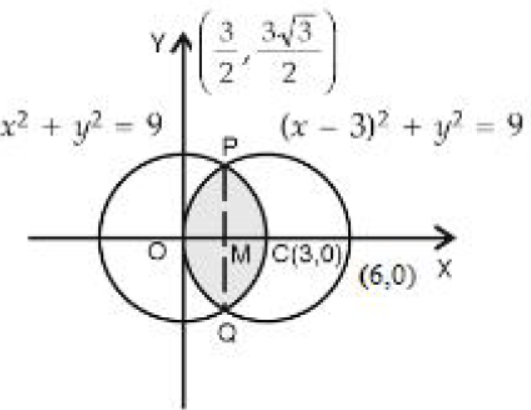
1) \( (x - 3)^2 + y^2 \ge 9 \)
(.) circle : center = \( (3,0) \) and radius = 3
(.) solution : outside the circle
2) \( x^2 + y^2 \le 9 \)
(.) circle : center \( (0,0) \) and radius = 3
(.) solution : Inside the circle
Intersection point:
Solving \( x^2 + y^2 = 9 \) and \( (x - 3)^2 + y^2 = 9 \)
Put \( y^2 = 9 - x^2 \) in \( (x - 3)^2 + y^2 = 9 \)
\( \Rightarrow (x - 3)^2 + 9 - x^2 = 9 \)
\( \Rightarrow x^2 + 9 - 6x + 9 - x^2 = 9 \)
\( \Rightarrow 6x = 9 \)
\( x = \frac{3}{2} \)
\( \therefore y = \frac{3\sqrt{3}}{2} \)
points \( \left( \frac{3}{2}, \frac{3\sqrt{3}}{2} \right) \)
Now required = Area of circle - [Area of region (A + B)]
Area of circle = \( \pi r^2 = \pi(3)^2 = 9\pi \) sq. units
\[ \text{Area of region (A + B)} = 2 \int_{0}^{\frac{3}{2}} \sqrt{9 - (x - 3)^2} \, dx + 2 \int_{\frac{3}{2}}^{3} \sqrt{9 - x^2} \, dx \]
\[ = 2 \left[ \frac{(x-3)}{2}\sqrt{9 - (x - 3)^2} + \frac{9}{2}\sin^{-1}\left(\frac{x-3}{3}\right) \right]_{0}^{\frac{3}{2}} + 2 \left[ \frac{x}{2}\sqrt{9 - x^2} + \frac{9}{2}\sin^{-1}\left(\frac{x}{3}\right) \right]_{\frac{3}{2}}^{3} \]
\[ = 2 \left[ \left( -\frac{3}{4} \cdot \frac{3\sqrt{3}}{2} + \frac{9}{2}\sin^{-1}\left(-\frac{1}{2}\right) \right) - \left( 0 + \frac{9}{2}\sin^{-1}(-1) \right) \right] + 2 \left[ \left( 0 + \frac{9}{2}\sin^{-1}(1) \right) - \left( \frac{3}{4} \cdot \frac{3\sqrt{3}}{2} + \frac{9}{2}\sin^{-1}\left(\frac{1}{2}\right) \right) \right] \]
\[ = 2 \left[ \left( -\frac{9\sqrt{3}}{8} - \frac{9}{2} \cdot \frac{\pi}{6} \right) - \left( -\frac{9}{2} \cdot \frac{\pi}{2} \right) \right] + 2 \left[ \frac{9}{2} \cdot \frac{\pi}{2} - \frac{9\sqrt{3}}{8} - \frac{9}{2} \cdot \frac{\pi}{6} \right] \]
\[ = -\frac{9\sqrt{3}}{4} - \frac{9\pi}{6} + \frac{9\pi}{2} + \frac{9\pi}{2} - \frac{9\sqrt{3}}{4} - \frac{9\pi}{6} \]
\[ = 9\pi - \frac{9\pi}{3} - \frac{9\sqrt{3}}{2} = \frac{18\pi}{3} - \frac{9\sqrt{3}}{2} \text{ sq. units} \]
Now required area = \( 9\pi - \left( \frac{18\pi}{3} - \frac{9\sqrt{3}}{2} \right) \)
\[ = \left( \frac{9\pi}{3} + \frac{9\sqrt{3}}{2} \right) \text{ sq. units ans.} \]
Free study material for Mathematics
Free CBSE Practice Worksheets: Class 12 Mathematics Chapter 08 Application Of Integrals
Practice Exercises for Class 12 Mathematics Chapter 08 Application Of Integrals
Review targeted practice exercises for Class 12 Mathematics Chapter 08 Application Of Integrals. Curated to match official CBSE guidelines, these printable problem sets support daily revision and improve overall test readiness.
Step-by-Step Solutions and Practice Guidelines
Built using official NCERT guidelines for Class 12 Mathematics, these practice sheets provide reliable academic support. Cross-reference your completed work with our detailed solutions to learn standard answer-writing formats for CBSE exams.
Enhance Speed with Online Practice
Wrap up your chapter revision by testing your knowledge against standard objective question formats. Explore our full library of free, up-to-date printable assignments to maximize your academic results in upcoming CBSE evaluations.
FAQs
You can download the latest chapter-wise printable worksheets for Class 12 Mathematics Chapter 08 Application Of Integrals for free from StudiesToday.com. These have been made as per the latest CBSE curriculum for this academic year.
Yes, Class 12 Mathematics worksheets for Chapter 08 Application Of Integrals focus on activity-based learning and also competency-style questions. This helps students to apply theoretical knowledge to practical scenarios.
Yes, we have provided solved worksheets for Class 12 Mathematics Chapter 08 Application Of Integrals to help students verify their answers instantly.
Yes, our Class 12 Mathematics test sheets are mobile-friendly PDFs and can be printed by teachers for classroom.
For Chapter 08 Application Of Integrals, regular practice with our worksheets will improve question-handling speed and help students understand all technical terms and diagrams.