

Find the CBSE Class 12 Mathematics Continuity And Differentiability Worksheet Set 07 right below. We offer detailed and printable Class 12 Mathematics worksheets for Chapter 5 Continuity and Differentiability, updated for the 2026-27 term. Each resource matches official syllabus rules from NCERT, CBSE, and KVS to support effective student revision.
Chapter-wise Worksheet for Class 12 Mathematics Chapter 5 Continuity and Differentiability
Use this Mathematics practice paper to evaluate your Chapter 5 Continuity and Differentiability skills. Built for Class 12 students, it offers essential questions and clear answers so you can practice daily and perform better in school tests and final examinations.
Download Worksheet: Chapter 5 Continuity and Differentiability (Class 12 Mathematics)
CBSE Class 12 Mathematics Continuity And Differentiability Worksheet 7. The Continuity And Differentiability questions in the worksheets have been specifically designed by best mathematics teachers so that the students can practise them to clear their Continuity And Differentiability concepts and get better marks in class 12 mathematics tests and examinations. Students can free download these Continuity And Differentiability worksheets in pdf and practice them. This will help them to get better marks in examinations. Also refer to other worksheets for the Continuity And Differentiability chapter and other subjects too. Use them for better understanding of the subjects..
Continuity & Differentiability
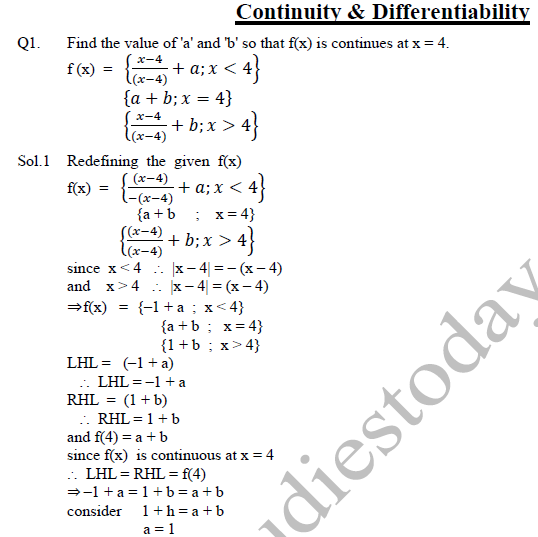
Question. Find the value of 'a' and 'b' so that f(x) is continues at x = 4. \[ f(x) = \begin{cases} \frac{x-4}{|x-4|} + a & ; \ x < 4 \\ a + b & ; \ x = 4 \\ \frac{x-4}{|x-4|} + b & ; \ x > 4 \end{cases} \]
Answer: Redefining the given f(x) \[ f(x) = \begin{cases} \frac{x-4}{-(x-4)} + a & ; \ x < 4 \\ a+b & ; \ x = 4 \\ \frac{x-4}{x-4} + b & ; \ x > 4 \end{cases} \] since \( x < 4 \dots |x - 4| = -(x - 4) \)
and \( x > 4 \dots |x - 4| = (x - 4) \)
\( \Rightarrow f(x) = \begin{cases} -1 + a & ; \ x < 4 \\ a + b & ; \ x = 4 \\ 1 + b & ; \ x > 4 \end{cases} \)
LHL = \( (-1 + a) \)
\( \therefore \text{LHL} = -1 + a \)
RHL = \( (1 + b) \)
\( \therefore \text{RHL} = 1 + b \)
and \( f(4) = a + b \)
since f(x) is continuous at \( x = 4 \)
\( \therefore \text{LHL} = \text{RHL} = f(4) \)
\( \Rightarrow -1 + a = 1 + b = a + b \)
consider \( 1 + b = a + b \)
\( a = 1 \)
and \( -1 = a = a + b \)
\( b = -1 \)
\( \therefore f(x) \) is continuous at \( x = 4 \) for \( a = 1 \) & \( b = -1 \). Ans.
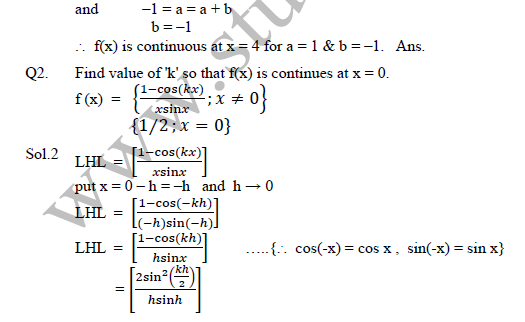
Question. Find value of 'k' so that f(x) is continues at x = 0. \[ f(x) = \begin{cases} \frac{1-\cos(kx)}{x\sin x} & ; \ x \neq 0 \\ \frac{1}{2} & ; \ x = 0 \end{cases} \]
Answer: LHL = \( \left[\frac{1-\cos(kx)}{x\sin x}\right] \)
put \( x = 0 - h = -h \) and \( h \to 0 \)
LHL = \( \left[\frac{1-\cos(-kh)}{(-h)\sin(-h)}\right] \)
LHL = \( \left[\frac{1-\cos(kh)}{h\sin h}\right] \dots\dots \{\because \cos(-x) = \cos x, \sin(-x) = \sin x\} \)
\( = \left[\frac{2\sin^2\left(\frac{kh}{2}\right)}{h\sin h}\right] \)
\[ = \left[ \frac{\frac{2\sin^2\left(\frac{kh}{2}\right)}{\frac{k^2h^2}{4}} \times \frac{k^2h^2}{4}}{\frac{\sin h}{h} \times h \times h} \right] \]
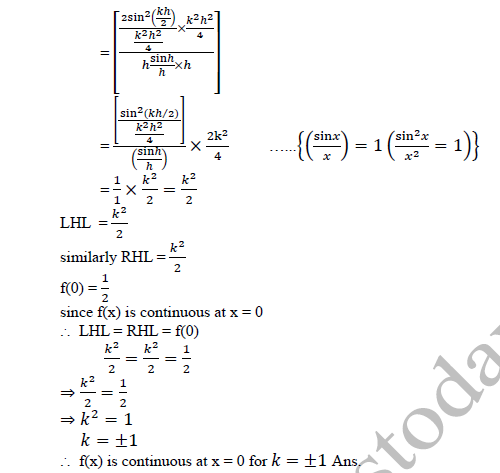
\[ = \left[ \frac{\frac{\sin^2(kh/2)}{\frac{k^2h^2}{4}}}{\frac{\sin h}{h}} \right] \times \frac{2k^2}{4} \dots\dots \left\{ \lim_{x \to 0}\left(\frac{\sin x}{x}\right) = 1 \left(\frac{\sin^2 x}{x^2} = 1\right) \right\} \]
\( = \frac{1}{1} \times \frac{k^2}{2} = \frac{k^2}{2} /> LHL = \( \frac{k^2}{2} \)
similarly RHL = \( \frac{k^2}{2} \)
\( f(0) = \frac{1}{2} \)
since f(x) is continuous at \( x = 0 \)
\( \therefore \text{LHL} = \text{RHL} = f(0) \)
\( \frac{k^2}{2} = \frac{k^2}{2} = \frac{1}{2} \)
\( \Rightarrow \frac{k^2}{2} = \frac{1}{2} \)
\( \Rightarrow k^2 = 1 \)
\( k = \pm 1 \)
\( \therefore f(x) \) is continuous at \( x = 0 \) for \( k = \pm 1 \) Ans.
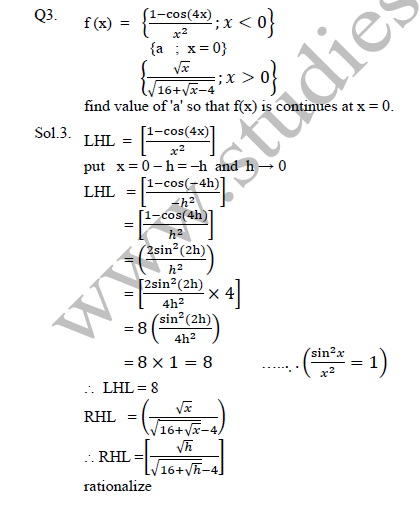
Question. Find value of 'a' so that f(x) is continues at x = 0. \[ f(x) = \begin{cases} \frac{1-\cos(4x)}{x^2} & ; \ x < 0 \\ a & ; \ x = 0 \\ \frac{\sqrt{x}}{\sqrt{16+\sqrt{x}}-4} & ; \ x > 0 \end{cases} \]
Answer: LHL = \( \left[\frac{1-\cos(4x)}{x^2}\right] \)
put \( x = 0 - h = -h \) and \( h \to 0 \)
LHL = \( \left[\frac{1-\cos(-4h)}{(-h)^2}\right] \)
\( = \left[\frac{1-\cos(4h)}{h^2}\right] \)
\( = \left(\frac{2\sin^2(2h)}{h^2}\right) \)
\( = \left[\frac{2\sin^2(2h)}{4h^2} \times 4\right] \)
\( = 8\left(\frac{\sin^2(2h)}{4h^2}\right) \)
\( = 8 \times 1 = 8 \dots\dots \left(\frac{\sin^2 x}{x^2} = 1\right) \)
\( \therefore \text{LHL} = 8 \)
RHL = \( \left(\frac{\sqrt{x}}{\sqrt{16+\sqrt{x}}-4}\right) \)
\( \therefore \text{RHL} = \left[\frac{\sqrt{h}}{\sqrt{16+\sqrt{h}}-4}\right] \)
rationalize
RHL = \( \left[\frac{\sqrt{h}}{\sqrt{16+\sqrt{h}}-4} \times \frac{(\sqrt{16+\sqrt{h}}+4)}{(\sqrt{16+\sqrt{h}}+4)}\right] \)
\( = \left[\frac{\sqrt{h}(\sqrt{16+\sqrt{h}}+4)}{16+\sqrt{h}-16}\right] \)
\( = \left[\sqrt{16} + \sqrt{h} + 4\right] \)
\( = 4 + 4 \)
RHL = 8
Now \( f(0) = a \)
since f(x) is continuous at \( x = 0 \)
LHL = RHL = \( f(0) \)
\( \Rightarrow 8 = 8 = a \dots a = 8 \)
\( \therefore f(x) \) is cont. at \( x = 0 \) for \( a = 8 \) Ans.
Question. Determine the value of a, b and c so that the function is continues at x = 0. \[ f(x) = \begin{cases} \frac{\sin(a+1)x+\sin x}{x} & ; \ x < 0 \\ c & ; \ x = 0 \\ \frac{\sqrt{x+bx^2}-\sqrt{x}}{bx^{3/2}} & ; \ x > 0 \end{cases} \]
Answer: LHL = \( \left[\frac{\sin(a+1)x+\sin x}{x}\right] \)
put \( x = 0 - h = -h \) and \( h \to 0 \)
LHL = \( \left[\frac{\sin(a+1)(-h)+\sin(-h)}{-h}\right] \)
\( = \left[\frac{-\sin(a+1)h-\sin h}{-h}\right] \)
\( = \left[\frac{\sin(a+1)h+\sin h}{h}\right] \)
\( = \left(\frac{\sin(a+1)h}{h} + \frac{\sin h}{h}\right) \)
\( = \left(\frac{\sin(a+1)h}{h(a+1)} \times (a + 1) + \frac{\sin h}{h}\right) \)
\( = (a + 1)\left(\frac{\sin(a+1)h}{h(a+1)}\right) + \left(\frac{\sin h}{h}\right) \)
\( = (a + 1)1 + 1 \dots\dots \left\{\left(\frac{\sin x}{x}\right) = 1\right\} \)
LHL = \( a + 2 \)
RHL = \( \left(\frac{\sqrt{x+bx^2}-\sqrt{x}}{bx^{3/2}}\right) \)
put \( x = 0 + h = h \) and \( h \to 0 \)
RHL = \( \left(\frac{\sqrt{h+bh^2}-\sqrt{h}}{bh^{3/2}}\right) \)
\( = \left(\frac{\sqrt{h}\sqrt{1+bh}-\sqrt{h}}{bh\sqrt{h}}\right) \)
\( = \left(\frac{\sqrt{h}(\sqrt{1+bh}-1)}{bh\sqrt{h}}\right) \)
Rationalize
\( = \left(\frac{(\sqrt{1+bh}-1)(\sqrt{1+bh}+1)}{bh(\sqrt{1+bh}+1)}\right) \)
\( = \left(\frac{1+bh-1}{bh(\sqrt{1+bh}+1)}\right) \)
\( = \left(\frac{1}{\sqrt{1+bh}+1}\right) = \frac{1}{1+1} = \frac{1}{2} /> RHL = \( \frac{1}{2} \)
\( f(0) = c \)
since f(x) is continuous at \( x = 0 \)
\( \therefore \text{LHL} = \text{RHL} = f(0) \)
\( \Rightarrow a + 2 = \frac{1}{2} = c \)
\( \Rightarrow a + 2 = \frac{1}{2} \) and \( c = \frac{1}{2} \)
\( a = -\frac{3}{2} \) and \( c = \frac{1}{2} \) and \( b = \mathbb{R} - \{0\} \dots\dots \{\text{for } b = 0 : f(x) \text{ does not exist}\} \). Ans.
Question. If the function f(x) is continues at x = 0. Find the value of k. \[ f(x) = \begin{cases} \frac{\log(1+ax)-\log(1-bx)}{x} & ; \ x \neq 0 \\ k & ; \ x = 0 \end{cases} \]
Answer: RHL = \( \left[\frac{\log(1+ax)-\log(1-bx)}{x}\right] \)
put \( x = 0 + h \) and \( h \to 0 \)
RHL = \( \left[\frac{\log(1+ah)-\log(1-bh)}{h}\right] \)
\( = \left[\frac{\log(1+ah)}{h} - \frac{\log(1-bh)}{h}\right] \)
\( = \left[\frac{\log(1+ah)}{ah} \times a - \frac{\log(1+(-bh))}{(-bh)} \times (-b)\right] \)
\( = a\left(\frac{\log(1+ah)}{ah}\right) + b\left(\frac{\log(1+(-bh))}{(-bh)}\right) \)
\( = a(1) + b(1) \dots\dots \left(\frac{\log(1+x)}{x} = 1\right) \)
RHL = \( a + b \)
\( f(0) = k \)
since f(x) is continuous at \( x = 0 \)
\( \therefore \text{RHL} = f(0) \Rightarrow a + b = k \)
\( \therefore k = a + b \) Ans.
Question. Prove that the greatest integer function [x] is discontinues at all integral points.
Answer: We have \( f(x) = [x] \)
let \( k \) be only integer i.e. \( k \in \mathbb{Z} \)
then \( f(x) = [x] = \begin{cases} k - 1 & ; \text{if } k - 1 \le x < k \\ k & ; \text{if } k \le x < k + 1 \end{cases} \)
LHL = \( (k - 1) \)
LHL = \( k - 1 \)
RHL = \( (k) \)
RHL = \( k \)
and \( f(k) = k \)
since LHL \( \neq \) RHL \( \therefore f(x) \) is discontinuous at 'k' i.e. all integral points \( (\because k \in \mathbb{Z}) \). Ans.
Question. Show that the function g(x) = x - [x] is discontinues at all integral points.
Answer: We have \( g(x) = x - [x] \)
let \( k \) be any integer i.e \( k \in \mathbb{Z} \)
\( g(x) = \begin{cases} x - (k - 1) & ; \text{if } k - 1 \le x < k \\ x - k & ; \text{if } k \le x < k + 1 \end{cases} \)
LHL = \( (x - (k - 1)) \)
put \( x = k - h \) and \( h \to 0 \)
\( \therefore \text{LHL} = (k - h - k + 1) \)
LHL = \( -h + 1 = 1 \)
RHL = \( (x - k) \)
put \( x = k + h \) & \( h \to 0 \)
\( \therefore \text{RHL} = (k + h - k) = 0 \)
\( f(x) = k - k = 0 \)
since LHL \( \neq \) RHL \( \dots f(x) \) is discontinuous at all integral points \( (\because k \in \mathbb{Z}) \). Ans.
Question. Discus the continuity of the function f(x) = |x - 3| - |x - 1|
Answer: We have \( f(x) = |x - 3| - |x - 1| \)
first arrange moduli so that their critical points are in ascending order.
i.e \( f(x) = -|x - 1| + |x - 3| \)
\( f(x) = \begin{cases} +(x - 1) - (x - 3) & ; \ x < 1 \\ -1(x - 1) - (x - 3) & ; \ 1 \le x < 3 \\ -(x - 1) + (x - 3) & ; \ x \ge 3 \end{cases} \)
\( f(x) = \begin{cases} +2 & ; \ x < 1 \\ -2x + 4 & ; \ 1 \le x < 3 \\ -2 & ; \ x \ge 3 \end{cases} \)
when \( x < 1 \)
\( f(x) = 2 \) which is a constant function, which is everywhere continuous. \( \therefore f(x) \) is continuous when \( x < 1 \).
when \( 1 < x < 3 \)
\( f(x) = -2x + 4 \) which is a polynomial function, which is everywhere continuous. \( f(x) \) is continuous when \( 1 < x < 3 \).
when \( x > 3 \)
\( f(x) = -2 \) which is a constant function, which is everywhere continuous. \( \therefore f(x) \) is continuous when \( x \ge 3 \).
Now Continuity at \( x = 1 \)
LHL = \( (2) \Rightarrow \text{LHL} = 2 \)
RHL = \( (-2x + 4) \)
put \( x = 1 + h \) & \( h \to 0 \)
\( \therefore \text{RHL} = (-2(1 + h) + 4) = 2 \)
RHL = \( -2 + 4 = 2 \)
\( f(1) = -2(1) + 4 = 2 \)
LHL = RHL = \( f(1) = 2 \)
\( \therefore f(x) \) is also continuous at \( x = 1 \)
Now continuity at \( x = 3 \)
LHL = \( (-2x + 4) \)
put \( x = 3 - h \) and \( h \to 0 \)
LHL = \( (-2(3 - h) + 4) \)
\( \Rightarrow \text{LHL} = -6 + 4 = -2 \)
RHL = \( (-2) \)
\( f(3) = -2 \)
LHL = RHL = \( f(3) = -2 \)
\( \therefore f(x) \) is also continuous at \( x = 3 \)
\( \therefore f(x) \) is continuous everywhere (or) there is no point of discontinuity. (Ans.)
Question. Show that the function f(x) = | 1 - x + |x| | is a continues function.
Answer: Let \( g(x) = | -x + |x| | \)
and \( h(x) = |x| \)
Now \( (hog)(x) = h(g(x)) \)
\( = h(1 - x + |x|) \)
\( (hog)(x) = |1 - x + |x|| /> \( \Rightarrow (hog)(x) = f(x) \dots\dots(1) \)
Now \( h(x) = |x| \) is sum of polynomial and modulus function and sum of two continuous functions is also continuous. \( \therefore g(x) \) is continuous everywhere
and composite function of two continuous functions is also continuous
here \( f(x) \) being a composite function of \( h(x) \) and \( g(x) \dots\dots\{\text{from (1) is also continuous}\} \) Ans.
Question. Examine that sin | x | is a continues function.
Answer: Let \( f(x) = \sin|x| \)
again let \( g(x) = |x| \) and \( h(x) = \sin x \)
Now, \( (hog)(x) = h(g(x)) \)
\( = h(|x|) \)
\( = \sin|x| \)
\( hog(x) = f(x) \dots\dots(1) \)
\( g(x) = |x| \); which is a modulus function and it is continuous everywhere.
\( h(x) = \sin x \); is a sine function and it is continuous everywhere.
and composite function of two continuous functions is also continuous.
here, \( f(x) \) being a composite function of \( g(x) \) and \( h(x) \) is also continuous. (Ans)
Please click the link below to download CBSE Class 12 Mathematics Continuity And Differentiability Worksheet 7
Free study material for Mathematics
Mathematics Class 12 Curriculum Worksheets: Chapter 5 Continuity and Differentiability
Mastering Chapter 5 Continuity and Differentiability with Printable Worksheets
Prepare effectively for your upcoming evaluations by utilizing the curated practice tasks for Chapter 5 Continuity and Differentiability featured above. Built by expert educators to reflect the current 2026 CBSE guidelines for Class 12, these tools support steady academic growth. Regular practice is strongly recommended for Class 12 students seeking lasting proficiency in Mathematics.
Verified Solutions & Answer Formats
Crafted in direct consultation with the newest NCERT book for Class 12 Mathematics, these exercises provide authentic practice. Cross-checking your responses against our teacher-crafted detailed solutions teaches you proper presentation techniques required for CBSE exams. Additionally, reviewing the preceding MCQ questions for Mathematics ensures comprehensive coverage of every critical sub-topic within the chapter.
Boosting Grades with Free Mathematics Resources
Routine completion of these Class 12 Mathematics exercises ensures complete comfort with standard exam structures. Should any section of Chapter 5 Continuity and Differentiability prove complex, our specialized NCERT solutions for Class 12 Mathematics provide straightforward explanations. Access our regularly updated collection of free printable assignments online to secure top grades in your evaluations.
FAQs
You can download the latest chapter-wise printable worksheets for Class 12 Mathematics Chapter 5 Continuity and Differentiability for free from StudiesToday.com. These have been made as per the latest CBSE curriculum for this academic year.
Yes, Class 12 Mathematics worksheets for Chapter 5 Continuity and Differentiability focus on activity-based learning and also competency-style questions. This helps students to apply theoretical knowledge to practical scenarios.
Yes, we have provided solved worksheets for Class 12 Mathematics Chapter 5 Continuity and Differentiability to help students verify their answers instantly.
Yes, our Class 12 Mathematics test sheets are mobile-friendly PDFs and can be printed by teachers for classroom.
For Chapter 5 Continuity and Differentiability, regular practice with our worksheets will improve question-handling speed and help students understand all technical terms and diagrams.