

Class 12 Mathematics Practice Sheet: CBSE Class 12 Mathematics Continuity And Differentiability Worksheet Set 08
Explore structured practice materials through the CBSE Class 12 Mathematics Continuity And Differentiability Worksheet Set 08. Tailored for Class 12 learners, utilizing these Mathematics worksheets ensures thorough preparation and strengthens problem-solving accuracy before final school evaluations.
Download Chapter 05 Continuity and Differentiability Worksheet PDF with Answers
View or download the dedicated CBSE Class 12 Mathematics Continuity And Differentiability Worksheet Set 08 resource below. Engaging with these practice papers under focused study conditions ensures continuous academic progress and mastery of the 2026-27 curriculum for Chapter 05 Continuity and Differentiability.
CBSE Class 12 Mathematics Continuity And Differentiability Worksheet 8. The Continuity And Differentiability questions in the worksheets have been specifically designed by best mathematics teachers so that the students can practise them to clear their Continuity And Differentiability concepts and get better marks in class 12 mathematics tests and examinations. Students can free download these Continuity And Differentiability worksheets in pdf and practice them. This will help them to get better marks in examinations. Also refer to other worksheets for the Continuity And Differentiability chapter and other subjects too. Use them for better understanding of the subjects.

Continuity & Differentiability
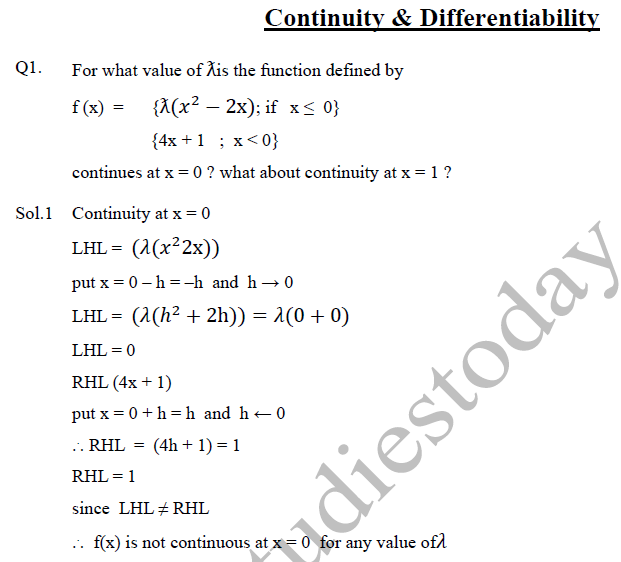
Question. For what value of \( \lambda \) is the function defined by \[ f(x) = \begin{cases} \lambda(x^2 - 2x) & \text{if } x \le 0 \\ 4x + 1 & \text{if } x > 0 \end{cases} \] continuous at \( x = 0 \)? What about continuity at \( x = 1 \)?
Answer:
Continuity at \( x = 0 \):
LHL = \( \lim_{x \to 0^-} f(x) = \lim_{x \to 0^-} \lambda(x^2 - 2x) \)
Put \( x = 0 - h = -h \) and \( h \to 0 \):
LHL = \( \lim_{h \to 0} \lambda((-h)^2 - 2(-h)) = \lambda(0 + 0) = 0 \)
RHL = \( \lim_{x \to 0^+} f(x) = \lim_{x \to 0^+} (4x + 1) \)
Put \( x = 0 + h = h \) and \( h \to 0 \):
RHL = \( \lim_{h \to 0} (4h + 1) = 1 \)
Since \( \text{LHL} \neq \text{RHL} \), the function \( f(x) \) is not continuous at \( x = 0 \) for any value of \( \lambda \).
Continuity at \( x = 1 \):
Here, for both LHL and RHL, \( f(x) = 4x + 1 \) (since \( x > 0 \)).
LHL = \( \lim_{x \to 1^-} (4x + 1) \)
Put \( x = 1 - h \) and \( h \to 0 \):
LHL = \( \lim_{h \to 0} (4(1 - h) + 1) = 4 + 1 = 5 \)
RHL = \( \lim_{x \to 1^+} (4x + 1) \)
Put \( x = 1 + h \) and \( h \to 0 \):
RHL = \( \lim_{h \to 0} (4(1 + h) + 1) = 4 + 1 = 5 \)
\( f(1) = 4(1) + 1 = 5 \)
Since \( \text{LHL} = \text{RHL} = f(1) \), \( f(x) \) is continuous at \( x = 1 \) irrespective of the value of \( \lambda \).
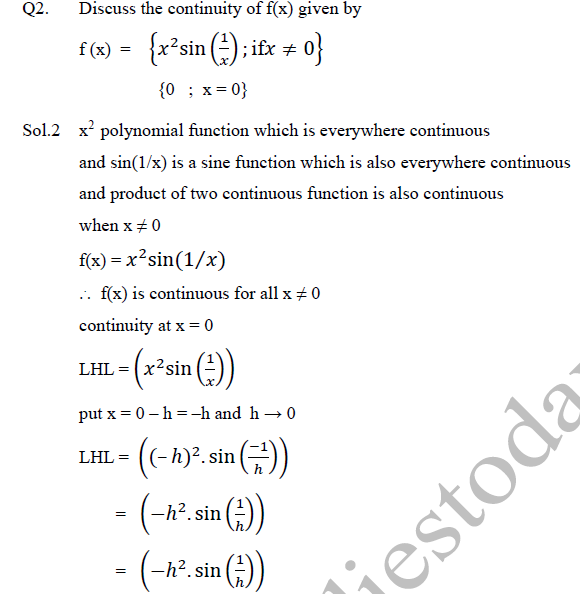
Question. Discuss the continuity of \( f(x) \) given by \[ f(x) = \begin{cases} x^2 \sin\left(\frac{1}{x}\right) & \text{if } x \neq 0 \\ 0 & \text{if } x = 0 \end{cases} \]
Answer:
Since \( x^2 \) is a polynomial function, it is everywhere continuous. Similarly, \( \sin\left(\frac{1}{x}\right) \) is a trigonometric sine function which is everywhere continuous for all \( x \neq 0 \). The product of two continuous functions is also continuous. Therefore, \( f(x) \) is continuous for all \( x \neq 0 \).
Continuity at \( x = 0 \):
LHL = \( \lim_{x \to 0^-} x^2 \sin\left(\frac{1}{x}\right) \)
Put \( x = 0 - h = -h \) and \( h \to 0 \):
LHL = \( \lim_{h \to 0} \left( (-h)^2 \sin\left(\frac{-1}{h}\right) \right) = \lim_{h \to 0} \left( -h^2 \sin\left(\frac{1}{h}\right) \right) \)
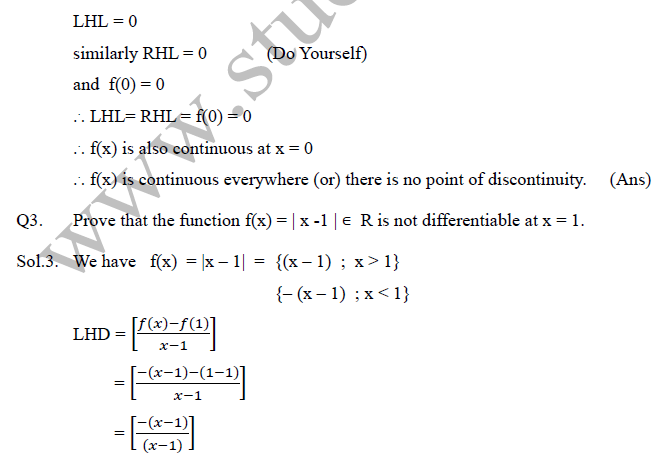
LHL = \( 0 \times (\text{an oscillating number between } -1 \text{ and } 1) = 0 \)
Similarly, RHL = \( \lim_{x \to 0^+} x^2 \sin\left(\frac{1}{x}\right) = 0 \).
Also, we are given \( f(0) = 0 \).
Since \( \text{LHL} = \text{RHL} = f(0) = 0 \), \( f(x) \) is also continuous at \( x = 0 \).
Thus, \( f(x) \) is continuous everywhere, meaning there is no point of discontinuity.
Question. Prove that the function \( f(x) = |x - 1| \in \mathbb{R} \) is not differentiable at \( x = 1 \).
Answer:
We have: \[ f(x) = |x - 1| = \begin{cases} x - 1 & \text{if } x \ge 1 \\ -(x - 1) & \text{if } x < 1 \end{cases} \]
Left Hand Derivative (LHD):
LHD = \( \lim_{x \to 1^-} \frac{f(x) - f(1)}{x - 1} \)
\( = \lim_{x \to 1^-} \frac{-(x - 1) - (1 - 1)}{x - 1} \)
\( = \lim_{x \to 1^-} \frac{-(x - 1)}{x - 1} = -1 \)
\( \implies \text{LHD} = -1 \)
Right Hand Derivative (RHD):
RHD = \( \lim_{x \to 1^+} \frac{f(x) - f(1)}{x - 1} \)
\( = \lim_{x \to 1^+} \frac{(x - 1) - (1 - 1)}{x - 1} \)
\( = \lim_{x \to 1^+} \frac{x - 1}{x - 1} = 1 \)
\( \implies \text{RHD} = 1 \)
Since \( \text{LHD} \neq \text{RHD} \), the function \( f(x) \) is not differentiable at \( x = 1 \).
Question. Prove that the greatest integer function \( f(x) = [x] \); \( 0 < x < 3 \) is not differentiable at \( x = 1 \) and \( x = 2 \).
Answer:
We have \( f(x) = [x] \) for \( 0 < x < 3 \), which can be written as: \[ f(x) = \begin{cases} 0 & \text{if } 0 < x < 1 \\ 1 & \text{if } 1 \le x < 2 \\ 2 & \text{if } 2 \le x < 3 \end{cases} \]
Differentiability at \( x = 1 \):
LHD = \( \lim_{x \to 1^-} \frac{f(x) - f(1)}{x - 1} = \lim_{x \to 1^-} \frac{0 - 1}{x - 1} \)
Put \( x = 1 - h \) and \( h \to 0 \):
LHD = \( \lim_{h \to 0} \frac{-1}{1 - h - 1} = \lim_{h \to 0} \frac{1}{h} = \infty \)
RHD = \( \lim_{x \to 1^+} \frac{f(x) - f(1)}{x - 1} = \lim_{x \to 1^+} \frac{1 - 1}{x - 1} = \lim_{x \to 1^+} \frac{0}{x - 1} = 0 \)
Since \( \text{LHD} \neq \text{RHD} \), \( f(x) \) is not differentiable at \( x = 1 \).
Differentiability at \( x = 2 \):
LHD = \( \lim_{x \to 2^-} \frac{f(x) - f(2)}{x - 2} = \lim_{x \to 2^-} \frac{1 - 2}{x - 2} \)
Put \( x = 2 - h \) and \( h \to 0 \):
LHD = \( \lim_{h \to 0} \frac{-1}{2 - h - 2} = \lim_{h \to 0} \frac{1}{h} = \infty \)
RHD = \( \lim_{x \to 2^+} \frac{f(x) - f(2)}{x - 2} = \lim_{x \to 2^+} \frac{2 - 2}{x - 2} = \lim_{x \to 2^+} \frac{0}{x - 2} = 0 \)
Since \( \text{LHD} \neq \text{RHD} \), \( f(x) \) is not differentiable at \( x = 2 \).
Question. If \( f(x) = |x|^3 \). Show that \( f''(x) \) exists for all \( x \in \mathbb{R} \) and find it.
Answer:
We have: \[ f(x) = |x|^3 = \begin{cases} x^3 & \text{if } x \ge 0 \\ -x^3 & \text{if } x < 0 \end{cases} \]
Differentiability of \( f(x) \) at \( x = 0 \):
LHD = \( \lim_{x \to 0^-} \frac{f(x) - f(0)}{x - 0} = \lim_{x \to 0^-} \frac{-x^3 - 0}{x} = \lim_{x \to 0^-} (-x^2) \)
Put \( x = 0 - h = -h \) and \( h \to 0 \):
LHD = \( \lim_{h \to 0} (-(-h)^2) = 0 \)
RHD = \( \lim_{x \to 0^+} \frac{f(x) - f(0)}{x - 0} = \lim_{x \to 0^+} \frac{x^3 - 0}{x} = \lim_{x \to 0^+} (x^2) \)
Put \( x = 0 + h = h \) and \( h \to 0 \):
RHD = \( \lim_{h \to 0} (h^2) = 0 \)
Since \( \text{LHD} = \text{RHD} = 0 \), \( f(x) \) is differentiable at \( x = 0 \).
Thus, \( f'(x) \) exists for all \( x \in \mathbb{R} \) and is given by: \[ f'(x) = \begin{cases} 3x^2 & \text{if } x \ge 0 \\ -3x^2 & \text{if } x < 0 \end{cases} \]
Differentiability of \( f'(x) \) at \( x = 0 \):
LHD = \( \lim_{x \to 0^-} \frac{f'(x) - f'(0)}{x - 0} = \lim_{x \to 0^-} \frac{-3x^2 - 0}{x} = \lim_{x \to 0^-} (-3x) \)
Put \( x = 0 - h = -h \) and \( h \to 0 \):
LHD = \( \lim_{h \to 0} (3h) = 0 \)
RHD = \( \lim_{x \to 0^+} \frac{f'(x) - f'(0)}{x - 0} = \lim_{x \to 0^+} \frac{3x^2 - 0}{x} = \lim_{x \to 0^+} (3x) \)
Put \( x = 0 + h = h \) and \( h \to 0 \):
RHD = \( \lim_{h \to 0} (3h) = 0 \)
Since \( \text{LHD} = \text{RHD} = 0 \), \( f'(x) \) is differentiable at \( x = 0 \).
Therefore, \( f''(x) \) exists for all \( x \in \mathbb{R} \) and is given by: \[ f''(x) = \begin{cases} 6x & \text{if } x \ge 0 \\ -6x & \text{if } x < 0 \end{cases} \]= \( 6|x| \)
Question. Find the values of 'a' and 'b' so that the function \[ f(x) = \begin{cases} x^2 + 3x + a & \text{if } x \le 1 \\ bx + 2 & \text{if } x > 1 \end{cases} \] is differentiable at \( x = 1 \).
Answer:
Since \( f(x) \) is differentiable at \( x = 1 \), it must also be continuous at \( x = 1 \).
Continuity at \( x = 1 \):
LHL = \( \lim_{x \to 1^-} (x^2 + 3x + a) \)
Put \( x = 1 - h \) and \( h \to 0 \):
LHL = \( \lim_{h \to 0} ((1 - h)^2 + 3(1 - h) + a) = 1 + 3 + a = 4 + a \)
RHL = \( \lim_{x \to 1^+} (bx + 2) \)
Put \( x = 1 + h \) and \( h \to 0 \):
RHL = \( \lim_{h \to 0} (b(1 + h) + 2) = b + 2 \)
Also, \( f(1) = 1^2 + 3(1) + a = 4 + a \).
Since \( \text{LHL} = \text{RHL} = f(1) \):
\( b + 2 = 4 + a \implies b = a + 2 \) ----(1)
Differentiability at \( x = 1 \):
LHD = \( \lim_{x \to 1^-} \frac{f(x) - f(1)}{x - 1} \)
\( = \lim_{x \to 1^-} \frac{x^2 + 3x + a - (4 + a)}{x - 1} \)
\( = \lim_{x \to 1^-} \frac{x^2 + 3x - 4}{x - 1} \)
\( = \lim_{x \to 1^-} \frac{(x + 4)(x - 1)}{x - 1} = \lim_{x \to 1^-} (x + 4) \)
Put \( x = 1 - h \) and \( h \to 0 \):
LHD = \( \lim_{h \to 0} (1 - h + 4) = 5 \)
RHD = \( \lim_{x \to 1^+} \frac{f(x) - f(1)}{x - 1} \)
\( = \lim_{x \to 1^+} \frac{bx + 2 - (4 + a)}{x - 1} \)
Using \( 4 + a = b + 2 \) from equation (1):
RHD = \( \lim_{x \to 1^+} \frac{bx + 2 - (b + 2)}{x - 1} = \lim_{x \to 1^+} \frac{b(x - 1)}{x - 1} = b \)
Since the function is differentiable, \( \text{LHD} = \text{RHD} \):
\( 5 = b \implies b = 5 \)
Substituting \( b = 5 \) in equation (1):
\( 5 = a + 2 \implies a = 3 \).
Thus, \( a = 3 \) and \( b = 5 \).
Question. Show that \( f(x) \) is discontinues at \( x = 0 \) \[ f(x) = \begin{cases} \frac{e^{1/x} - 1}{e^{1/x} + 1} & \text{if } x \neq 0 \\ 0 & \text{if } x = 0 \end{cases} \]
Answer:
LHL = \( \lim_{x \to 0^-} \frac{e^{1/x} - 1}{e^{1/x} + 1} \)
Put \( x = 0 - h = -h \) and \( h \to 0 \):
LHL = \( \lim_{h \to 0} \frac{e^{-1/h} - 1}{e^{-1/h} + 1} \)
Since as \( h \to 0 \), \( -\frac{1}{h} \to -\infty \), we have \( e^{-1/h} \to e^{-\infty} = 0 \):
LHL = \( \frac{0 - 1}{0 + 1} = -1 \)
RHL = \( \lim_{x \to 0^+} \frac{e^{1/x} - 1}{e^{1/x} + 1} \)
Put \( x = 0 + h = h \) and \( h \to 0 \):
RHL = \( \lim_{h \to 0} \frac{e^{1/h} - 1}{e^{1/h} + 1} \)
Dividing both numerator and denominator by \( e^{1/h} \):
RHL = \( \lim_{h \to 0} \frac{1 - e^{-1/h}}{1 + e^{-1/h}} = \frac{1 - 0}{1 + 0} = 1 \)
Since \( \text{LHL} \neq \text{RHL} \), the function \( f(x) \) is not continuous at \( x = 0 \).
Rolle's And Mean Value Theorem
Question. Verify mean value theorem if \( f(x) = x^3 - 5x^2 - 3x \) in the interval \( a = 1 \) & \( b = 3 \) i.e. \( [1, 3] \). Find all \( c \in (1, 3) \) for which \( f'(c) = 0 \).
Answer:
We have \( f(x) = x^3 - 5x^2 - 3x \) on \( [1, 3] \).
Since \( f(x) \) is a polynomial function, it is everywhere continuous. Thus, \( f(x) \) is continuous in \( [1, 3] \).
Differentiating \( f(x) \) with respect to \( x \):
\( f'(x) = 3x^2 - 10x - 3 \)
Clearly, \( f'(x) \) exists for all \( x \in (1, 3) \), hence \( f(x) \) is differentiable in \( (1, 3) \).
The conditions of Mean Value Theorem are satisfied, so there exists some \( c \in (1, 3) \) such that: \[ f'(c) = \frac{f(3) - f(1)}{3 - 1} \]
Here, \( f(3) = 3^3 - 5(3)^2 - 3(3) = 27 - 45 - 9 = -27 \)
and \( f(1) = 1^3 - 5(1)^2 - 3(1) = 1 - 5 - 3 = -7 \)
\( \implies 3c^2 - 10c - 3 = \frac{-27 - (-7)}{3 - 1} \)
\( \implies 3c^2 - 10c - 3 = \frac{-20}{2} = -10 \)
\( \implies 3c^2 - 10c + 7 = 0 \)
\( \implies 3c^2 - 3c - 7c + 7 = 0 \)
\( \implies 3c(c - 1) - 7(c - 1) = 0 \)
\( \implies (3c - 7)(c - 1) = 0 \)
\( \implies c = 1 \text{ or } c = \frac{7}{3} \)
Since \( c = \frac{7}{3} \approx 2.33 \in (1, 3) \), Mean Value Theorem is verified.
(ii) Now, let us find \( c \) such that \( f'(c) = 0 \):
\( 3c^2 - 10c - 3 = 0 \)
Using the quadratic formula \( c = \frac{-b \pm \sqrt{b^2 - 4ac}}{2a} \) for \( a = 3, b = -10, c = -3 \):
\( c = \frac{-(-10) \pm \sqrt{(-10)^2 - 4(3)(-3)}}{2(3)} = \frac{10 \pm \sqrt{100 + 36}}{6} = \frac{10 \pm \sqrt{136}}{6} \approx \frac{10 \pm 11.7}{6} \)
\( \implies c \approx \frac{21.7}{6} \approx 3.61 \) and \( c \approx \frac{-1.7}{6} \approx -0.28 \)
Clearly, both values do not belong to the open interval \( (1, 3) \). Therefore, there is no value of \( c \in (1, 3) \) for which \( f'(c) = 0 \).
Question. Verify Rolle's theorem for the function \( f(x) = \sqrt{4 - x^2} \) on \( [-2, 2] \).
Answer:
We have \( f(x) = \sqrt{4 - x^2} \).
For all \( x \in [-2, 2] \), \( 4 - x^2 \ge 0 \), so the limit of the function equals its value at any point. Thus, \( f(x) \) is continuous on \( [-2, 2] \).
Differentiating \( f(x) \) with respect to \( x \):
\( f'(x) = \frac{1}{2\sqrt{4 - x^2}}(-2x) = -\frac{x}{\sqrt{4 - x^2}} \)
Clearly, \( f'(x) \) exists for all \( x \in (-2, 2) \). Thus, \( f(x) \) is differentiable on \( (-2, 2) \).
Now, checking boundary values:
\( f(-2) = \sqrt{4 - (-2)^2} = \sqrt{4 - 4} = 0 \)
\( f(2) = \sqrt{4 - 2^2} = \sqrt{4 - 4} = 0 \)
\( \therefore f(-2) = f(2) \)
Since all three conditions of Rolle's theorem are satisfied, there exists a value \( c \in (-2, 2) \) such that \( f'(c) = 0 \):
\( -\frac{c}{\sqrt{4 - c^2}} = 0 \implies -c = 0 \implies c = 0 \)
Clearly, \( c = 0 \in (-2, 2) \). Hence, Rolle's theorem is verified.
Question. Discuss the “applicability” of Rolle's theorem on indicated intervals.
Answer:
(i) \( f(x) = 3 + (x - 2)^{2/3} \) on \( [1, 3] \)
\( f'(x) = 0 + \frac{2}{3}(x - 2)^{-1/3} = \frac{2}{3(x - 2)^{1/3}} \)
Clearly, \( f'(x) \) does not exist at \( x = 2 \). Since \( x = 2 \in (1, 3) \), the function is not differentiable on \( (1, 3) \).
Hence, Rolle's theorem is not applicable.
(ii) \( f(x) = \tan x \) on \( [0, \pi] \)
Clearly, \( \tan\left(\frac{\pi}{2}\right) = \infty \), which means \( \tan x \) is not continuous at \( x = \frac{\pi}{2} \in [0, \pi] \).
Since \( f(x) \) is not continuous on \( [0, \pi] \), Rolle's theorem is not applicable.
(iii) \( f(x) = [x] \) for \( x \in [-1, 1] \)
\( f(-1) = [-1] = -1 \)
\( f(1) = [1] = 1 \)
Clearly, \( f(-1) \neq f(1) \).
Hence, Rolle's theorem is not applicable.
(iv) \( f(x) = |x| \) for \( x \in [-1, 1] \)
The modulus function \( f(x) = |x| \) is not differentiable at \( x = 0 \). Since \( x = 0 \in (-1, 1) \), the function is not differentiable on \( (-1, 1) \).
Hence, Rolle's theorem is not applicable.
(v) \( f(x) = \begin{cases} -4x + 5 & \text{if } 0 \le x \le 1 \\ 2x - 3 & \text{if } 1 < x \le 2 \end{cases} \)
Here, LHL at \( x = 1 \) is \( \lim_{x \to 1^-} (-4x + 5) = -4(1) + 5 = 1 \).
RHL at \( x = 1 \) is \( \lim_{x \to 1^+} (2x - 3) = 2(1) - 3 = -1 \).
Since \( \text{LHL} \neq \text{RHL} \), \( f(x) \) is not continuous at \( x = 1 \).
Hence, Rolle's theorem is not applicable.
Please click the link below to download CBSE Class 12 Mathematics Continuity And Differentiability Worksheet 8.
Free study material for Mathematics
Free CBSE Practice Worksheets: Class 12 Mathematics Chapter 05 Continuity and Differentiability
Download Chapter Worksheets: Class 12 Mathematics
Explore reliable practice questions for Chapter 05 Continuity and Differentiability tailored for Class 12 Mathematics learners. Use these structured worksheets to evaluate exam preparedness and strengthen problem-solving skills throughout the 2026 academic session.
Concept Clarification for Chapter 05 Continuity and Differentiability
Designed around the official curriculum for Class 12 Mathematics, these practice sheets guarantee standard compliance. Reviewing step-by-step solutions after completion sharpens your accuracy and clarifies complex sub-topics within Chapter 05 Continuity and Differentiability.
Effective Revision Strategies for School Exams
Wrap up your chapter revision by testing your knowledge against standard objective question formats. Explore our full library of free, up-to-date printable assignments to maximize your academic results in upcoming CBSE evaluations.
FAQs
You can download the latest chapter-wise printable worksheets for Class 12 Mathematics Chapter 05 Continuity and Differentiability for free from StudiesToday.com. These have been made as per the latest CBSE curriculum for this academic year.
Yes, Class 12 Mathematics worksheets for Chapter 05 Continuity and Differentiability focus on activity-based learning and also competency-style questions. This helps students to apply theoretical knowledge to practical scenarios.
Yes, we have provided solved worksheets for Class 12 Mathematics Chapter 05 Continuity and Differentiability to help students verify their answers instantly.
Yes, our Class 12 Mathematics test sheets are mobile-friendly PDFs and can be printed by teachers for classroom.
For Chapter 05 Continuity and Differentiability, regular practice with our worksheets will improve question-handling speed and help students understand all technical terms and diagrams.