

Chapter-wise Worksheets for Class 12 Mathematics: Chapter 01 Relations and Functions
Review targeted academic worksheets with the CBSE Class 12 Mathematics Relations And Functions Worksheet Set 03. Built according to official educational standards for the 2026-27 term, these downloadable Class 12 Mathematics resources support effective daily practice and detailed self-evaluation for Chapter 01 Relations and Functions.
Practice Class 12 Mathematics Worksheets: Chapter 01 Relations and Functions
Access the complete worksheet PDF for Class 12 Mathematics below. Regular practice with these targeted academic tasks builds familiarity with standard question patterns and helps secure higher marks in final school examinations.
Relation and Functions Case Study Questions
CASE STUDY 1:
A general election of Lok Sabha is a gigantic exercise. About 900 million people were eligible to vote and voter turnout was about 75%, the highest ever. Let I be the set of all citizens of India who were eligible to exercise their voting right in general election held in 2019. A relation ‘R’ is defined on I as follows:
R = {(𝑉1,2)∶ 𝑉1,𝑉2 ∈𝐼 and both use their voting right in general election – 2019}. Based on given information, answer the following questions
Q1) Is R a reflexive relation? Justify your answer.
Q2) Is R a symmetric relation? Justify your answer.
Q3) Is R a transitive relation? Justify your answer.
Q4) Is R an equivalence relation? Justify your answer.
CASE STUDY 2:
Sherlin and Danju are playing Ludo at home during Covid-19. While rolling the dice, Sherlin’s sister Raji observed and noted the possible outcomes of the throw every time belongs to set {1,2,3,4,5,6}. Let A be the set of players while B be the set of all possible outcomes A i.e. A ={S, D} and B = {1,2,3,4,5,6}, based on given information, answer the following questions.
Q1) Let R : B ⟶ B be defined by R = {(x, y) : y is divisible by x}. Is R an equivalence relation? Justify your answer.
Q2 ) Raji wants to know the number of functions from A to B. How many number of functions are possible?
CASE STUDY 3:
An organization conducted bike race under 2 different categories-boys and girls. Totally there were 250 participants. Among all of them finally three from Category 1 and two from Category 2 were selected for the final race. Ravi forms two sets B and G with these participants for his college project. Let G={g1,g2} and B = {b1,b2,b3} where B represents the set of boys selected and G the set of girls who were selected for the final race. based on given information, answer the following questions.
Q1) Ravi wishes to form all the relations possible from B to G. How many such relations are possible?
Q2) Ravi wants to know among those relations, how many functions can be formed from B to G?
Q3) Let R: B→B be defined by R = {(𝑥, 𝑦): 𝑥 and y are students of same sex}, then verify whether R is an equivalence relation?
CASE STUDY 4:
Raji visited the Exhibition along with her family. The Exhibition had a huge swing, which attracted many children. Raji found that the swing traced the path of a Parabola as given by 𝑦 = 𝑥2. Answer the following questions using the above information.
Q1) Let 𝑓: 𝑅→𝑅 be defined by (𝑥)= 𝑥2, then verify whether 𝑓 is a bijective function?
Q2) Let 𝑓: N→R be defined by (𝑥)= 𝑥2, then find the range of R?
Q3) Let 𝑓: Z→R be defined by (𝑥)= 𝑥2, Is f Injective function? Justify your answer?
Question. A relation R on set A = {1, 2, 3, 4, 5} is defined as R = {(1, 1), (2, 2), (3, 3), (4, 4), (5, 5)} then R is _______________ relation
a) Reflexive
b) Symmetric
c) Transitive
d) Equivalence.
Answer : D
Question. Let R be the relation on set A = { x ∈ Z : x ≤ 20}, defined by R = {(a, b) : Ia - bI is a multiple of 3}, then [4], the equivalence class of 4, is
a) {0, 4, 8, 12, 16, 20}
b) {1, 4, 7, 10, 13, 16, 19}
c) {0, 1, 4, 7, 10, 13, 16, 19}
d) A
Answer : B
Question. If a relation R on the set {a, b, c, d} is defined as R = {(a, b)}, then R is _______________ relation
a) Reflexive
b) Symmetric
c) Transitive
d) simply a relation
Answer : C
Question. The function 𝑓:R → Z, defined as 𝑓(𝑥) = [𝑥] is (Z is set of integers)
a) neither one – one nor onto
b) one – one but not onto
c) onto but not one – one
d) one – one and onto
Answer : C
Question. The function 𝑓(𝑥) = 5 − |sin(4𝑥)| has maximum value ‘a’ and minimum value ‘b’, then (a, b) =
a) (4, 5)
b) (5, 4)
c) (5, 6)
d) (6, 5)
Answer : B
Question. The function 𝑓: R → R, given by 𝑓(𝑥) = |𝑥| is
a) Surjective
b) Injective
c) Bijective
d) neither surjective nor injective.
Answer : D
Question. A relation R on set A = {a, b, c} is defined as R = {(a, b), (b, b)} then R will be _______________ relation when (b, a) will be added
a) Reflexive
b) Symmetric
c) Transitive
d) Equivalence
Answer : B
Question. The function 𝑓: R → R, given by 𝑓(𝑥) = 3𝑥 + 2 is
a) Surjective
b) Injective
c) Bijective
d) neither surjective nor injective.
Answer : C
Question. The maximum number of equivalence relation on the set A = {a, b, c} are
a) 2
b) 3
c) 5
d) 6
Answer : D
Question. A relation R on set A = {a, b, c} is defined as R = {(a, b), (b, b), (c,c), (a, a)} then R will be _______________ relation when (b, a) will be added
a) Reflexive
b) Symmetric
c) Transitive
d) Equivalence.
Answer : D
Question. The function 𝑓:R → R, defined as 𝑓(𝑥) = [𝑥] + x is
a) neither one – one nor onto
b) one – one but not onto
c) onto but not one – one
d) one – one and onto
Answer : D
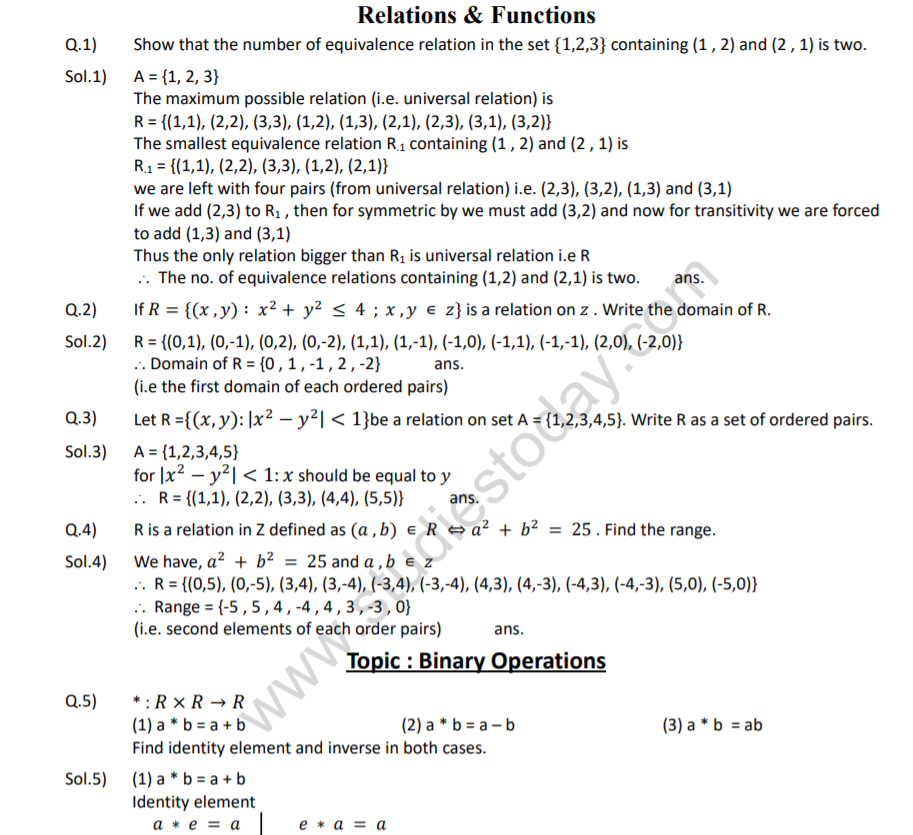
Question. Show that the number of equivalence relation in the set {1,2,3} containing (1 , 2) and (2 , 1) is two.
Answer: \( A = \{1, 2, 3\} \)
The maximum possible relation (i.e. universal relation) is
\( R = \{(1,1), (2,2), (3,3), (1,2), (1,3), (2,1), (2,3), (3,1), (3,2)\} \)
The smallest equivalence relation \( R_1 \) containing \( (1 , 2) \) and \( (2 , 1) \) is
\( R_1 = \{(1,1), (2,2), (3,3), (1,2), (2,1)\} \)
we are left with four pairs (from universal relation) i.e. \( (2,3), (3,2), (1,3) \) and \( (3,1) \)
If we add \( (2,3) \) to \( R_1 \), then for symmetric by we must add \( (3,2) \) and now for transitivity we are forced to add \( (1,3) \) and \( (3,1) \)
Thus the only relation bigger than \( R_1 \) is universal relation i.e \( R \)
\( \therefore \) The no. of equivalence relations containing \( (1,2) \) and \( (2,1) \) is two.
Question. If \( R = \{(x , y) : x^2 + y^2 \leq 4 ; x , y \in Z\} \) is a relation on \( Z \). Write the domain of R.
Answer: \( R = \{(0,1), (0,-1), (0,2), (0,-2), (1,1), (1,-1), (-1,0), (-1,1), (-1,-1), (2,0), (-2,0)\} \)
\( \therefore \) Domain of \( R = \{0, 1, -1, 2, -2\} \)
(i.e the first domain of each ordered pairs)
Question. Let R =\(\{ (x, y): |x^2 - y^2| < 1 \}\) be a relation on set A = {1,2,3,4,5}. Write R as a set of ordered pairs.
Answer: \( A = \{1,2,3,4,5\} \)
for \( |x^2 - y^2| < 1 \): \( x \) should be equal to \( y \)
\( \therefore R = \{(1,1), (2,2), (3,3), (4,4), (5,5)\} \)
Question. R is a relation in Z defined as \( (a , b) \in R \iff a^2 + b^2 = 25 \). Find the range.
Answer: We have, \( a^2 + b^2 = 25 \) and \( a, b \in Z \)
\( \therefore R = \{(0,5), (0,-5), (3,4), (3,-4), (-3,4), (-3,-4), (4,3), (4,-3), (-4,3), (-4,-3), (5,0), (-5,0)\} \)
\( \therefore \) Range = \( \{-5, 5, 4, -4, 3, -3, 0\} \)
(i.e. second elements of each order pairs)
Question. * : \( R \times R \rightarrow R \)
(1) a * b = a + b (2) a * b = a - b (3) a * b = ab
Find identity element and inverse in both cases.
Answer: (1) a * b = a + b
Identity element
\( a * e = a \quad e * a = a \)
\( \implies a + e = a \quad e + a = a \)
\( \implies e = 0 \in R \quad e = 0 \in R \)
\( \therefore e = 0 \) is the identity element
Inverse
\( a * b = e \)
\( \implies a + b = 0 \)
\( \implies b = -a \in R \quad \{ a \in R \implies -a \text{ also } \in R \} \)
\( \therefore -a \) is the inverse of a i.e \( a^{-1} = -a \)
(2) a * b = a - b
Identity element
\( a * e = a \quad e * a = a \)
\( a - e = a \quad e - a = a \)
\( -e = 0 \quad e = 2a \)
\( e = 0 \in R \) but 'e' cannot be a variable as when a changes e also change but should be same for all \( a \in R \)
\( \therefore \) Identity element does not exist
hence inverse does not exist
(3) a * b = ab
Identity element
\( a * e = a \quad e * a = a \)
\( ae = a \quad ea = a \)
\( e = 1 \in R \quad e = 1 \in R \)
\( \therefore 1 \) is the identity element
Inverse
\( a * b = e \)
\( ab = 1 \)
\( b = \frac{1}{a} \in R; a \neq 0 \)
\( \therefore \) all elements of R are invertible except '0' and \( a^{-1} = \frac{1}{a}; a \neq 0 \)
Question. Let * be a binary operation on R (real no's)
* : \( R \times R \rightarrow R \)
\( a * b = a + b + ab \)
(.) Check whether * is binary operation or not
(.) Check the commutativity and Associativity
(.) Find identity element and inverse.
Answer: We have,
\( a * b = a + b + ab \)
since * carries each pair (a, b) in \( R \times R \) to a unique element \( a + b + ab \) in R
\( \therefore * \) is a binary operation on R
Alternate : since \( (a, b) \in R \times R \) and addition and multiplication of real no.s is also a real no.
\( a + b + ab \in R \)
\( \therefore * \) is a binary operation on R
Commutative :
let \( a, b \in R \)
\( a * b = a + b + ab \)
\( b * a = b + a + ba \)
\( = a + b + ab \) ...{\( \therefore \) addition and multiplication are itself commutative}
\( = a * b \)
\( \therefore b * a = a * b \) for all \( a, b \in R \)
\( \therefore * \) is commutative on R
Associative:
let \( a, b, c \in R \)
\( (a * b) * c = (a + b + ab) * c \)
\( = a + b + ab + c + (a + b + ab)c \)
\( = a + b + ab + c + ac + bc + abc \)
\( = a + b + c + ab + bc + ac + abc \)
Now \( a * (b * c) = a * (b + c + bc) \)
\( = a + b + c + bc + a(b + c + bc) \)
\( = a + b + c + bc + ab + ac + abc \)
\( = a + b + c + ab + bc + ac + abc \)
clearly \( (a * b) * c = a * (b * c) \) for all \( a, b, c \in R \)
\( \therefore * \) is Associative on R.
Identity element :
let e be the identity element in R
\( a * e = a \) and \( e * a = a \) for all \( a \in R \)
\( \implies a + e + ae = a \quad e + a + ea = a \)
\( \implies e(1 + a) = 0 \quad e(1 + a) = 0 \)
\( \implies e = 0 \in R \quad e = 0 \in R \)
\( \therefore 0 \) is the identity element
Inverse :
\( a * b = e \)
\( a + b + ab = 0 \)
\( b(1 + a) = -a \)
\( b = \frac{-a}{1+a} \in R \) {except a = -1}
\( \therefore \) -1 is not the invertible element
(.) all elements of R are invertible except -1
(.) and \( a^{-1} = \frac{-a}{1+a}; a \neq -1 \)
(.) e.g. inverse of 2 = \( \frac{-2}{1+2} = \frac{-2}{3} \)
Question. Let * be a binary operation on Z (integers) \( a * b = a + ab \)
Check the commutative, Associativity, identify element and inverse (if it exists).
Answer: We have
\( a * b = a + ab \) where \( a, b \in Z \)
Commutative :
let \( a, b \in Z \), then
\( a * b = a + ab \)
\( b * a = b + ba \)
\( = b + ab \)
\( b * a \neq a * b \)
e.g. \( (1 * 2) = 1 + (1)(2) = 1 + 2 = 3 \)
\( (2 * 1) = 2 + 2(1) = 2 + 2 = 4 \)
clearly \( 1 * 2 \neq 2 * 1 \)
\( \therefore * \) is not commutative on Z
Associative :
let \( a, b, c \in Z \) then
\( (a * b) * c = (a + ab) * c \)
\( = a + ab + (a + ab)c \)
\( = a + ab + ac + abc \)
\( a * (b * c) = a * (b + bc) \)
\( = a + a(b + bc) \)
\( = a + ab + abc \)
\( \neq (a * b) * c \)
e.g. \( (1 * 2) * 3 = (1 + 2) * 3 \)
\( = 3 * 3 \)
\( = 3 + 3(3) = 12 \)
\( 1 * (2 * 3) = 1 * (2 + 6) = 1 * 8 \)
\( = 1 + 1(8) = 9 \)
Clearly * is not Associative on Z
Identity element:
let e be the identity element \( \in Z \), then
\( a * e = a \quad e * a = a \)
\( a + ae = a \quad e + ea = a \)
\( ae = 0 \quad e(1 + a) = a \)
\( e = 0 \in Z \quad e = \frac{a}{1+a} \)
as a changes e also changes, but e must be constant for all value of a
\( \therefore \) identity element does not exist and hence inverse not possible.
Question. Let * be a binary operation on N given by a * b = LCM of a & b
(1) Find 5 * 7 , 20 * 16
(2) Is * commutative ?
(3) If * Associative ?
(4) Find the identity element in N.
(5) which elements of N are invertible ?
Answer: We have
\( a * b = \text{LCM of } a \text{ & } b; a, b \in N \)
(1) \( 5 * 7 = \text{LCM of } 5 \text{ and } 7 = 35 \)
\( 20 * 16 = \text{LCM of } 20 \text{ and } 16 = 80 \)
(2) Commutative :
let \( a, b \in N \)
\( a * b = \text{LCM of } a \text{ and } b \)
\( b * a = \text{LCM of } b \text{ and } a \)
\( = \text{LCM of } a \text{ and } b \)
\( = a * b \)
\( \therefore b * a = a * b \) for all \( a, b \in N \)
\( \therefore * \) is commutative on N
(3) Associative :
let \( a, b, c \in N \)
\( (a * b) * c = (\text{LCM of } a \text{ and } b) * c \)
\( = \text{LCM of } [(\text{LCM of } a \text{ and } b) \text{ and } c] \)
\( = \text{LCM of } a, b \text{ and } c \)
\( a * (b * c) = a * (\text{LCM of } b \text{ and } c) \)
\( = \text{LCM of } [a \text{ and } (\text{LCM of } b \text{ and } c)] \)
\( = \text{LCM of } a, b \text{ and } c \)
clearly \( (a * b) * c = a * (b * c) \) for all \( a, b, c \in N \)
\( \therefore * \) is Associative on N
(4) Identity element
let e be an identity element \( \in N \)
\( a * e = a \)
\( \implies \text{LCM of } a \text{ and } e = a \quad e * a = a \)
\( \implies \text{LCM of } a \text{ & } 1 = a \quad \text{LCM of } e \text{ and } a = a \)
\( \implies e = 1 \in N \quad \text{LCM of } 1 \text{ and } a = a \)
\( \implies e = 1 \in N \)
\( \dots 1 \) is the identity element for all \( a \in N \)
(5) Inverse
\( a * b = e \)
\( \implies \text{LCM of } a \text{ and } b = 1 \)
this is possible only when \( a = 1 \) & \( b = 1 \)
\( \therefore 1 \) is the only invertible element and 1 is its inverse
Question. Let R be a of real no.s and \( A = R \times R \) is a binary operation on A given by \( (a , b) * (c , d) = (ac , bd) \) for all \( (a , b), (c , d) \in A \)
(1) Show that * is Commutative
(2) Show that * is Associative
(3) Find the identity element
(4) Find invertible elements and their inverse.
Answer: We have,
\( (a , b) * (c , d) = (ac , bd) \)
Commutative :
let \( (a, b) \) & \( (c, d) \in A \), then
\( (a, b) * (c, d) = (ac, bd) \)
\( (c, d) * (a, b) = (ca, db) \)
\( = (ac, bd) \)
\( = (a, b) * (c, d) \)
\( \therefore * \) is commutative on A
Associative :
let \( (a, b), (c, d) \) & \( (e, f) \in A \)
\( [(a, b) * (c, d)] * (e, f) \)
\( = (ac, bd) * (e, f) \)
\( = (ace, bdf) \)
\( (a, b) * [(c, d) * (e, f)] \)
\( = (a, b) * (ce, df) \)
\( = (ace, bdf) \)
clearly \( ((a, b) * (c, d)) * (e, f) = (a, b) * ((c, d) * (e, f)) \)
\( \therefore * \) is Associative on A
Identity element
let \( (x, y) \) be the identity element
\( (a, b) * (x, y) = (a, b) \quad (x, y) * (a, b) = (a, b) \)
\( \implies (ax, by) = (a, b) \quad \implies (xa, yb) = (a, b) \)
\( \implies ax = a \) & \( by = b \quad \implies xa = a \) & \( yb = b \)
\( \implies x = 1 \) and \( y = 1 \quad \implies x = 1 \) & \( y = 1 \)
\( \therefore (1, 1) \) is the identity element
Inverse
\( (a, b) * (c, d) = (x, y) \)
\( \implies (ac, bd) = (1, 1) \)
\( \implies ac = 1 \) and \( bd = 1 \)
\( \implies c = \frac{1}{a} \) and \( d = \frac{1}{b} \)
\( \therefore (c, d) = \left(\frac{1}{a}, \frac{1}{b}\right) \in R \) except \( (0, b) = (0, 0) \)
(.) all elements of A are invertible except \( (0, 0) \)
(.) inverse of \( (a, b) \) is \( \left(\frac{1}{a}, \frac{1}{b}\right); (a, b) \neq (0, 0) \)
Question. X is a non-empty set and * is a binary operation \( * : P(X) \times P(X) \rightarrow P(X) \) given by \( A * B = A \cap B \)
(.) Show * is Commutative
(.) Show * is Associative
(.) Find the Identity element
(.) Find the Invertible elements in \( P(X) \) and their inverse.
Answer: We have, \( A * B = A \cap B \)
Commutative :
let \( A, B \in P(X) \)
\( A * B = A \cap B \)
\( B * A = B \cap A \)
\( = A \cap B \) ...{\( \cap \) is commutative}
clearly \( A * B = B * A \) for all \( A, B \in P(X) \)
\( \therefore * \) is commutative on P(x)
Associative :
let \( A, B, C \in P(X) \)
\( (A * B) * C = (A \cap B) * C \)
\( = (A \cap B) \cap C \)
\( A * (B * C) = A * (B \cap C) \)
\( = A \cap (B \cap C) \) ...{\( \cap \) is itself Associative}
clearly \( (A * B) * C = A * (B * C) \) for all \( A, B, C \in P(X) \)
\( \therefore * \) is Associative on P(x)
Identity element
let E is an identity element then
\( A * E = A \quad E * A = A \)
\( \implies A \cap E = A \quad \implies E \cap A = A \)
\( \implies E = X \in P(X) \quad \implies E = X \in P(X) \) {reason : X is the largest subset in P(x)}
\( \therefore X \) is the identity element
Inverse :
\( A * B = E \)
\( \implies A \cap B = X \)
this is possible only when \( A = B = X \)
since \( X \cap X = X \)
\( \therefore X \) is only the invertible element in \( P(X) \) and X is its inverse
Please click the link below to download CBSE Class 12 Mathematics Relations And Functions (3).
Free study material for Mathematics
Download Class 12 Mathematics Chapter 01 Relations and Functions Practice Worksheets
Daily Practice Questions for Class 12 Mathematics
Explore reliable practice questions for Chapter 01 Relations and Functions tailored for Class 12 Mathematics learners. Use these structured worksheets to evaluate exam preparedness and strengthen problem-solving skills throughout the 2026 academic session.
Detailed Answers for Class 12 Mathematics Chapter 01 Relations and Functions
Each worksheet draws directly from authorized standard textbooks to maintain academic accuracy. Evaluating your finished exercises against expert-verified solutions helps master the formal presentation standards expected in school evaluations.
Complete Your Chapter Revision
Follow up your worksheet practice by attempting the interactive online MCQ tests for Chapter 01 Relations and Functions to evaluate your execution speed. All printable assignments and revision sheets on our platform are updated for the 2026 session and available free of charge.
FAQs
You can download the latest chapter-wise printable worksheets for Class 12 Mathematics Chapter 01 Relations and Functions for free from StudiesToday.com. These have been made as per the latest CBSE curriculum for this academic year.
Yes, Class 12 Mathematics worksheets for Chapter 01 Relations and Functions focus on activity-based learning and also competency-style questions. This helps students to apply theoretical knowledge to practical scenarios.
Yes, we have provided solved worksheets for Class 12 Mathematics Chapter 01 Relations and Functions to help students verify their answers instantly.
Yes, our Class 12 Mathematics test sheets are mobile-friendly PDFs and can be printed by teachers for classroom.
For Chapter 01 Relations and Functions, regular practice with our worksheets will improve question-handling speed and help students understand all technical terms and diagrams.